Not AI, Not War: Should the US Stock Market Be Most Concerned About Japan?

链捕手Published on 2026-07-24Last updated on 2026-07-24

Abstract

The article warns that global markets may be underestimating a systemic risk from Japan, centered on the potential for its Government Pension Investment Fund (GPIF) to repatriate capital. With JPY at multi-decade lows and improving domestic investment appeal, political pressure is growing for GPIF—managing $1.8 trillion—to shift more assets home. Such a move, involving reallocating part of its ~$930 billion in overseas holdings, could boost demand for JPY and Japanese government bonds while pressuring US Treasuries (raising yields), weakening the USD, and weighing on risk assets like US stocks. A concurrent unwinding of yen carry trades could amplify the pressure. While markets currently price in little immediate risk, technical signals like the narrow USD/JPY cross-currency basis warrant attention. Conversely, the shift could benefit Japanese equities, which trade at a discount and are driven by corporate governance reforms rather than AI hype, though persistent JPY weakness remains a headwind for foreign investors.

Author: Zhao Ying

The global market is underestimating a potential systemic risk—Japan. As the yen falls to multi-decade lows and the attractiveness of Japanese domestic assets rises, the world's largest pension fund is facing policy pressure to repatriate assets on a massive scale. Once this process begins, the US stock market, bond market, and the US dollar could simultaneously face pressure.

Recently, Japanese Prime Minister Takaichi Sanae stated that the government will encourage the Government Pension Investment Fund (GPIF) and other national pension funds to increase investment in Japan's domestic financial assets. Finance Minister Katayama Satsuki had previously signaled similar intentions. Although GPIF has not announced any formal asset allocation adjustments, the market has begun to assess its potential impact: if the fund repatriates its overseas holdings, US Treasury yields could rise, the US dollar could weaken, and risk assets could come under pressure.

Currently, the market's pricing for the above risks remains relatively calm, but some technical indicators are already showing subtle changes. Investors should not be complacent.

The $1.8 Trillion Variable

GPIF manages about $1.8 trillion, with domestic and foreign assets each accounting for roughly half. Its overseas holdings total about $930 billion. In recent years, the fund's holdings of Japanese government bonds have decreased from about $770 billion to about $515 billion, while its holdings of foreign bonds have increased from about $128 billion to about $470 billion.

This structural change means that even a modest asset reallocation could trigger significant volatility in global markets. According to MarketWatch, analyst Michael Kramer points out that if GPIF repatriates some overseas assets, it would directly boost demand for the yen and introduce large-scale buying into the Japanese government bond market—a positive for Japan, but implying higher interest rates and a weaker dollar for the US.

At the same time, a large-scale unwinding of yen carry trades (borrowing low-interest yen, converting to dollars, and investing in US assets) would further weigh on the performance of risk assets.

Yen and JGBs: Rising Attractiveness of Domestic Assets

Driving GPIF's potential reallocation is a substantial improvement in the fundamentals of Japanese domestic assets. As Japan's inflation recovers and economic growth resumes, the appeal of domestic investment opportunities has increased significantly. In February of this year, the spread between US and Japanese two-year government bond yields narrowed to its lowest level since early 2022.

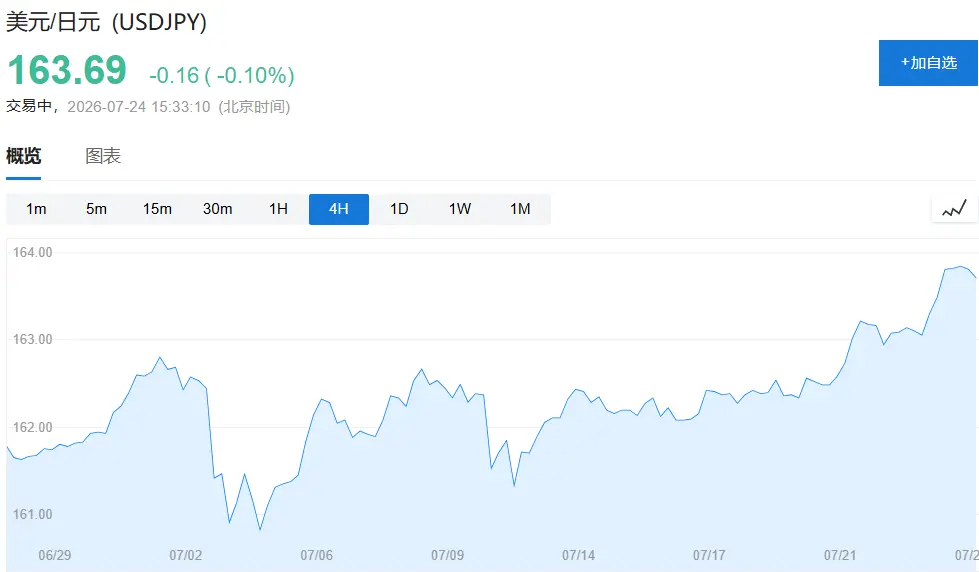
At the same time, the yen continues to weaken, with USD/JPY breaking above 163, reaching its highest level since 1986. From a technical analysis perspective, if the exchange rate rises further, the next resistance level is around 176. According to the Financial Times, Fredrik Repton of Neuberger Berman believes that if GPIF allocates more funds to domestic assets, it could be a "very elegant solution" to Japan's macro problems, but other domestic financial institutions would also need to follow suit, and "this process would take a very long time."
Japan's 10-year government bond yield recently touched 2.7%, the first time in 30 years. Deutsche Bank analyst Mallika Sachdeva noted in a recent report that the focus of Japanese authorities' policy may be shifting from exchange rate management to yield management. If this shift materializes, it would put further pressure on the yen.

The Market Hasn't Priced It In, But Signals Are Emerging

Currently, the global market's reaction to the risk of Japanese capital repatriation remains relatively restrained. The five-year USD/JPY cross-currency basis swap recently stood at around minus 30 basis points, the narrowest level since the data series began in 2021, indicating that the market's demand to hedge against yen appreciation has not risen significantly.

However, this indicator itself is a key signal for observing whether capital flows are beginning to shift. Historical data shows that the S&P 500 index and cross-currency basis swaps have moved in tandem during multiple periods—when hedging demand rises sharply, US stocks often fall as liquidity tightens. Once market expectations for yen appreciation heat up, demand for dollar hedging will climb, and the liquidity tightening effect will become more pronounced.

Japanese Stocks: The Other Side of the Risk

It is worth noting that GPIF's potential asset reallocation, while bringing pressure to the US market, also provides a new narrative for Japanese stocks. The Japanese stock market is benefiting from drivers quite different from those in the US market: the concentration of the technology sector in the Topix index is much lower than in the S&P 500, its exposure to artificial intelligence is relatively limited, and its valuation still trades at a discount of over 20% compared to the S&P 500.

Corporate governance reform is a core catalyst for Japanese stocks. Dan Rasmussen of Verdad Advisers points out that there are still about 1,000 companies in Japan whose stock prices are below book value. Among the cheapest one-fifth of companies, cross-shareholdings still account for about 40% of their market value. As cross-shareholdings are gradually unwound, a large amount of historically accumulated profits is expected to be released, providing a substantive positive impact on corporate earnings.

However, for foreign investors, the persistently weak yen is the biggest obstacle—yen depreciation over the past two years has significantly eroded the real returns for foreign capital in Japanese stocks. How to handle currency hedging, and whether the cost of hedging is bearable, remain core issues facing global investors.


Trending Cryptos

Related Questions

QAccording to the article, what is the potential systemic risk that global markets might be underestimating?

AThe article suggests that global markets are underestimating the potential systemic risk posed by Japan, specifically the possibility of massive capital repatriation by Japan's Government Pension Investment Fund (GPIF) back to domestic assets.

QWhat could be the impact on the US if Japan's GPIF reallocates its assets back to Japan?

AIf GPIF reallocates assets from overseas back to Japan, it could lead to higher U.S. Treasury yields, a weaker U.S. dollar, and put pressure on U.S. risk assets like stocks.

QWhat is the approximate size of Japan's GPIF and its overseas holdings?

AJapan's GPIF manages approximately $1.8 trillion. Its overseas holdings total around $930 billion, which is roughly half of its total assets.

QWhat are the two key factors that are increasing the attractiveness of Japanese domestic assets, according to the article?

AThe two key factors are: 1) The recovery of inflation and economic growth in Japan, and 2) The substantial depreciation of the yen to multi-decade lows against the dollar.

QWhat is a major obstacle for foreign investors in the Japanese stock market despite positive domestic catalysts?

AA major obstacle is the persistent weakness of the Japanese yen (JPY), which has significantly eroded the real returns for foreign investors in Japanese stocks over the past two years, raising concerns about the cost and feasibility of currency hedging.

Related Reads

Qualcomm Chip Price Hike Deals a Blow to Android Phones

Qualcomm has officially announced a new round of price increases for its entire chip portfolio, effective September 1. The hikes, reaching up to 18% for the flagship Snapdragon 8 Elite Gen 6 Pro, follow similar moves by MediaTek, intensifying cost pressures on the already strained smartphone industry. CEO Cristiano Amon confirmed the plan, citing the need to offset rising industry-wide costs and restore declining profit margins. Qualcomm's Q3 FY2026 results showed a 25% drop in net profit, with mobile revenue plunging 20% year-over-year, hitting its lowest level since 2021. The surge in AI computing demand has led memory manufacturers to prioritize HBM production, creating a shortage in general-purpose DRAM and NAND Flash chips. Their prices soared by 93%-98% and 55%-60% respectively in Q1 2026, causing the memory cost share in smartphones to jump from 10%-15% to over 30%. Coupled with the soaring cost of advanced nodes like TSMC's 2nm and packaging, overall chip costs have reached historic highs. These upstream pressures are forcing downstream smartphone brands like Xiaomi, OPPO, and vivo to cut orders for mid-to-low-end models by up to 20% and use cost-saving measures like older chipsets. Reportedly, the Snapdragon 8E5 will be repurposed as a "long-lasting" chip for sub-brand phones in H2 2026. Amid this cost crisis, the Android market remains sluggish. Q2 2026 smartphone shipments in China fell 4.3% year-over-year, marking five consecutive quarters of decline. Major Android brands saw market share drop, while Huawei and Apple, with their in-house chip advantages, gained share. Qualcomm is diversifying into automotive and IoT sectors to reduce reliance on smartphones, but these new segments cannot yet fill the mobile revenue gap. Industry observers warn that the full impact of component cost hikes will hit in the second half of 2026, likely leading to higher-than-expected price increases for Android flagships and a further contraction in the Chinese smartphone market.

marsbit57m ago

Qualcomm Chip Price Hike Deals a Blow to Android Phones

marsbit57m ago

Breaking: GPT-5.6 Prices Slashed Effective Today

OpenAI has announced significant price cuts for its GPT-5.6 model API, effective immediately. The entry-level **GPT-5.6 Luna** sees the most drastic reduction, with input prices dropping 80% to $0.20 per million tokens and output prices falling to $1.20 per million tokens. The mid-tier **GPT-5.6 Terra** is reduced by 20%, now costing $2.00 (input) and $12.00 (output) per million tokens. The flagship **GPT-5.6 Sol** maintains its original price but introduces a new **Fast mode**, offering speeds up to 2.5 times faster for double the cost. The company attributes these price reductions to efficiency gains achieved through **GPT-5.6 Sol's own involvement in optimizing its production systems**. The model assisted in rewriting GPU kernels and improving speculative decoding, leading to a 20% reduction in end-to-end service costs and over 15% improvement in token generation efficiency. OpenAI emphasizes this process remained human-led. A key focus of the降价 is to lower the barrier for running **AI agent workflows**. By making the capable, tool-calling Luna model significantly cheaper, OpenAI aims to enable more frequent use in cost-sensitive, high-volume tasks like code review and monitoring. This creates a potential feedback loop: model-assisted efficiency gains lead to lower costs, which enables broader agent deployment, which in turn drives further optimization. The new pricing and features will also apply to Codex and ChatGPT Work subscriptions. The changes intensify competition in the large language model market, with OpenAI directly challenging rivals like Anthropic to respond.

marsbit1h ago

Breaking: GPT-5.6 Prices Slashed Effective Today

marsbit1h ago

Trading

Spot

Hot Articles

How to Buy WAR

Welcome to HTX.com! We've made purchasing WAR (WAR) simple and convenient. Follow our step-by-step guide to embark on your crypto journey.Step 1: Create Your HTX AccountUse your email or phone number to sign up for a free account on HTX. Experience a hassle-free registration journey and unlock all features.Get My AccountStep 2: Go to Buy Crypto and Choose Your Payment MethodCredit/Debit Card: Use your Visa or Mastercard to buy WAR (WAR) instantly.Balance: Use funds from your HTX account balance to trade seamlessly.Third Parties: We've added popular payment methods such as Google Pay and Apple Pay to enhance convenience.P2P: Trade directly with other users on HTX.Over-the-Counter (OTC): We offer tailor-made services and competitive exchange rates for traders.Step 3: Store Your WAR (WAR)After purchasing your WAR (WAR), store it in your HTX account. Alternatively, you can send it elsewhere via blockchain transfer or use it to trade other cryptocurrencies.Step 4: Trade WAR (WAR)Easily trade WAR (WAR) on HTX's spot market. Simply access your account, select your trading pair, execute your trades, and monitor in real-time. We offer a user-friendly experience for both beginners and seasoned traders.

2.6k Total ViewsPublished 2024.03.29Updated 2026.06.02

How to Buy WAR

Discussions

Welcome to the HTX Community. Here, you can stay informed about the latest platform developments and gain access to professional market insights. Users' opinions on the price of WAR (WAR) are presented below.

活动图片