Crypto market’s weekly winners and losers – VELVET, BEAT, WLD, XLM

ambcryptoPublished on 2026-06-28Last updated on 2026-06-28

Abstract

This week, crypto markets faced pressure as Bitcoin and Ethereum extended their weakness, prompting capital rotation into select low-cap altcoins. Key weekly gainers included **Velvet (VELVET)**, which surged 235% nearing its all-time high; **DeXe (DEXE)**, up 60% and reclaiming a key level from late 2021; and **Audiera (BEAT)**, rising 45% following a prior sharp crash. Other notable movers were Cortex (CX) and Synapse (SYN). On the losing side, **MemeCore (M)** crashed 70% amid reports of insider manipulation, **Worldcoin (WLD)** fell 26% in a post-rally cooldown, and **Stellar (XLM)** dropped 18.5%, extending a bearish streak. The action highlighted a week of sharp volatility and rotational moves within a cautious broader market.

Crypto markets stayed under pressure this week.

Bitcoin [BTC] and Ethereum [ETH] extended their weak performance, with risk appetite remaining subdued amid persistent macro uncertainty.

While major cryptocurrencies struggled to gain traction, capital rotated into a handful of low-cap altcoins, fueling triple-digit rallies in select tokens even as broader market sentiment remained cautious and profit-taking accelerated across many large-cap assets.

Weekly winners

Velvet [VELVET] – Emerging ecosystem topped the board with triple-digit gains

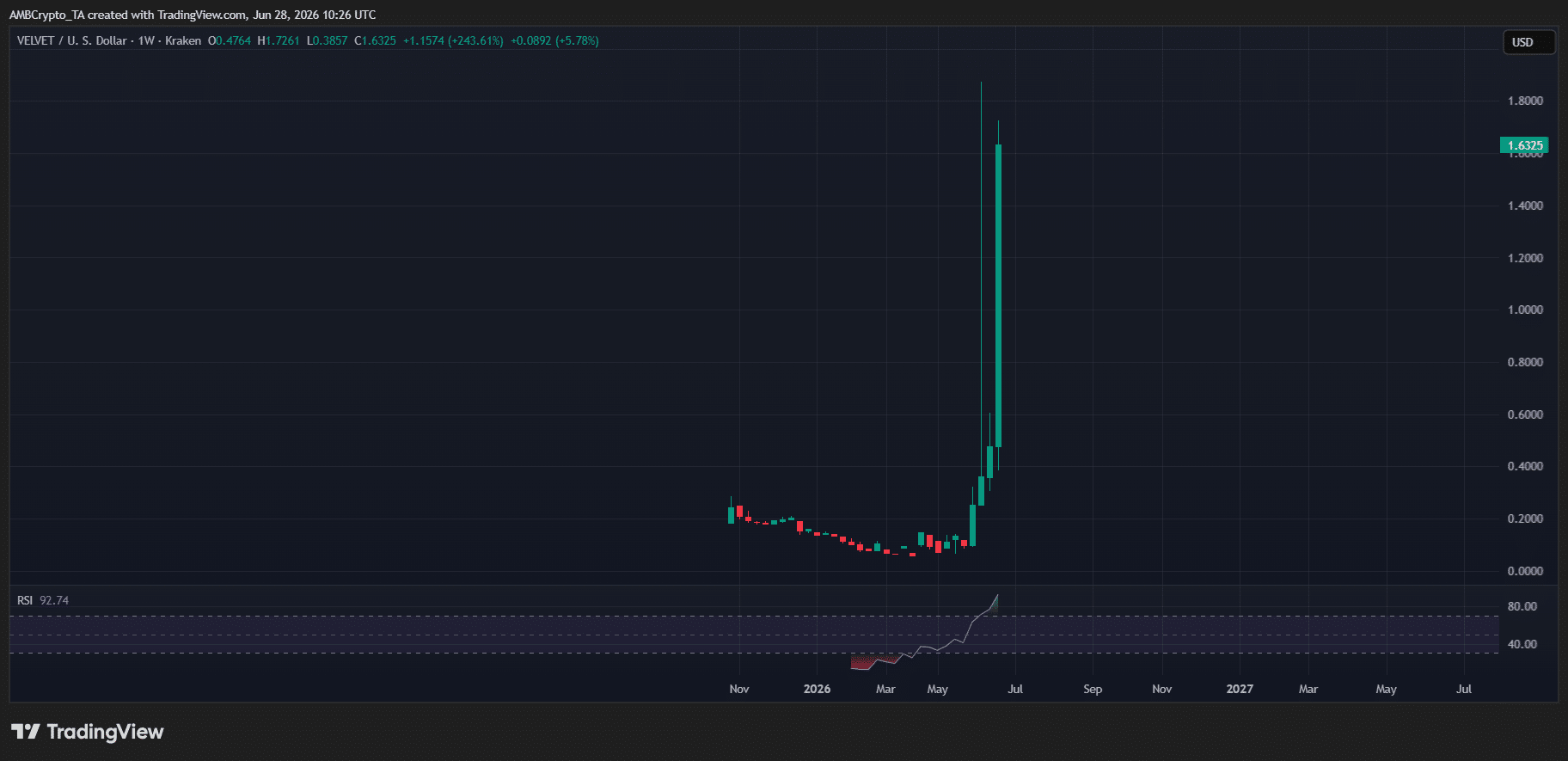
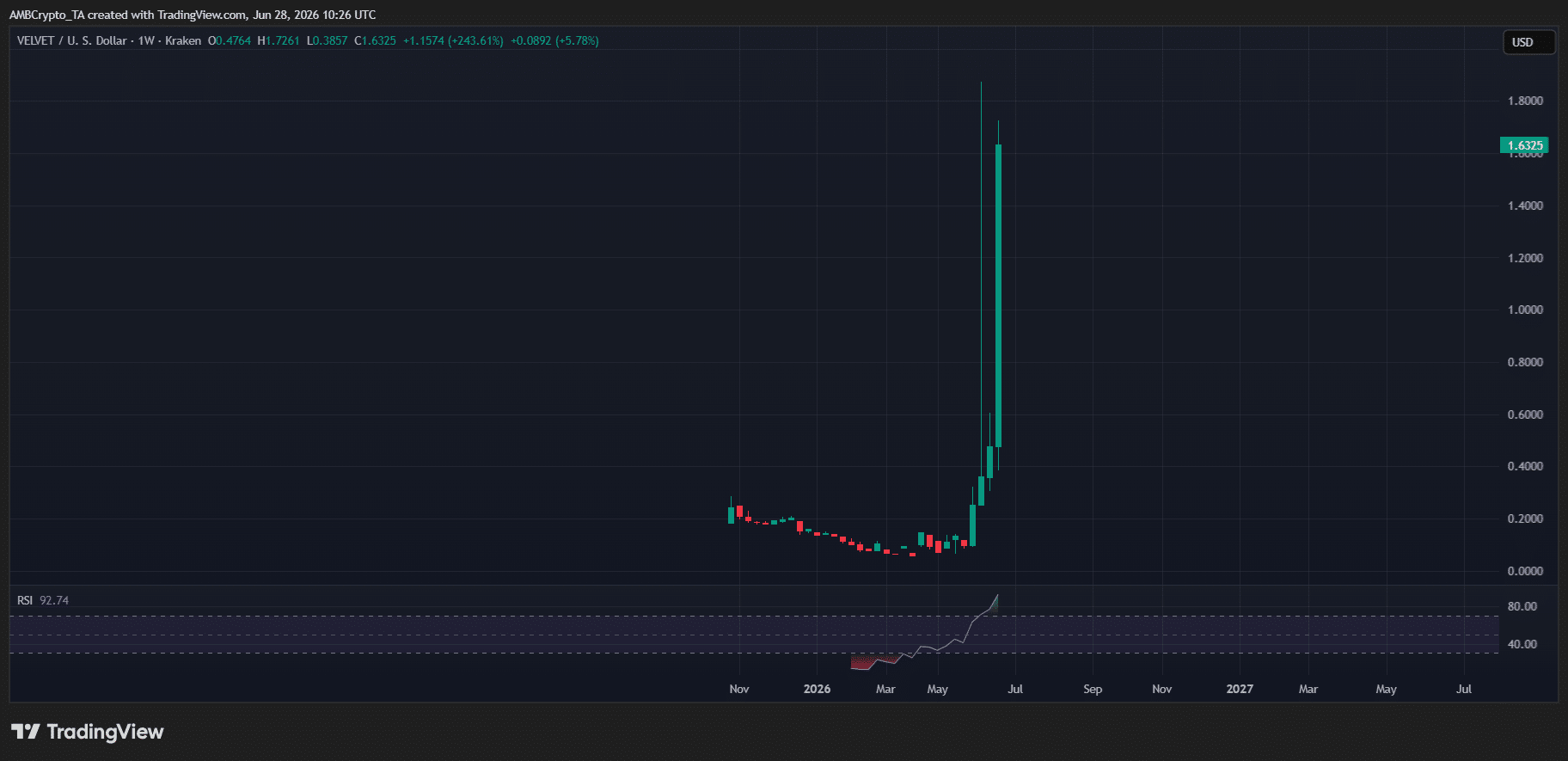
Velvet [VELVET] emerged as the biggest weekly gainer, rallying 235%. With the token now closing in on its $1.80 all-time high, a short-term cooldown wouldn’t be surprising after such a sharp move.

Backing this up, the RSI has pushed deep into overbought territory, suggesting profit-taking could kick in. That said, price history suggests the rally may not be over just yet. After a 157% rally in early June, VELVET continued pushing higher over the following three weeks, showing that buyers remained firmly in control despite overbought conditions.

This week’s move also comes after a lengthy consolidation phase. Following its previous run to $1.80, VELVET spent weeks ranging around the $0.50 level before finally breaking out. That kind of base-building usually adds more strength to a breakout than a straight vertical move.
Source: TradingView (VELVET/USDT)

In short, both the daily and weekly charts still favor the bulls. While a brief pullback or consolidation would be healthy, the broader trend remains intact. If buying pressure holds up, a break above the $1.80 all-time high looks increasingly likely, putting the $2 level firmly in focus.

DeXe [DEXE] – Decentralized protocol reinforced steady bullish continuation

DeXe [DEXE] came in as the second-biggest weekly gainer, climbing 60%. More importantly, the token has reclaimed the $22 level for the first time since Q4 2021, meaning a large portion of long-term holders who had been underwater are finally back in profit.

Normally, that would increase the chances of profit-taking. However, DEXE’s recent price action suggests the bulls are still in control. After pulling back for three straight days, the token bounced nearly 4% in under 48 hours, showing buyers are quickly absorbing selling pressure.

That dip-buying behavior keeps the broader uptrend intact. If the current momentum continues, a break above $25 could trigger another leg higher as fresh buyers pile in and existing holders become less willing to sell. In that scenario, the $30 level becomes the next logical upside target.

Audiera [BEAT] – Entertainment token surged sharply on a classic short squeeze

Audiera [BEAT] rounded out this week’s top three gainers with a 45% rally. What’s more interesting is that this comes just one week after the token crashed nearly 70%. That kind of reversal is usually a sign that buyers have stepped back in aggressively after an oversold move.

The sharp sell-off also appears to have flushed out excess leverage and shaken out weak hands. On top of that, the RSI has cooled back toward the neutral zone, giving BEAT more room to move higher.

The next level to watch is $2.50, which now stands as the key resistance. A break above it could quickly open the door for a move back toward $3. But it won’t be easy, BEAT’s 3% intraday pullback shows sellers are still defending that area. If they do, BEAT could spend some more time consolidating before making another breakout attempt.

Other notable winners

Outside the majors, altcoin movers also stood out this week.

Cortex [CX] led the action with a +2710% move, followed by Biconomy [BICO] surging +246%, while Synapse [SYN] climbed +186%, rounding out the list of biggest movers.

Weekly losers

MemeCore [M] – Meme token saw a massive crash this week

MemeCore [M] ended the week as the biggest loser, crashing 70% after reports of insider manipulation triggered a wave of panic selling. The move almost perfectly mirrors Audiera’s 70% collapse from last week, setting up an interesting reversal setup to watch.

Technically, the damage has been significant. M lost the $1 support and has now retraced back to the $0.60-$0.65 area, effectively erasing its post-October rally. The sharp decline has also pushed the RSI deep into oversold territory, showing sellers may be getting exhausted after such an aggressive flush.

The positive is that the crash has also cleared out most of the excess leverage. As AMBCrypto reported, nearly $8 million in long positions were liquidated, alongside a wave of short liquidations. That kind of reset usually gives price a better chance to build a base instead of continuing a leveraged sell-off.
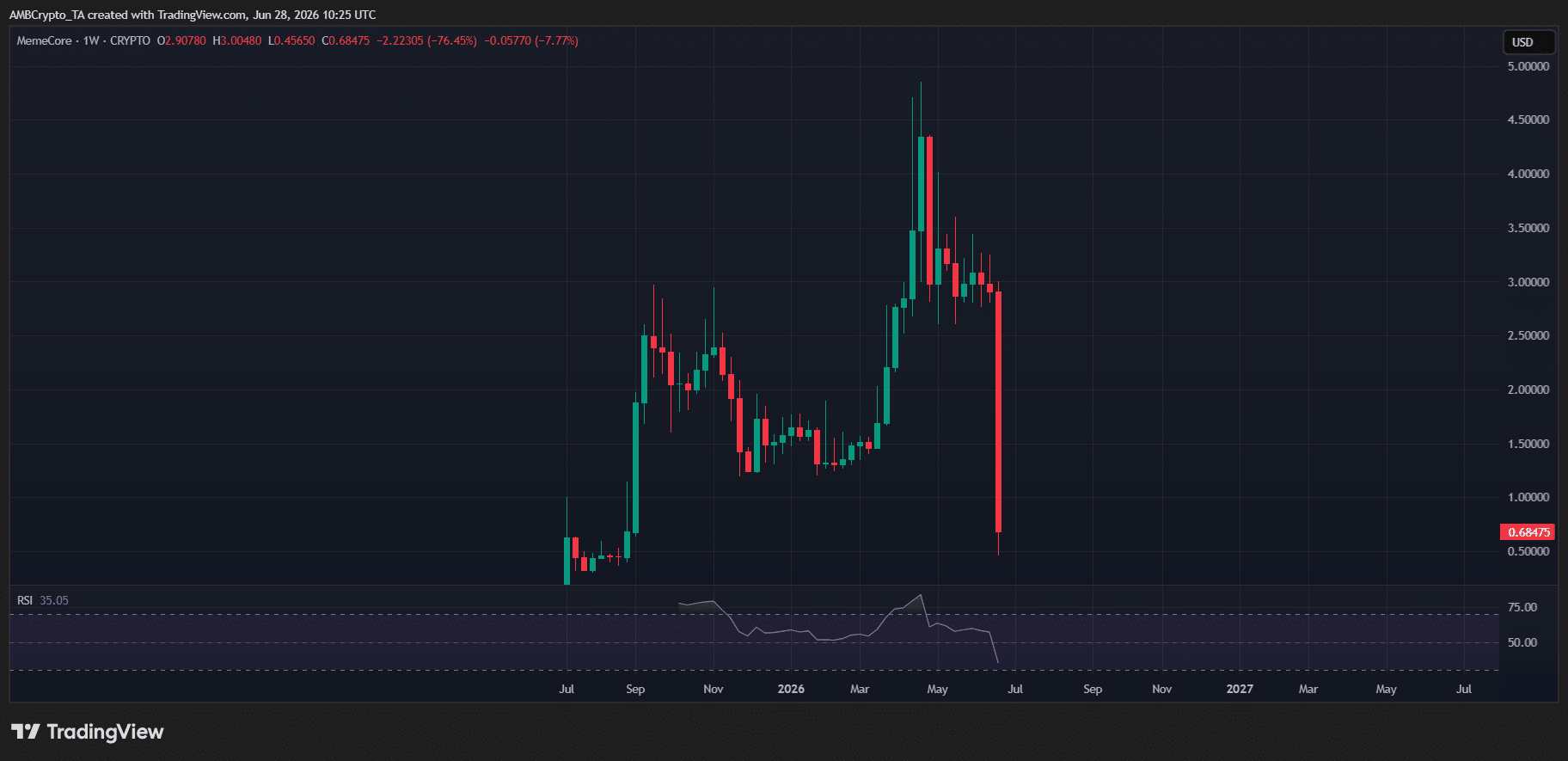
Source: TradingView (M/USDT)

The next question is whether M can pull off a BEAT-style rebound.

So far, the chart is showing early signs of stabilization. MemeCore has spent the last 48 hours trading around the $0.65 level, suggesting buyers are starting to absorb the selling pressure. It’s still too early to call a bottom, but if this consolidation continues, a relief bounce becomes much more likely.

For now, volume is the chart to watch. A pickup in buying volume while price holds above $0.65 would be the first real sign that the bulls are trying to take back control.

Worldcoin [WLD] – Crypto project retraced back to a key support level this week

Worldcoin [WLD] finished as the second-biggest weekly loser, falling 26%. Unlike MemeCore’s panic-driven sell-off, though, WLD’s decline looks more like a healthy cooldown after a strong multi-week run.

From a technical lens, WLD had rallied for five straight weeks. That move put plenty of STHs into profit, so profit-taking was always on the cards. The only concern is momentum. Even after the five-week rally, the RSI never pushed into overbought territory, suggesting the uptrend wasn’t backed by strong buying pressure.

That’s now showing up on the chart. On the daily timeframe, WLD has posted six straight days of pullbacks, dragging price back toward the $0.40 support area. If selling pressure continues and support gives way, a deeper correction could be next before the bulls return.

Steller [XLM] – Payments-focused blockchain failed to show strong bullish conviction

Stellar [XLM] finished as the third-biggest weekly loser, dropping 18.5%. Like Worldcoin, XLM’s daily chart has been under steady selling pressure, with the token extending its losing streak to 11 consecutive days, keeping the short-term trend firmly bearish.

On the weekly chart, though, the picture is a bit more interesting.

Last week’s 9% rally came after two straight weeks of selling that knocked nearly 30% off the price, with buyers stepping in around the $0.25 level. This week, however, that support failed to hold. Unless XLM can quickly reclaim $0.25 and start building a base, the risk of a deeper correction remains elevated.

If the current structure stays intact, XLM could retrace a large chunk of its two-month rally, with $0.15 emerging as the next major support to watch. Until buyers show up and confirm a bottom, the chart continues to favor the bears.

Other notable losers

In the broader market, downside volatility hit hard.

Humanity [H] – 71% drop, followed by Biconomy [BICO] falling 68.5%, and Yei Finance [CLO] slipping 42.2%, as momentum sharply cooled.

Conclusion

This week was a rollercoaster. Big pumps, sharp dips, and nonstop action. As always, stay sharp, do your own research, and trade smart.


Final Summary

  • Velvet [VELVET], DeXe [DEXE], Audiera [BEAT] led the week in gains.
  • MemeCore [M], Worldcoin [WLD], Steller [XLM] saw significant declines.

Trending Cryptos

Related Questions

QWhat were the top three weekly gainers in the cryptocurrency market according to the article?

AThe top three weekly gainers were Velvet [VELVET] with a 235% rally, DeXe [DEXE] with a 60% climb, and Audiera [BEAT] with a 45% surge.

QWhy did MemeCore [M] experience a massive price crash this week?

AMemeCore [M] crashed 70% after reports of insider manipulation triggered a wave of panic selling and liquidations, erasing its post-October rally.

QWhat technical indicator is mentioned as a reason Velvet [VELVET] might see a short-term cooldown despite its strong rally?

AThe article states that Velvet's RSI has pushed deep into overbought territory, suggesting profit-taking could kick in, potentially leading to a short-term cooldown.

QAccording to the analysis, what is a key difference between Worldcoin's [WLD] decline and MemeCore's [M] crash?

AWorldcoin's 26% decline is described as a healthy cooldown after a strong multi-week run, whereas MemeCore's crash was a panic-driven sell-off triggered by reports of insider manipulation.

QWhat are the next major upside targets mentioned for DeXe [DEXE] and Velvet [VELVET]?

AFor DeXe [DEXE], a break above $25 could target the $30 level. For Velvet [VELVET], a break above its $1.80 all-time high would put the $2 level firmly in focus.

Related Reads

SK Hynix Q2 Profit Soars Sixfold, Still 'Misses Expectations'; Secures Long-Term Agreements with 10 Clients, HBM4 to Accelerate Volume Ramp in Second Half

SK Hynix reported record-breaking Q2 2026 financial results, with operating profit soaring 557% year-over-year to 60.5 trillion won and revenue increasing 257% to 79.3 trillion won, driven by strong demand for AI server memory, HBM, and enterprise SSDs. The operating profit margin reached 76.3%. However, both figures fell short of analyst expectations, leading to a drop in its share price. The company attributed the earnings miss to three factors: a high sales mix of HBM, which limited upside from surging prices of general-purpose DRAM; a deceleration in memory price increases compared to Q1; and long-term supply agreements (LTAs) with major customers that lock in prices, reducing sensitivity to spot market gains. SK Hynix has signed LTAs with about 10 clients, covering roughly half of its sales. Despite the miss, the company remains optimistic about AI-driven demand. Its net profit of 93.9 trillion won was significantly boosted by a one-time gain from the partial sale of its Kioxia stake. Financially, it strengthened its cash position, ending the quarter with a net cash position of 69.4 trillion won. Looking ahead, SK Hynix plans capital expenditures at the high end of its 40-50 trillion won range for 2026 to expand capacity for HBM and advanced NAND products, including accelerating the mass production of HBM4 in the second half of the year.

marsbit10m ago

SK Hynix Q2 Profit Soars Sixfold, Still 'Misses Expectations'; Secures Long-Term Agreements with 10 Clients, HBM4 to Accelerate Volume Ramp in Second Half

marsbit10m ago

Behind the 67,000 Semiconductor Talent Shortage: U.S. Industrial Policy Game and Implications for China

The U.S. push to reshore semiconductor manufacturing faces a core challenge: a significant talent shortage. While over $770 billion in investments are planned across 160 projects, a key hurdle is finding enough people to run the new fabs. According to industry projections, the U.S. could face a shortage of approximately 67,000 technicians, engineers, and computer scientists by 2030. This shortage is multi-faceted. It includes not only high-level chip design engineers requiring advanced degrees but also a substantial need for technicians to operate and maintain fab equipment. Technician roles, while often requiring less formal education, are hard to fill due to factors like shift work, factory locations, and local community infrastructure. Conversely, for high-end engineers, the issue is less about salary—which is already competitive—and more about intense competition for specialized skills from other tech sectors and the long lead time to develop such expertise. The geographic dispersion of new investments complicates recruitment, as fabs need large numbers of local, stable employees. In response, U.S. policy emphasizes building workforce development as critical infrastructure. Strategies include expanding community college programs for technician training, fostering industry-education partnerships, and pursuing immigration reforms for high-skilled talent, aiming to balance immediate needs with long-term domestic pipeline development. For China, the key takeaway is the need to integrate talent supply planning with factory construction from the outset. This involves requiring companies to submit workforce plans, strengthening vocational education aligned with industry needs, and building supportive local ecosystems to retain talent. Ultimately, a sustainable semiconductor industry depends not just on building fabs, but on cultivating a continuous, local talent pipeline capable of keeping them running and advancing.

marsbit1h ago

Behind the 67,000 Semiconductor Talent Shortage: U.S. Industrial Policy Game and Implications for China

marsbit1h ago

Trading

Spot

Hot Articles

How to Buy BEAT

Welcome to HTX.com! We've made purchasing Audiera (BEAT) simple and convenient. Follow our step-by-step guide to embark on your crypto journey.Step 1: Create Your HTX AccountUse your email or phone number to sign up for a free account on HTX. Experience a hassle-free registration journey and unlock all features.Get My AccountStep 2: Go to Buy Crypto and Choose Your Payment MethodCredit/Debit Card: Use your Visa or Mastercard to buy Audiera (BEAT) instantly.Balance: Use funds from your HTX account balance to trade seamlessly.Third Parties: We've added popular payment methods such as Google Pay and Apple Pay to enhance convenience.P2P: Trade directly with other users on HTX.Over-the-Counter (OTC): We offer tailor-made services and competitive exchange rates for traders.Step 3: Store Your Audiera (BEAT)After purchasing your Audiera (BEAT), store it in your HTX account. Alternatively, you can send it elsewhere via blockchain transfer or use it to trade other cryptocurrencies.Step 4: Trade Audiera (BEAT)Easily trade Audiera (BEAT) on HTX's spot market. Simply access your account, select your trading pair, execute your trades, and monitor in real-time. We offer a user-friendly experience for both beginners and seasoned traders.

3.3k Total ViewsPublished 2026.01.22Updated 2026.06.02

How to Buy BEAT

Discussions

Welcome to the HTX Community. Here, you can stay informed about the latest platform developments and gain access to professional market insights. Users' opinions on the price of BEAT (BEAT) are presented below.

活动图片