Hurun Report Interview with Justin Sun: New Paradigms of Value Circulation under the Web3 Transformation Cycle

marsbitPublished on 2026-05-29Last updated on 2026-05-29

Abstract

In a deep-dive interview with *Hurun Report*, Justin Sun, founder of TRON, outlines his vision for Web3's evolution from proof-of-concept to global adoption, emphasizing stablecoins as the cornerstone for building a new paradigm of value transfer. Sun defines the core mission as enabling low-cost, efficient global fund movement for anyone, anywhere, regardless of bank access. He argues that sustainable blockchain projects must be driven by genuine demand and usage, with stablecoin payments currently representing the most mature and scalable application. Citing TRON's position as a leading stablecoin network with over $86.3 billion in USDT circulation, he attributes this growth to real-world use in cross-border transfers, savings, and payments, viewing it as a "natural replacement" for traditional financial infrastructure's inefficiencies. On strategy, Sun advocates for a methodology combining data-driven iteration, rapid execution, and user-centricity. He highlights the pivotal decision to partner with Tether on TRC-20 USDT as a calculated move that capitalized on stablecoins' long-term trend and network effects. While Web3 is inherently global, Sun stresses the critical importance of local compliance and cultural adaptation for successful market entry. Looking ahead, Sun identifies the convergence of AI and blockchain as a key frontier. He sees AI as fundamentally reshaping thinking and decision-making, with blockchain providing decentralized infrastructure for AI, while ...

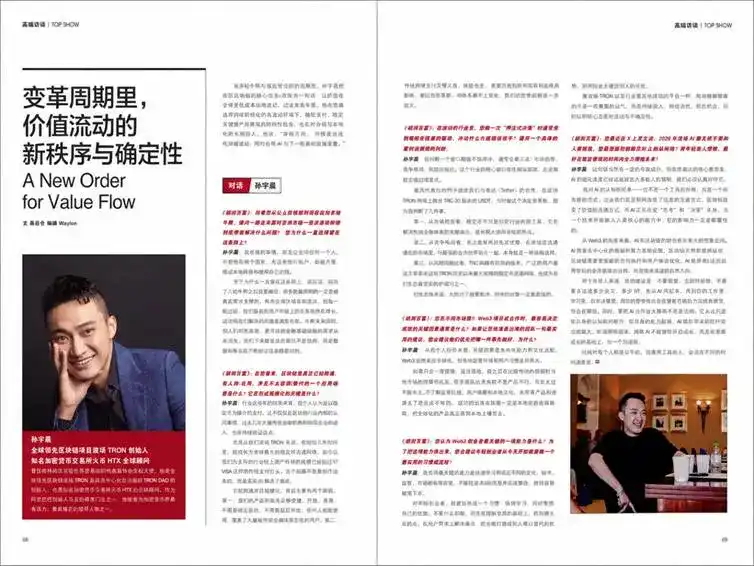
Against the backdrop of the Web3 industry entering deep waters and the accelerated restructuring of global financial infrastructure, blockchain is transitioning from early exploration to large-scale application. As an authoritative institution with extensive influence in the business and investment fields, an in-depth interview by the renowned magazine Hurun Report is regarded as a significant industry bellwether. Recently, in an exclusive interview with Hurun Report, Justin Sun, founder of TRON, systematically elaborated his judgments on industry evolution and long-term value around core issues such as stablecoin payments, globalization paths, and the AI integration trend. His perspectives also reflect the crucial phase where Web3 infrastructure is moving from "feasibility validation" to "global adoption."
Stablecoins Build a Global Value Circulation Network, Web3 Infrastructure Enters Scaling Phase

In the Hurun Report interview, Justin Sun succinctly summarized his long-term core objective: "To enable anyone in the world, regardless of location or bank account access, to transfer and use their funds with low cost and high efficiency." This statement fundamentally reveals the value essence of blockchain technology — building an open and inclusive Internet of Value.

He further pointed out that after experiencing multiple bull and bear cycles, projects capable of enduring cycles must be built on real demand and practical usage. The sustained growth in on-chain user scale and transaction volume is an important basis for his judgment on industry direction. Against this backdrop, the on-chain payment system with stablecoins at its core has become the most mature and scalable application scenario.

In the Hurun Report interview, Justin Sun mentioned that TRON has rapidly developed into one of the world's largest stablecoin circulation networks, with its on-chain asset transfer volume even surpassing that of some traditional payment networks. This growth is not driven by short-term market sentiment but by continuous usage from real users in scenarios like cross-border transfers, value storage, and daily payments. Official data shows that the circulating supply of USDT on the TRON network currently exceeds $86.3 billion, reflecting robust network effects driven by genuine user demand.

In terms of structural advantages, the scalability of stablecoin payments benefits from two factors: on one hand, blockchain networks possess openness and permissionless characteristics, enabling them to reach user groups inaccessible to traditional financial systems; on the other hand, limitations in efficiency, cost, and user experience within traditional cross-border payment systems provide significant substitution space for new-generation infrastructure. Sun believes this trend is essentially a "natural substitution" of existing financial systems by technological advancement, rather than short-term competition.

Globalization Strategy and Technological Integration Advance in Tandem, Building Long-Term Competitive Advantage for Web3

When discussing enterprise growth and strategic decision-making, Sun presented a highly systematic methodology in the Hurun Report interview. He summarized the success factors as the combination of "data-driven iteration, rapid execution, and user-centric orientation," emphasizing that in a rapidly changing technological environment, single-dimensional capabilities can hardly sustain long-term competitiveness; instead, efficient trial-and-error and precise decision-making must be achieved through the synergy of these three.

At the organizational level, he proposed a management framework of "clear direction, layered support, and a sense of ownership among all members" to prevent deviation and loss of control during rapid expansion. This organizational structure emphasizing flatness and agility is seen as an important foundation for Web3 enterprises to maintain competitiveness in a highly uncertain environment.

Regarding specific key strategic decisions, Sun reflected on the case of TRON's collaboration with Tether to launch TRC-20 USDT in the Hurun Report interview. He stated that this decision was based on a comprehensive judgment of market trends, competitive landscape, and risk-reward ratio: stablecoins represent a long-term trend in financial system evolution, leading assets exhibit significant network effects, and the upside potential in this field far outweighs potential risks. This partnership has proven to be a major growth engine for the TRON ecosystem and has constructed its core competitive moat in the stablecoin domain.

Regarding global expansion, Sun emphasized that while Web3 has inherent cross-border attributes, its actual implementation still heavily depends on local compliance and cultural adaptation. In the Hurun Report interview, he noted that different markets have significant differences in regulatory frameworks, user habits, and business environments, and a project's success often hinges on the depth of understanding these differences and the ability to build local partnership networks.

Furthermore, Sun expressed clear judgment regarding AI technology development. He stated in the interview that AI is not merely a tool upgrade but a reconstruction of "thinking and decision-making capabilities." Its integration with blockchain in areas like data, computing power, and intelligent execution will be an important direction for the next phase of technological evolution. Blockchain provides decentralized infrastructure for AI, while AI enhances the intelligence and user experience of blockchain systems; the fusion of the two possesses long-term strategic value.

Addressing industry participants and young entrepreneurs, the core advice Sun offered in the Hurun Report interview is: in a highly uncertain environment, continuous learning and rapid adaptation are the most crucial capabilities. Simultaneously, one should focus investments and build irreplaceable core strengths based on an understanding of the industry's overall picture, rather than dispersing resources across multiple tracks.

Transitioning from early-stage technical validation and market exploration, to the large-scale application phase represented by stablecoins, and extending towards AI integration and global compliant implementation. In this process, TRON is continuously advancing the realization and evolution of the Internet of Value through infrastructure capabilities, globalization strategy, and technological foresight.

Trending Cryptos

Related Reads

The Semiconductor Industry's Most Obscure Chokepoint Material: It Has Multiplied in Price Unnoticed, and China Just Banned Its Export

"Helium: The Silent Choke Point in Semiconductors" Helium, despite being the universe's second most abundant element, is critically scarce on Earth. It cannot be synthesized artificially and escapes Earth's gravity once released, making it a non-renewable resource. Yet, it is indispensable for advanced semiconductor manufacturing, requiring ultra-high purity (99.9999%) for processes like wafer etching, leak detection, and thermal management in lithography tools, with no viable substitutes. This low-profile resource, whose price has doubled unnoticed, suddenly gained attention when China imposed an export ban on July 10th. The ban is a response to a severe global shortage triggered months earlier. In March, missile attacks damaged the world's largest helium production hub in Qatar's Ras Laffan, halting a third of global supply with repairs expected to take 3-5 years. Concurrently, Russia tightened export controls, and the US sold off its federal helium reserve. Approximately 200 specialized transport containers, each worth ~$1 million, were stranded with perishable cargo. Global spot prices skyrocketed, and chipmakers like TSMC warned of potential impacts. China, which imports over 84% of its helium (primarily from Qatar and Russia), faces a severe squeeze. Despite being helium-poor, China has developed domestic extraction technology over five years, processing byproduct gases from LNG plants to produce ultra-pure helium. Domestic output, while still only covering less than 20% of demand, enabled the recent export ban aimed at securing domestic supply for its own expanding chip industry. The industry now faces "Helium Shortage 5.0." With key global sources constrained for years, this invisible gas—once wasted on party balloons—has become a critical, geopolitically charged bottleneck for chips, healthcare (MRI machines), and beyond, forcing the world to finally treat it as the finite strategic resource it is.

marsbit28m ago

The Semiconductor Industry's Most Obscure Chokepoint Material: It Has Multiplied in Price Unnoticed, and China Just Banned Its Export

marsbit28m ago

Early Investor of Unitree Bets on a Brain-Computer Interface Company

"Wabo Technologies, a brain-computer interface (BCI) startup, has secured new funding from Vertex Ventures (under Temasek), Hongtai Fund, Chengdu Future Industry Fund, and Huifengda Capital. Vertex Ventures is known for its early bet on Unitree Robotics. Inspired by the sci-fi film "Avatar," founder Zhang Xingzhi has pursued human-machine interaction for over a decade. He established Wabo in late 2025, coinciding with China's push for BCI as a future industry. Unlike companies focused solely on medical hardware, Wabo positions itself as a model company. Its core mission is to develop a "Human Neural Intent Model" that decodes EEG, EMG, and behavioral signals to understand a user's goals, confirmations, corrections, and stop intentions before physical action, translating them into standardized control signals for machines, robots, or smart devices. The young, full-stack team, backed by academic collaborators from Tianjin University and Fudan University, quickly attracted investors. The company had previously raised a seed round from Ceyuan Capital. Investors were impressed by Wabo's systematic capabilities in data collection, signal processing, and engineering, seeing potential beyond a single hardware product toward a reusable layer of human intent interpretation. Applications span medical rehabilitation, smart homes, embodied AI, and even space exploration, with Wabo partnering with Tianjin University on pioneering "space BCI" research. Wabo plans a dual-headquarters strategy, with Shanghai focusing on high-end R&D and model development, and Chengdu handling hardware, product development, and supply chain. The BCI sector in China is heating up, with over 30 financing deals in early 2026. Zhang believes future competition will center on who can build a sustainable data-model-scenario loop. He predicts industry consolidation within three years, with only companies that master this闭环 surviving. The vision from "Avatar" is inching closer to reality."

marsbit43m ago

Early Investor of Unitree Bets on a Brain-Computer Interface Company

marsbit43m ago

ChangXin Technology: A Cyclical Stock Standing Atop the Cycle Peak

Changxin Technology: A Cyclical Stock at the Peak On July 27, 2026, Changxin Technology topped the A-share market with a market capitalization of 3.28 trillion yuan, surging 465% on its first trading day. The company, which lost 16.3 billion yuan in 2023, reported an estimated net profit of 50-57 billion yuan for the first half of 2026. Its dramatic reversal mirrors the volatile DRAM (Dynamic Random Access Memory) cycle. The DRAM industry is inherently cyclical, with booms and busts every 3-4 years. This is due to product standardization and a significant time lag in supply adjustment. When prices rise, manufacturers expand capacity, but new production takes 2-3 years to come online, often leading to oversupply and price crashes when demand cools. Changxin's performance perfectly tracks this cycle. It recorded deep losses in 2023-2024 during the industry downturn, turned its first annual profit in 2025, and saw profits skyrocket in Q1 2026. This surge is primarily price-driven. The AI boom has led major players like Samsung and SK Hynix to shift 70-80% of new capacity to high-margin HBM (High Bandwidth Memory), creating a severe shortage and price explosion in general-purpose DRAM markets where Changxin competes. However, a massive global capacity expansion is underway. The top three manufacturers have announced nearly $70 billion in capital expenditure for 2026. Changxin itself plans to expand from three to seven 12-inch wafer fabs. This investment will translate into significant new supply in 2-3 years. While DRAM prices are expected to remain high through 2026-2027, price growth is already slowing, and a potential downturn is forecast for around 2028 as new capacity ramps up. A key challenge for Changxin is catching up in the critical HBM segment. While it has delivered HBM3 samples, leaders are already mass-producing more advanced HBM3E. Success in HBM is crucial for gaining true cyclical resilience. In conclusion, Changxin is a commendable company that has broken foreign monopolies in DRAM. Its long-term growth narrative—driven by import substitution and AI—is valid. Yet, its current valuation of 5-6x forward P/E, typical for a cyclical stock at its peak, suggests much future growth is already priced in. AI may extend the current cycle but cannot eliminate the industry's inherent volatility. For investors, the critical question is preparedness for the inevitable downturn when the cycle turns.

marsbit47m ago

ChangXin Technology: A Cyclical Stock Standing Atop the Cycle Peak

marsbit47m ago

Trading

Spot

Hot Articles

How to Buy SUN

Welcome to HTX.com! We've made purchasing SUN (SUN) simple and convenient. Follow our step-by-step guide to embark on your crypto journey.Step 1: Create Your HTX AccountUse your email or phone number to sign up for a free account on HTX. Experience a hassle-free registration journey and unlock all features.Get My AccountStep 2: Go to Buy Crypto and Choose Your Payment MethodCredit/Debit Card: Use your Visa or Mastercard to buy SUN (SUN) instantly.Balance: Use funds from your HTX account balance to trade seamlessly.Third Parties: We've added popular payment methods such as Google Pay and Apple Pay to enhance convenience.P2P: Trade directly with other users on HTX.Over-the-Counter (OTC): We offer tailor-made services and competitive exchange rates for traders.Step 3: Store Your SUN (SUN)After purchasing your SUN (SUN), store it in your HTX account. Alternatively, you can send it elsewhere via blockchain transfer or use it to trade other cryptocurrencies.Step 4: Trade SUN (SUN)Easily trade SUN (SUN) on HTX's spot market. Simply access your account, select your trading pair, execute your trades, and monitor in real-time. We offer a user-friendly experience for both beginners and seasoned traders.

7.6k Total ViewsPublished 2024.03.29Updated 2026.06.02

How to Buy SUN

Discussions

Welcome to the HTX Community. Here, you can stay informed about the latest platform developments and gain access to professional market insights. Users' opinions on the price of SUN (SUN) are presented below.

活动图片