Qualcomm: AI Hype Subsides, When Will Smartphones Emerge from the Gloom?

marsbitPublished on 2026-08-03Last updated on 2026-08-03

Abstract

Qualcomm reported its Q3 FY2026 results (ending June 2026), with revenue of $9.95B, down 4% YoY but above expectations. Gross margin declined to 53.1%, pressured by rising costs across manufacturing and memory. Key business segments showed mixed performance: Handset revenue fell 19.6% YoY to $5.09B, dragged by an 11% decline in non-Apple Android shipments and weaker high-end mix. Conversely, Automotive revenue surged 61% to $1.59B, and IoT grew 9% to $1.83B. Core operating profit dropped 41% YoY due to margin compression and higher expenses. Management's Q4 FY2026 guidance projects revenue of $9.7B-$10.5B, in line with consensus, but Non-GAAP EPS guidance of $2.05-$2.25 fell short of expectations. Amidst persistent weakness in its core handset market, Qualcomm is pursuing growth in AI, focusing on Edge AI (smartphones, PCs, automotive) and Data Center AI. Its data center strategy includes four pillars: AI accelerators (e.g., AI200), commercial CPUs (Dragonfly C1000), custom silicon, and connectivity solutions. While these initiatives initially boosted its stock, concerns over AI capital expenditure sustainability have since erased those gains. The company targets $5B in data center revenue for FY2027 and $15B for FY2029. The report concludes that with the traditional handset business still under pressure, the data center opportunity is currently viewed as a longer-term option, and a more conservative valuation based on core operations may be warranted until AI contributio...

Qualcomm (QCOM.O) released its fiscal year 2026 third-quarter earnings report (ending June 2026) after the U.S. market closed on the morning of July 30, 2026, Beijing time. Key points are as follows:

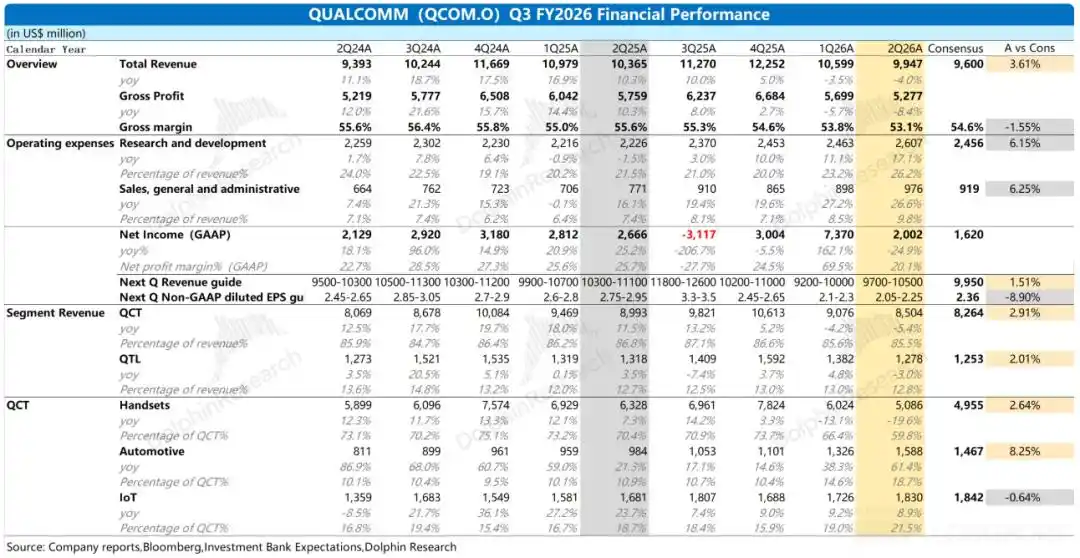
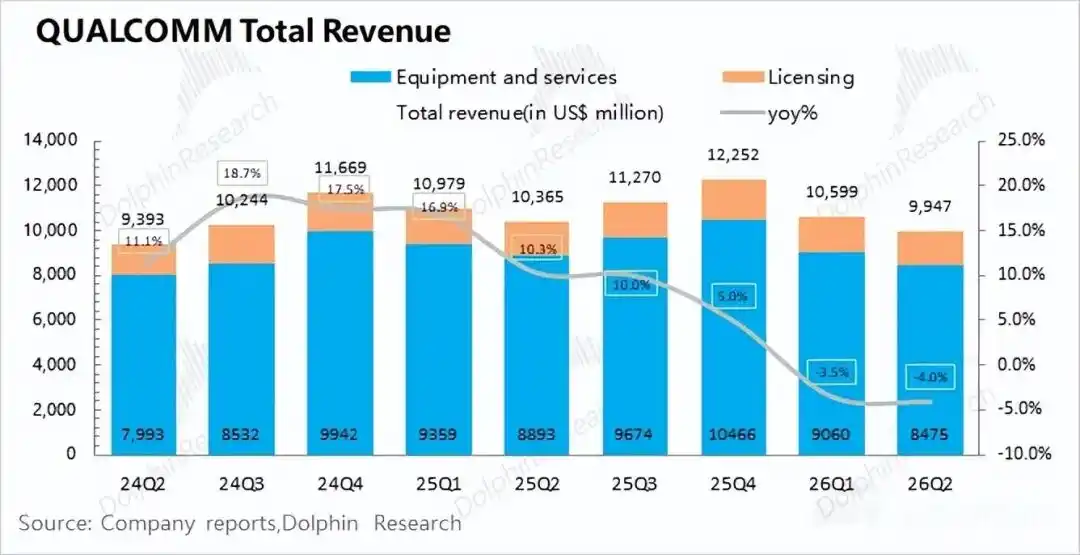
1. Core Data: Qualcomm's revenue for this quarter was $9.95 billion, down 4% year-over-year, better than market expectations ($9.6 billion). Despite significant growth in the automotive business, revenue was still dragged down by the decline in the handset business.

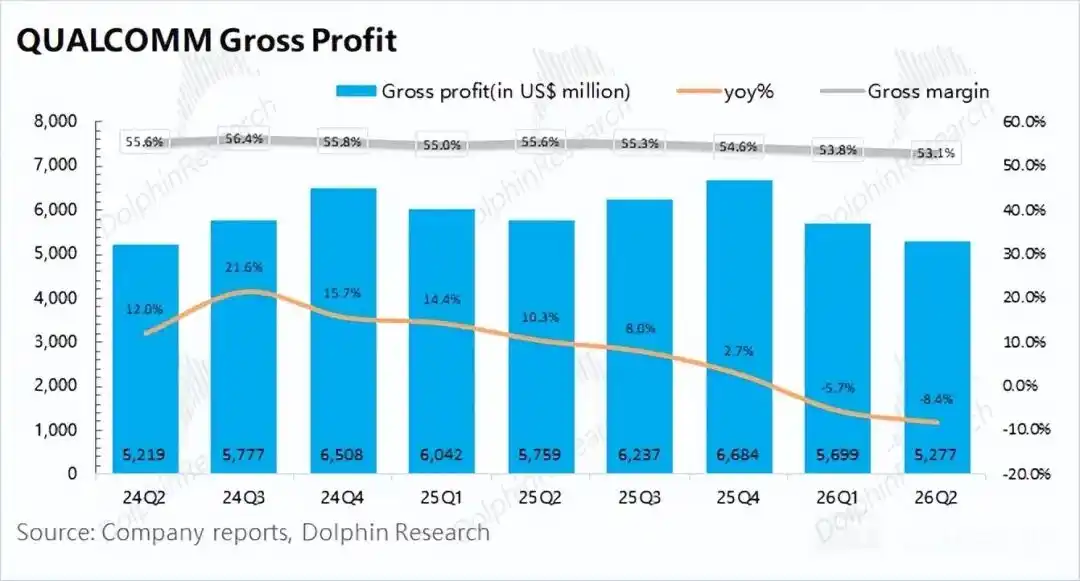
The company's gross margin for this quarter was 53.1%, down 2.5 percentage points year-over-year, below market expectations (54.6%). Increases in costs across wafer fabrication, packaging, testing, advanced packaging, memory, and other materials put significant pressure on the company's gross margin.

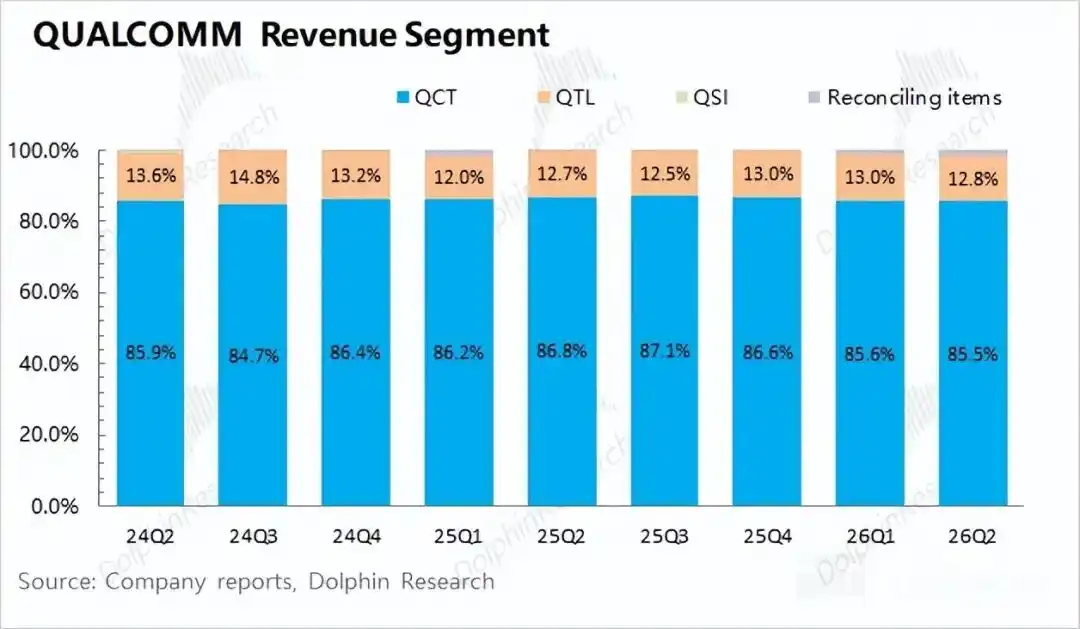
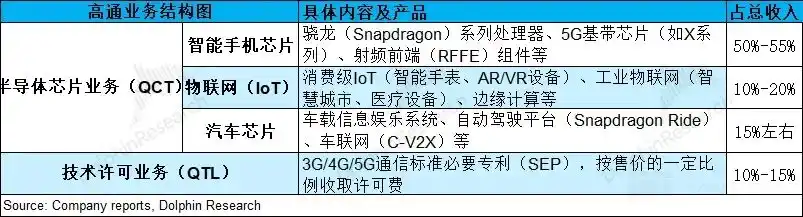
2. Business Segment Details: $Qualcomm's (QCOM.US) business is primarily divided into the Semiconductor Chip business (QCT) and the Technology Licensing business (QTL), with the Semiconductor Chip business being the largest revenue source, accounting for over 80%.

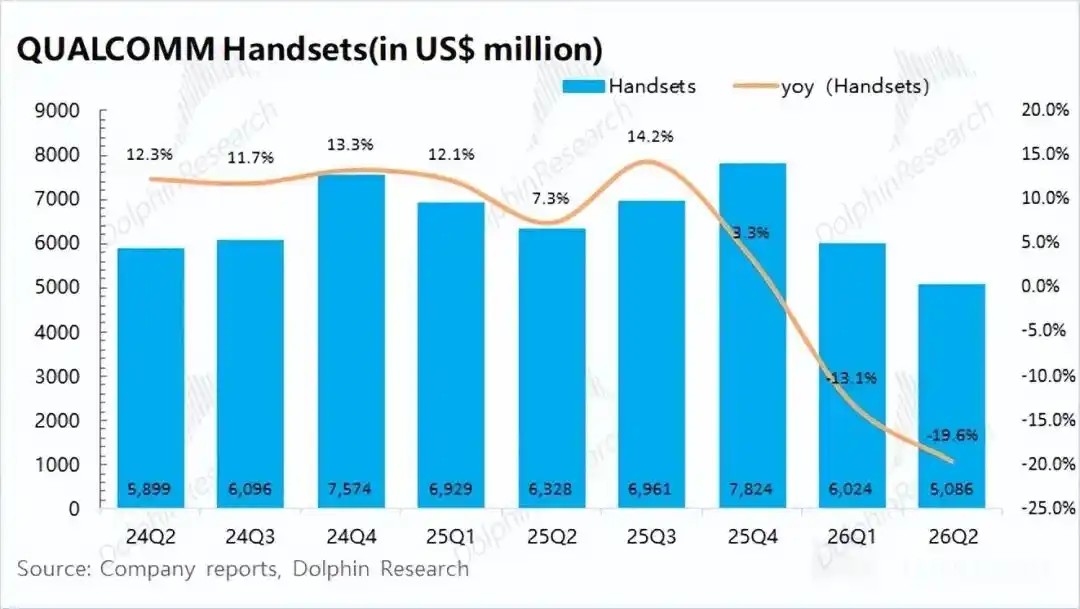
Within the Semiconductor Chip business: 1. Handset business this quarter was $5.09 billion, down 19.6% year-over-year. The decline in the company's handset business was mainly influenced by two factors: Firstly, industry-wide factors, as handset shipments (excluding Apple) fell 11% this quarter; secondly, a weakening internal mix towards premium models, with handset manufacturers tending to use previous-generation platforms to reduce costs.

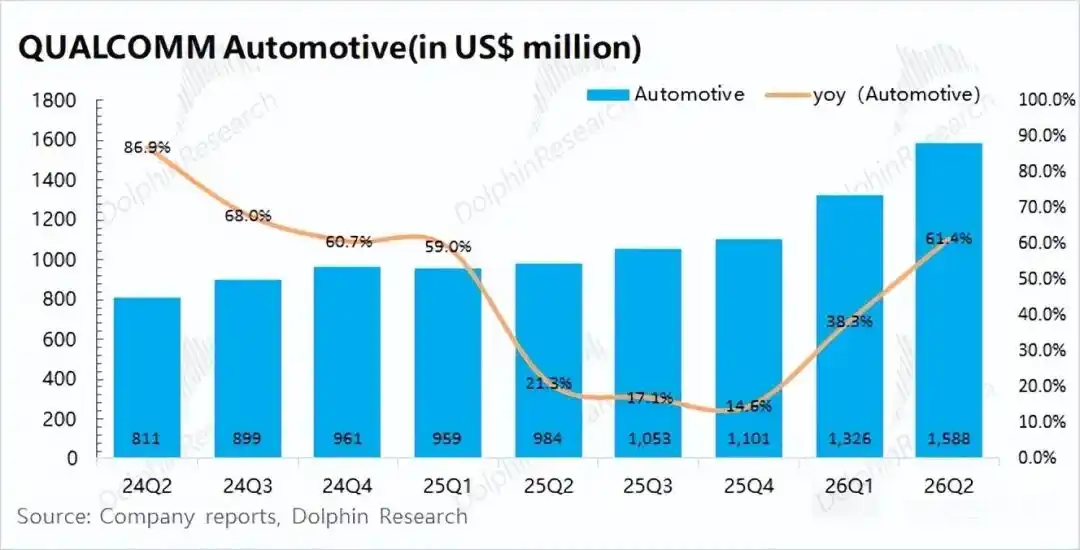
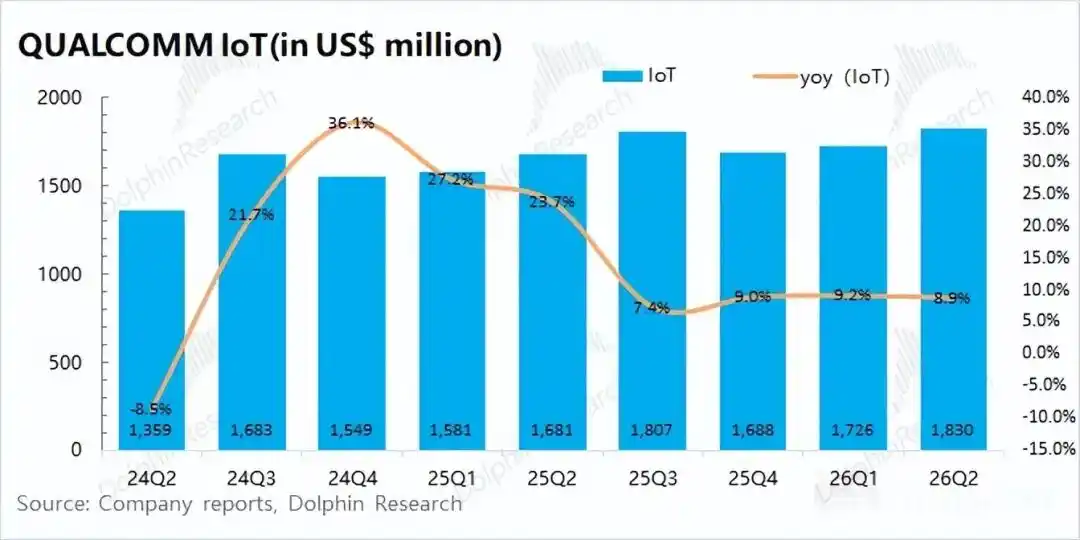
2. Automotive business this quarter was $1.59 billion, up 61% year-over-year, driven by shipments of the fourth-generation Snapdragon Digital Chassis. The company's fifth-generation Snapdragon Digital Chassis will ramp up production in September, with significantly higher value per vehicle. 3. IoT business this quarter was $1.83 billion, up 9% year-over-year, with growth driven by consumer and industrial product demand.

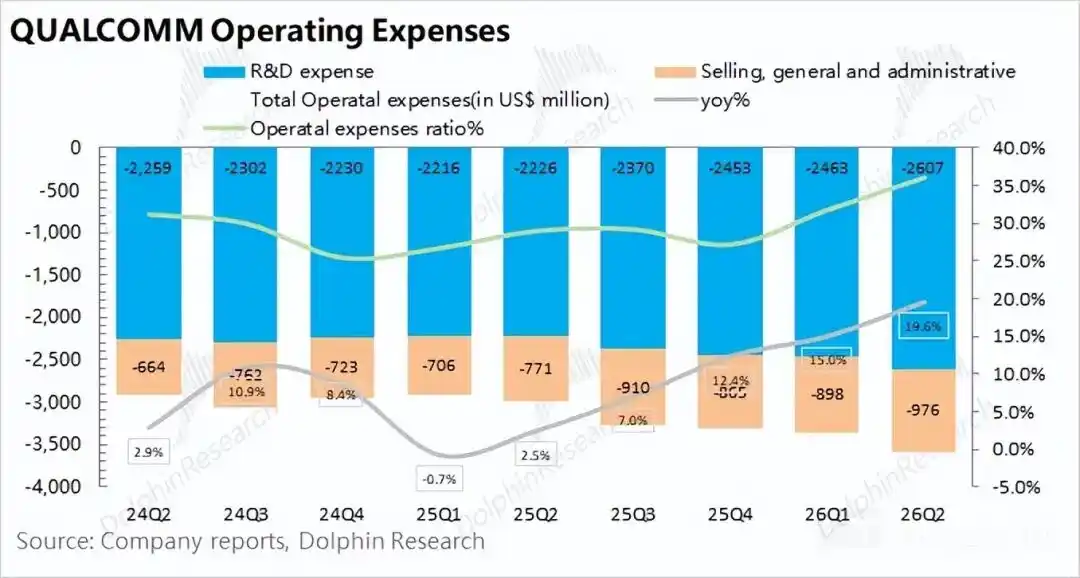
3. Operating Expenses: The company's core operating expenses increased to approximately $3.6 billion, with R&D expenses rising to $2.6 billion this quarter and SG&A expenses amounting to $980 million for the quarter.

The company reported net income of $2.0 billion for the quarter, following the release of a valuation allowance for deferred tax assets (approximately $5.7 billion) in the previous quarter. From an operational perspective, core operating profit for the quarter was $1.63 billion, down 41% year-over-year, primarily due to lower gross margin and increased expenses.

4. Next Quarter Guidance: Qualcomm expects fiscal Q4 2026 revenue of $9.7-$10.5 billion, in line with market expectations ($9.95 billion).; The company expects Non-GAAP EPS for the next quarter to be $2.05-$2.25, below market expectations ($2.36).
Dolphin Research's Overall View: Memory Weighs on Handsets, Data Center "Promises" Await Fulfillment

Qualcomm's earnings report this time remains tepid. While revenue met market expectations, it continues to show a declining trend. Gross margin continues to fall, primarily due to factors like memory price increases and weak demand, leading to higher costs.

Looking at the guidance for the next quarter, the company expects revenue of $9.7-$10.5 billion, showing no clear signs of recovery; while Non-GAAP EPS is expected to be $2.05-$2.25, below market expectations ($2.36). Demand in end markets like handsets remains weak, and factors like memory price increases will continue to pressure the company's costs.
While its traditional core business is sluggish, the company is actively seeking breakthroughs in the data center domain. It plans to focus on four areas: custom chips, commercial CPUs, AI accelerators, and connectivity products. This initially pushed the company's stock price above $250. As market concerns grew about the sustainability of AI Capex, the stock price fell back below $160, essentially erasing the gains brought by data center prospects.

Beyond this earnings report, the market is focusing on the following aspects of Qualcomm:

1) Traditional Domains: The Core Business, Bearing the Pressure of Memory

The handset business is Qualcomm's largest segment, accounting for over half of its business. Its weak performance amidst the overall sluggish handset market puts significant pressure on the company's results. Global handset shipments this quarter remained at 290 million units, down 6% year-over-year.

The handset market mainly consists of Apple and Android. Looking in detail, Apple's handset shipments grew nearly 20% year-over-year this quarter. Shipments for the rest of the Android camp fell approximately 11% year-over-year, directly impacting Qualcomm's handset business performance this quarter.
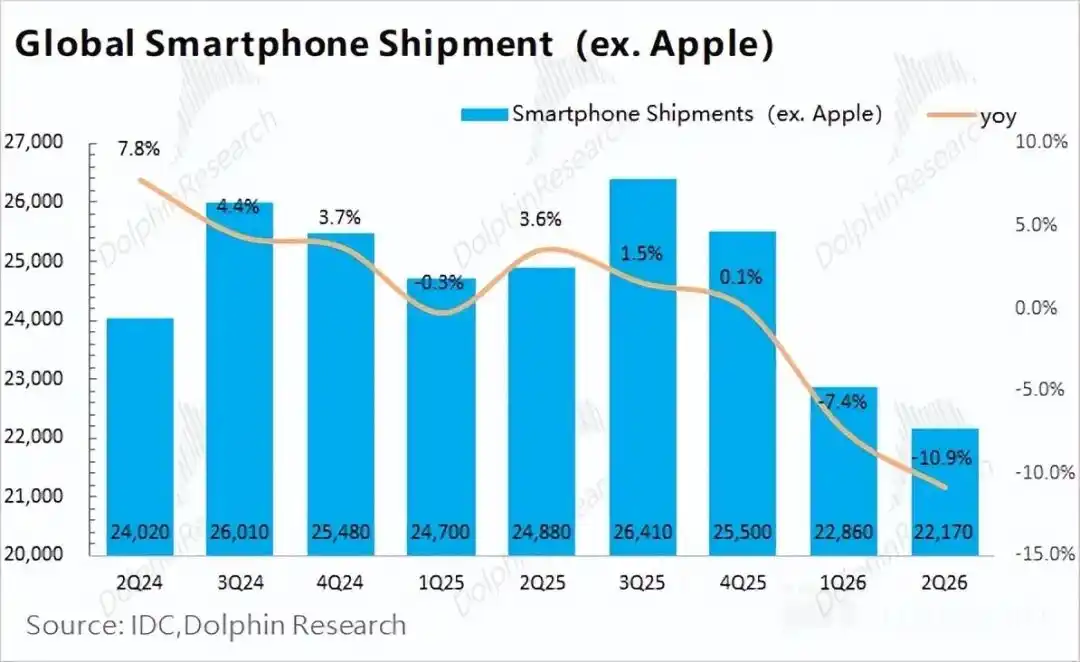
The company expects next quarter's handset business to be around $5.2 billion, down about 25% year-over-year, with Android sequential growth partially offset by declining Apple product revenue (seasonal uptick in the second half, the traditional peak season).

The recent pace of memory price increases has started to slow. As seen in OPPO and VIVO rejecting price hikes from memory suppliers, the "skyrocketing memory" has caused market discontent. If the memory cycle turns downward subsequently, pressure on the company's traditional core business may ease.

2) AI Domain: On-Device AI and Data Center, Potential Growth Markets

While traditional markets are weak, the company is also actively laying out in the AI field, hoping for new breakthroughs.

a) On-Device AI: The company views on-device AI as a core part of its Physical AI strategy, covering all end devices like smartphones, PCs, cars, XR, robots, and industrial IoT, areas where the company already has a presence.

The two main areas: 1. The potential replacement cycle driven by AI Phones, as AI Agents become the "new interface" for smartphones; 2. In the AI PC domain, the company has launched the Snapdragon C platform (for Windows laptops), with core advantages in: Oryon CPU, low-power AI inference, heterogeneous computing (CPU+GPU+NPU collaboration, supporting on-device AI Agent operation).

b) AI Data Center: Qualcomm ultimately couldn't resist entering the main AI arena, which is also the company's most notable strategic plan in the AI field.

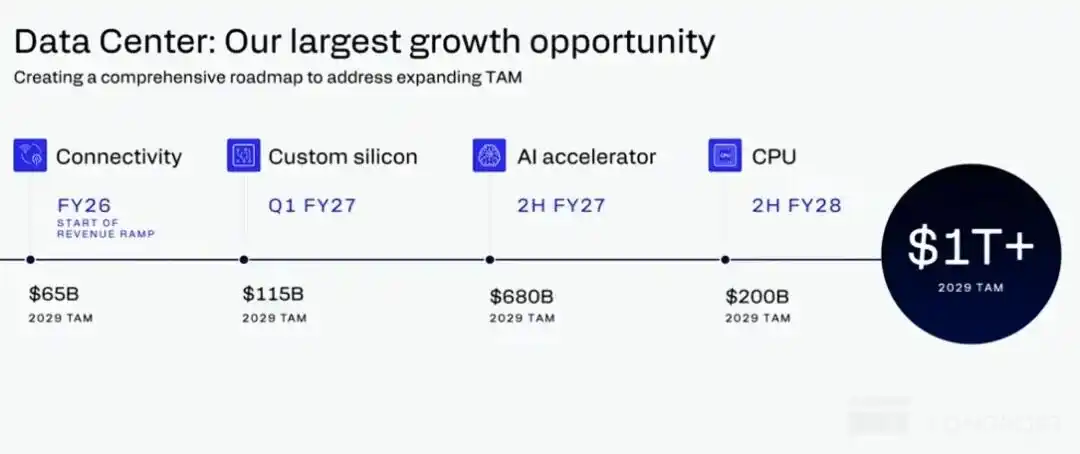
At its investor day on June 24, 2026, Qualcomm disclosed that its AI data center strategy will cover four product lines:

1. AI Accelerators (HBC): Microsoft confirmed a multi-generation partnership.

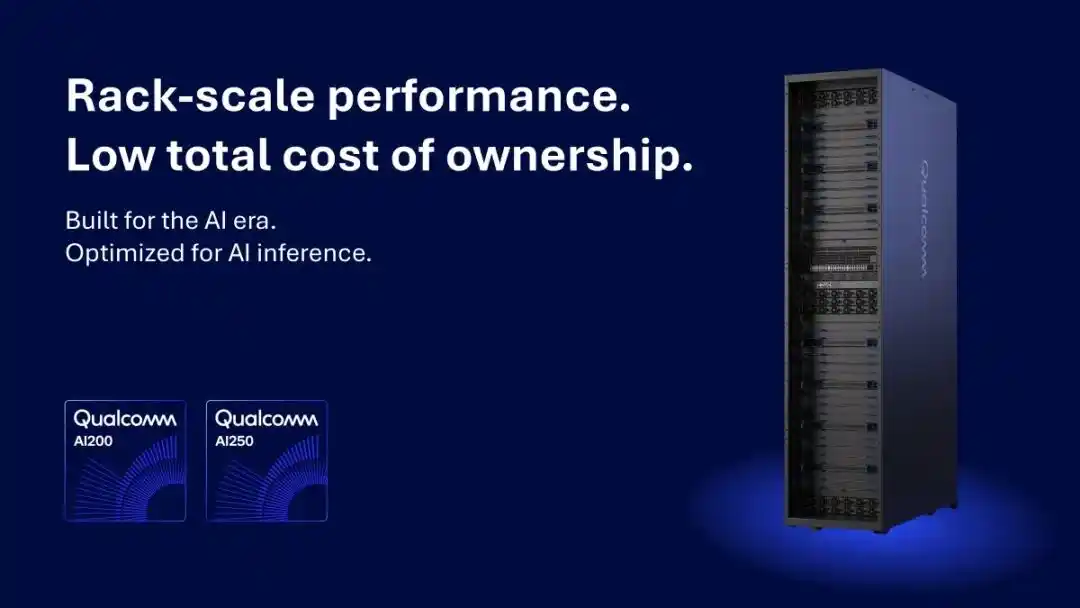
Qualcomm's core differentiated technology, using LPDDR5X (vs. HBM) to enable Processing Near Memory, optimized for memory-capacity-intensive AI inference workloads.

AI200 is currently ramping production; the next-gen AI250 is expected to sample in 2027. Subsequent AI300 will be based on UALink and ESUN for Scale-up network interconnection, with effective bandwidth 54 times that of AI200.
2. Commercial CPU (Dragonfly C1000): Meta confirmed a multi-generation partnership.

This is primarily based on Qualcomm's Oryon CPU architecture from smartphones and PCs, extended to the data center. Positioned as an "Agentic CPU," specifically for CPU-intensive workloads like agent orchestration, multi-step reasoning, and tool invocation.

3. Custom Silicon Business: Confirmed 2 hyperscale customers (each contributing $1 billion+ in FY2027)

This is based on capabilities acquired from Alphawave Semi (SerDes, Die-to-Die, PCIe/CXL, HBM PHY) and Ventana (Veyron V2 RISC-V CPU), primarily providing custom AI chip (XPU) design services to hyperscale customers.

4. Connectivity Business: Secured first hyperscale customer.

Based on Alphawave IP, offering products like 800G/1.6T optical modules, AOCs, AECs. The company currently has 800G LR2 modules, 800G optical modules/AOCs/AECs in production; 1.6T optical modules/AOCs/AECs expected in 2026-2027.
Previously, driven by AI hype, the company's move into the AI data center field once pushed its stock price above $250. Now, with concerns over AI Capex, the stock has fallen back to around $160, erasing the growth expectations from data centers.

Although the company estimates the AI data center business market opportunity at $1 trillion, its data center business currently doesn't contribute significant revenue. Looking back at the traditional business, with weak end markets like handsets, the company's current P/E multiple is actually relatively high.

As for the data center business, while management has set a $15 billion revenue target for FY2029, the focus should currently be on nearer-term performance. Based on the company's FY2027 data center revenue target of $5 billion, this could contribute about $1.2 billion in operating profit (referencing the company's OPM).

In the current fragile market environment, it's more prudent to look for Qualcomm's relatively safe bottom range. From a traditional business perspective, a further decline in the stock price is safer. Of course, this essentially treats the data center business as "an option."

If the company's FY2027 targets are met, they will inject valuation expectations for the data center segment.

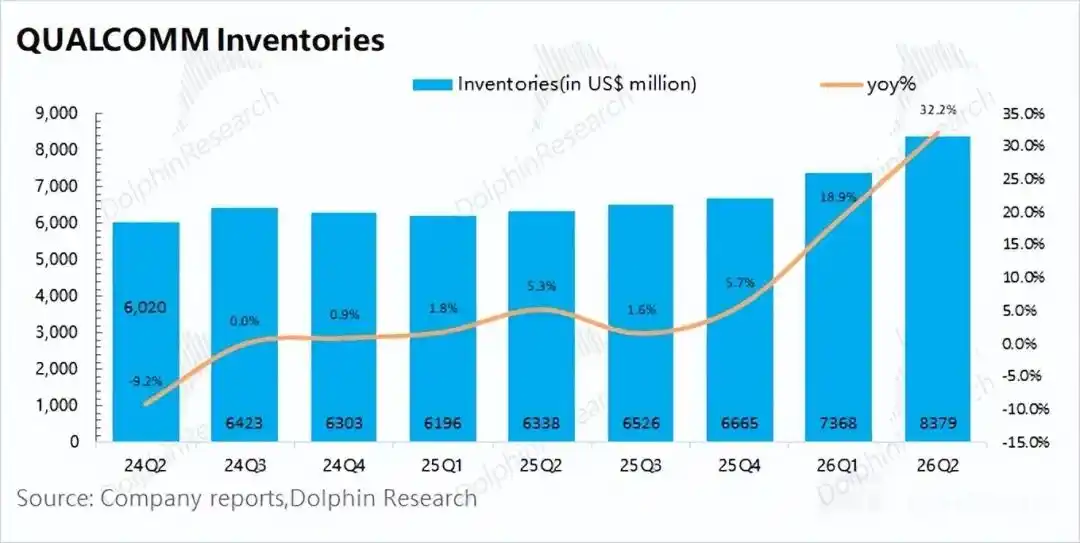
Below are relevant charts from Dolphin Research regarding this Qualcomm earnings report:
This article is from the WeChat public account "Dolphin Investment Research" (ID: haituntouyan), author: Dolphin Research


Trending Cryptos

Related Questions

QAccording to the article, what were the key financial highlights of Qualcomm's Q3 2026 earnings report?

AIn its Q3 2026 earnings report, Qualcomm's revenue was $9.95 billion, a 4% year-over-year (YoY) decline but surpassing market expectations of $9.6 billion. The company's gross margin was 53.1%, a decrease of 2.5 percentage points YoY, which fell below market expectations of 54.6%. Net profit reached $2 billion.

QWhat were the main factors causing the decline in Qualcomm's mobile phone business revenue in Q3 2026?

AThe decline in Qualcomm's mobile phone business revenue, which fell 19.6% YoY to $5.09 billion, was primarily attributed to two factors: first, a broader industry downturn where smartphone shipments (excluding Apple) declined by 11% in the quarter; second, a weakening structure within the high-end smartphone market, where manufacturers tended to use previous-generation platforms to reduce costs.

QWhat are the four key product lines in Qualcomm's AI data center strategy as mentioned in the article?

AQualcomm's AI data center strategy comprises four key product lines: 1) AI Accelerators (HBC), with Microsoft as a confirmed multi-generation partner; 2) Commercial CPUs (Dragonfly C1000), with Meta as a confirmed multi-generation partner; 3) Custom Silicon, with two confirmed hyperscale customers expected to contribute over $1 billion each in fiscal year 2027; and 4) Connectivity Business, which has secured its first hyperscale customer.

QWhat is the outlook for Qualcomm's mobile phone business in the next quarter (Q4 2026) according to the article?

AFor the next quarter (Q4 2026), Qualcomm expects its mobile phone business revenue to be approximately $5.2 billion, representing a year-over-year decline of around 25%. The article notes that this forecast includes some seasonal recovery in Android phone shipments, which is partly offset by a decline in revenue from Apple's products.

QHow does the article characterize the market's current view of Qualcomm's AI data center business, and what is the company's related financial target?

AThe article characterizes the market's current view of Qualcomm's AI data center business as cautious, describing it as a "piece of 'optionality'" given its lack of significant current revenue contribution. Amid concerns about AI capital expenditure sustainability, the stock price surge driven by this business has largely been erased. However, the article mentions that management has set a target of $15 billion in revenue from the data center business by fiscal year 2029, with a nearer-term goal of $5 billion for fiscal year 2027.

Related Reads

Annual Salary of Millions Competing for Electricians, Meta Rushes to Open Its Own Technical School

The AI boom is facing an unexpected bottleneck: a severe shortage of skilled construction workers and electricians. As tech giants like Meta, OpenAI, and Alphabet race to build massive data centers—such as OpenAI's $16 billion "Stargate" project—they are hitting a critical labor wall. The U.S. needs an estimated 130,000 more electricians, 240,000 construction workers, and 150,000 supervisors by 2030 for AI infrastructure alone, but tens of thousands of electrician jobs go unfilled each year. While AI companies offer high premiums, with electricians earning up to $280,000 annually, worker scarcity still causes massive losses—delays on a single project can cost $14.2 million per month. The complexity of building AI data centers, which require immense power (equivalent to powering hundreds of thousands of homes), sophisticated electrical systems, and advanced liquid cooling solutions, demands highly skilled technicians who are in short supply. To combat this, companies are investing heavily in training. Meta has committed $115 million to a free training school offering tuition, housing, and stipends, targeting 5,000 new workers. OpenAI is partnering with unions to secure skilled labor. These efforts are paying off, with a significant rise in Gen Z interest in trade schools over college. However, the power demands are staggering. AI data centers are driving a rapid surge in electricity consumption, projected to account for up to 12% of U.S. power use by 2028 and raising costs for consumers. Furthermore, the construction boom is project-based, leading to a potential future glut of trained workers once building peaks, which could depress wages industry-wide. The race for AI supremacy now depends as much on skilled hands as on advanced chips.

marsbit21m ago

Annual Salary of Millions Competing for Electricians, Meta Rushes to Open Its Own Technical School

marsbit21m ago

OpenAI No Longer Sells Its Most Expensive Model for Profit

OpenAI is shifting its business strategy away from promoting its most expensive, flagship models for every task. Recent price cuts—80% for GPT-5.6 Luna and 20% for Terra—signal a deeper change: the company now actively advises users that many tasks don't require the most powerful model. Instead, OpenAI recommends a tiered approach: use the high-end GPT-5.6 Sol for complex planning and analysis, then delegate execution to cheaper models like Luna. This mirrors moves by Anthropic, which recently launched Claude Opus 5 at half the price of its top model, Fable 5. Both companies are de-emphasizing flagship models as primary revenue drivers, using them instead for brand prestige and technological showcases. The industry is entering a "mass-market" phase, similar to automotive, where high-volume, cost-effective models handle daily operations and drive scale. OpenAI's price reductions are partly enabled by AI models themselves optimizing underlying code and infrastructure, creating a self-reinforcing cycle of efficiency gains and cost reduction. Competition is shifting from "who is smartest" to "who offers the best value." The goal is no longer selling individual models but fostering widespread API adoption and ecosystem lock-in. By making AI calls cheap and ubiquitous, companies like OpenAI aim to become the indispensable, utility-like infrastructure powering automated workflows—the "water and electricity" of software, quietly embedded everywhere.

marsbit21m ago

OpenAI No Longer Sells Its Most Expensive Model for Profit

marsbit21m ago

Will the Fed Definitely Raise Interest Rates in September? How Will Crypto and U.S. Stocks Withstand the Pressure?

The market's expectation for a September Fed rate hike surged dramatically in early August, jumping from under 50% to over 80% within a week. This shift followed a contentious July FOMC meeting, where a 9-3 vote to hold rates revealed growing dissent from hawkish members advocating for an immediate hike to combat persistent inflation. The primary catalyst for this repricing is rising oil prices, driven by renewed geopolitical tensions around the Strait of Hormuz, which threaten global supply. Energy costs directly influence inflation metrics, making the upcoming July CPI report (due August 12th) a critical data point. If it shows inflation reaccelerating, the probability of a September hike will solidify. For Bitcoin and crypto assets, this is typically bearish news. Bitcoin continues to behave as a high-beta, liquidity-sensitive risk asset. A rate hike raises the opportunity cost of holding non-yielding assets and could drive capital toward money markets, pressuring crypto prices in the short term. However, historical patterns suggest that if a hike is perceived as the end of a tightening cycle rather than the start, any negative price impact may be brief. U.S. stocks, particularly crypto-linked equities like Coinbase and growth-oriented tech stocks, are also vulnerable. Higher rates increase discount rates in valuation models, putting pressure on high-multiple companies. This coincides with a pivotal tech earnings season where investor focus has shifted from massive AI capital expenditure to tangible revenue and cash flow generation. Companies with negative cash flow and weak growth narratives could face heightened volatility if borrowing costs rise in September. In summary, a September Fed hike has evolved into a mainstream market scenario. Key factors to watch are oil prices, the July CPI report, and Fed communications, which will determine the final decision and its impact on volatile crypto and equity markets.

marsbit32m ago

Will the Fed Definitely Raise Interest Rates in September? How Will Crypto and U.S. Stocks Withstand the Pressure?

marsbit32m ago

Trading

Spot

Hot Articles

How to Buy HYPE

Welcome to HTX.com! We've made purchasing Hyperliquid (HYPE) simple and convenient. Follow our step-by-step guide to embark on your crypto journey.Step 1: Create Your HTX AccountUse your email or phone number to sign up for a free account on HTX. Experience a hassle-free registration journey and unlock all features.Get My AccountStep 2: Go to Buy Crypto and Choose Your Payment MethodCredit/Debit Card: Use your Visa or Mastercard to buy Hyperliquid (HYPE) instantly.Balance: Use funds from your HTX account balance to trade seamlessly.Third Parties: We've added popular payment methods such as Google Pay and Apple Pay to enhance convenience.P2P: Trade directly with other users on HTX.Over-the-Counter (OTC): We offer tailor-made services and competitive exchange rates for traders.Step 3: Store Your Hyperliquid (HYPE)After purchasing your Hyperliquid (HYPE), store it in your HTX account. Alternatively, you can send it elsewhere via blockchain transfer or use it to trade other cryptocurrencies.Step 4: Trade Hyperliquid (HYPE)Easily trade Hyperliquid (HYPE) on HTX's spot market. Simply access your account, select your trading pair, execute your trades, and monitor in real-time. We offer a user-friendly experience for both beginners and seasoned traders.

5.4k Total ViewsPublished 2024.03.29Updated 2026.06.02

How to Buy HYPE

Discussions

Welcome to the HTX Community. Here, you can stay informed about the latest platform developments and gain access to professional market insights. Users' opinions on the price of HYPE (HYPE) are presented below.

活动图片