Trump’s crypto empire generates $1.4B in 2025: WLFI, TRUMP under scrutiny

ambcryptoPublished on 2026-07-01Last updated on 2026-07-01

Abstract

Former President Donald Trump's cryptocurrency holdings have become the primary revenue source for his business empire, generating over $1.4 billion in 2025. Key contributors were the sale of WLFI tokens and his TRUMP memecoin. This financial success coincides with major U.S. regulatory initiatives like the GENIUS and CLARITY Acts, raising significant scrutiny over potential conflicts of interest. Critics argue that favorable crypto regulations could directly benefit Trump's commercial ventures. Concurrently, regulatory enforcement by agencies like the SEC has decreased sharply as focus shifts to creating new market frameworks. While markets remain driven by traditional fundamentals, the intertwining of Trump's crypto wealth with policymaking is expected to lead to increased ethics oversight and stricter disclosure requirements for the industry going forward.

President Donald Trump’s latest financial disclosure signals a fundamental shift in his business empire. This comes after his cryptocurrency investments overtake traditional ventures as his largest revenue source.

That transition stems from the rapid expansion of family-backed crypto projects, which generated more than $1.4 billion in reported income during 2025.

Of that, nearly $600 million came from the sale of tokens by World Liberty Financial [WLFI]. And even though the price of Official TRUMP [TRUMP] memecoin fell from $74.24 at its peak to $1.67 at one point, it still managed to generate approximately $636 million.
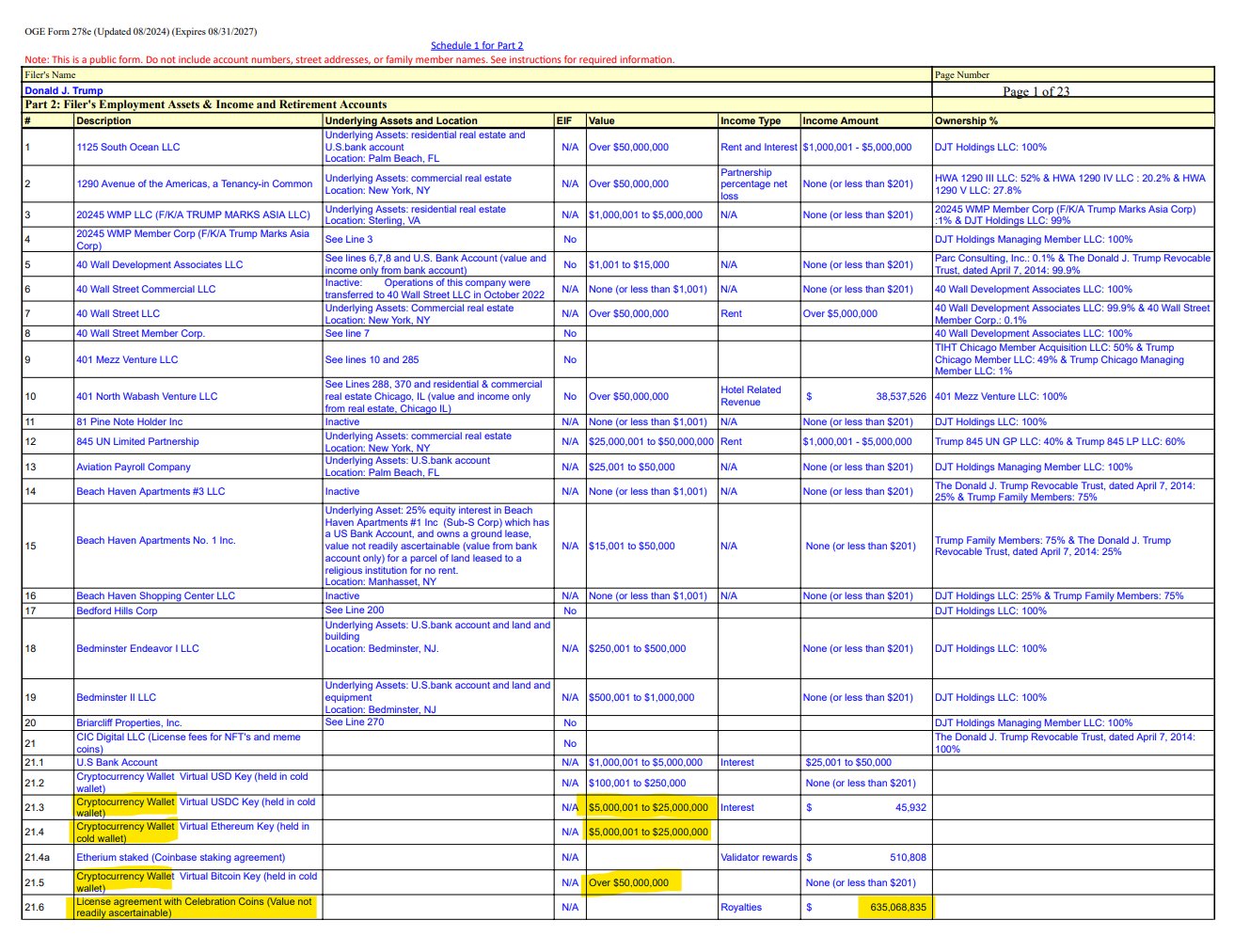
Source: Office of Government Ethics

Other types of equity sales furthered crypto earnings. Altogether, the data points to the conclusion that earning money is no longer dependent solely upon the value of his crypto assets.

Rather, the main drivers of Trump’s increasing digital assets include license agreements, token sales, and equity transactions.

Crypto wealth and policy collide under growing scrutiny

Trump’s crypto success has now shifted attention beyond profits toward policymaking. That focus emerged because his business interests expanded alongside major regulatory reforms.

Meanwhile, the administration also created an executive order, the GENIUS Act. It was followed by the CLARITY Act, and both acts support clearer rules for stablecoins, as well as a larger digital asset marketplace.

Those disclosures have since become central to the debate, as they link the president’s commercial interests to an industry undergoing significant regulatory reform.

That overlap intensified concerns because friendlier regulations could strengthen businesses tied to the president. AMBCrypto earlier reported that Trump leverages the CLARITY Act in broader negotiations, stalling its 4th of July passage amid housing bill disputes.

As scrutiny increased, lawmakers proposed stronger ethics safeguards and disclosure requirements. This will result in increasing oversight of the policies and laws regarding cryptocurrency going forward.

Markets test the impact of crypto policy shifts

Political scrutiny has now shifted toward how regulators oversee the cryptocurrency industry. Beginning in 2022, the political spotlight began focusing on regulators’ supervision of the digital assets sector.

At that time, enforcement activities were decreasing rapidly due to increasing activity for rule-making from U.S. federal agencies.

According to Cornerstone Research, enforcement by the SEC regarding cryptocurrencies decreased approximately 60 percent in 2025, with CFTC enforcement action for virtual currencies dropping to almost zero.
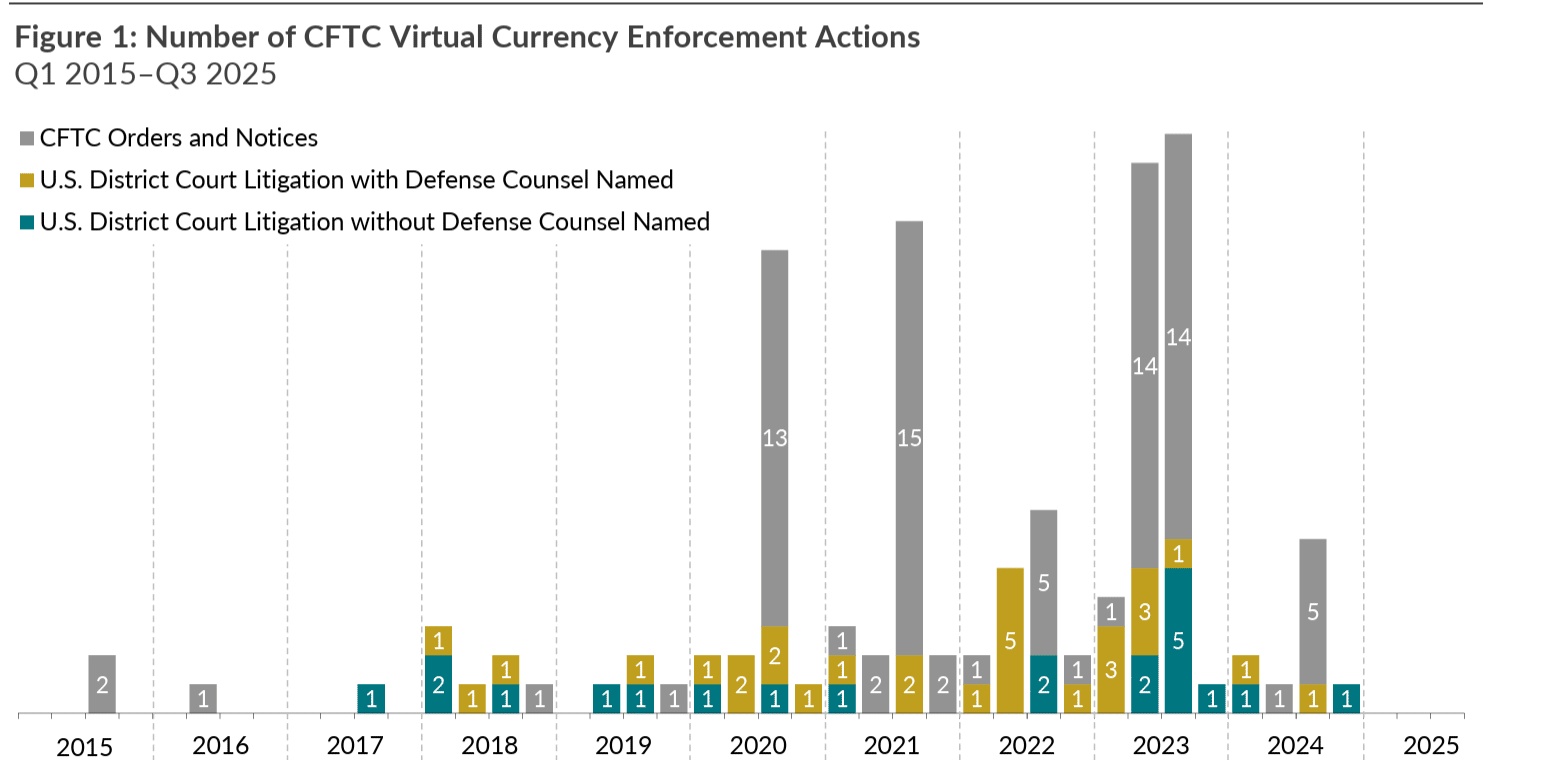
Source: Cornerstone Research

The transition in both areas was reflective of an emerging focus for regulators on developing frameworks for stablecoins and implementing structural changes in digital asset markets.

However, investors largely continued following interest rates, ETF flows, and broader macroeconomic conditions instead. That distinction suggests markets still prioritize fundamentals over politics.

Going forward, mounting ethics scrutiny could reshape regulatory standards and strengthen institutional accountability across future crypto oversight.


Final Summary

  • Trump’s crypto empire now extends beyond business into U.S. digital asset policy.
  • Crypto regulation now faces greater scrutiny as ethics and innovation increasingly collide.

Trending Cryptos

Related Questions

QWhat was the total reported income generated by Trump's family-backed crypto projects in 2025, and what were the two main sources?

ATrump's family-backed crypto projects generated more than $1.4 billion in reported income during 2025. The two main sources were: nearly $600 million from the sale of World Liberty Financial (WLFI) tokens, and approximately $636 million from the Official TRUMP (TRUMP) memecoin.

QAccording to the article, what are the main drivers of Trump's increasing digital assets, moving beyond simple asset value?

AThe main drivers of Trump's increasing digital assets are license agreements, token sales, and equity transactions. The article states that earning money is no longer dependent solely on the value of his crypto assets.

QHow did U.S. regulatory enforcement actions in the cryptocurrency sector change in 2025, according to Cornerstone Research?

AAccording to Cornerstone Research, enforcement by the SEC regarding cryptocurrencies decreased by approximately 60 percent in 2025. Furthermore, CFTC enforcement action for virtual currencies dropped to almost zero in the same year.

QWhy has Trump's crypto success shifted attention toward policymaking and regulatory reforms?

AAttention has shifted toward policymaking because Trump's business interests expanded alongside major regulatory reforms. There is concern that friendlier regulations could strengthen businesses tied to the president, creating an overlap between his commercial interests and an industry undergoing significant regulatory change.

QWhat are the two legislative acts mentioned in the article that support clearer rules for the digital asset marketplace?

AThe two legislative acts mentioned are the GENIUS Act, an executive order, and the CLARITY Act. Both acts support clearer rules for stablecoins and aim to foster a larger digital asset marketplace.

Related Reads

Bitcoin Withdrawals Continue: 8 Years of Storage in a Coldcard Cold Wallet Ended in Zero

Coldcard Hardware Wallet Hacked: Losses Mount Due to Vulnerable Seed Generation A critical vulnerability in Coldcard hardware wallets has led to a continued wave of fund thefts. According to Galaxy Research, the total stolen has reached 1,367.05 BTC (approx. $88.6 million) from 4,585 addresses, a significant increase from the initial 594.5 BTC reported on July 30, 2026. Most of the stolen funds remain on the attackers' addresses. The issue is not with the current firmware, which Coinkite has updated, but with seed phrases generated on vulnerable devices between March 2021 and the release of fixed firmware versions. Due to a programmer error, devices switched from using a hardware random number generator to the software-based Yasmarang generator, which was initialized with publicly accessible data like the chip's serial number. This made the seed phrases predictable through offline brute-force attacks, meaning wallets remain at risk until funds are moved to a new wallet generated with the patched firmware. Affected devices include Mk2/Mk3 with firmware 4.0.1–4.1.9 (and up to 5.0.3), Mk4/Mk5 up to version 5.6.0, and Q models up to 1.5.0Q. The only exceptions are seeds created with a high-entropy method like at least 50 independent dice rolls or a strong unique BIP-39 passphrase. All other owners must generate a new seed on the fixed firmware and transfer their assets. A case highlighting the human impact involves a 39-year-old long-term investor who lost 2 BTC (approx. $130,000) in minutes. He had accumulated the Bitcoin over eight years through physical labor, viewing it as a financial lifeline and a retirement plan in a country suffering from hyperinflation. His story underscores that even conservative "buy and hold in cold storage" strategies can be compromised by such underlying technical flaws. From a technical perspective, this incident echoes historical failures where weak random number generators undermined cryptographic security, challenging the assumption that offline storage is automatically foolproof.

cryptonews.ru5h ago

Bitcoin Withdrawals Continue: 8 Years of Storage in a Coldcard Cold Wallet Ended in Zero

cryptonews.ru5h ago

Trading

Spot

Hot Articles

Discussions

Welcome to the HTX Community. Here, you can stay informed about the latest platform developments and gain access to professional market insights. Users' opinions on the price of S (S) are presented below.

活动图片















