Solana hits 10B transactions as Ethereum crosses 200M — two blockchains, two models

ambcryptoPublished on 2026-04-01Last updated on 2026-04-01

Abstract

Blockchain activity is rising, but the latest data reveals a widening gap in how that activity is defined. Solana processed a record 10.1 billion transactions in Q1 2026, driven by its high-throughput, low-fee model optimized for high-frequency use cases like trading and gaming. In the same period, Ethereum recorded just over 200 million transactions, also a record, reflecting its role as a high-value settlement layer for DeFi, institutional flows, and L2s. The contrast underscores two definitions of activity: Solana emphasizes quantity and volume, while Ethereum emphasizes value density and security. The data suggests these ecosystems are specializing rather than competing, with Solana as a high-throughput execution environment and Ethereum as a foundational settlement layer. Both models are expanding simultaneously, indicating a multi-chain future where networks optimize for different use cases.

Blockchain activity is rising across major networks, but the latest data highlights a widening gap in how that activity is defined.

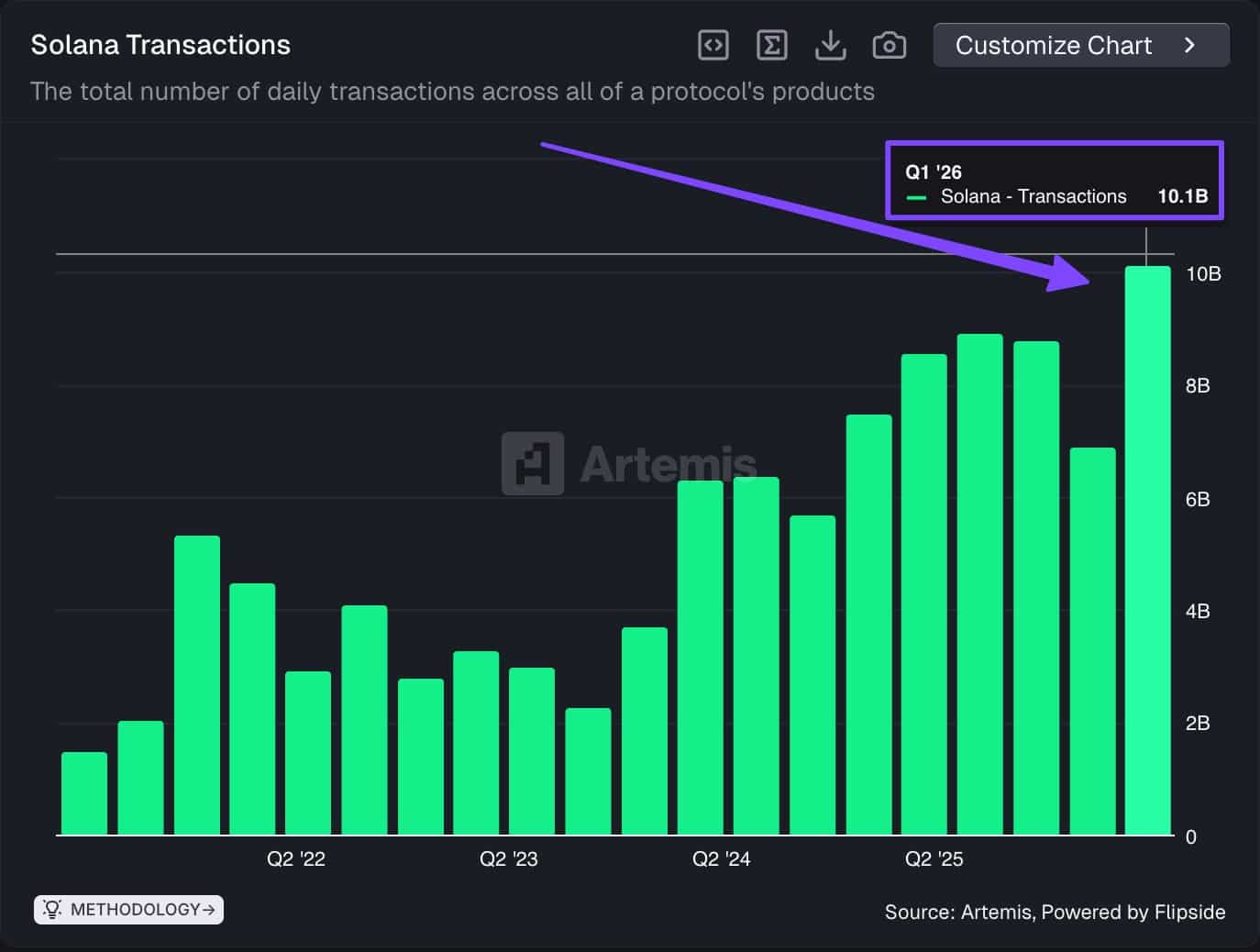
New figures from Artemis show Solana processed 10.1 billion transactions in Q1 2026, marking the first time it has crossed the 10B threshold in a single quarter.

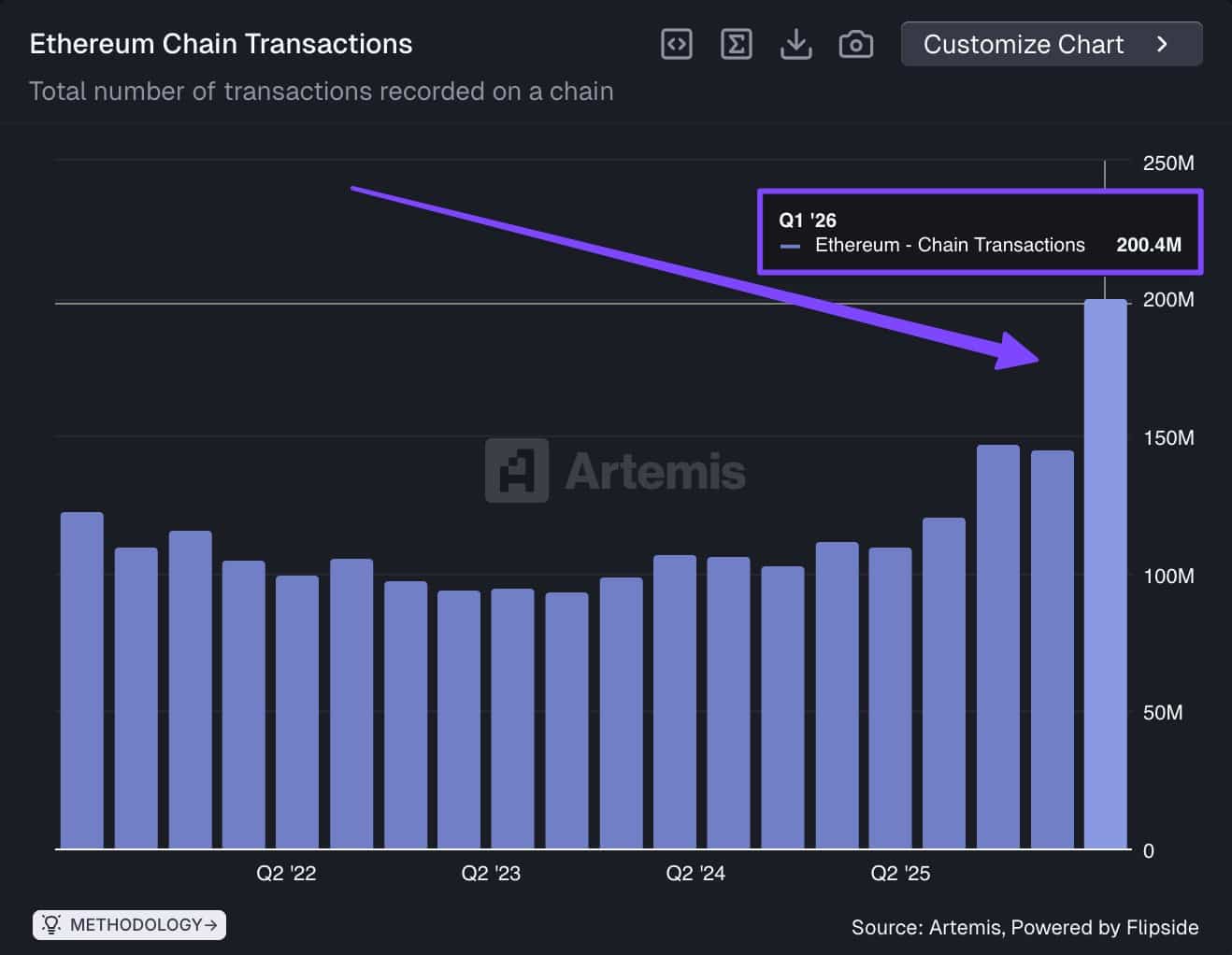
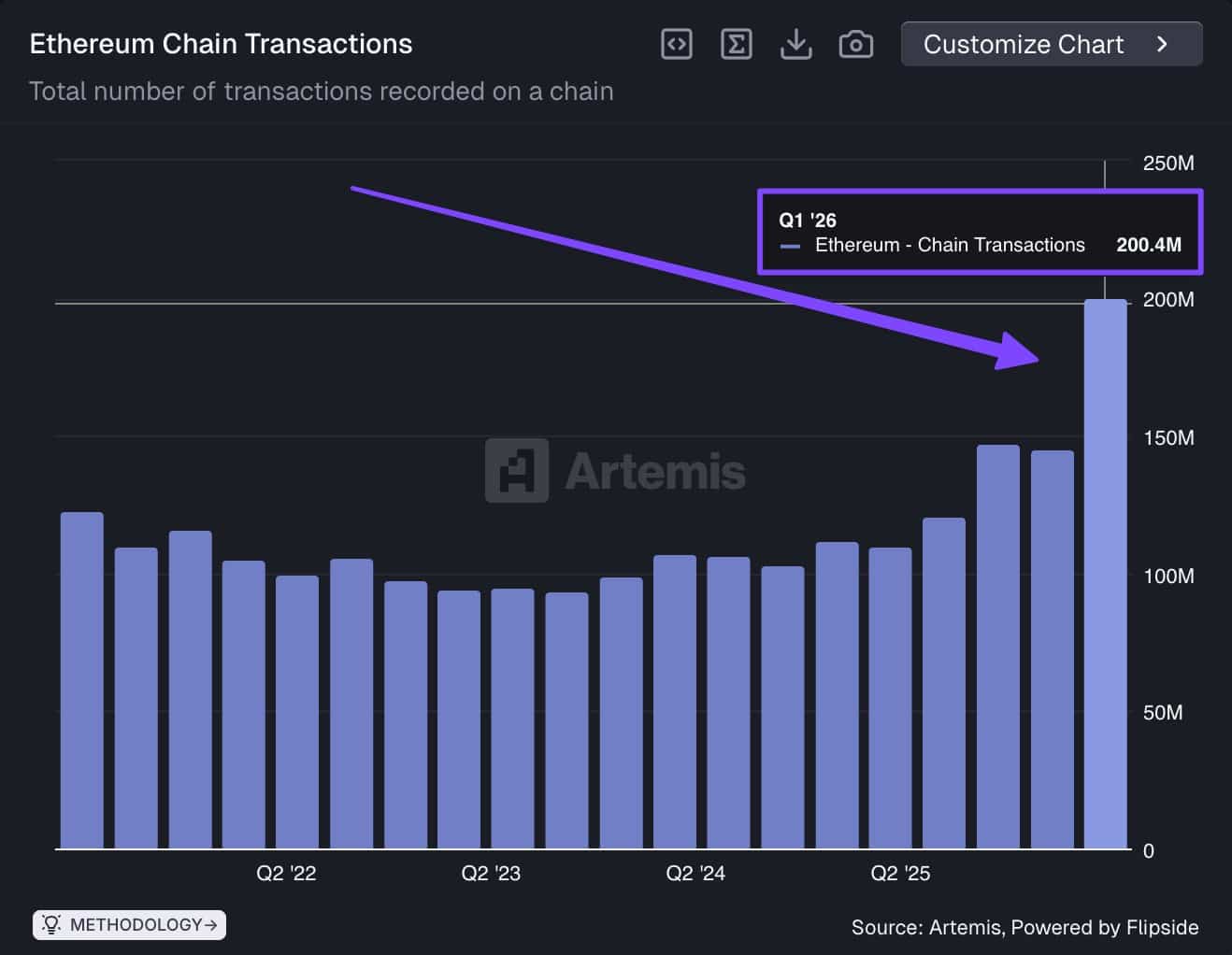
Over the same period, Ethereum recorded just over 200 million transactions, also a record high.

At face value, the disparity is stark. But the numbers point less to competition and more to diverging blockchain roles.

Solana’s throughput model accelerates

Solana’s transaction growth has been driven by its core design: high throughput and low fees.

The network has positioned itself as a platform for high-frequency activity, including trading, gaming, and automated transactions. This has enabled it to process billions of transactions per quarter, with activity accelerating through 2025 and into early 2026.
Source: Artemis

The scale reflects a system optimized for speed and volume, where transaction costs remain low enough to support frequent interactions.

Ethereum’s value layer expands steadily

Ethereum’s growth trajectory looks different.

While transaction counts remain significantly lower, the network continues to anchor high-value activity, including decentralized finance, institutional flows, and Layer 2 settlement.
Source: Artemis

Rather than maximizing raw throughput, Ethereum’s ecosystem has evolved toward a model where activity is distributed across scaling layers, with the base chain acting as a secure settlement layer.

The result is fewer transactions, but typically higher value per interaction.

Two definitions of blockchain activity

The contrast between the two networks underscores a broader shift in how blockchain usage is measured.

Solana’s metrics highlight quantity — the ability to process massive volumes of transactions efficiently.

Ethereum’s metrics reflect value density — where fewer transactions can represent significant economic activity.

As a result, raw transaction count alone no longer provides a complete picture of network dominance.

A multi-chain reality takes shape

The data suggests that blockchain ecosystems are increasingly specializing rather than competing directly.

Solana is emerging as a high-throughput execution environment, while Ethereum continues to function as a foundational settlement layer for a broader ecosystem of applications.

Both models are expanding simultaneously, suggesting a market structure where different networks optimize for different use cases.


Final Summary

  • Solana’s 10.1B quarterly transactions highlight its strength in high-throughput, low-cost activity at scale.
  • Ethereum’s 200M transactions reflect its role as a high-value settlement layer, emphasizing quality over quantity.


Related Questions

QWhat are the key differences in transaction volume between Solana and Ethereum in Q1 2026, and what do these numbers represent?

AIn Q1 2026, Solana processed 10.1 billion transactions, while Ethereum recorded just over 200 million. These numbers represent a fundamental difference in their roles: Solana's high volume reflects its design as a high-throughput platform for frequent, low-cost activities like trading and gaming, whereas Ethereum's lower count reflects its role as a high-value settlement layer for DeFi and institutional flows, where fewer transactions carry greater economic weight.

QHow does Solana achieve its high transaction throughput, and what type of activity drives its growth?

ASolana achieves high transaction throughput through its core design, which prioritizes speed and low fees. This enables it to support high-frequency activities such as trading, gaming, and automated transactions, driving its growth in processing billions of transactions per quarter.

QWhat is Ethereum's primary function in the blockchain ecosystem, and how does its transaction model differ from Solana's?

AEthereum functions primarily as a secure settlement layer for high-value activities, including decentralized finance (DeFi) and institutional flows. Its transaction model differs from Solana's by emphasizing value density—fewer transactions that represent significant economic activity—rather than raw throughput, with much of its activity distributed across Layer 2 scaling solutions.

QWhy does raw transaction count no longer provide a complete picture of network dominance, according to the article?

ARaw transaction count no longer provides a complete picture of network dominance because blockchain ecosystems are specializing. Solana's metrics highlight quantity and efficiency in processing high volumes, while Ethereum's metrics reflect the economic significance and value per transaction, indicating that both networks serve different but equally important roles.

QWhat does the data suggest about the future structure of blockchain ecosystems, as illustrated by Solana and Ethereum?

AThe data suggests that blockchain ecosystems are increasingly specializing rather than competing directly. Solana is emerging as a high-throughput execution environment for frequent interactions, while Ethereum serves as a foundational settlement layer for high-value applications. This indicates a multi-chain reality where different networks optimize for distinct use cases, and both models can expand simultaneously.

Related Reads

Anthropic Starts Poaching Scientists? $27K Weekly Onsite Stipend to Fix Claude's Expert-Level Errors

Anthropic has launched a new STEM Fellow program, offering $3,800 per week for a three-month, in-person residency in San Francisco. The role targets experts from science, technology, engineering, and mathematics (STEM) fields—machine learning experience is helpful but not required. Instead, Anthropic values scientific judgment and a willingness to learn quickly. Fellows will work with Claude models and internal tools under the guidance of an Anthropic researcher. Example projects include a materials scientist identifying errors in Claude’s reasoning or a climate scientist integrating atmospheric modeling software with Claude. The goal is to have experts "tell Claude where it's wrong" and improve its scientific capabilities. This initiative is part of Anthropic’s broader strategy to strengthen its scientific ecosystem, following earlier programs like the AI Safety Fellows and AI for Science programs. The company acknowledges that current AI models, while powerful, still produce high-confidence errors and lack end-to-end research autonomy. The program aims to embed domain expertise directly into model development, turning scientists into "high-level reviewers" for AI. Anthropic CEO Dario Amodei has previously emphasized AI’s potential to accelerate scientific breakthroughs, particularly in biology and healthcare. The company believes that the next phase of AI competition will depend not on scaling parameters, but on integrating human expertise to refine model accuracy and reliability.

marsbit26m ago

Anthropic Starts Poaching Scientists? $27K Weekly Onsite Stipend to Fix Claude's Expert-Level Errors

marsbit26m ago

On the Eve of X Money's Launch, Musk Dismantles the Referee First

"X Money Launches After Dismantling Regulator: Musk's 9-Day Power Play" In February 2025, a team from the "Department of Government Efficiency" (DOGE), led by Elon Musk, entered the Consumer Financial Protection Bureau (CFPB) headquarters. Shortly after, the CFPB was effectively dismantled—its funding frozen, activities suspended, and nearly 90% of staff laid off. This move came just nine days after X announced a partnership with Visa and as X Money prepared to launch. The article contrasts this with the decade-long regulatory battles faced by companies like Coinbase and PayPal. Coinbase spent over $75 million in political contributions and endured a major SEC lawsuit to operate legally. PayPal complied with strict state and federal rules for its stablecoin PYUSD, including 100% reserve requirements and monthly audits. However, Musk’s approach was different. After the CFPB introduced a rule placing large digital payment apps under federal oversight, Musk tweeted "Delete CFPB." Within months, the rule was revoked by Congress. Meanwhile, DOGE operatives gained "god-tier" access to CFPB databases, potentially obtaining sensitive competitive information from rivals like Apple, Google, and PayPal. The article also highlights a "suspicious exemption clause" in the GENIUS Act, which allows private companies like X to issue stablecoins with fewer restrictions. Senator Elizabeth Warren questioned whether Musk, who was a senior presidential advisor during the Act’s drafting, influenced this clause. X Money offers a 6% APY on deposits, despite FDIC warnings that stablecoin users are not insured. As X Money launches to 600 million monthly users, the article questions the fairness of a system where Musk can bypass regulations that others spent years and millions to comply with. The dismantling of the CFPB and the alleged regulatory advantages raise concerns about the future of equitable rule-making in the U.S. financial system.

marsbit35m ago

On the Eve of X Money's Launch, Musk Dismantles the Referee First

marsbit35m ago

Trading

Spot
Futures

Hot Articles

Discussions

Welcome to the HTX Community. Here, you can stay informed about the latest platform developments and gain access to professional market insights. Users' opinions on the price of ETH (ETH) are presented below.

活动图片