Crypto Morning Report: Binance to Blacklist/Penalize Non-Compliant Market Makers, Bitmine Launches Self-Developed ETH Staking Platform MAVAN

marsbitPublished on 2026-03-26Last updated on 2026-03-26

Abstract

Binance has issued new market maker guidelines, warning of penalties including blacklisting for manipulative practices like coordinated selling and wash trading. Separately, Bitmine launched MAVAN, its proprietary Ethereum staking platform, which has already staked 3.14 million ETH, generating nearly $300 million in annualized yield. In regulatory news, the SEC is preparing to release a tokenization exemption framework in the coming weeks, while the Ethereum Foundation published a quantum-resistant upgrade roadmap targeting L1 completion by 2029. Visa joined the Canton Network as a super validator. Other developments include Polymarket introducing taker fees on most markets, Tether pausing its $20 billion fundraising plan pending an audit, and Glimpse raising $35 million in Series A funding led by a16z. Market-moving political news featured a Democratic call to remove Trump via the 25th Amendment and his plans to form a tech advisory board with Zuckerberg and Nvidia's Huang.

Author: Deep Tide TechFlow

Yesterday's Market Dynamics

US Democratic Congresswoman Calls for Trump's Removal from Office

Market News: US Democratic Congresswoman Alexandria Ocasio-Cortez has formally called for the removal of President Trump from office under the 25th Amendment of the Constitution. The 25th Amendment of the US Constitution stipulates that if the President becomes incapable of governing, the Vice President shall assume the powers and duties of the office.

SEC Chair: Tokenization Innovation Exemption Plan May Be Released in Coming Weeks

According to The Block, the US House Financial Services Committee held a hearing on "Tokenization and the Future of Securities: Modernizing Capital Markets." Meanwhile, the US Securities and Exchange Commission (SEC) is preparing to launch an innovation exemption plan for tokenized assets, which may operate as a regulatory sandbox mechanism for on-chain assets.

SEC Chair Paul Atkins stated that the regulatory agency will solicit public comments on issues related to future rulemaking. Previously, the SEC has approved several initiatives related to tokenized securities: in December of last year, it authorized the Depository Trust & Clearing Corporation (DTCC) to tokenize specific highly liquid assets on pre-approved blockchains; the New York Stock Exchange (NYSE) announced the development of a platform for trading tokenized securities and on-chain settlement; Nasdaq also received SEC approval for rule changes to support the trading of tokenized stocks.

During the hearing, several lawmakers expressed reservations. Representative Brad Sherman expressed concern that the exemption plan would create a "two-track market," allowing tokenized securities on the blockchain to bypass core securities regulations. Representative Maxine Waters, citing lessons from the 2008 financial crisis, questioned whether tokenization would truly benefit investors rather than just "middlemen," and also expressed concern regarding Trump's cryptocurrency-related conflicts of interest.

Trump Plans to Appoint Zuckerberg, Huang Renxun, and Ellison to Technology Advisory Committee

According to the Wall Street Journal: Trump plans to appoint Mark Zuckerberg, Jensen Huang (Huang Renxun), and Larry Ellison to a Technology Advisory Committee. This committee will provide opinions on the government's artificial intelligence policies and other issues. David Sacks will serve as the committee's co-chair.

Binance Releases Market Maker Guidelines, Warns Projects and Users About Market Manipulation Risks

According to the Binance official blog, Binance has published a Red Flag Guide for crypto market makers, alerting users and project parties to be vigilant of the following risky behaviors: aggressive selling that conflicts with token release schedules, one-way sell orders, coordinated cross-platform selling, high trading volume mismatched with price movements, and abnormal price volatility caused by insufficient liquidity.

Binance advises project parties to conduct strict due diligence when selecting market makers, clearly define contract terms, prohibit profit-sharing models, and continuously monitor market maker activities after listing. Binance stated it will take punitive measures, including blacklisting, against non-compliant market makers and has opened a reporting channel.

Bitmine Launches Self-Developed Ethereum Staking Platform MAVAN, Has Staked 3.1426 Million ETH with Nearly $300 Million Annualized Yield

According to PR Newswire, Bitmine Immersion Technologies (NYSE: BMNR) officially announced on March 25th the launch of MAVAN (Made In America VAlidator Network), its self-developed institutional-grade Ethereum staking platform. As of March 24, 2026, Bitmine has staked 3.1426 million ETH, equivalent to approximately $6.8 billion at current prices, making it the world's largest Ethereum holder. After MAVAN is fully operational, the annualized staking yield is projected to be close to $300 million (based on a 7-day yield of 2.83%).

The company stated that MAVAN will be open to institutional investors, custodians, and ecosystem partners, with plans to gradually expand to other proof-of-stake chains and blockchain infrastructure services. Within 2026, it will also advance businesses such as on-chain treasury and post-quantum client development. Bitmine's backers include institutions such as ARK's Cathie Wood, Founders Fund, Pantera, Galaxy Digital, among others. The company's long-term goal is to hold 5% of the world's ETH.

Ethereum Foundation Releases Quantum-Resistant Upgrade Roadmap, Expects L1 Upgrade Completion by 2029

According to DL News, the Ethereum Foundation officially released a quantum-resistant upgrade roadmap on Tuesday, planning to complete the initial L1 protocol upgrade by 2029, with the full execution layer migration to be carried out in the following years.

The roadmap revolves around four key hard forks: The "I" fork will provide network validators with quantum-resistant public keys; the "J" fork aims to reduce the Gas fees required to verify quantum-resistant signatures; these two upgrades have been included as candidate proposals for the Hegota fork expected later this year. The "L" fork will compress the blockchain state into zero-knowledge proofs; the "M" fork will provide quantum resistance for second-layer networks.

The Ethereum Foundation stated that quantum computing will ultimately break the public-key cryptography currently securing ownership, authentication, and consensus mechanisms, but estimates that quantum computers "with cryptographically threatening capabilities" are still 8 to 12 years away. The Foundation established a dedicated quantum research team in January of this year and emphasized that "related work must begin before the threat arrives."

Polymarket to Impose Taker Fees on Almost All Trading Categories Starting March 30

According to CryptoNews, the decentralized prediction market platform Polymarket announced that starting March 30, it will for the first time introduce taker fees for almost all trading categories, with rates varying by category. Among them, cryptocurrency-related contracts have the highest fees, peaking at 1.8%; politics, sports, finance, culture, weather, and general categories apply lower tiered fees; mention-class and some economic bets peak around 1.5%. Geopolitics is the only category exempt from fees.

Makers can still receive rebates, with rebate ratios ranging from 20% to 50% depending on the category.

This adjustment ends Polymarket's long-standing zero-fee model. The platform had accumulated significant liquidity during the 2024 US election cycle thanks to zero fees. The platform positions this fee adjustment as a necessary measure to achieve sustainable growth and liquidity provision.

Visa Announces It Has Become a Canton Network Super Validator

According to The Block, Visa announced it has been selected as a Super Validator for the Canton Network, marking Visa's first submitted and approved blockchain governance proposal.

Visa's application was submitted on March 20 and approved on March 23, granting it the highest super validator weight of 10. Visa stated that it will use this as a basis to assist institutions in introducing Canton into practical business scenarios such as payments, settlement, and treasury management, and plans to leverage Canton's payment layer to expand its stablecoin business.

The Canton Network currently has 42 super validators, with a total of 849 validator nodes, and daily fee revenue is approximately $2.3 million. Current participating institutions include BNP Paribas, Goldman Sachs, DTCC, Nasdaq, Circle, Paxos, among others.

Y Combinator-Backed Startup Glimpse Completes $35 Million Series A Funding Round Led by a16z

According to TechCrunch, Y Combinator-backed startup Glimpse announced the completion of a $35 million Series A funding round led by Andreessen Horowitz (a16z), with participation from 8VC and Y Combinator. Glimpse focuses on helping retail brands automate financial deduction processes, using AI technology to identify invalid deductions and automatically submit disputes, assisting brands in recovering potential lost funds. The company was previously involved in Airbnb product display business and completed its transformation in 2024. Its total funding has reached $52 million, and it currently serves over 200 retail brands, including clients like Suave and ChapStick.

Market News: SpaceX Plans to Raise Up to $75 Billion in IPO

According to market news, SpaceX plans to raise up to $75 billion in its IPO.

Bloomberg: Tether Has Paused $20 Billion Financing Plan, Awaiting Results of Its First Full Financial Audit

According to Bloomberg, stablecoin issuer Tether Holdings SA had previously planned to raise $20 billion in funding, but the plan has now been paused. The company is awaiting the results of its first comprehensive financial audit and may restart the fundraising after the audit results are released. According to informed sources, throughout the financing process, potential investors and bankers have been urging Tether to improve financial transparency. However, one source indicated that some potential investors are still prepared to support the company before the audit results are announced.

Market Dynamics
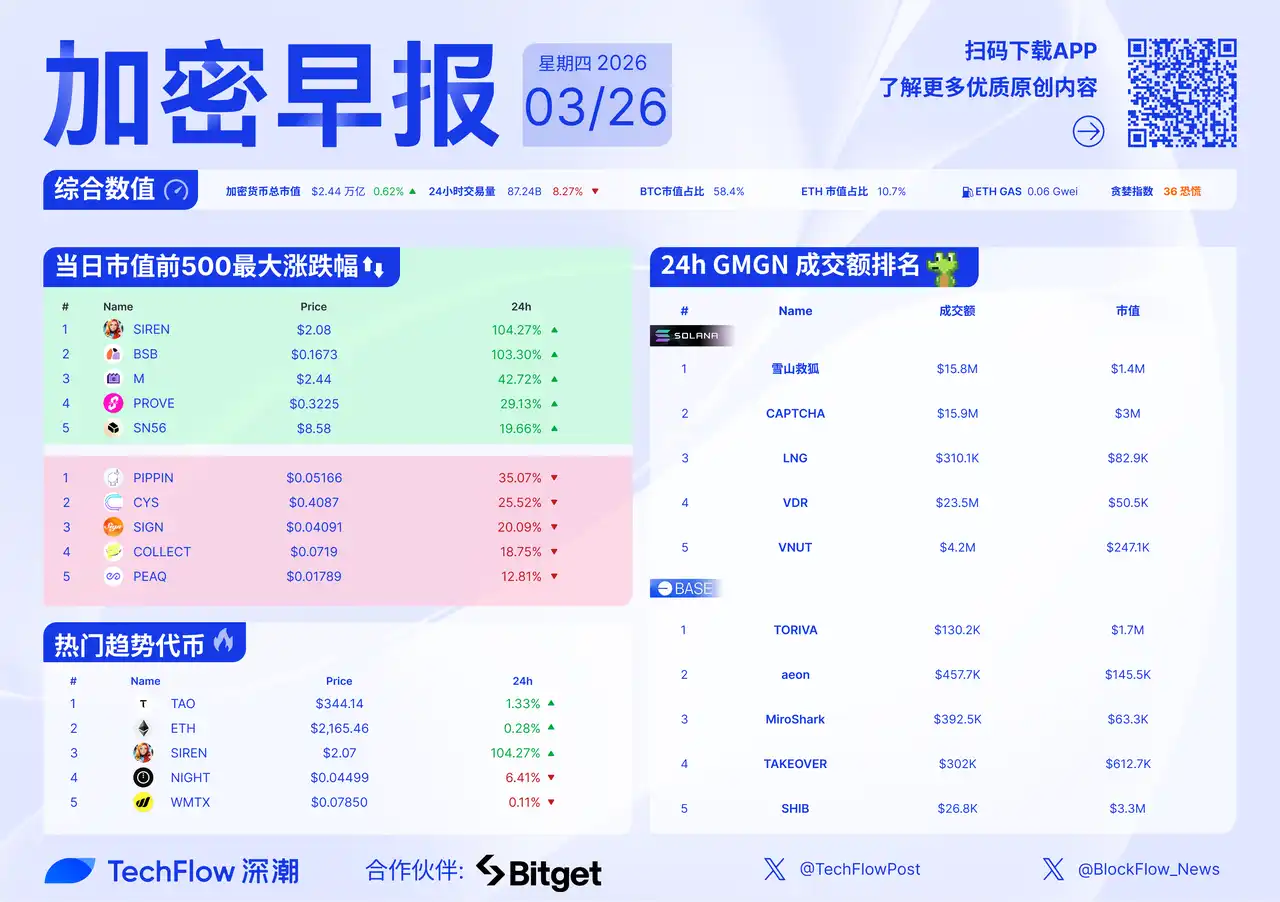
Recommended Reading

Those Who Can't Buy Anthropic Are Trading Its Shadow Stock at 16 Times the Price

This article discusses the recent listing of the closed-end fund VCX on the NYSE. The fund, which indirectly holds shares in unlisted high-valuation tech companies (such as Anthropic, OpenAI, SpaceX, etc.), has attracted significant market attention. Investors, unable to buy shares of these companies directly, are willing to purchase VCX fund shares at a high premium. However, this premium may gradually diminish as lock-up periods end and related companies proceed with their IPOs.

Dialogue with Huobi HTX Marketing Center Head: Product + Brand, Huobi HTX Unleashes Big Moves in 2026

This article delves into the management philosophy, user-first理念 (concept), and 2026 brand and product strategy planning of Molly, the head of Huobi HTX's marketing center. Through a review of her personal experience and team growth, the article showcases Huobi HTX's efforts in its globalization process and future development direction.

March 25 Market Summary: US Submits 15-Point Ceasefire Plan, Oil Prices Plunge Over 5% in a Single Day, While Gold Soars Against the Trend

This article covers the US submitting a 15-point ceasefire plan to Iran, triggering剧烈 (sharp) market fluctuations. US stocks rebounded, oil prices fell sharply, gold prices rose against the trend, and cryptocurrencies experienced overall volatility. The market is watching whether Iran will accept the proposal.

a16z: Without Relying on Interest Spreads or Burning Cash, How Did Revolut Become Europe's Most Profitable Neobank?

This article analyzes the 2025 annual report data of fintech company Revolut, exploring the reasons for its rapid growth in Europe's mature financial market. The article provides a detailed breakdown of Revolut's growth logic, revenue sources, user growth strategy, and future growth potential, pointing out that it is no longer a traditional challenger bank but has the potential to become one of the world's largest banks.

Circle Casually Freezes 16 Corporate Wallets, For Whom Is Compliance Really Designed?

This article examines Circle's policies and actions regarding the freezing functionality of the cryptocurrency USDC, revealing its double standards when facing authorities and ordinary users. Through multiple case studies, the article analyzes Circle's different reactions to government demands and user needs, pointing out the one-sided nature of its compliance system and questioning the shortcomings of relevant legislation.

Related Questions

QWhat actions will Binance take against non-compliant market makers according to their new guidelines?

ABinance will blacklist and penalize non-compliant market makers. It has issued guidelines warning against practices like aggressive selling that conflicts with token release plans, one-way sell orders, coordinated cross-platform selling, mismatched high trading volume with price action, and abnormal price volatility due to insufficient liquidity.

QWhat is MAVAN, and how much ETH has Bitmine staked on this platform?

AMAVAN (Made In America VAlidator Network) is an institutional-grade Ethereum staking platform developed by Bitmine Immersion Technologies. As of March 24, 2026, Bitmine has staked 3.1426 million ETH on it, valued at approximately $6.8 billion.

QWhat is the timeline for Ethereum's quantum-resistant upgrade as per the Ethereum Foundation?

AThe Ethereum Foundation plans to complete the initial L1 protocol upgrade for quantum resistance by 2029. The full execution layer migration will be carried out over the subsequent years, involving key hard forks labeled 'I', 'J', 'L', and 'M'.

QWhat major change is Polymarket implementing to its fee structure starting March 30th?

AStarting March 30th, Polymarket will introduce a taker fee for almost all trading categories, ending its long-standing zero-fee model. The fee rates vary by category, with crypto-related contracts having the highest peak rate of 1.8%. Makers will still receive rebates.

QWhy has Tether paused its $20 billion fundraising plan according to Bloomberg?

ATether has paused its $20 billion fundraising plan while it awaits the results of its first comprehensive financial audit. The plan may be restarted after the audit results are published, as potential investors and bankers have been urging the company for greater financial clarity.

Related Reads

Day 6 of the rsETH Incident: DeFi United Secures Approximately $100 Million in Intentional Commitments, but a $50 Million Gap Remains

On April 18, Kelp DAO’s rsETH LayerZero bridge was exploited, resulting in the unauthorized minting of 116.5k rsETH (approx. $292M). The attacker borrowed around $190M on Aave V3. The Arbitrum Security Council froze 30,766 ETH linked to the incident. DeFi United, a cross-protocol rescue initiative led by Awe, was formed to cover a total shortfall of 112.2k rsETH ($258M). As of April 24, several protocols have pledged around $100M in support, though most commitments are still under DAO voting or discussion. Key pledges include: - Golem: 1,000 ETH ($2.3M) - Aave founder Stani Kulechov: 5,000 ETH ($11.5M) - EtherFi: up to 5,000 ETH ($11.5M) - Lido: up to 2,500 stETH ($5.75M), contingent on full coverage - Mantle: proposed a $69M loan to Aave DAO under specific terms The remaining shortfall is estimated at $50M. Aave’s treasury and safety module (~$236M combined) can cover the worst-case bad debt scenario ($230M). Three potential loss distribution paths were outlined by DefiLlama’s 0xngmi: 1. Uniform 18.5% haircut for all rsETH holders: Aave bad debt ~$216M 2. Only protect Mainnet, abandon L2: bad debt up to $341M 3. Repay only pre-attack holders: technically difficult, ~$91M net loss KelpDAO has not yet announced a specific plan. The success of DeFi United depends heavily on KelpDAO’s final decision on loss allocation.

marsbit26m ago

Day 6 of the rsETH Incident: DeFi United Secures Approximately $100 Million in Intentional Commitments, but a $50 Million Gap Remains

marsbit26m ago

Kicked Out of PayPal, Musk Aims for a Comeback in the Crypto Market

Elon Musk's X (formerly Twitter) has launched its "Smart Cashtags" feature, generating approximately $1 billion in trading volume within days of its April 2026 pilot launch. The feature allows users to click on stock or crypto tickers (or even full Solana token contract addresses) in posts to view real-time price charts and discussions without leaving the app. Initially available to iPhone users in the US and Canada, with a partnership in Canada enabling direct trading via the Wealthsimple app. This move is part of Musk's broader "Everything App" vision, spearheaded by the upcoming X Money platform. Analysts, such as Mizuho's Dan Dolev, see this as a potential disruptor to the US payments market, even prompting a downgrade of PayPal's stock. X Money's beta offers services like 6% APY on deposits, cashback, and P2P transfers, with speculation it may later incorporate crypto trading and stablecoin settlements for faster transactions. However, the ambitious plan faces significant regulatory scrutiny. Senator Elizabeth Warren has questioned the sustainability of the high 6% yield and raised concerns over X's banking partner, Cross River Bank, which has a history of regulatory violations. Additional risks involve the "GENIUS Act," which may create loopholes for stablecoin issuance without full FDIC insurance coverage, potentially leaving users unprotected. The integration of social trading on a platform with over 500 million users could inject new liquidity and retail interest into the crypto market. Yet, it also amplifies risks like herd mentality and the blurring of lines between entertainment and financial speculation. Musk's return to finance, after his ouster from PayPal, hinges on balancing innovation with regulatory compliance.

marsbit2h ago

Kicked Out of PayPal, Musk Aims for a Comeback in the Crypto Market

marsbit2h ago

Trading

Spot
Futures

Hot Articles

What is BNB WHALES

Understanding BNB Whales: A Deep Dive into the Cryptocurrency Landscape Introduction to BNB Whales In the vibrant world of cryptocurrencies, new projects regularly emerge, often promising innovative solutions and unique experiences. One such project is BNB Whales, launched in 2023 and built on the BNB Smart Chain (BEP20). BNB Whales sets out to establish a distinctive presence within the cryptocurrency ecosystem, focusing on creating an engaging platform that combines the benefits of blockchain technology with social and gaming interactions. This article aims to delve deeper into BNB Whales, exploring its core components, mechanics, and developmental trajectory. What are BNB Whales? BNB Whales is a cryptocurrency initiative that seeks to provide a diverse range of features and opportunities for its users in the burgeoning Web3 environment. Utilizing the BEP20 standard, the project operates with a total token supply of 100 trillion (100,000,000,000,000,000). Despite this significant figure, it is noteworthy that no tokens are currently in circulation, indicating that the project may still be in its early developmental stages. The primary goal of BNB Whales is to create a platform where users can participate in various interactive activities while benefiting from the security and transparency afforded by blockchain technology. By fostering a unique and engaging environment, BNB Whales aims to build a strong community of users who are invested in the project and its development. Who is the Creator of BNB Whales? The identity of the creator of BNB Whales remains undisclosed at this time, presenting a challenge for those looking to understand the project's founding principles and visionary insights. This absence of publicly available information regarding the project's leadership may raise questions among potential investors and users about its governance and accountability structure. Who are the Investors of BNB Whales? As BNB Whales continues to evolve, information concerning specific investors or support from investment foundations is currently unavailable. The project’s official documentation, including its whitepaper, does not disclose either individual or institutional financial backers. The lack of transparency in this regard can sometimes raise questions about the legitimacy and sustainability of new projects within the cryptocurrency ecosystem. How Does BNB Whales Work? BNB Whales operates on the BNB Smart Chain utilizing the BEP20 standard, which is known for its efficiency and low transaction fees, attracting a variety of developers and projects. The unique aspect of BNB Whales lies in its focus on creating a community-driven platform. While precise operational details are scarce, the project emphasizes interaction and engagement, potentially incorporating gamified elements into its offerings. The emphasis on community is pivotal, as it aligns with prevailing trends in the cryptocurrency space, where user input and participation often dictate a project's success. Further innovation may be anticipated, but at present, the specific mechanisms and features that differentiate BNB Whales from other crypto initiatives remain to be fully elucidated. Without detailed information regarding its functionality, it is challenging to evaluate the project's differentiators comprehensively. Timeline of BNB Whales The development of BNB Whales has unfolded across key milestones, marking its journey in the cryptocurrency landscape. Below is a timeline of significant events pertaining to the project: 2023: Launch of BNB Whales, marking the project's entry into the market. 2023: Publication of the project's whitepaper, which lays out the overarching goals and operational framework. Ongoing: BNB Whales continues to develop its features, aiming to build a robust user base and expand its offerings. Key Points About BNB Whales Platform: BNB Smart Chain (BEP20) Total Supply: 100 trillion tokens (100,000,000,000,000,000) Circulating Supply: 0 tokens (indicating a nascent stage) Project Goal: To foster an engaging cryptocurrency platform for interaction and community building. Creator: Unknown Investors: Not disclosed Operational Status: Active with ongoing development and expansion Conclusion As BNB Whales navigates the competitive cryptocurrency landscape, it offers a glimpse into the potential of community-driven projects built on the foundations of blockchain technology. By focusing on engagement and interaction, the initiative stands at the forefront of innovation in the Web3 space. However, the project's success ultimately hinges on the clarity of its operational mechanics, the disclosure of its governance, and the establishment of a solid user community. For potential users and investors alike, BNB Whales represents a case study in the evolving nature of cryptocurrency projects—one that illustrates both the exciting possibilities and the complexities associated with new initiatives. As the landscape continues to evolve, it will be essential to monitor BNB Whales' progress and its impact on the broader cryptocurrency ecosystem.

3.1k Total ViewsPublished 2024.04.01Updated 2024.12.03

What is BNB WHALES

What is PONKE BNB

Ponke BNB: A New Approach in the Cryptocurrency Space Introduction Ponke BNB, a newcomer in the cryptocurrency arena, was launched in 2024 and operates on the BNB Smart Chain (BEP20) platform. This innovative project seeks to build a distinctive and engaged community, focusing on sustainable reward generation. As the cryptocurrency landscape evolves, Ponke BNB aims to address critical issues surrounding reward sustainability, making it a project worth observing for enthusiasts and investors alike. What is Ponke BNB? At its core, Ponke BNB is a cryptocurrency designed specifically for the BNB Smart Chain ecosystem. Boasting an immense total supply of 370,000,000,000,000,000 tokens, it is worth noting that currently, there are no tokens in circulation. The guiding mission of Ponke BNB is to foster a sustainable reward system that mitigates the challenges associated with rewards depletion, a common pitfall in many cryptocurrencies today. The mechanics of Ponke BNB's functionality centre around encouraging user participation, while simultaneously providing rewards that can stand the test of time. The unique structure of its reward system is aimed at ensuring longevity and stability, addressing essential market concerns. Who is the Creator of Ponke BNB? Despite extensive exploration, the identity of Ponke BNB's creator remains unknown. There is a notable absence of publicly available information regarding the project’s founder or its development team. This anonymity, while not uncommon in the cryptocurrency space, raises some questions about transparency and accountability in project management. Who are the Investors of Ponke BNB? Similar to the lack of clarity surrounding its creator, there is no public information available regarding any investment foundations or organizations that support Ponke BNB. This absence of investor data can often breed uncertainty among prospective investors, who typically prefer a clear understanding of the backing behind cryptocurrencies they consider engaging with. How Does Ponke BNB Work? Ponke BNB stands out through its inventive two-layered sustainable reward generating system. This system is built to tackle the issue of rewards depletion effectively. By engaging users and creating a vibrant community, Ponke BNB seeks to provide a stable and enjoyable environment, which emphasizes user interaction and rewards. The operation framework of Ponke BNB encourages participation through various activities and challenges that are designed to incentivise users while ensuring that the reward system remains sustainable. It aims to stimulate the community and promote an engaging atmosphere where members can feel valued and appreciated. Timeline of Ponke BNB The evolution of Ponke BNB can be summarized through a few key milestones: 2024: The inception of Ponke BNB on the BNB Smart Chain (BEP20) platform marked a significant entry into the cryptocurrency market. 2024: The release of the project’s whitepaper and official website provided comprehensive insights into Ponke BNB’s goals and objectives, forming the foundation for its community-driven approach. Key Features of Ponke BNB Ponke BNB is built on several key features that set it apart from other cryptocurrency projects: Sustainable Reward System The two-layered reward system is designed to foster engagement, prevent depletion of rewards, and ensure the longevity of returns for participants in the Ponke BNB ecosystem. Community Engagement The project places a strong emphasis on active community engagement, driving participation through activities designed to create a social and collaborative environment. This community-centric approach empowers users to have a hand in shaping the project's future directions. BNB Smart Chain Integration Operating on the BEP20 platform, Ponke BNB is reinforced by the security and efficiency offered by the BNB Smart Chain. Users benefit from fast and cost-effective transactions, positioning Ponke BNB well within the broader cryptocurrency ecosystem. Conclusion In summary, Ponke BNB is an emergent cryptocurrency project aiming to carve a niche for itself in the growing digital currency landscape. With its focus on a sustainable reward system and community engagement, it presents a fresh outlook in an otherwise volatile sector. While uncertainties linger concerning the project's creators and investors, Ponke BNB continues to strive for transparency and innovation. As the cryptocurrency market continues to develop, Ponke BNB’s principles of sustainability and community-driven dynamics place it in a promising light for future observers and participants alike.

3.0k Total ViewsPublished 2024.04.01Updated 2024.12.03

What is PONKE BNB

What is BNB CARD

Understanding BNB Card: Revolutionizing Digital Identity in Web3 In the rapidly evolving landscape of blockchain technology and cryptocurrency, the BNB Card or $BNBCARD stands out as a noteworthy project. This community-driven utility meme token leverages the BNB Smart Chain (BSC), aiming to integrate meme culture with innovative digital identity solutions. As more users dive into the realms of decentralization, it is crucial to dissect what BNB Card offers, its operational nuances, and its potential market impact. What is BNB Card ($BNBCARD)? At its core, BNB Card represents a meme token with substantial utility. It is designed to empower users by enabling the creation of personalized digital identity cards that are both expressive and functional. The project encapsulates several key features: Customizable ID Cards: Users have the ability to design Binance-themed digital ID cards, providing them with a platform for self-expression and enhanced community interaction. Decentralized Framework: Developed on the BSC, BNB Card emphasizes key attributes such as security, transparency, and user sovereignty. The decentralized nature of the framework allows for transactions that are both efficient and secure. Community-Centric Model: The emphasis on grassroots participation rather than laboratory-driven financial models creates an engaging environment for its users. By leveraging the inherent virality of meme culture, BNB Card fosters a robust community movement. The primary goal of BNB Card is to democratize digital identity tools in Web3, offering accessible solutions that benefit the users without the encumbrances typically associated with traditional identity management systems. Creator and Investors When exploring the identity behind BNB Card, it is important to note that no singular creator is explicitly credited. Instead, the project appears to be community-driven, suggesting a collective effort inspired by the notion of Binance's “Early Builder Card.” This organic development approach is common among projects within the meme token spectrum, where development is often influenced by the community's passion rather than a central authority. In terms of investment, the absence of publicly disclosed institutional backers further highlights the project's grassroots foundation. It thrives on organic community support, reflecting a usual characteristic of meme-driven projects that often engage their audience through social channels rather than formal investment routes. How It Works BNB Card employs several mechanisms that delineate its functioning and innovative spirit: Token Utility: The BNBCARD token allows users access to a suite of ID creation tools while also providing a platform for community governance. The token serves as the linchpin that enables these functionalities. Blockchain Integration: By utilizing the BSC, BNB Card ensures compatibility with Ethereum Virtual Machine (EVM)-based applications. This integration provides users with the benefits of low transaction fees while enhancing accessibility. DIY Ecosystem: Central to BNB Card’s appeal is its do-it-yourself (DIY) approach to digital identity card generation. This participatory element encourages users to engage in creative expression, fostering an inclusive culture that thrives on contribution and collaboration. Timeline Chronology is vital to understanding BNB Card's trajectory. Important milestones in the project’s history include: March 18, 2025: BNB Card was listed on LBank, marking a significant step in its exchange journey and opening doors for liquidity and user accessibility. March 19, 2025: A pivotal moment occurred as the token experienced an astronomical surge of 26,000% within 24 hours, garnering attention for its potential and the community’s enthusiasm. Ongoing Developments: The project is continuously expanding its partnerships with decentralized exchanges (DEXs) like PancakeSwap, further enhancing liquidity and user engagement. Innovation and Differentiation Understanding what sets BNB Card apart involves deeper exploration into its innovative framework: Meme-Utility Hybrid: BNB Card successfully merges the playful allure of meme culture with practical applications in digital identity management. This niche approach effectively caters to a broad demographic, appealing to both tech-savvy users and those new to crypto. Decentralized Governance: Operating devoid of centralized control allows the project to harness community input directly. The collective decision-making process buoyed by community involvement empowers users, ensuring their voices contribute to the development and direction of the project. Scalability: BNB Card stands to benefit immensely from the 2025 roadmap upgrades to the BNB Chain, which include enhancements such as increased transaction speeds and the integration of artificial intelligence tools. These improvements position the project advantageously within a highly competitive environment. Conclusion BNB Card is emblematic of a new wave of digital identity solutions within the Web3 ecosystem. By blending fun, community engagement, and practical utility, it invites users to participate actively in shaping their digital personas. As the project navigates the dynamic cryptocurrency landscape, its success will likely hinge on maintaining strong community support while adapting to technological advancements and user needs. The integration of decentralization with meme culture serves not only as a means for user-driven engagement but also as a foundation for the evolving narrative surrounding digital identity in the age of blockchain. In summation, BNB Card not only exemplifies the convergence of creativity and utility within the crypto space but also underscores the importance of community in steering the future of decentralized technologies.

3.4k Total ViewsPublished 2025.03.26Updated 2025.03.26

What is BNB CARD

Discussions

Welcome to the HTX Community. Here, you can stay informed about the latest platform developments and gain access to professional market insights. Users' opinions on the price of BNB (BNB) are presented below.

活动图片