Chip Rally Cooling Down? Morgan Stanley's Wilson: Funds Are Shifting to AI Hyperscalers Like Microsoft, Amazon

marsbitPublished on 2026-07-06Last updated on 2026-07-06

Abstract

Market strategist Michael Wilson of Morgan Stanley notes a shift in investment flows from high-flying semiconductor stocks toward AI hyperscale cloud computing giants like Microsoft, Amazon, and Meta. He observes waning momentum in the chip sector, with the Philadelphia Semiconductor Index down nearly 14% from its recent peak amid valuation concerns, despite a 123% rally since last September. Wilson argues this rotation is occurring against a backdrop of overall market weakness, keeping pressure on major indices, though he maintains a year-end S&P 500 target of 8000, implying roughly 7% upside. The report highlights AI hyperscalers as relatively undervalued within the AI ecosystem, with a basket of such stocks compiled by UBS having fallen 2% since last September. Wilson believes their strong core businesses provide solid footing, though he cautions they may soon temper capital expenditure forecasts in response to market worries over excessive AI spending. The rotation is also expected to benefit sectors beyond tech, such as consumer discretionary, transportation, and biotech. This view aligns with JPMorgan's Mislav Matejka, who anticipates a broadening of market gains beyond the technology sector in the second half of the year.

Author: Bu Shuqing, Wall Street News Agency

U.S. stock markets may struggle to hit new highs in the short term, as funds flow out from this year's best-performing semiconductor stocks towards AI hyperscale cloud providers.

Morgan Stanley's chief equity strategist, Michael Wilson, pointed out in a latest report that momentum in the semiconductor sector is fading, and investors are starting to shift towards this year's underperforming AI hyperscale giants, including Microsoft, Amazon, and Meta.

He believes this rotation is occurring against a backdrop of overall choppy and weak market performance, with major indices continuing to face pressure. Wilson simultaneously maintained his year-end S&P 500 target at 8000 points, implying approximately 7% upside from current levels.

The direct market impact of this assessment is that chip stocks, which previously led the AI rally, face valuation pressure, while hyperscalers, with their strong core businesses, are poised to become the new landing spot for funds. Meanwhile, JPMorgan strategist Mislav Matejka holds a similar view, expecting the market's gains to broaden beyond the tech sector in the second half of the year.

Chip Momentum Fading, Valuation Pressure Emerges

The Philadelphia Semiconductor Index has fallen nearly 14% since hitting a record high last month, with concerns about a valuation bubble persisting. Nonetheless, the index has still surged 123% cumulatively since September last year, highlighting the magnitude of its previous gains.
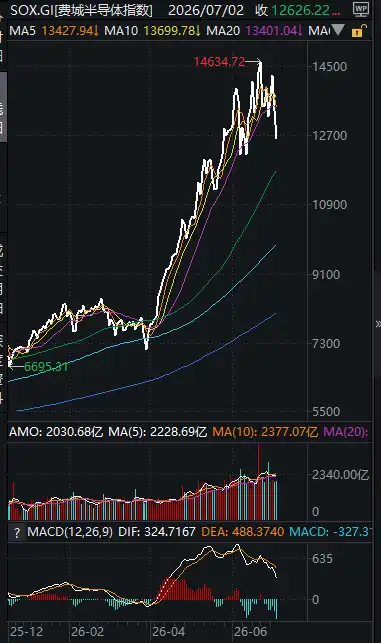
Micron Technology's better-than-expected sales forecast last month failed to sustain the chip stock rally, further confirming the sector's fading momentum. Currently, investors are awaiting comments from companies like Nvidia for more clues on AI chip demand.

Wilson points out that the breakdown in momentum is happening among large, index-weighting companies, which will keep major U.S. benchmark indices under pressure in the near term. The S&P 500 index has been gradually retreating since peaking in early June.

Hyperscalers: Value Opportunity Within the AI Ecosystem

Wilson stated he has recently favored hyperscalers over semiconductor-related stocks. He believes companies like Microsoft, Amazon, and Meta are attractive within the AI ecosystem, primarily because their robust underlying businesses provide solid support.

In contrast, according to Bloomberg data, a basket of hyperscaler stocks compiled by UBS Group has fallen 2% cumulatively since last September, forming a stark contrast with the gains in the semiconductor sector and implying relative catch-up potential for this group.

However, Wilson also anticipates that hyperscalers may begin to moderate expectations for their capital expenditure plans in response to recent market concerns about excessive AI investment. The outlook for capital spending will become a core focus for investors in the next phase.

Rotation Broadening, Opportunities Outside Tech Emerge

Wilson's rotation thesis is not confined to the hyperscale sector. He is also optimistic about the consumer discretionary, transportation, and biotechnology sectors benefiting from the fund outflow from chip stocks.

JPMorgan strategist Mislav Matejka aligns with Wilson's view, expecting market gains to extend beyond the tech sector in the second half of the year. "AI is unlikely to be the only game in town," Matejka wrote in a research note.

It is worth noting that Wilson previously correctly predicted that U.S. stock markets would remain resilient amid geopolitical risks due to strong corporate earnings, lending some credibility to his current assessment. His year-end S&P 500 target of 8000 points implies about 7% potential upside from current levels, but short-term volatility risks cannot be ignored.


Trending Cryptos

Related Questions

QAccording to Morgan Stanley's Michael Wilson, what are the two main areas where a shift in investor capital is occurring in the U.S. stock market?

AAccording to Michael Wilson, investor capital is flowing out of semiconductor stocks, which have seen significant gains, and is rotating towards AI hyperscalers like Microsoft, Amazon, and Meta.

QWhat specific evidence from the semiconductor market does the article cite to show that its momentum is fading?

AThe article cites that the Philadelphia Semiconductor Index has fallen nearly 14% from its all-time high last month and that strong sales forecasts from companies like Micron Technology failed to sustain a rally, indicating fading momentum.

QWhy does Michael Wilson find AI hyperscalers like Microsoft and Amazon attractive for investment compared to semiconductor stocks?

AWilson finds them attractive because their strong core businesses provide a solid foundation within the AI ecosystem, and their stocks have significantly underperformed the semiconductor sector, suggesting potential for relative catch-up.

QBeyond technology stocks, which other sectors does Michael Wilson believe could benefit from the rotation of funds away from semiconductors?

AMichael Wilson believes the consumer discretionary, transportation, and biotech sectors could benefit from the rotation of funds away from semiconductor stocks.

QWhat is Michael Wilson's year-end target for the S&P 500 index, and what does it imply for potential market movement?

AMichael Wilson maintains a year-end target of 8000 for the S&P 500, which implies approximately 7% potential upside from current levels, though he also warns of near-term volatility and pressure on major indexes.

Related Reads

The Verdict in Choi Tae-won's Divorce Case: Revealing the Inheritance Undercurrent Behind SK Hynix's Trillion-Won Empire

SK Group Chairman Chey Tae-won's high-profile divorce case, involving a record 1.38 trillion won settlement, has drawn attention to the succession plans for Korea's second-largest conglomerate, especially its crown jewel, SK hynix. Unlike traditional chaebol scripts centered on the eldest son, Chey's three children from his marriage to former President Roh Tae-woo's daughter, Roh Soh-yeong, are carving distinct, non-traditional paths. Eldest daughter Chey Yun-jung (b. 1989) is seen as the most evident successor. With a scientific and consulting background, she holds executive roles at SK bioscience and SK Inc.'s growth support department, focusing on future strategy and biopharma. Her marriage is to an AI infrastructure entrepreneur, not a traditional business alliance. Second daughter Chey Min-jung (b. 1991) took a unique route, voluntarily serving as a South Korean naval officer, including an anti-piracy deployment. She later worked on policy and strategy for SK hynix in Washington D.C. before co-founding an AI-driven healthcare startup. She married a former U.S. Marine Corps officer, connecting her to U.S. defense and policy circles—networks crucial for a global semiconductor giant. The only son, Chey In-geun (b. 1995), who studied physics like his father, worked briefly at SK E&S before joining McKinsey. Despite fitting the traditional "heir" profile as the eldest son, he remains silent and holds no public position or shares in SK, suggesting the old succession playbook is obsolete. As SK hynix's valuation soars, becoming a geopolitical asset in the AI era, the heirs' legitimacy is no longer automatic. They must prove themselves in fields like AI biotech, global policy, and strategic consulting. Their marriages also reflect new elite networks in tech and defense, not old political alliances. Their inheritance is the complex challenge of navigating a globalized, tech-driven world, not just a corporate throne.

marsbit17h ago

The Verdict in Choi Tae-won's Divorce Case: Revealing the Inheritance Undercurrent Behind SK Hynix's Trillion-Won Empire

marsbit17h ago

From OpenSea to OpenRouter: Is Alex Atallah Repeating His 'Exit at the Peak' Playbook?

From OpenSea to OpenRouter: Is Alex Atallah Repeating His "Exit at the Peak" Playbook? According to the Wall Street Journal, payments giant Stripe is in talks to acquire the AI model aggregation platform OpenRouter in a potential deal valuing the company near $100 billion. This would mark founder Alex Atallah's second creation of a company reaching a $100 billion valuation, following his co-founding of NFT marketplace OpenSea. OpenRouter, founded just over three years ago, has grown rapidly by acting as a unified gateway for developers to access over 400 AI models. It currently has about 10 million users and processes over 200 trillion tokens monthly. While the platform's annualized revenue is around $50 million, its valuation has skyrocketed from $1.3 billion in March 2026. The potential acquisition by Stripe, a company OpenRouter's founder once likened it to, represents a major expansion into AI infrastructure for the payments leader. This move echoes Atallah's previous timing with OpenSea, where he departed before the NFT market's significant downturn. For OpenRouter, selling now may be strategic. Despite its scale, its business model—charging a 5-5.5% fee on AI inference calls—faces pressure from competition, open-source models, and potential price wars among model providers, limiting its profitability narrative for an IPO. A key asset for potential acquirers like Stripe is OpenRouter's vast repository of real-world AI usage data, which offers unique insights into model performance and developer preferences that are difficult to replicate. Whether this potential deal signifies a new valuation benchmark for AI infrastructure or another market peak signal remains to be seen.

链捕手17h ago

From OpenSea to OpenRouter: Is Alex Atallah Repeating His 'Exit at the Peak' Playbook?

链捕手17h ago

Trading

Spot

Hot Articles

Discussions

Welcome to the HTX Community. Here, you can stay informed about the latest platform developments and gain access to professional market insights. Users' opinions on the price of S (S) are presented below.

活动图片















