‘Ownership must be tracked at creation’ – Can Camp Network solve it?

ambcryptoPublished on 2026-03-23Last updated on 2026-03-23

Abstract

Camp Network, a blockchain startup, proposes using crypto to address challenges in entertainment finance and digital ownership, particularly as AI accelerates content creation. It replaces traditional intermediaries with "on-chain vaults" for programmable ownership and automated revenue distribution, allowing communities to fund projects and share in IP success. The system emphasizes "proof of provenance" to track ownership at creation, ensuring proper attribution and royalties. While the model has attracted investment and industry interest, adoption remains cautious, with executives seeking solutions to real inefficiencies like rights tracking and payment delays rather than added complexity.

Camp Network, a blockchain startup focused on artificial intelligence [AI] and intellectual property [IP], is pitching crypto as a fix for growing problems in entertainment finance and digital ownership.

The pitch comes as AI speeds up content creation, while funding and rights systems lag.

Creators often face unclear ownership and complex financing. Camp Network’s approach, using blockchain-based “on-chain vaults”, tries to replace intermediaries with programmable ownership and automated revenue flows.

Funding without middlemen

In an interview with AltcoinDesk, Co-Founder Nirav Murthy said entertainment financing remains slow and controlled by a few players. Creators often give up equity and pay high legal costs to secure funding.

Camp’s model allows communities to fund projects directly. Fans can share in the upside of the IP they support. A recent example included a $200,000 vault used for film post-production and marketing.

Murthy said this model builds stronger audiences. Supporters become more engaged when they have economic exposure.

Tokenizing entertainment flows collapses the distance between creators, capital, and audiences.

The company said 53 global music festivals have joined the network, including Clockenflap and S2O Festival.

Industry response remains cautious. In an interview with IBM, a New York City-based record label said,

Royalty payments are often three to six months delayed. What happens if a song blows up and when the stats come in, not everyone was credited? At that point, changing the metadata is a pain and often swept under the rug.

Executives are open to blockchain only if it solves real inefficiencies such as cross-border payments, rights tracking and revenue distribution, rather than adding complexity.

AI exposes cracks in ownership

The pressure comes from AI’s rapid growth. Content is being created faster than ownership systems can track.

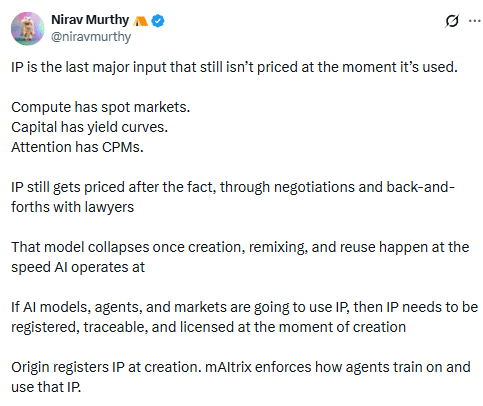
IP still gets priced after the fact... that model collapses once creation happens at AI speed.

Murthy said ownership must be tracked at the moment of creation. Delays can leave creators without payment or control.
Source: Nirav Murthy/X

Camp Network’s system focuses on “proof of provenance,” which records who created content and how it is used. The goal is to allow creators to license work and receive royalties automatically.

The company describes this as building an “Autonomous IP Layer” for AI systems, where data used to train models is traceable and permissioned.

That approach aligns with broader industry concerns. According to a16z Crypto’s State of Crypto 2025 report, AI and blockchain are increasingly converging, with crypto infrastructure evolving into a core layer of the digital economy.

Capital flows into IP blockchains

Investors have backed this approach.

Camp Network has raised about $30 million across funding rounds. That includes a $25 million Series A led by 1kx and Blockchain Capital.

Murthy has also pointed to broader changes in the market, including how creators and platforms are reacting to AI.

If you’re a startup trying to train a voice model or a video model... you can’t do it anymore

At the same time, legal pressure is rising. Creators and publishers have filed lawsuits over AI training on copyrighted material.

Anyways, adoption remains uneven. Institutional investors still dominate early participation in tokenized assets. As AI creates more content, ownership may become harder to define.


Final Summary

  • Creators still face slow financing, high legal costs, and loss of equity under traditional systems.
  • Camp’s “on-chain vaults” enable direct funding from communities, allowing fans to share in IP revenue.

Trending Cryptos

Related Questions

QWhat problem does Camp Network aim to solve in the entertainment and AI industries?

ACamp Network aims to solve problems related to unclear ownership, complex financing, and delayed royalty payments in entertainment and AI-driven content creation by using blockchain technology to provide programmable ownership and automated revenue flows.

QHow does Camp Network's 'on-chain vaults' model work for funding creative projects?

ACamp Network's 'on-chain vaults' allow communities to fund projects directly, enabling fans to share in the financial upside of the intellectual property they support. This model replaces intermediaries and reduces legal costs while building stronger audience engagement through economic exposure.

QWhy is tracking ownership at the moment of creation particularly important in the age of AI?

ATracking ownership at creation is crucial because AI accelerates content generation beyond the capacity of traditional ownership systems. Delays in establishing ownership can leave creators without payment or control, especially when content goes viral or is used in training AI models without proper attribution.

QWhat is Camp Network's approach to ensuring proof of provenance for digital content?

ACamp Network focuses on 'proof of provenance,' which records who created content and how it is used. This system allows creators to license their work and receive royalties automatically, ensuring traceable and permissioned use of data, particularly in AI training.

QHow much funding has Camp Network raised, and which firms led their Series A round?

ACamp Network has raised about $30 million across funding rounds, including a $25 million Series A led by 1kx and Blockchain Capital.

Related Reads

The Verdict in Choi Tae-won's Divorce Case: Revealing the Inheritance Undercurrent Behind SK Hynix's Trillion-Won Empire

SK Group Chairman Chey Tae-won's high-profile divorce case, involving a record 1.38 trillion won settlement, has drawn attention to the succession plans for Korea's second-largest conglomerate, especially its crown jewel, SK hynix. Unlike traditional chaebol scripts centered on the eldest son, Chey's three children from his marriage to former President Roh Tae-woo's daughter, Roh Soh-yeong, are carving distinct, non-traditional paths. Eldest daughter Chey Yun-jung (b. 1989) is seen as the most evident successor. With a scientific and consulting background, she holds executive roles at SK bioscience and SK Inc.'s growth support department, focusing on future strategy and biopharma. Her marriage is to an AI infrastructure entrepreneur, not a traditional business alliance. Second daughter Chey Min-jung (b. 1991) took a unique route, voluntarily serving as a South Korean naval officer, including an anti-piracy deployment. She later worked on policy and strategy for SK hynix in Washington D.C. before co-founding an AI-driven healthcare startup. She married a former U.S. Marine Corps officer, connecting her to U.S. defense and policy circles—networks crucial for a global semiconductor giant. The only son, Chey In-geun (b. 1995), who studied physics like his father, worked briefly at SK E&S before joining McKinsey. Despite fitting the traditional "heir" profile as the eldest son, he remains silent and holds no public position or shares in SK, suggesting the old succession playbook is obsolete. As SK hynix's valuation soars, becoming a geopolitical asset in the AI era, the heirs' legitimacy is no longer automatic. They must prove themselves in fields like AI biotech, global policy, and strategic consulting. Their marriages also reflect new elite networks in tech and defense, not old political alliances. Their inheritance is the complex challenge of navigating a globalized, tech-driven world, not just a corporate throne.

marsbit2 days ago 09:06

The Verdict in Choi Tae-won's Divorce Case: Revealing the Inheritance Undercurrent Behind SK Hynix's Trillion-Won Empire

marsbit2 days ago 09:06

From OpenSea to OpenRouter: Is Alex Atallah Repeating His 'Exit at the Peak' Playbook?

From OpenSea to OpenRouter: Is Alex Atallah Repeating His "Exit at the Peak" Playbook? According to the Wall Street Journal, payments giant Stripe is in talks to acquire the AI model aggregation platform OpenRouter in a potential deal valuing the company near $100 billion. This would mark founder Alex Atallah's second creation of a company reaching a $100 billion valuation, following his co-founding of NFT marketplace OpenSea. OpenRouter, founded just over three years ago, has grown rapidly by acting as a unified gateway for developers to access over 400 AI models. It currently has about 10 million users and processes over 200 trillion tokens monthly. While the platform's annualized revenue is around $50 million, its valuation has skyrocketed from $1.3 billion in March 2026. The potential acquisition by Stripe, a company OpenRouter's founder once likened it to, represents a major expansion into AI infrastructure for the payments leader. This move echoes Atallah's previous timing with OpenSea, where he departed before the NFT market's significant downturn. For OpenRouter, selling now may be strategic. Despite its scale, its business model—charging a 5-5.5% fee on AI inference calls—faces pressure from competition, open-source models, and potential price wars among model providers, limiting its profitability narrative for an IPO. A key asset for potential acquirers like Stripe is OpenRouter's vast repository of real-world AI usage data, which offers unique insights into model performance and developer preferences that are difficult to replicate. Whether this potential deal signifies a new valuation benchmark for AI infrastructure or another market peak signal remains to be seen.

链捕手2 days ago 08:42

From OpenSea to OpenRouter: Is Alex Atallah Repeating His 'Exit at the Peak' Playbook?

链捕手2 days ago 08:42

Trading

Spot

Hot Articles

How to Buy CAMP

Welcome to HTX.com! We've made purchasing Camp Network (CAMP) simple and convenient. Follow our step-by-step guide to embark on your crypto journey.Step 1: Create Your HTX AccountUse your email or phone number to sign up for a free account on HTX. Experience a hassle-free registration journey and unlock all features.Get My AccountStep 2: Go to Buy Crypto and Choose Your Payment MethodCredit/Debit Card: Use your Visa or Mastercard to buy Camp Network (CAMP) instantly.Balance: Use funds from your HTX account balance to trade seamlessly.Third Parties: We've added popular payment methods such as Google Pay and Apple Pay to enhance convenience.P2P: Trade directly with other users on HTX.Over-the-Counter (OTC): We offer tailor-made services and competitive exchange rates for traders.Step 3: Store Your Camp Network (CAMP)After purchasing your Camp Network (CAMP), store it in your HTX account. Alternatively, you can send it elsewhere via blockchain transfer or use it to trade other cryptocurrencies.Step 4: Trade Camp Network (CAMP)Easily trade Camp Network (CAMP) on HTX's spot market. Simply access your account, select your trading pair, execute your trades, and monitor in real-time. We offer a user-friendly experience for both beginners and seasoned traders.

4.5k Total ViewsPublished 2025.08.27Updated 2026.06.02

How to Buy CAMP

Discussions

Welcome to the HTX Community. Here, you can stay informed about the latest platform developments and gain access to professional market insights. Users' opinions on the price of CAMP (CAMP) are presented below.

活动图片