Token FOLD Auction Imminent, What is The Interfold, Supported by Vitalik?

Foresight NewsPublished on 2026-07-08Last updated on 2026-07-08

Abstract

**Title:** FOLD Token Auction Approaches: What is The Interfold, Supported by Vitalik? **Summary:** The Interfold, a "confidential coordination infrastructure" previously known as Enclave, is launching its functional token FOLD via a Uniswap Continuous Clearing Auction (CCA) starting July 8th. Endorsed by Ethereum co-founder Vitalik Buterin in May, the protocol tackles the core problem of governance bribery in decentralized voting (e.g., on platforms like Votium) by enabling multiple parties to compute a verifiable result without exposing their private input data. Its core technology, the Encrypted Execution Environment (E3), uses a distributed network of "Ciphernodes" that perform computations on fully encrypted data using Fully Homomorphic Encryption (FHE), with process integrity verified by Zero-Knowledge (ZK) proofs and decryption keys managed via Decentralized Threshold Cryptography (DTC) to eliminate a single point of trust. The primary application is CRISP (Coercion-Resistant Impartial Selection Protocol) for DAO governance, which ensures encrypted voting, "receipt-free" votes to prevent bribery, and verifiable tallying. The Interfold, developed by the Gnosis Guild team (creators of the Zodiac DAO tooling), positions itself as a focused solution to make on-chain voting truly un-buyable, realizing the vision of Vitalik's earlier MACI (Minimal Anti-Collusion Infrastructure) framework without its reliance on a single trusted coordinator. FOLD tokens will be used for C...


Author:angelilu,Foresight News

Originally Published on June 2nd


Vitalik wrote an article in May this year supporting The Interfold, a confidential coordination infrastructure. Its token FOLD will officially start auctioning today (July 8th) at 22:00 via the Uniswap CCA (Continuous Commitment Auction) mechanism, lasting for 48 hours until July 10th.


FOLD is the functional token of The Interfold: Ciphernodes can use it to stake and join the network and receive rewards, applications can use it to pay for encrypted computation requests, and holders can participate in protocol governance.


This auction adopts a uniform clearing price mechanism, where all successful bidders transact at the same price. Portions of bids exceeding the clearing price can be withdrawn for rebidding. Participation in the auction requires KYC verification via Predicate, and the pre-registration window closed yesterday. After the auction, there is a 40-day cooling period, during which FOLD can only be used for Ciphernode staking and cannot be freely transferred. The official TGE is expected on August 19th.


Below is the original article:


On-chain voting is one of the most attractive aspects of decentralized protocols—transparent, open, and accessible to anyone. But openness does not guarantee it fully represents community consensus. The existence of 'governance bribery markets' like Votium allows anyone with sufficient funds to directly bid to voters before the voting deadline. The result is: the direction of a protocol is often not decided by community consensus, but by the highest bidder.


A protocol called The Interfold has chosen to tackle this problem at its root.


Confidential Coordination Infrastructure


The Interfold (formerly known as Enclave) positions itself as a 'confidential coordination infrastructure,' aiming to allow multiple independent participants to jointly produce a verifiable result without exposing their respective input data.
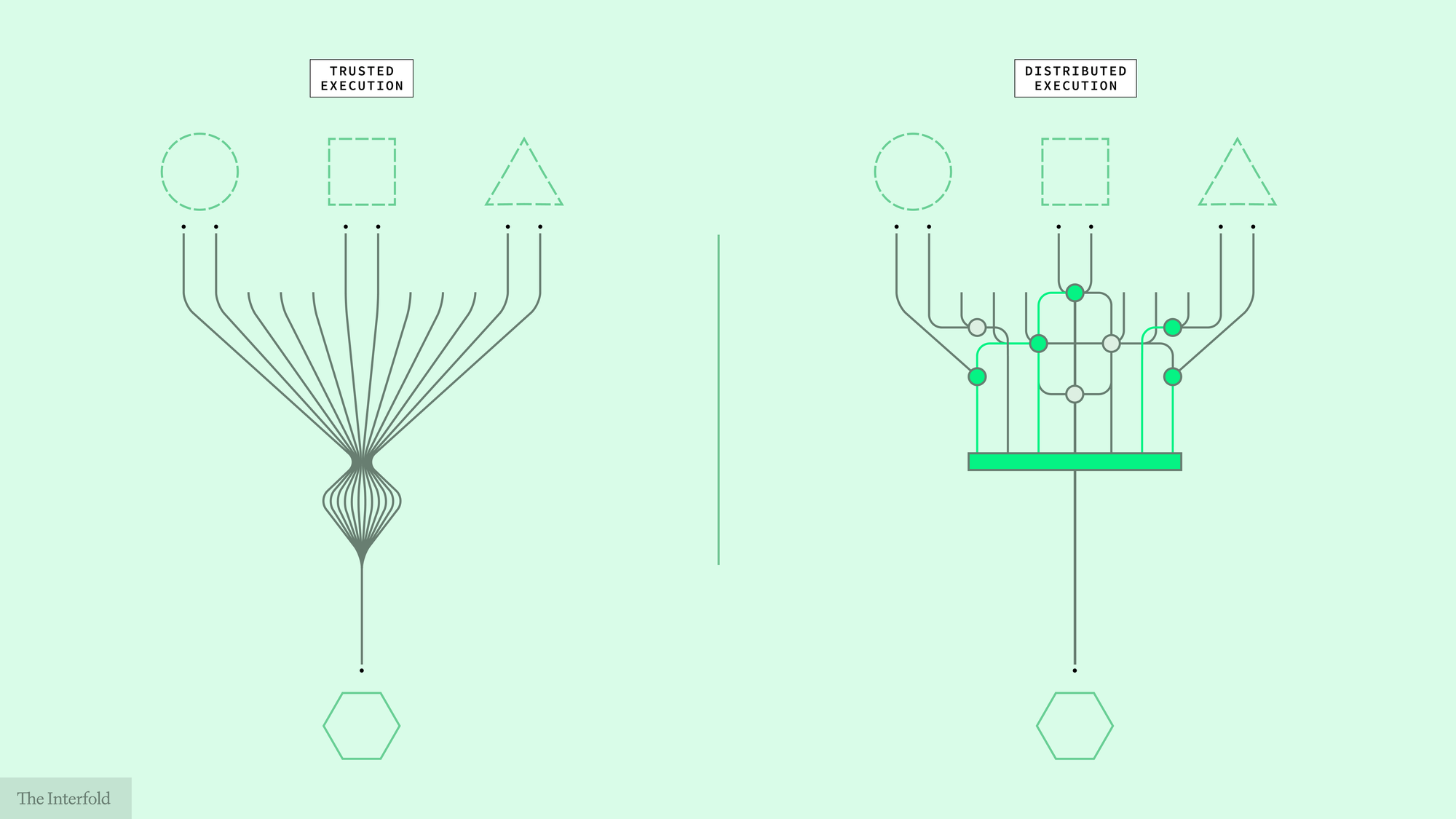


The core concept of The Interfold is E3 (Encrypted Execution Environment). Its principle is: computation tasks are assigned to a distributed network of 'Ciphernodes': user input always remains encrypted, computations are performed directly on ciphertext, and finally, only the aggregated result is decrypted and made public. No party can see anyone else's original data throughout the entire process.
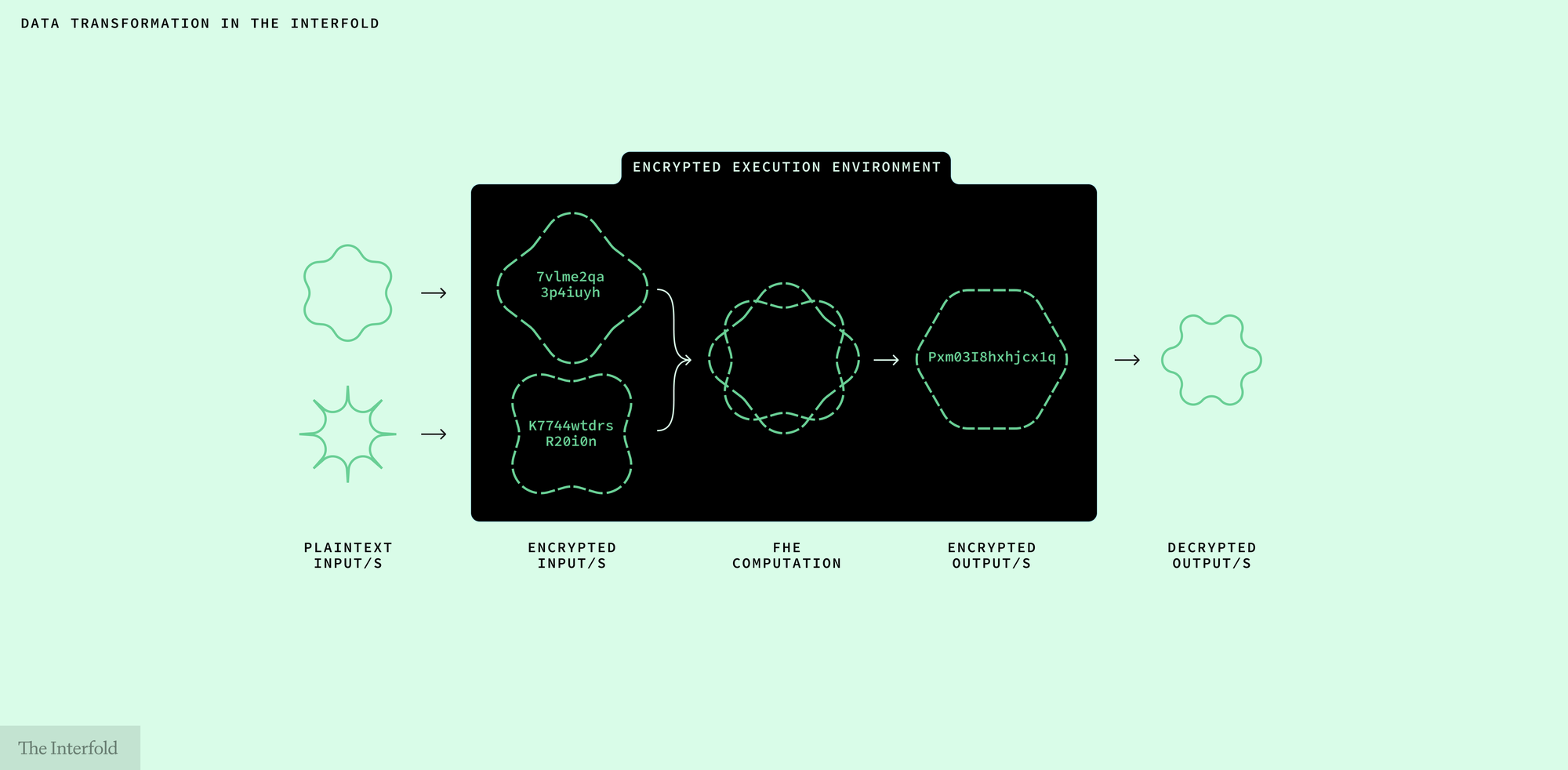


The technology stack supporting this mechanism consists of three layers: FHE (Fully Homomorphic Encryption) allows computations directly on encrypted data; ZK proofs (Zero-Knowledge proofs) verify whether the computation process itself was executed honestly; and DTC (Decentralized Threshold Cryptography) distributes decryption authority across multiple nodes, eliminating single points of trust.


The Interfold's currently promoted application scenario is CRISP (Coercion-Resistant Impartial Selection Protocol), designed for voting scenarios within DAO governance. CRISP achieves three things: the entire voting process is encrypted, and no one can view individual votes before the tally; 'receipt-free voting,' where users cannot prove to a third party how they voted, fundamentally cutting off bribery paths; and ZK proofs ensure the verifiability of tally results.


Two demo versions of CRISP are already live, with the team currently in the system integration and internal testnet validation phase. Confirmed ecosystem partnerships include: Zcash community's private governance tool Zecret Ballots, mobile DAO governance application Goverland, and joint integrations with Aragon and Status App.


Vitalik's Public Endorsement


On-chain governance bribery is not a new problem, but its measurable scale has rapidly expanded since 2024. Within the Curve ecosystem alone, the total value of bribes flowing through platforms like Votium exceeded $120 million in 2024; meanwhile, the median voter participation rate for various DAO proposals remains in the single digits.


The Ethereum community has not been unaware of this issue. In 2019, Vitalik posted a research note on ethresear.ch, proposing the conceptual framework of MACI (Minimal Anti-Collusion Infrastructure), envisioning the use of cryptographic means to eliminate voting bribery. This post has since been frequently cited, but practical implementation progress has been limited—the MACI scheme relies on a trusted 'Coordinator' role, who can see all votes. Once data is leaked, privacy guarantees immediately fail.


On May 28th, 2026, Vitalik publicly endorsed The Interfold on the X platform, stating: 'It basically is the thing I've been yelling for almost a decade for someone to build, and it's now built in a generalized way.'


The Interfold's core bet is: a single trusted coordinator is the fundamental bottleneck of MACI, and distributed threshold decryption is the correct path.


Team Background


The Interfold is developed by Gnosis Guild, a team with long-term expertise in Ethereum DAO infrastructure, previously well-known for its modular DAO toolset Zodiac. Zodiac is one of the most widely used permission and execution frameworks in the Ethereum DAO ecosystem, with partners covering several leading protocols. Specific core member names have not been publicly disclosed through official channels. The project also has no publicly disclosed institutional funding records.


Compared to larger-scale general-purpose privacy protocols like Aztec and Zama, The Interfold is a 'small but beautiful' project. It does not attempt to become a general-purpose privacy infrastructure; instead, it focuses on a specific, long-unresolved problem—making on-chain votes truly un-purchasable. The ambition may not be vast, but the target is precise.


From MACI to The Interfold


The conceptual framework of MACI (Minimal Anti-Collusion Infrastructure), proposed by Vitalik in 2019, has seen deployment in scenarios like Gitcoin but always had a structural flaw: it required a trusted coordinator, and if its private key were leaked, the entire privacy guarantee would fail. The Interfold is a generalized implementation of this framework—replacing a single coordinator with a distributed network of Ciphernodes, turning 'trust in a person' into 'trust in cryptography.'

Trending Cryptos

Related Questions

QWhat is the main problem in DAO governance that The Interfold aims to solve?

AThe Interfold aims to solve the problem of governance bribery in DAO voting, where individuals or entities with sufficient funds can directly 'bribe' voters to sway decisions, undermining true community consensus.

QWhat is the core technological concept of The Interfold, and what does it stand for?

AThe core technological concept of The Interfold is the E3, or Encrypted Execution Environment. It enables a distributed network of 'Ciphernodes' to perform computations directly on encrypted user data, with only the final aggregated result being decrypted and revealed.

QAccording to the article, what is the key difference between The Interfold's approach and the earlier MACI framework proposed by Vitalik Buterin?

AThe key difference is that the original MACI framework relied on a single trusted 'coordinator' who could see all votes, creating a privacy vulnerability. The Interfold replaces this single point of trust with a distributed network of nodes using threshold cryptography.

QWhat are the primary uses of the FOLD token within The Interfold ecosystem?

AThe FOLD token has three primary uses: 1) For Ciphernodes to stake and join the network to earn rewards. 2) For applications to pay for encrypted computation requests. 3) For holders to participate in protocol governance.

QWhat major public endorsement did The Interfold receive, and who gave it?

AVitalik Buterin publicly endorsed The Interfold on the X platform on May 28, 2026, stating, 'It's basically the thing I've been shouting for almost a decade that someone should build, and it's now implemented in a general form.'

Related Reads

The Verdict in Choi Tae-won's Divorce Case: Revealing the Inheritance Undercurrent Behind SK Hynix's Trillion-Won Empire

SK Group Chairman Chey Tae-won's high-profile divorce case, involving a record 1.38 trillion won settlement, has drawn attention to the succession plans for Korea's second-largest conglomerate, especially its crown jewel, SK hynix. Unlike traditional chaebol scripts centered on the eldest son, Chey's three children from his marriage to former President Roh Tae-woo's daughter, Roh Soh-yeong, are carving distinct, non-traditional paths. Eldest daughter Chey Yun-jung (b. 1989) is seen as the most evident successor. With a scientific and consulting background, she holds executive roles at SK bioscience and SK Inc.'s growth support department, focusing on future strategy and biopharma. Her marriage is to an AI infrastructure entrepreneur, not a traditional business alliance. Second daughter Chey Min-jung (b. 1991) took a unique route, voluntarily serving as a South Korean naval officer, including an anti-piracy deployment. She later worked on policy and strategy for SK hynix in Washington D.C. before co-founding an AI-driven healthcare startup. She married a former U.S. Marine Corps officer, connecting her to U.S. defense and policy circles—networks crucial for a global semiconductor giant. The only son, Chey In-geun (b. 1995), who studied physics like his father, worked briefly at SK E&S before joining McKinsey. Despite fitting the traditional "heir" profile as the eldest son, he remains silent and holds no public position or shares in SK, suggesting the old succession playbook is obsolete. As SK hynix's valuation soars, becoming a geopolitical asset in the AI era, the heirs' legitimacy is no longer automatic. They must prove themselves in fields like AI biotech, global policy, and strategic consulting. Their marriages also reflect new elite networks in tech and defense, not old political alliances. Their inheritance is the complex challenge of navigating a globalized, tech-driven world, not just a corporate throne.

marsbit2 days ago 09:06

The Verdict in Choi Tae-won's Divorce Case: Revealing the Inheritance Undercurrent Behind SK Hynix's Trillion-Won Empire

marsbit2 days ago 09:06

From OpenSea to OpenRouter: Is Alex Atallah Repeating His 'Exit at the Peak' Playbook?

From OpenSea to OpenRouter: Is Alex Atallah Repeating His "Exit at the Peak" Playbook? According to the Wall Street Journal, payments giant Stripe is in talks to acquire the AI model aggregation platform OpenRouter in a potential deal valuing the company near $100 billion. This would mark founder Alex Atallah's second creation of a company reaching a $100 billion valuation, following his co-founding of NFT marketplace OpenSea. OpenRouter, founded just over three years ago, has grown rapidly by acting as a unified gateway for developers to access over 400 AI models. It currently has about 10 million users and processes over 200 trillion tokens monthly. While the platform's annualized revenue is around $50 million, its valuation has skyrocketed from $1.3 billion in March 2026. The potential acquisition by Stripe, a company OpenRouter's founder once likened it to, represents a major expansion into AI infrastructure for the payments leader. This move echoes Atallah's previous timing with OpenSea, where he departed before the NFT market's significant downturn. For OpenRouter, selling now may be strategic. Despite its scale, its business model—charging a 5-5.5% fee on AI inference calls—faces pressure from competition, open-source models, and potential price wars among model providers, limiting its profitability narrative for an IPO. A key asset for potential acquirers like Stripe is OpenRouter's vast repository of real-world AI usage data, which offers unique insights into model performance and developer preferences that are difficult to replicate. Whether this potential deal signifies a new valuation benchmark for AI infrastructure or another market peak signal remains to be seen.

链捕手2 days ago 08:42

From OpenSea to OpenRouter: Is Alex Atallah Repeating His 'Exit at the Peak' Playbook?

链捕手2 days ago 08:42

Trading

Spot

Hot Articles

How to Buy AUCTION

Welcome to HTX.com! We've made purchasing Auction (AUCTION) simple and convenient. Follow our step-by-step guide to embark on your crypto journey.Step 1: Create Your HTX AccountUse your email or phone number to sign up for a free account on HTX. Experience a hassle-free registration journey and unlock all features.Get My AccountStep 2: Go to Buy Crypto and Choose Your Payment MethodCredit/Debit Card: Use your Visa or Mastercard to buy Auction (AUCTION) instantly.Balance: Use funds from your HTX account balance to trade seamlessly.Third Parties: We've added popular payment methods such as Google Pay and Apple Pay to enhance convenience.P2P: Trade directly with other users on HTX.Over-the-Counter (OTC): We offer tailor-made services and competitive exchange rates for traders.Step 3: Store Your Auction (AUCTION)After purchasing your Auction (AUCTION), store it in your HTX account. Alternatively, you can send it elsewhere via blockchain transfer or use it to trade other cryptocurrencies.Step 4: Trade Auction (AUCTION)Easily trade Auction (AUCTION) on HTX's spot market. Simply access your account, select your trading pair, execute your trades, and monitor in real-time. We offer a user-friendly experience for both beginners and seasoned traders.

3.7k Total ViewsPublished 2024.03.29Updated 2026.06.02

How to Buy AUCTION

Discussions

Welcome to the HTX Community. Here, you can stay informed about the latest platform developments and gain access to professional market insights. Users' opinions on the price of AUCTION (AUCTION) are presented below.

活动图片