Willy Woo says Bitcoin OGs will buy Satoshi's stash if a quantum hack occurs

cointelegraphPublished on 2025-12-14Last updated on 2025-12-14

Abstract

A debate emerged on social media regarding the potential scenario of a quantum computer hacking and dumping Satoshi Nakamoto’s 1 million BTC. YouTuber Josh Otten suggested this could crash Bitcoin's price to $3, but long-term holder Willy Woo countered that many original Bitcoin investors (OGs) would buy such a flash crash, ensuring the network's survival. Woo noted that around 4 million BTC in older "pay-to-public-key" (P2PK) addresses, including Satoshi's, are vulnerable because they expose public keys onchain, which a powerful quantum computer could use to derive private keys. Newer wallet types are more secure as they don’t reveal public keys. While some fear quantum computing could destroy crypto, experts like Blockstream’s Adam Back believe the threat is decades away, allowing time to adopt quantum-resistant cryptography. Analyst James Check added that the bigger risk is to Bitcoin’s market price, as the community is unlikely to preemptively freeze Satoshi’s coins before a quantum attack.

A debate broke out on social media on Saturday about the potential effects of a quantum computer hacking Satoshi Nakamoto’s Bitcoin (BTC) stash and then dumping those coins onto the market.

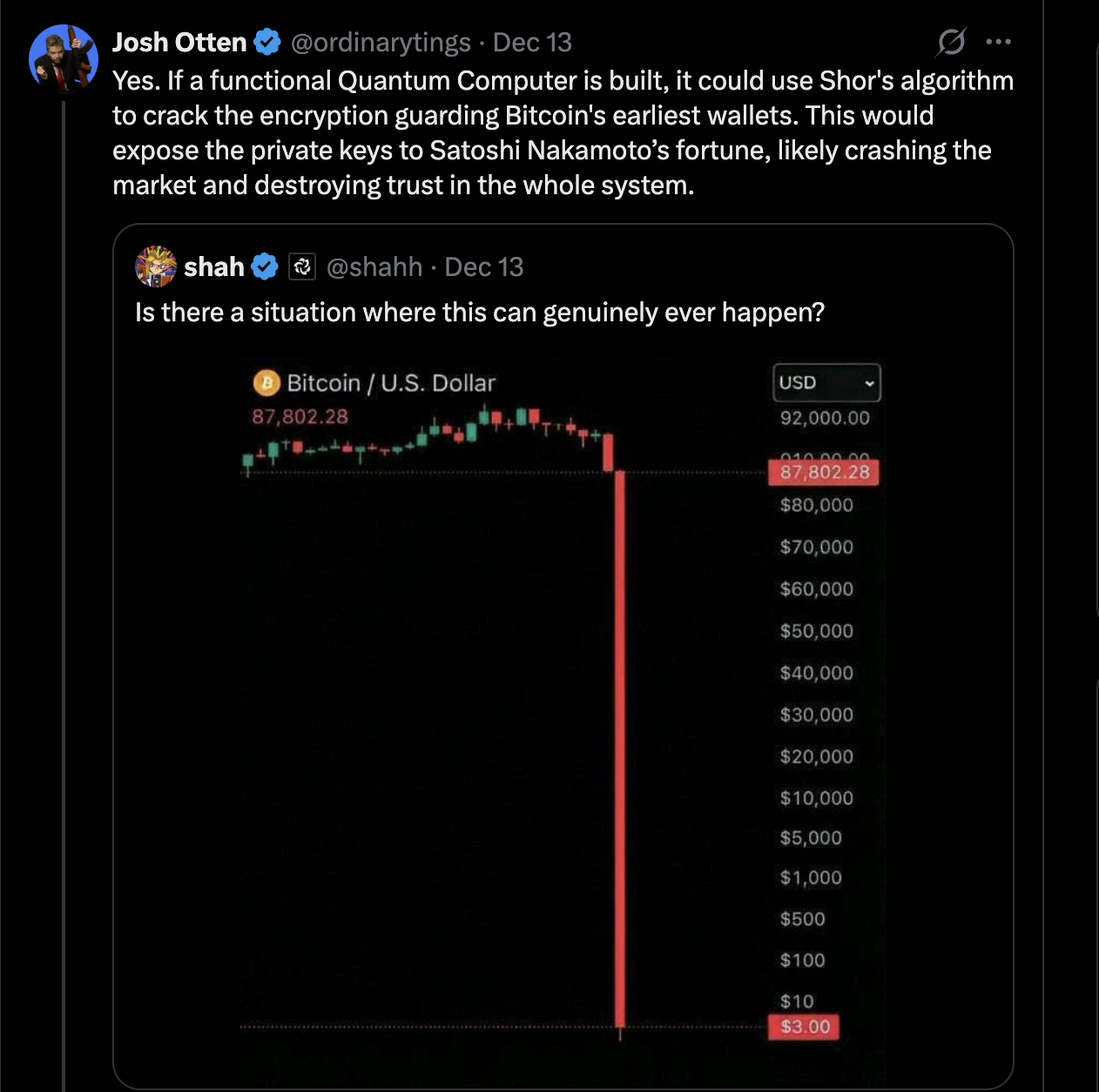
The debate began when YouTuber Josh Otten shared a price chart of BTC crashing to $3.00 and said that this could happen if a sufficiently powerful quantum computer emerges and steals pseudonymous Bitcoin creator Satoshi Nakamoto’s 1 million BTC and sells them.

“Many OGs would buy the flash crash. The Bitcoin network would survive; most coins are not immediately vulnerable,” long-term Bitcoin holder Willy Woo said.
Source: Josh Otten

However, there are about 4 million BTC held in pay-to-public-key (P2PK) addresses, including Satoshi’s coins, which show the full public key onchain when coins are spent, making them vulnerable to quantum attacks, Woo added.

Exposing a Bitcoin wallet’s full public key onchain exposes these wallets to quantum attacks in the future because a sufficiently powerful quantum computer could theoretically derive the private key from the public key in the future

Newer types of BTC wallet addresses are not as vulnerable to quantum attacks because they do not expose the full public keys onchain, and if the public key is not known, then a quantum computer cannot generate the paired private key from that data.
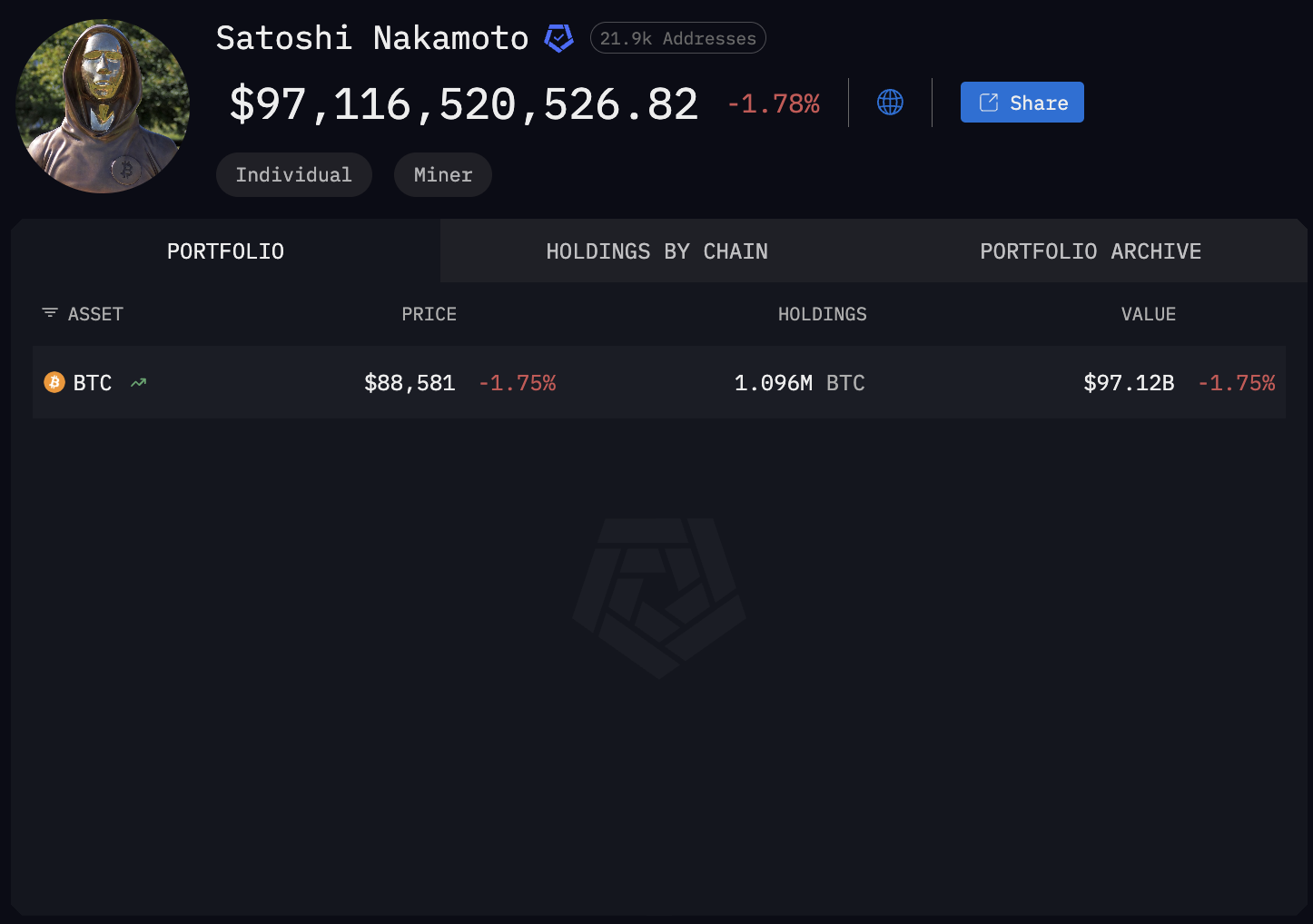
Satoshi Nakamoto’s Bitcoin holdings. Source: Arkham Intelligence

The Bitcoin and crypto communities continue to debate the potential effects of quantum computing on Bitcoin and the encryption technology that underpins cryptocurrencies, with some arguing that quantum computing will be the death of the industry.

Related: VanEck boss questions Bitcoin’s privacy, encryption against quantum tech

Bitcoin OG Adam Back says the threat of quantum computers is decades away

Adam Back, an early Bitcoin holder, cypherpunk and co-founder of Bitcoin technology company Blockstream, said that BTC will not face a quantum threat in the next 20-40 years.

Back argued that there is plenty of time to adopt post-quantum cryptography standards, which already exist, before a quantum computer powerful enough to crack modern encryption and cybersecurity standards is built.

Market analyst James Check said that quantum computing does not threaten Bitcoin’s technology because users will migrate to quantum-resistant addresses by the time a viable quantum computer emerges.

The quantum threat poses more of a threat to Bitcoin’s market price because there is “no chance” that the Bitcoin community will agree to freeze Satoshi’s coins before a quantum computer hacks his wallets and puts the coins back into circulation, Check said.

Magazine: Quantum attacking Bitcoin would be a waste of time: Kevin O’Leary

Trending Cryptos

Related Reads

The Verdict in Choi Tae-won's Divorce Case: Revealing the Inheritance Undercurrent Behind SK Hynix's Trillion-Won Empire

SK Group Chairman Chey Tae-won's high-profile divorce case, involving a record 1.38 trillion won settlement, has drawn attention to the succession plans for Korea's second-largest conglomerate, especially its crown jewel, SK hynix. Unlike traditional chaebol scripts centered on the eldest son, Chey's three children from his marriage to former President Roh Tae-woo's daughter, Roh Soh-yeong, are carving distinct, non-traditional paths. Eldest daughter Chey Yun-jung (b. 1989) is seen as the most evident successor. With a scientific and consulting background, she holds executive roles at SK bioscience and SK Inc.'s growth support department, focusing on future strategy and biopharma. Her marriage is to an AI infrastructure entrepreneur, not a traditional business alliance. Second daughter Chey Min-jung (b. 1991) took a unique route, voluntarily serving as a South Korean naval officer, including an anti-piracy deployment. She later worked on policy and strategy for SK hynix in Washington D.C. before co-founding an AI-driven healthcare startup. She married a former U.S. Marine Corps officer, connecting her to U.S. defense and policy circles—networks crucial for a global semiconductor giant. The only son, Chey In-geun (b. 1995), who studied physics like his father, worked briefly at SK E&S before joining McKinsey. Despite fitting the traditional "heir" profile as the eldest son, he remains silent and holds no public position or shares in SK, suggesting the old succession playbook is obsolete. As SK hynix's valuation soars, becoming a geopolitical asset in the AI era, the heirs' legitimacy is no longer automatic. They must prove themselves in fields like AI biotech, global policy, and strategic consulting. Their marriages also reflect new elite networks in tech and defense, not old political alliances. Their inheritance is the complex challenge of navigating a globalized, tech-driven world, not just a corporate throne.

marsbit2 days ago 09:06

The Verdict in Choi Tae-won's Divorce Case: Revealing the Inheritance Undercurrent Behind SK Hynix's Trillion-Won Empire

marsbit2 days ago 09:06

From OpenSea to OpenRouter: Is Alex Atallah Repeating His 'Exit at the Peak' Playbook?

From OpenSea to OpenRouter: Is Alex Atallah Repeating His "Exit at the Peak" Playbook? According to the Wall Street Journal, payments giant Stripe is in talks to acquire the AI model aggregation platform OpenRouter in a potential deal valuing the company near $100 billion. This would mark founder Alex Atallah's second creation of a company reaching a $100 billion valuation, following his co-founding of NFT marketplace OpenSea. OpenRouter, founded just over three years ago, has grown rapidly by acting as a unified gateway for developers to access over 400 AI models. It currently has about 10 million users and processes over 200 trillion tokens monthly. While the platform's annualized revenue is around $50 million, its valuation has skyrocketed from $1.3 billion in March 2026. The potential acquisition by Stripe, a company OpenRouter's founder once likened it to, represents a major expansion into AI infrastructure for the payments leader. This move echoes Atallah's previous timing with OpenSea, where he departed before the NFT market's significant downturn. For OpenRouter, selling now may be strategic. Despite its scale, its business model—charging a 5-5.5% fee on AI inference calls—faces pressure from competition, open-source models, and potential price wars among model providers, limiting its profitability narrative for an IPO. A key asset for potential acquirers like Stripe is OpenRouter's vast repository of real-world AI usage data, which offers unique insights into model performance and developer preferences that are difficult to replicate. Whether this potential deal signifies a new valuation benchmark for AI infrastructure or another market peak signal remains to be seen.

链捕手2 days ago 08:42

From OpenSea to OpenRouter: Is Alex Atallah Repeating His 'Exit at the Peak' Playbook?

链捕手2 days ago 08:42

Trading

Spot

Hot Articles

How to Buy WOO

Welcome to HTX.com! We've made purchasing WOO (WOO) simple and convenient. Follow our step-by-step guide to embark on your crypto journey.Step 1: Create Your HTX AccountUse your email or phone number to sign up for a free account on HTX. Experience a hassle-free registration journey and unlock all features.Get My AccountStep 2: Go to Buy Crypto and Choose Your Payment MethodCredit/Debit Card: Use your Visa or Mastercard to buy WOO (WOO) instantly.Balance: Use funds from your HTX account balance to trade seamlessly.Third Parties: We've added popular payment methods such as Google Pay and Apple Pay to enhance convenience.P2P: Trade directly with other users on HTX.Over-the-Counter (OTC): We offer tailor-made services and competitive exchange rates for traders.Step 3: Store Your WOO (WOO)After purchasing your WOO (WOO), store it in your HTX account. Alternatively, you can send it elsewhere via blockchain transfer or use it to trade other cryptocurrencies.Step 4: Trade WOO (WOO)Easily trade WOO (WOO) on HTX's spot market. Simply access your account, select your trading pair, execute your trades, and monitor in real-time. We offer a user-friendly experience for both beginners and seasoned traders.

2.2k Total ViewsPublished 2024.03.29Updated 2026.06.02

How to Buy WOO

Discussions

Welcome to the HTX Community. Here, you can stay informed about the latest platform developments and gain access to professional market insights. Users' opinions on the price of WOO (WOO) are presented below.

活动图片