XRP, Solana Holders Deeper In The Red Compared To Bitcoin, Data shows

bitcoinistPubblicato 2026-04-16Pubblicato ultima volta 2026-04-16

Introduzione

According to on-chain data from Glassnode, altcoins like XRP and Solana are experiencing significantly higher levels of investor losses relative to their market capitalizations compared to Bitcoin. The "Relative Unrealized Loss" metric, which calculates the total unrealized losses as a percentage of market cap, shows Bitcoin and Ethereum at 11.9% and 16.6%, respectively. In contrast, XRP and Solana are facing much steeper losses at 31.8% and 54.8%. This indicates that a larger portion of their supply is held by investors who bought near cycle highs. Despite the elevated loss levels, they remain below those seen during the 2022 bear market lows. At the time of writing, XRP is trading around $1.35, down 2% over the past week.

On-chain data shows altcoins like XRP and Solana are observing a higher amount of investor loss relative to their market caps than Bitcoin.

XRP & Solana Are Observing A High Value On The Relative Unrealized Loss

In a new post on X, on-chain analytics firm Glassnode has talked about how the Relative Unrealized Loss compares between the various top coins in the cryptocurrency sector. The “Unrealized Loss” is an indicator that keeps track of the total amount of loss that’s held by investors as a whole on a given digital asset network.

The metric works by going through the transaction history of each coin on the blockchain to determine the last price at which it was involved in a move. If this previous transfer value was more than the current spot price for any token, then that particular token is considered to be held at an unrealized loss right now.

The exact amount of loss held by the coin is naturally equal to the difference between the two prices. The Relative Unrealized Loss, which is the version of the metric that’s of relevance here, sums up this difference for all loss tokens and finds what percentage of the market cap that it makes up for.

A counterpart metric called the Relative Unrealized Profit finds the same for the profit portion of the supply. That is, the tokens that have a cost basis lower than the current spot price. Now, here is the chart shared by Glassnode that shows the trend in the Relative Unrealized Loss for the four top cryptocurrencies: Bitcoin, Ethereum, XRP, and Solana.
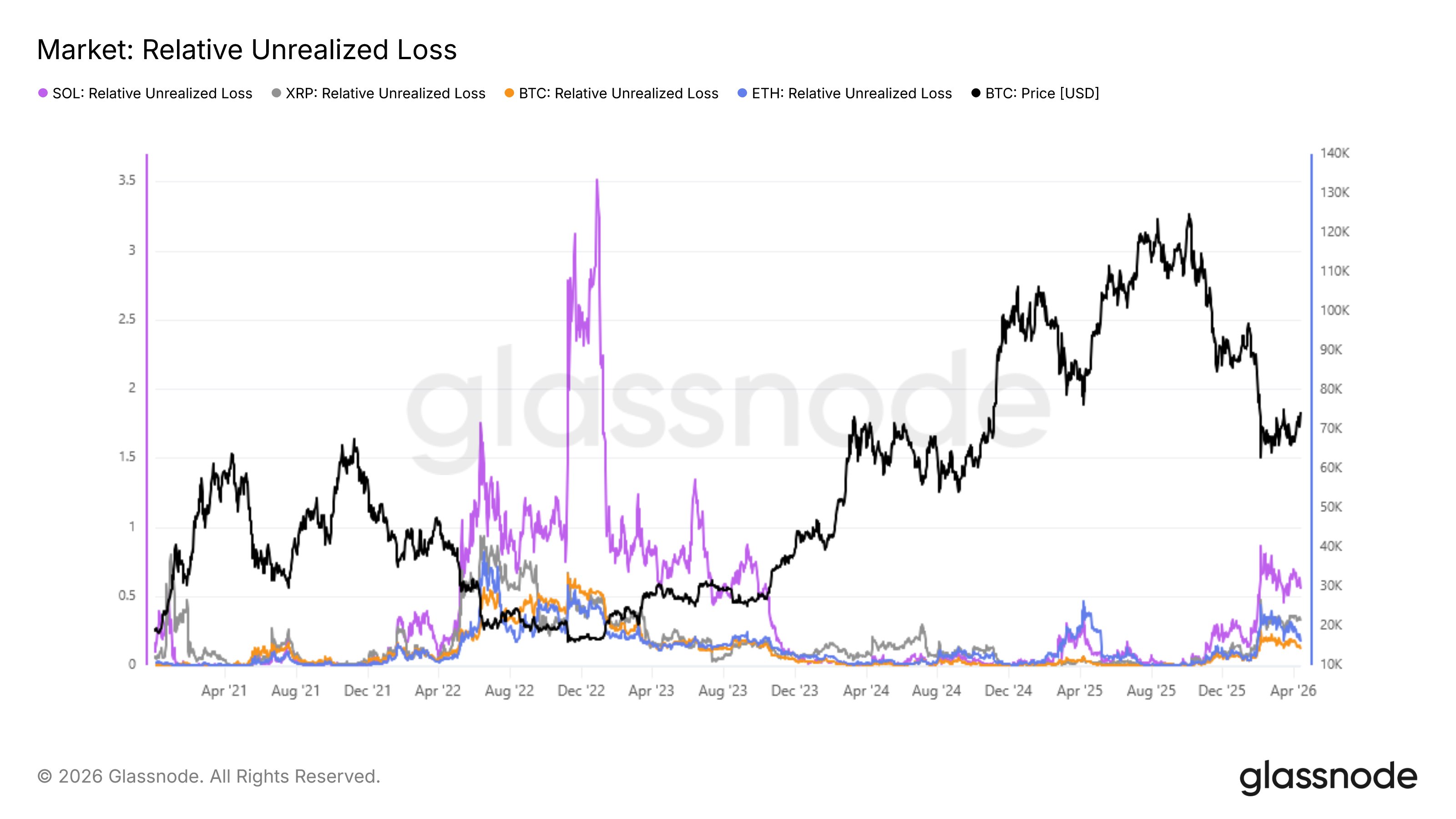
Looks like the indicator has gone up for all of these assets in recent months | Source: Glassnode on X

As is visible in the above graph, the Relative Unrealized Loss has witnessed a rise across the sector during the last few months. This increase is a natural consequence of the bearish price action that the various assets have seen in this window.

While the trend has been more-or-less uniform, the indicator’s value has differed in scale for the coins. Bitcoin and Ethereum, the two cryptocurrencies largest by market cap, have the metric sitting at relatively modest levels of 11.9% and 16.6%, respectively. Meanwhile, XRP and Solana have faced much heavier losses, with the Relative Unrealized Loss at 31.8% and 54.8%, respectively.

“The elevated loss levels in altcoins reflect how heavy the top is in these markets, where supply is more concentrated among buyers who entered near cycle highs,” explained the analytics firm. While the altcoins are facing high levels of losses, they are still lower than those observed at the lows of the 2022 bear market. XRP isn’t too far off, but Solana’s losses remain magnitudes lower.

XRP Price

At the time of writing, XRP is floating around $1.35, down 2% in the last seven days.

The price of the coin has retraced from Tuesday's high | Source: XRPUSDT on TradingView


Domande pertinenti

QWhat does the Relative Unrealized Loss metric measure for a cryptocurrency?

AThe Relative Unrealized Loss metric tracks the total amount of loss held by all investors in a cryptocurrency. It calculates the difference between the current spot price and the price at which each coin was last moved for all tokens currently held at a loss, and expresses this total as a percentage of the asset's market capitalization.

QAccording to the data, which two cryptocurrencies have the highest Relative Unrealized Loss?

AAccording to the data, XRP and Solana have the highest Relative Unrealized Loss, with values of 31.8% and 54.8% of their market caps, respectively.

QHow do Bitcoin and Ethereum's Relative Unrealized Loss levels compare to those of XRP and Solana?

ABitcoin and Ethereum have significantly lower Relative Unrealized Loss levels, at 11.9% and 16.6% respectively, compared to the much higher levels of XRP (31.8%) and Solana (54.8%).

QWhat reason does Glassnode give for the elevated loss levels in altcoins like XRP and Solana?

AGlassnode explains that the elevated loss levels in altcoins reflect how heavy the top is in these markets, meaning that the supply is more concentrated among buyers who entered near the cycle highs.

QWhat was the price of XRP at the time of writing, and how had it performed over the previous week?

AAt the time of writing, XRP was trading around $1.35, which was down 2% over the last seven days.

Letture associate

US Stocks Suffer Worst Plunge Since 2025: Three Triggers Ignite Tech Stock Valuation Reset

The US stock market experienced its most severe sell-off since the 2025 tariff crisis on June 5th, 2025. The Nasdaq Composite plummeted 4.18%, the S&P 500 fell 2.64%, and the Dow Jones dropped 695 points. The panic stemmed from three converging factors. First, Broadcom's earnings report ignited fears of a slowdown in AI growth. While its AI chip revenue surged 143% YoY to $10.8B, its Q3 AI revenue guidance of $16B fell short of the $17.2B consensus. This triggered a massive sector-wide sell-off, with the Philadelphia Semiconductor Index crashing 10.26% and semiconductor stocks losing roughly $1.3 trillion in market value in a single day. Second, a shockingly strong May jobs report crushed hopes for Federal Reserve rate cuts. Non-farm payrolls added 172,000 jobs, doubling expectations. This robust data, combined with persistently high oil prices above $92/barrel due to the ongoing Iran war and blockade of the Strait of Hormuz, drastically increased market expectations for a potential Fed rate hike instead of a cut. Higher interest rates compress the valuations of growth-heavy tech stocks. Third, the prolonged Iran conflict continues to fuel inflationary pressures, complicating the Fed's policy decisions and undermining the "inflation is tamed" narrative. Together, these events challenged the twin pillars of the market rally: the "limitless AI growth" story and expectations for imminent monetary easing. The sell-off spread globally, impacting Asian and European markets and cryptocurrencies. The article posits this is likely a severe "valuation repricing" rather than the end of the AI story. The underlying demand for AI remains strong, but investor expectations for growth speed and the prices they are willing to pay are being recalibrated. Key upcoming factors include the June FOMC meeting, future AI company earnings, and developments in the Iran conflict.

marsbit1 h fa

US Stocks Suffer Worst Plunge Since 2025: Three Triggers Ignite Tech Stock Valuation Reset

marsbit1 h fa

From Madison Square Garden to Kalshi: Prediction Markets Break into the NBA Finals

From Madison Square Garden to Kalshi: Prediction Markets Break into the NBA Finals Prediction markets are playing a significant role in the 2026 NBA Finals, particularly around the New York Knicks' unexpected 2-0 series lead. Platforms like Kalshi and Polymarket have seen massive trading volumes, exceeding hundreds of millions of dollars on championship and related markets. Their influence extends beyond online trading. Kalshi's official partnership with Madison Square Garden has given it prominent physical branding at the arena. Furthermore, local businesses like The Jeffrey bar are using prediction market contracts to hedge the risk of game-result-based promotions, turning potential losses into manageable costs—a concept similar to the famous "Mattress Mack" strategy from traditional sports betting. These markets differentiate themselves by offering a wider, more entertainment-focused range of "event contracts" beyond typical game outcomes, such as predicting celebrity attendance. They also have broader accessibility across the U.S. compared to age- and location-restricted traditional sportsbooks. However, their rapid integration into sports raises regulatory and ethical questions. The NBA is cautiously engaging, discussing integrity frameworks with regulators like the CFTC. While the league permits minor investments like Giannis Antetokounmpo's stake in Kalshi, it advocates for strict rules to prevent insider trading. Many fans express concern on platforms like Reddit, fearing that the close ties between prediction markets, the league, and players could compromise the game's integrity. The NBA Finals has thus become a high-stakes testing ground, showcasing prediction markets' commercial potential while challenging traditional boundaries between financial trading, entertainment, and gambling.

marsbit3 h fa

From Madison Square Garden to Kalshi: Prediction Markets Break into the NBA Finals

marsbit3 h fa

Recursive Self-Improvement AI Gains Traction, Google Pours Cold Water, While DeepSeek and Others Approach the Fringes

The term "recursive self-improvement" (RSI), where AI improves itself autonomously, is gaining momentum in the AI industry. Startups like Recursive Superintelligence and projects such as Andrej Karpathy's Auto-Research aim to create systems where AI designs, implements, and validates its own research, moving toward superintelligence. While Google CEO Sundar Pichai cautions that such exponential acceleration is not yet a reality, progress is evident. For instance, Anthropic reported its Claude Code writes nearly 100% of the team's code, though it still lacks true self-direction. Analysts frame RSI development in stages: "adequacy" (systems functioning without humans), "parity" (matching human research quality), and "supremacy" (exceeding human-AI collaboration). Reaching parity could trigger rapid, unpredictable advancement due to AI's continuous operation. In China, companies like DeepSeek and Baidu incorporate self-optimization techniques without explicitly branding them as RSI, focusing on algorithmic efficiency and reinforcement learning. However, challenges remain, including "model collapse" from training on AI-generated data and the immense computational and open-collaboration requirements. Ultimately, RSI represents a trend of increasing automation in AI development, potentially reducing human oversight in the creation process itself.

marsbit3 h fa

Recursive Self-Improvement AI Gains Traction, Google Pours Cold Water, While DeepSeek and Others Approach the Fringes

marsbit3 h fa

Trading

Spot
Futures

Articoli Popolari

Cosa è XRP 2.0

XRP 2.0: Una Nuova Frontiera nel Paesaggio delle Criptovalute Introduzione a XRP 2.0 Nel mondo in continua evoluzione delle criptovalute, nuovi progetti emergono continuamente, cercando attenzione e adozione. Una tale iniziativa promettente è XRP 2.0, un nuovo progetto di criptovaluta progettato per sfruttare avanzate tecnologie blockchain e metodologie di crittografia robuste. Anche se il nome richiama alla mente l'XRP di Ripple, è fondamentale notare che XRP 2.0 opera in modo indipendente, concentrandosi sul miglioramento della sicurezza delle transazioni, della privacy e della scalabilità. Mentre il panorama finanziario digitale abbraccia sempre di più soluzioni decentralizzate, XRP 2.0 mira a contribuire in modo significativo al web3 e all'espansione generale dei progetti crypto. Cos'è XRP 2.0? Alla sua base, XRP 2.0 è un progetto di criptovaluta che mira a creare un ecosistema di valuta digitale sicuro e decentralizzato. La sua tecnologia fondamentale integra principi di blockchain sofisticati con tecniche di crittografia all'avanguardia. L'obiettivo principale di XRP 2.0 è quello di affermarsi come una piattaforma affidabile ed efficiente in grado di consentire un'esecuzione rapida delle transazioni, dando priorità a migliori protezioni della privacy per i suoi utenti. Il progetto è promosso come una soluzione a molte limitazioni affrontate dalle criptovalute esistenti, proponendo un sistema in grado di gestire un volume maggiore di transazioni con migliorata velocità e privacy. Questa versatilità pone XRP 2.0 come un significativo competitor in un mercato affollato di varie valute digitali. Chi è il Creatore di XRP 2.0? L'identità del creatore dietro XRP 2.0 è stata segnalata come 'Wilbur'. Tuttavia, i dettagli completi riguardanti Wilbur o l'entità associata rimangono sfuggenti. L'anonimato di molti creatori di criptovalute non è un fenomeno raro nel settore, spesso progettato per mantenere un certo grado di privacy e sicurezza. Chi sono gli Investitori di XRP 2.0? Al momento, informazioni specifiche relative alle fondazioni o organizzazioni di investimento a supporto di XRP 2.0 non sono disponibili pubblicamente. Nel settore delle criptovalute, il supporto di investitori rinomati può influenzare significativamente la credibilità e il successo di un progetto, tuttavia la trasparenza riguardo ai sostenitori finanziari di XRP 2.0 non è stata stabilita. Come Funziona XRP 2.0? XRP 2.0 si distingue per l'impiego di una combinazione di tecnologia blockchain e algoritmi di crittografia avanzati che garantiscono transazioni sicure e decentralizzate. La sua struttura innovativa include caratteristiche uniche progettate per promuovere il coinvolgimento degli utenti e ampliare le funzionalità oltre le transazioni convenzionali delle criptovalute. Tra queste caratteristiche, XRP 2.0 incorpora capacità alimentate da intelligenza artificiale, come funzionalità di testo in immagini e testo in voce. Queste aggiunte sono progettate per migliorare l'esperienza interattiva per gli utenti, promuovendo una maggiore applicabilità in vari settori. Unendo progressi tecnologici con design incentrati sugli utenti, XRP 2.0 mira a catturare l'attenzione di una vasta gamma di individui e aziende che cercano di integrare soluzioni di criptovaluta nei loro framework operativi. Cronologia di XRP 2.0 Comprendere XRP 2.0 richiede di esaminare i traguardi che hanno definito il suo percorso fino ad ora: 23 luglio 2023: XRP 2.0 viene introdotto come un nuovo progetto di criptovaluta, mirante a rivoluzionare le capacità di transazione sicura e decentralizzata nel dominio blockchain. 8 settembre 2023: Si verifica il lancio di un altro progetto, XRP20, marcando l'emergere di un token ERC-20 sulla blockchain di Ethereum che resta non correlato a XRP 2.0. 13 novembre 2023: Il ledger XRP subisce un significativo aggiornamento con il rilascio della versione 2.0.0 del software server rippled. È essenziale notare che questo sviluppo è scollegato dal progetto di criptovaluta XRP 2.0. Punti Chiave su XRP 2.0 Per distillare l'essenza di XRP 2.0, emergono diversi fattori critici: Caratteristiche Uniche: L'inclusione di funzionalità come il testo in immagini e testo in voce alimentato da intelligenza artificiale diversifica ulteriormente le potenziali applicazioni di XRP 2.0. Tecnologia Blockchain: Il framework utilizza meccanismi blockchain avanzati e protocolli di crittografia, garantendo un ambiente sicuro e decentralizzato per le transazioni. Scalabilità e Privacy: XRP 2.0 dà priorità a migliori protezioni della privacy nei processi di transazione e alla scalabilità necessaria per accogliere una base di utenti in crescita. Nessuna Affiliazione con Ripple: È importante notare che, nonostante il suo nome, XRP 2.0 non ha alcuna fedeltà o collaborazione con l'XRP di Ripple, distinguendo il proprio framework operativo e obiettivi all'interno dell'ecosistema delle criptovalute. Conclusione XRP 2.0 rappresenta un'ambiziosa venture nell'ambito delle criptovalute, mirante a offrire una combinazione di sicurezza, privacy ed efficienza nelle transazioni digitali. Integrando tecnologie sofisticate e caratteristiche user-friendly, il progetto si propone di ampliare gli orizzonti di ciò che le criptovalute possono realizzare nell'economia digitale odierna. Sebbene l'anonimato del suo creatore e la mancanza di investitori dichiarati possano sollevare domande per alcuni, il focus di XRP 2.0 su funzionalità avanzate e decentralizzazione ne amplifica l'appeal in un mercato crypto sempre più affollato. Man mano che il panorama delle criptovalute continua a evolversi, XRP 2.0 potrebbe emergere come un attore decisivo nell'espansione di soluzioni blockchain sicure e scalabili.

166 Totale visualizzazioniPubblicato il 2024.04.05Aggiornato il 2024.12.03

Cosa è XRP 2.0

Come comprare XRP

Benvenuto in HTX.com! Abbiamo reso l'acquisto di XRP (XRP) semplice e conveniente. Segui la nostra guida passo passo per intraprendere il tuo viaggio nel mondo delle criptovalute.Step 1: Crea il tuo Account HTXUsa la tua email o numero di telefono per registrarti il tuo account gratuito su HTX. Vivi un'esperienza facile e sblocca tutte le funzionalità,Crea il mio accountStep 2: Vai in Acquista crypto e seleziona il tuo metodo di pagamentoCarta di credito/debito: utilizza la tua Visa o Mastercard per acquistare immediatamente XRPXRP.Bilancio: Usa i fondi dal bilancio del tuo account HTX per fare trading senza problemi.Terze parti: abbiamo aggiunto metodi di pagamento molto utilizzati come Google Pay e Apple Pay per maggiore comodità.P2P: Fai trading direttamente con altri utenti HTX.Over-the-Counter (OTC): Offriamo servizi su misura e tassi di cambio competitivi per i trader.Step 3: Conserva XRP (XRP)Dopo aver acquistato XRP (XRP), conserva nel tuo account HTX. In alternativa, puoi inviare tramite trasferimento blockchain o scambiare per altre criptovalute.Step 4: Scambia XRP (XRP)Scambia facilmente XRP (XRP) nel mercato spot di HTX. Accedi al tuo account, seleziona la tua coppia di trading, esegui le tue operazioni e monitora in tempo reale. Offriamo un'esperienza user-friendly sia per chi ha appena iniziato che per i trader più esperti.

1.5k Totale visualizzazioniPubblicato il 2024.12.10Aggiornato il 2026.06.02

Come comprare XRP

Discussioni

Benvenuto nella Community HTX. Qui puoi rimanere informato sugli ultimi sviluppi della piattaforma e accedere ad approfondimenti esperti sul mercato. Le opinioni degli utenti sul prezzo di XRP XRP sono presentate come di seguito.

活动图片













