Gate Research Institute: The 'Wall Street-ization' Wave of Crypto Financial Products – Competition or Integration?

marsbitPubblicato 2026-07-22Pubblicato ultima volta 2026-07-22

Introduzione

The article titled "Gate Research Institute: Are Crypto Financial Products Sparking a 'Wall Street' Wave—Competition or Convergence?" explores the evolving relationship between the crypto ecosystem and traditional finance (TradFi). The piece begins by reflecting on Bitcoin's original 2009 vision of decentralization, disintermediation, and moving away from banks. It then contrasts this with the 2024 landscape, where key crypto assets like Bitcoin are increasingly held through Wall Street products like ETFs issued by giants like BlackRock. The article questions whether this signifies that TradFi is systematically taking over the rights to issue, price, custody, and distribute crypto financial assets. The core argument is that this is not a zero-sum takeover but rather a bidirectional convergence where each side addresses the other's weaknesses. Crypto offers 24/7 global markets, programmable settlement, and open access but lacks compliant channels, institutional-grade custody, deep fiat liquidity, and mainstream distribution. TradFi possesses these but is constrained by legacy systems, limited operating hours, and slow settlement. Two primary convergence paths are highlighted: * **Path A (CEX to TradFi):** Exemplified by Gate, which has progressed from offering tokenized stocks and CFDs to providing direct, real stock trading (US, Hong Kong, South Korea) within its platform, using USDT. * **Path B (TradFi to Crypto):** Exemplified by Robinhood, which has integrated crypt...

In January 2009, Satoshi Nakamoto embedded a line in the Bitcoin genesis block: "The Times 03/Jan/2009 Chancellor on brink of second bailout for banks." This line served as a timestamp and is often seen as a critique of the bank bailout system following the 2008 financial crisis: Bitcoin aimed to establish a peer-to-peer value transfer system that didn't rely on banks or trusted third parties.

Yet, seventeen years later, one of the mainstream ways to hold Bitcoin is to buy a share of an ETF issued by BlackRock, the world's largest asset manager, or hold shares of related Bitcoin treasury companies. Does this mean the crypto market has strayed from its founding purpose? Is Wall Street systematically seizing the issuance, pricing, custody, and distribution rights of crypto-financial assets?

1. Is Wall Street Seizing the Issuance, Pricing, Custody, and Distribution Rights of Crypto Assets?

1.1 The Ideal: Bitcoin's Founding Intent in 2009

This goes back to Bitcoin's original intent. The Bitcoin whitepaper envisioned a financial order built around three "de-" principles:

• Decentralization: No central issuer, no headquarters, no servers that can be shut down. The ledger is maintained by a global network of nodes, with rules written into the code.

• Disintermediation: Peer-to-peer value transfer without the need for banks, brokerages, or clearinghouses to act as intermediaries or guarantors. "Private key equals ownership," with self-custody as the default.

• Debanking: Anyone can hold and transfer assets and participate in new coin issuance (through mining) without needing to open an account, undergo KYC, or have accredited investor status.

The core ethos of this ideal was to reclaim the four powers of finance—issuance, pricing, custody, and distribution—from the hands of a few institutions and distribute them among every participant in the network. This was both a direct response to the 2008 financial crisis and a benchmark, declaring to the market that if the centralized financial system could fail, then build a system that doesn't need it.

1.2 Reality: Are These Four Powers Being Seized?

However, this decentralized order seems to have lost its purity following the approval of spot Bitcoin ETFs in 2024. In other words, traditional finance is incorporating crypto technology into its own asset issuance, settlement, and distribution systems.

Asset management giants like BlackRock, Fidelity, and Franklin Templeton have packaged BTC and ETH into products that can be bought in traditional financial accounts. When BTC and ETH are packaged as ETFs, they transform from "on-chain assets requiring an understanding of wallets and private keys" into "financial products that can be bought in traditional securities accounts." As of May 2026, ETFs hold approximately 1.5 million Bitcoin. In just two years, ETFs represent about 7.14% of Bitcoin's total capped supply of 21 million.

A similar shift is happening in the derivatives market. CME's Bitcoin and Ethereum futures and options provide institutions with a regulated venue for trading, hedging, and integrating into risk models. Increasingly, institutions can gain crypto exposure without directly touching on-chain assets, through futures, options, ETFs, structured products, and fund shares.

RWA and tokenized government bonds further expand the boundaries of this "Wall Street-ization." The tokenized US Treasury market grew from about $380 million in early 2023 to over $11 billion by 2026, making it the fastest-growing segment in the entire RWA space. The list of issuers reads almost like a roll call of Wall Street: BlackRock's BUIDL, Franklin Templeton's Benji, JPMorgan's Kinexys, Ondo's tokenized Treasury products—all are moving traditional financial assets on-chain.

Institutions like Coinbase, Fidelity Digital Assets, and BNY Mellon handle custody, trading, and compliance infrastructure. Furthermore, in August 2025, a US executive order allowed cryptocurrencies, private equity, and other alternative assets into 401(k) retirement plans, opening the door to the approximately $12.5 trillion in retirement account funds. As more institutions participate, numerous brokerages and wealth managers are gradually incorporating parts of the distribution rights.

This is not just a change in product form; it's a change in power structure: asset managers handle issuance, brokerages and advisors handle distribution, compliant custodians handle safekeeping, market makers and authorized participants handle primary market creation/redemption, exchanges handle listing, and regulatory frameworks define the boundaries. Crypto assets are thus entering the language system of traditional finance.

2. A Two-Way Convergence: 1+1>2

But Wall Street's "centralization" is only one side of the coin. Zooming out, the other side is the two systems complementing each other's shortcomings. This is not a zero-sum game where one side swallows the other, but a two-way convergence of two systems.

The crypto-native system has permissionless openness, 24/7 global markets, and programmable on-chain settlement. However, it has always lacked four things: compliant issuance channels, institutional-grade custody trust, deep fiat liquidity, and distribution networks that can reach mainstream users. These four are precisely what Wall Street has in abundance.

Conversely, Wall Street has licenses, custody, trillion-dollar capital pools, and global distribution channels. But its assets are trapped in an archaic system: markets open only on weekdays, cross-border barriers are high, settlement takes T+2, and products cannot be freely combined. These limitations are precisely what the crypto rails can inherently solve. Thus, this 1+1>2 dynamic is not just a theoretical exercise.

Over the past year, crypto exchanges have successively launched real stock trading. This wave presents two completely opposite yet converging directions. One starts from crypto exchanges and moves towards traditional finance; the other starts from traditional finance and moves towards crypto. Gate and Robinhood are the clearest representatives of these two paths.

2.1 Path A: From CEX to Traditional Finance

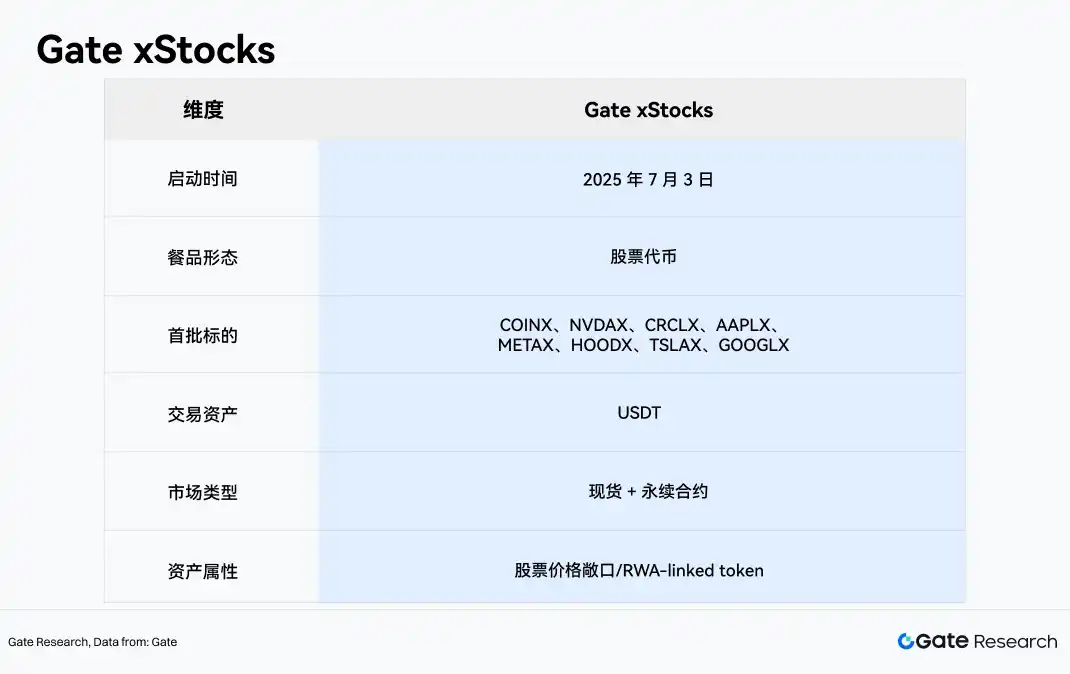
Gate's TradFi path can be divided into four stages. The first stage is the tokenization of traditional assets/stocks. Gate officially launched the xStocks Trading Section on July 3, 2025, becoming one of the earliest crypto exchanges to offer tokenized asset trading. Partnering with xStocks and Ondo, it allows users to trade spot and perpetual contracts for stocks like Apple, Tesla, and Meta directly with USDT, 24/7, without needing a traditional securities account. The core of this path is the "third-party compliant issuance + CEX distribution" model represented by xStocks. The underlying structure involves compliant Swiss entity Backed Finance holding the real underlying stocks 1:1 via an SPV structure under DLT law (purchased through brokers like Interactive Brokers and custodied at regulated custodians like InCore Bank). Tokens are issued on the Solana SPL standard, with Chainlink oracles synchronizing prices with off-chain markets at high frequency.
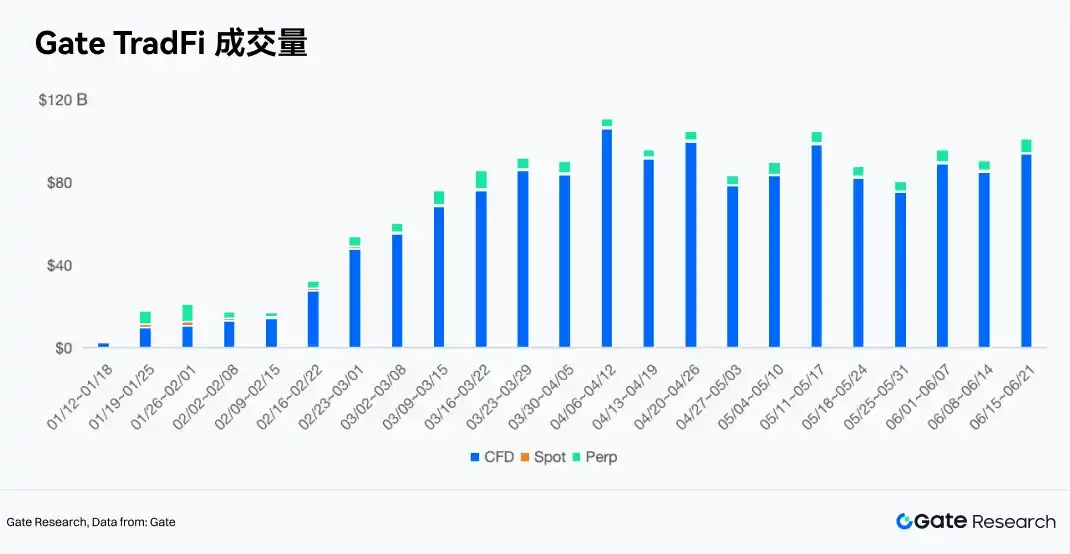
The second stage is the CFD-ization of traditional assets, providing price exposure to gold, forex, indices, commodities, and select stocks via contracts for difference. In January 2026, Gate expanded its TradFi CFD products to cover gold, forex, indices, commodities, and popular stocks, integrating the trading experience using USDx, an internal unit of account pegged to USDT. In this stage, the exchange acts as a price exposure gateway; users trade derivatives without directly holding the underlying stock assets.
The third stage is the launch of real stock trading in June 2026. On June 1, Gate officially launched real stock trading, currently supporting over 10,000 US stocks and ETFs, covering major markets like NYSE and Nasdaq. Users can trade directly using USDT. This means a native crypto trading platform is no longer content with offering spot, futures, Launchpad, copy trading, wallets, and on-chain tools to native users; it has begun to include stock, ETF, bond, forex, and fund traders into its trading ecosystem.

The difference from the previous CFD stage is that Gate emphasizes its connection to real securities markets through compliant brokerage infrastructure, not via stock tokens or synthetic assets. On June 3, Gate also announced a strategic partnership with Alpaca to expand access to real stock trading for eligible users. Alpaca is an SEC-registered clearing broker, and the partnership focuses on trade execution, clearing, and custody infrastructure. In other words, Gate isn't issuing stocks itself; it's acting as the front-end gateway between crypto accounts, stablecoin funds, and the traditional brokerage clearing system.
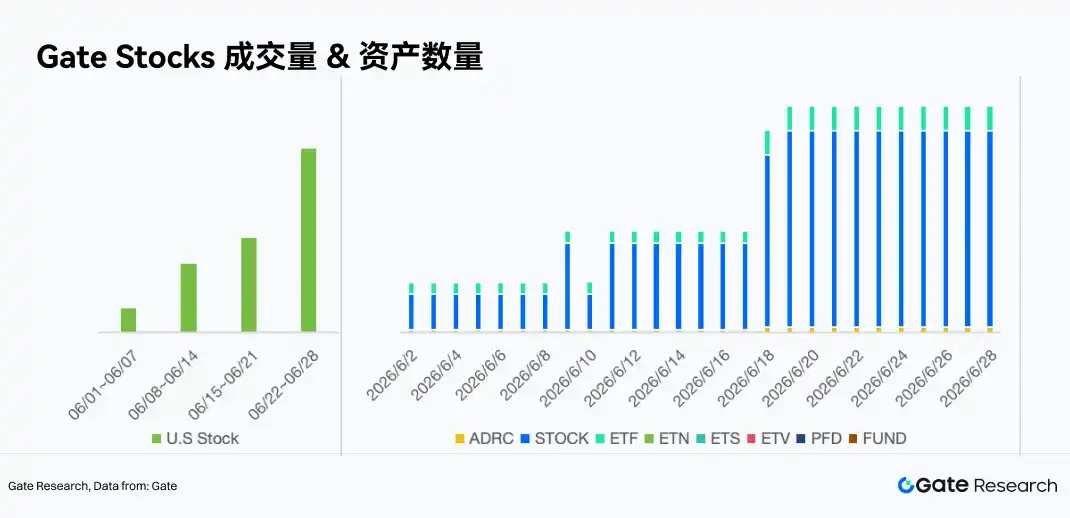
The fourth stage is geographical expansion in stock markets. Following US stocks, Gate launched Hong Kong stock trading on June 15, initially covering over 1,000 stocks listed on the Hong Kong Exchange. Users can trade assets like Tencent, HSBC, Xiaomi, Meituan, BYD, and China Mobile using USDT, sharing the same stock account system as for US stocks. On June 22, Gate further launched Korean stock trading, supporting stocks listed on the KRX exchange, initially covering the top 1,000 companies by market cap, including Samsung Electronics, SK Hynix, NAVER, Hyundai Motor, and Celltrion, covering both KOSPI and KOSDAQ markets. Within June, Gate rapidly deployed a "US-Hong Kong-Korean stocks" matrix, forming a multi-market product portfolio with USDT as the unified funding entry point and global stocks as the allocation targets.

These four stages reflect a shift in CEX growth logic. In the past, CEXs primarily relied on spot, futures, Launchpad, wealth management, and Web3 wallets to build user ecosystems. However, as crypto trading penetration increases, fee competition intensifies, and regulatory demands rise, growth space relying solely on crypto-to-crypto trading is narrowing. Traditional assets like stocks, ETFs, and commodities can expand the pool of tradable assets and improve user asset retention. For Gate, real stock trading not only serves the cross-asset allocation needs of crypto users but also helps attract traditional finance users into its account system.

2.2 Path B: From Traditional Finance to Crypto

Opposite to Gate's direction, traditional brokerages represented by Robinhood have been gradually penetrating the crypto market. The advantage of these traditional brokerages lies in their established retail brokerage user base, compliance frameworks, and experience in retail trading products. This allows them to integrate traditional finance products like stocks, ETFs, and options with crypto assets on the same trading platform at a relatively low customer acquisition cost. Traditional financial institutions not only incorporate crypto assets as a supplement to their traditional wealth management systems but also leverage characteristics like 24/7 trading and high volatility to explore new revenue streams and enhance platform competitiveness.

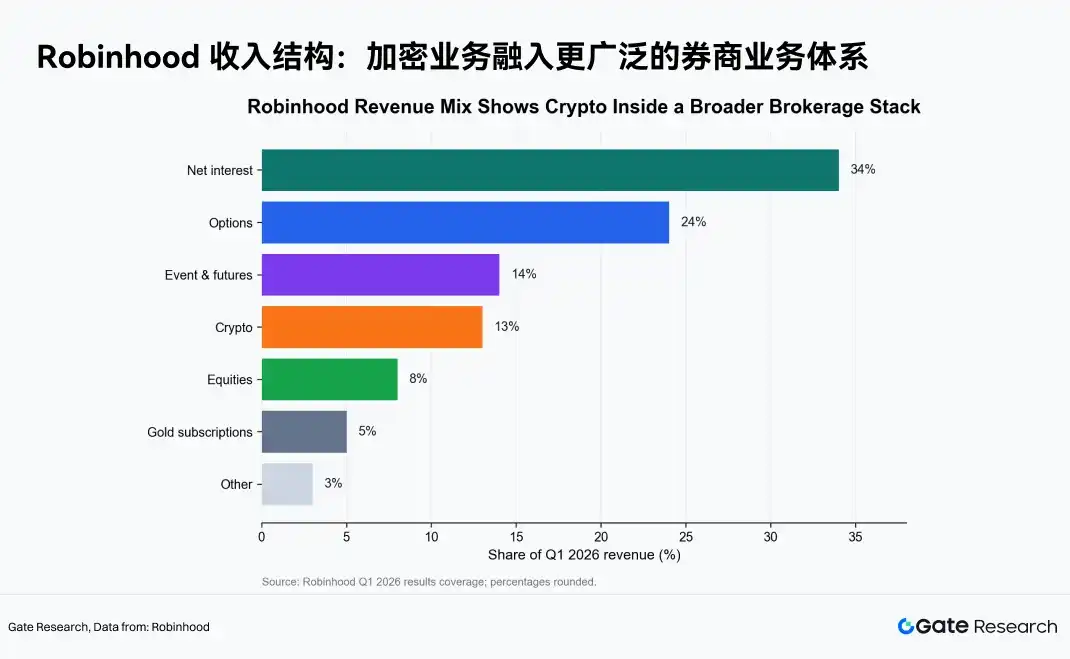
The most representative among traditional brokerages is Robinhood. Originally a typical retail brokerage and fintech platform starting with stocks, options, cash management, margin, and subscription services, crypto assets have become one of its growth engines in recent years. In Q4 2024, Robinhood's crypto trading revenue reached $358 million, a year-on-year increase of over 700%, driving a more than 200% increase in trading revenue. For the full year 2025, Robinhood's total revenue reached $4.5 billion, net deposits for the year reached $68 billion, and Gold subscription users reached 4.2 million, indicating its evolution from a single stock trading app into a comprehensive financial account.
Robinhood's crypto strategy is not limited to listing coins for trading. In June 2025, Robinhood completed its acquisition of Bitstamp, integrating Bitstamp's retail and institutional crypto trading businesses covering the EU, UK, US, and Asia, and strengthening its global crypto licensing and institutional capabilities. This shows Robinhood isn't simply adding crypto as another trading category within its stock app; it's acquiring crypto exchange capabilities, licenses, institutional clients, and global operations through M&A.

More importantly, it is working on moving traditional stock assets on-chain. On June 30, 2025, Robinhood announced the launch of Stock Tokens in Europe and disclosed plans to build the Robinhood Layer 2 to support real-world asset tokenization, 24/7 trading, cross-chain functionality, and self-custody. Its stock tokens were initially issued on Arbitrum, with plans to migrate to its own Layer 2 based on Arbitrum's tech stack. These Classic Stock Tokens are derivative contracts with Robinhood reflecting the price performance of the underlying stocks and ETPs.

This contrasts with Gate's path emphasizing real stock trading. Robinhood leans more towards encapsulating traditional stock exposure as on-chain or quasi-on-chain tokenized exposure, while Gate is connecting to real securities brokerage infrastructure starting from its CEX account.

2.3 The Common Goal of Both Paths: Competing for the Next-Generation Integrated Financial Account

For the average user, the financial classification behind an asset may not be that important. Most people don't care whether they're trading stocks, cryptocurrencies, ETFs, event contracts, or tokenized securities. What users truly care about is whether they can execute trades in the same account, enter and exit positions at low cost, see price changes in real-time, and quickly switch positions during market volatility.

And this is precisely the core motivation for traditional brokerages to embrace crypto assets. They don't simply want to become another Gate or CEX; they want to avoid the next generation of financial gateways being captured by crypto platforms.

Therefore, the key isn't whether a particular product succeeds in the short term, but that the direction of industry convergence is clear: Traditional brokerages want the trading speed, global liquidity, younger user base, and high-frequency trading behavior of the crypto market. Crypto platforms want the real assets, compliant identity, institutional trust, and broader asset supply of traditional finance.

Both sides are moving towards the most valuable parts of the other. The boundary between Crypto and TradFi is being broken at the product level. The core competition in the next phase will be around compliance capabilities, asset coverage, capital efficiency, user experience, and global account systems.

3. RWA and On-Chain Treasuries: The Middle Layer Unifying Capital Markets

The Gate and Robinhood examples mentioned above represent convergence at the user gateway level, while RWA and on-chain Treasuries represent convergence at the asset layer.

Historically, one of the biggest issues in the crypto market was the relatively closed supply of on-chain assets. Beyond native tokens, stablecoins, NFTs, and a few derivative assets, the on-chain world struggled to host a sufficiently rich, low-volatility, and institutionally suitable pool of real-yield assets.

On-chain Treasuries change this. When US Treasuries, money market funds, and short-term bond funds are tokenized, they become the on-chain world's approximation of "risk-free yield." They can serve as collateral, be integrated into DeFi compositions, facilitate institutional treasury management, and become the yield source backing stablecoins and other on-chain financial products.

However, this market is still nascent. Data from May 2026 shows the tokenized US Treasury market is around $15 billion, while the entire US Treasury market is approximately $30 trillion. There is a difference of over three orders of magnitude.
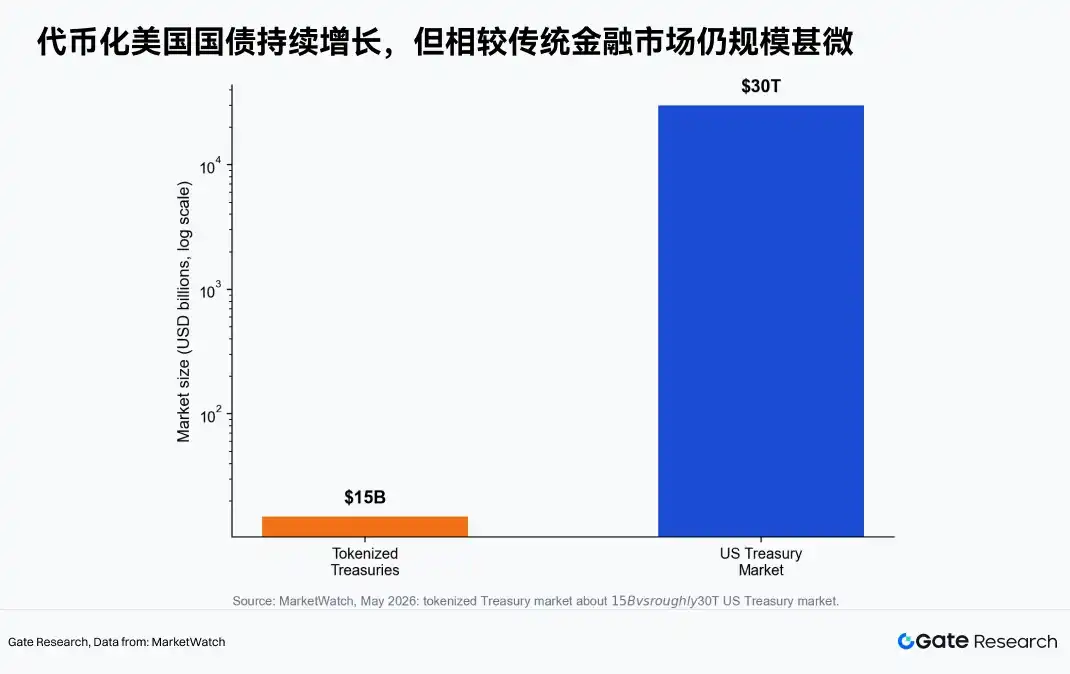
This gap indicates two things. First, RWA is not a completed market but a market just beginning its institutionalization. Second, its ceiling isn't determined by crypto-native users but by whether traditional financial assets can enter the on-chain environment in a compliant, auditable, settleable, and distributable manner. This is why traditional institutions like JPMorgan, BlackRock, Franklin Templeton, BNY, DTCC, and Nasdaq simultaneously appear in the tokenization narrative. In the long run, they are not creating a separate crypto product but testing the underlying settlement and asset registration methods for future capital markets.

And data proves this convergence is not a narrative bubble but a real structural trend. In H1 2026, while the broader crypto market fell 28% and DeFi TVL shrank over 25%, the RWA sector grew over 40% against the trend, surpassing $32 billion in scale. Tokenized stocks were the growth engine: the number of holding wallets grew 188% in six months, reaching about 350,000, making it the largest RWA category by wallet count, surpassing tokenized gold. This means many users already in the crypto world who wanted exposure to US stocks found an entry point without returning to traditional brokerages. Meanwhile, DTCC, US, and Japanese banks plan to enter in 2026–2027, aiming to "infrastructure-ize" tokenized stocks.

4. The Logical Endpoint: Stocks, Crypto, RWA, On-Chain Treasuries Trading Side-by-Side

4.1 Unified Capital Markets and the "Super Account"

In the old financial system, different assets were segregated into different accounts: stocks in brokerage accounts, funds in asset management accounts, bonds in institutional systems, deposits in bank accounts, crypto on exchanges or wallets, and on-chain assets in self-custody addresses. Each asset class had its own trading hours, settlement cycles, custody rules, compliance requirements, and user interfaces. But the new generation of platforms is attempting to compress these divisions into a single account.

Crypto exchanges are expanding from coins to stocks, ETFs, RWA, payments, and on-chain yield. Traditional brokerages are expanding from stocks to crypto, tokenized securities, prediction markets, stablecoins, and 24/7 trading. Asset managers are expanding from funds to ETFs, tokenized funds, and on-chain distribution. Banks are expanding from deposits and settlement to tokenized deposits, on-chain payments, and institutional clearing networks.

On the surface, they offer different products. In reality, they are all competing for the same thing: the default entry point for the next-generation multi-asset account. Whoever controls this gateway controls distribution; whoever controls distribution can influence liquidity, pricing, custody, and asset issuance.

The future taking shape likely involves users trading BTC, ETH, Apple stock, Nvidia stock, S&P ETFs, on-chain US Treasuries, money market funds, gold, RWA, prediction market contracts, and even tokenized shares of private companies—all within the same interface. Stablecoins may become the cross-market funding layer, on-chain Treasuries may serve as collateral and yield base, ETFs and tokenized funds may become bridges for traditional assets to enter crypto accounts, and the boundaries between brokerage apps and crypto exchange apps will increasingly blur.

This market will likely not be fully decentralized nor fully controlled by Wall Street. A hybrid structure is more probable. Asset issuance will remain regulated, custody will require compliant institutions, securities trading will still have geographic and investor suitability restrictions, but the trading interface, fund flow, settlement speed, and asset composition methods will increasingly resemble the crypto market.

The competition for the next generation of capital markets isn't between crypto exchanges and stock exchanges; it's about who can compress the most assets, deepest liquidity, most trustworthy custody, and smoothest user experience into the same account.

4.2 Conclusion: Wall Street Hasn't Conquered Crypto, and Crypto Hasn't Bypassed Wall Street

The "Wall Street-ization" of crypto financial products should not be interpreted as the crypto market being taken over by traditional finance. More accurately, it is a mutual transformation. Future industry competition may no longer be point-to-point between CEXs and brokerages, but among financial super-gateways. CEXs will continue expanding into stocks, ETFs, bonds, funds, gold, forex, payments, and wealth management. Traditional brokerages will continue expanding into crypto spot, staking, tokenized assets, stablecoin payments, and on-chain settlement. What end-users eventually see might not be a "crypto exchange" or a "stock brokerage," but a unified account containing BTC, ETH, USDT, US stocks, ETFs, gold, on-chain yield products, and more.

Long-term, asset categories will remain important, regulatory boundaries will persist, but the user experience will become far less fragmented than today. Stocks, crypto, RWA, and on-chain Treasuries will no longer belong to separate worlds but will be repriced within the same funding layer, the same account system, and the same trading interface.

Wall Street hasn't simply conquered crypto. Crypto hasn't bypassed Wall Street. They are jointly reshaping capital markets into another form.

Returning to that line in Satoshi's genesis block. Seventeen years ago, Bitcoin aimed to bypass Wall Street and build its own financial order. Seventeen years later, Bitcoin and Wall Street are co-building a new track. The decentralized ideal hasn't faded; it continues operating at the protocol's foundational layer. And at the application layer accessible to ordinary people, a more efficient, more global, and freer unified capital market is quietly taking shape at the intersection of these two converging paths.

Data Sources

• Gate, https://www.gate.com

• CryptoTimes, https://www.cryptotimes.io/insights/how-etfs-are-driving-bitcoin-in-2026-big-players-shaping-the-trend/

• InvestaX, https://investax.io/blog/q1-2026-real-world-asset-tokenization-market-report

• RWA.xyz, https://app.rwa.xyz/

• CoinGape, https://coingape.com/best-crypto-exchanges-to-trade-real-world-assets/

• Eco, https://eco.com/support/en/articles/15083160-robinhood-tokenized-stocks-what-s-live-and-how-it-works

• Eco, https://eco.com/support/en/articles/15254023-tokenized-equities-2026-backed-dinari-robinhood

• CEX.IO, https://blog.cex.io/ecosystem/tokenized-stocks-q2-2026-trends-35636

Gate Research Institute is a comprehensive blockchain and cryptocurrency research platform, providing readers with in-depth content including technical analysis, hot topic insights, market reviews, industry research, trend forecasts, and macroeconomic policy analysis.

Disclaimer

Investing in cryptocurrency markets involves high risks. Users are advised to conduct independent research and fully understand the nature of the assets and products they purchase before making any investment decisions. Gate assumes no responsibility for any losses or damages arising from such investment decisions.


Crypto di tendenza

Domande pertinenti

QWhat were the original three 'de-' principles of Bitcoin's creation as described in the article?

AThe original three 'de-' principles of Bitcoin's creation were: decentralization (no central issuer, global node maintenance), de-intermediation (peer-to-peer value transfer without banks or brokers), and de-banking (anyone can hold, transfer, and issue new coins without needing a bank account, KYC, or accredited investor status).

QHow is the 'Wall Street-ization' of crypto assets manifested according to the article?

AThe 'Wall Street-ization' of crypto assets is manifested through several key developments: the approval and growth of Bitcoin and Ethereum ETFs managed by giants like BlackRock and Fidelity, the rise of regulated derivatives on CME, the rapid expansion of tokenized real-world assets (RWA) like U.S. Treasuries, and the integration of crypto assets into traditional retirement accounts like 401(k)s. This shifts control over issuance, pricing, custody, and distribution towards traditional financial institutions.

QWhat are the two opposite but converging paths described for the fusion of crypto and traditional finance (TradFi)?

AThe two converging paths are: Path A, where a crypto-native exchange (CEX) like Gate expands into traditional finance by offering tokenized stocks, CFDs, and eventually direct access to real stock trading. Path B, where a traditional brokerage like Robinhood expands into crypto by integrating crypto trading, acquiring crypto exchanges (e.g., Bitstamp), and tokenizing traditional stocks on-chain. Both aim to create a comprehensive, multi-asset financial account.

QWhat role do Real-World Assets (RWA) and tokenized Treasuries play in the fusion of financial markets?

ARWA and tokenized Treasuries act as a unifying middle layer or 'risk-free yield proxy' for the on-chain world. They bring low-volatility, yield-generating traditional assets onto the blockchain, serving as collateral in DeFi, a source of yield for stablecoins, and meeting institutional demand. Their growth, especially in tokenized equities, provides crypto users exposure to traditional assets without leaving the crypto ecosystem, while attracting traditional financial infrastructure providers to build on-chain.

QWhat is the article's conclusion about the relationship between Wall Street and crypto, and the likely future of capital markets?

AThe article concludes that the relationship is not a zero-sum game where one conquers the other. Instead, it's a process of mutual transformation and convergence. The future likely holds a hybrid structure where a 'unified capital market' emerges. Users will access a 'super account' or unified interface to trade diverse assets—like crypto, stocks, ETFs, RWA, and tokenized Treasuries—seamlessly. Competition will shift to who can build the best multi-asset platform with deep liquidity, strong custody, and smooth user experience, blurring the lines between crypto exchanges and traditional brokerages.

Letture associate

After Three Consecutive Quarters of Decline, Can the Crypto Market Find a Window for Stabilization in Q3?

The cryptocurrency market has just concluded its worst-performing quarter since 2022, with total capitalization dropping 12.6% to $2.1 trillion. All core metrics indicate capital is leaving the sector, not just rotating within it. Bitcoin fell 14.2% and Ethereum dropped 25.4% in Q2, breaking their previous correlation with US tech stocks. A key driver is the reversal in US spot Bitcoin ETF flows, which saw a net outflow of approximately $4.67 billion in Q2, including a record monthly outflow near $4.5 billion in June. While recent data suggests long-term holders are accumulating again, sustained ETF outflows mean continued selling pressure. Market focus is now singularly on the Federal Reserve. The upcoming July FOMC meeting is seen as the most critical event for Q3. A dovish signal could support Bitcoin reclaiming a $68,000-$84,000 range, while a hawkish stance might establish a new trading band around $50,000-$56,000. Additionally, regulatory uncertainty persists, with the progress of the crucial *CLARITY Act* stalling in the Senate, reducing its perceived 2026 passage probability to 40-45%. Despite the broad downturn, a few sectors showed growth. Prediction markets saw nominal volume surge 48.7% year-over-year to $113.8 billion, and tokenized collectibles transaction volume rose 143% quarterly to $1.4 billion. The Real-World Asset (RWA) tokenization sector also continued steady growth, now representing ~$28.1 billion in on-chain value. The market's foundation for an extreme crash appears limited, with Bitcoin price hovering near its 200-week moving average. However, the trading paradigm has shifted from narrative-driven speculation to decisions based on price action, policy developments, and interest rate expectations, making a broad sentiment-driven rally unlikely in the near term.

marsbit29 min fa

After Three Consecutive Quarters of Decline, Can the Crypto Market Find a Window for Stabilization in Q3?

marsbit29 min fa

BIT Trading Moment: BTC Still Suppressed by Weekly 200 EMA, Rejection May Restart Decline; Storage and Semiconductors that Surged Last Night Begin Falling in Evening Trading

**Crypto & Stock Market Wrap: Bitcoin Tests Resistance, Stocks Retreat After AI Surge** Bitcoin consolidates around $66,000, facing key resistance near $68,000—an area seen as a major psychological and technical hurdle where previous rallies have failed. Analysts note the cryptocurrency is caught between its 200-week moving average (~$63,333) and 200-week EMA (~$68,328). A clear break above $68k is needed to signal a stronger bullish trend, while a rejection could lead to a retest of $63k support. Market sentiment remains cautious, with low futures open interest pointing to a low-liquidity rebound rather than a full bull market. Bitcoin spot ETFs saw another $203 million inflow. US stock futures pointed lower after a strong Tuesday session led by a massive rebound in semiconductors and memory stocks. The rally was fueled by renewed optimism about AI-driven hardware demand, with Micron, SanDisk, and SK Hynix surging. However, those gains reversed in pre-market trading. Super Micro Computer (SMCI) soared over 20% after hours on strong guidance and a record backlog. Other standouts included Rocket Lab and nuclear energy plays Oklo and X-Energy. Rising oil prices (Brent above $91) and climbing Treasury yields (10-year near 4.64%), however, are reigniting inflation concerns and acting as a headwind for equities. In Asia, markets were mixed. South Korea's KOSPI pared early gains to close slightly higher as semiconductor stocks like SK Hynix gave back initial surges. Japan's Nikkei edged lower as the yen hit a fresh 38-year low against the dollar, raising fears of potential market intervention. Key events to watch include the Samsung Galaxy launch, AMD's AI event, and a slew of major tech earnings from Alphabet, Tesla, and IBM after the close on Wednesday, followed by the ECB meeting and Intel's earnings on Thursday.

marsbit37 min fa

BIT Trading Moment: BTC Still Suppressed by Weekly 200 EMA, Rejection May Restart Decline; Storage and Semiconductors that Surged Last Night Begin Falling in Evening Trading

marsbit37 min fa

Former CFTC Chairman, Circle President Tarbert: Preaching Long-Termism While Cashing Out $30 Million Himself

Former CFTC Chairman and Circle President Heath Tarbert has consistently advocated for a long-term vision in public, urging patience from investors as Circle’s stock price has fallen significantly from its peak. However, it has been revealed that since Circle’s IPO, Tarbert has continuously sold his CRCL shares through pre-arranged trading plans, cashing out approximately $30 million, without making any public market purchases. This contrast between his public messaging and personal actions has drawn criticism. Tarbert joined Circle in July 2023 as Chief Legal Officer, leveraging his regulatory experience to help guide the company through its IPO and expansion. Despite promoting stablecoins as long-term infrastructure, he established a 10b5-1 trading plan just before Circle went public, leading to substantial stock sales over the following year. In March 2026, he initiated another plan to sell more shares. His career trajectory highlights a pattern of moving between high-level regulatory roles and influential positions in the financial sector. After resigning as CFTC Chairman in early 2021, he joined Citadel Securities as Chief Legal Officer just 27 days later, during a period of intense regulatory scrutiny for the firm. He later joined Circle, aiding its efforts to navigate regulatory challenges for its public listing. While Tarbert's expertise in policy and compliance is valuable to companies like Circle, his actions—advocating long-term confidence while personally divesting—raise questions about the alignment between his public statements and his private financial decisions, leaving investors who followed his advice to bear the market risks.

marsbit1 h fa

Former CFTC Chairman, Circle President Tarbert: Preaching Long-Termism While Cashing Out $30 Million Himself

marsbit1 h fa

Trading

Spot

Articoli Popolari

Cosa è BITCOIN

Comprendere HarryPotterObamaSonic10Inu (ERC-20) e la sua posizione nel mondo delle criptovalute Negli ultimi anni, il mercato delle criptovalute ha assistito a un aumento della popolarità delle meme coin, catturando l'interesse non solo dei trader, ma anche di coloro che cercano coinvolgimento comunitario e valore di intrattenimento. Tra questi token unici c'è HarryPotterObamaSonic10Inu (ERC-20), un progetto intrigante che mescola riferimenti culturali nel tessuto delle criptovalute. Questo articolo esplora gli aspetti chiave di HarryPotterObamaSonic10Inu, analizzando i suoi meccanismi, l'etica guidata dalla comunità e il suo coinvolgimento con il panorama crittografico più ampio. Che cos'è HarryPotterObamaSonic10Inu (ERC-20)? Come suggerisce il suo nome, HarryPotterObamaSonic10Inu è una meme coin costruita sulla blockchain di Ethereum, classificata secondo lo standard ERC-20. A differenza delle criptovalute tradizionali che possono enfatizzare l'utilità pratica o il potenziale investimento, questo token prospera grazie al valore di intrattenimento e alla forza della sua comunità. Il progetto mira a creare un ambiente in cui gli utenti coinvolti possono riunirsi, condividere idee e partecipare ad attività ispirate a diversi fenomeni culturali. Una caratteristica notevole di HarryPotterObamaSonic10Inu è la zero tassa sulle transazioni. Questo elemento allettante tende a incoraggiare il trading e il coinvolgimento della comunità, privo di costi aggiuntivi che possono scoraggiare i trader di piccole dimensioni. L'offerta totale della moneta è fissata a un miliardo di token, un numero che segna la sua intenzione di mantenere una circolazione sostanziale all'interno della comunità. Creatore di HarryPotterObamaSonic10Inu (ERC-20) Le origini di HarryPotterObamaSonic10Inu sono avvolte in un certo mistero; i dettagli sul creatore rimangono sconosciuti. Lo sviluppo di questo token non presenta un team identificabile o un piano esplicito, cosa non rara nel settore delle meme coin. Invece, il progetto è emerso organicamente, con il suo progresso fortemente dipendente dall'entusiasmo e dalla partecipazione della sua comunità. Investitori di HarryPotterObamaSonic10Inu (ERC-20) Per quanto riguarda investimenti esterni e finanziamenti, HarryPotterObamaSonic10Inu rimane ambiguo. Il token non elenca alcuna fondazione di investimento conosciuta o un sostegno organizzativo significativo. Invece, la linfa vitale del progetto è la sua comunità di base, che informa la sua crescita e sostenibilità attraverso azioni collettive e coinvolgimento nello spazio crittografico. Come funziona HarryPotterObamaSonic10Inu (ERC-20)? In quanto meme coin, HarryPotterObamaSonic10Inu opera principalmente al di fuori delle strutture tradizionali che governano spesso il valore degli asset. Ci sono diversi aspetti distintivi che definiscono il funzionamento del progetto: Transazioni senza tasse: Senza costi fiscali sulle transazioni, gli utenti possono comprare e vendere liberamente il token senza preoccuparsi di costi nascosti. Coinvolgimento della comunità: Il progetto prospera sull'interazione della comunità, sfruttando le piattaforme social per creare entusiasmo e facilitare il coinvolgimento. Discussioni, condivisione di contenuti e coinvolgimento sono elementi cruciali che aiutano ad espandere la sua portata e a favorire la lealtà tra i sostenitori. Nessuna utilità pratica: Va notato che HarryPotterObamaSonic10Inu non offre un'utilità concreta all'interno dell'ecosistema finanziario. Piuttosto, è classificato come un token principalmente per attività di intrattenimento e comunitarie. Riferimento culturale: Il token incorpora astutamente elementi della cultura pop per attirare interesse, collegandosi a appassionati di meme e seguaci delle criptovalute. HarryPotterObamaSonic10Inu esemplifica come le meme coin operino in modo diverso rispetto ai progetti di criptovalute più tradizionali, entrando nel mercato come costrutti sociali innovativi piuttosto che come asset utilitari. Cronologia di HarryPotterObamaSonic10Inu (ERC-20) La storia di HarryPotterObamaSonic10Inu è segnata da diversi traguardi notevoli: Creazione: Il token è emerso da un meme virale, catturando l'immaginazione di molti appassionati di criptovalute. Le date di creazione specifiche non sono disponibili, sottolineando la sua crescita organica. Inserimento negli scambi: HarryPotterObamaSonic10Inu ha fatto il suo ingresso in vari scambi, consentendo un accesso e un trading più facili da parte della comunità. Iniziative di coinvolgimento della comunità: Attività in corso volte a migliorare l'interazione della comunità, comprese gare, campagne sui social media e generazione di contenuti da parte di fan e sostenitori. Piani di espansione futura: La tabella di marcia del progetto include il lancio di una collezione NFT, merchandising e un sito di eCommerce relativo ai suoi temi culturali, coinvolgendo ulteriormente la comunità e cercando di aggiungere più dimensioni al suo ecosistema. Punti chiave su HarryPotterObamaSonic10Inu (ERC-20) Natura guidata dalla comunità: Il progetto dà priorità al contributo collettivo e alla creatività, garantendo che il coinvolgimento degli utenti sia al centro del suo sviluppo. Classificazione come meme coin: Rappresenta l'epitome delle criptovalute basate sull'intrattenimento, distinguendosi dai veicoli d'investimento tradizionali. Nessuna affiliazione diretta con Bitcoin: Nonostante la somiglianza nel nome del ticker, HarryPotterObamaSonic10Inu è distintivo e non ha alcuna relazione con Bitcoin o altre criptovalute consolidate. Focus sulla collaborazione: HarryPotterObamaSonic10Inu è progettato per creare uno spazio per la collaborazione e la condivisione di storie tra i suoi detentori, fornendo un canale per la creatività e il legame comunitario. Prospettive future: L'ambizione di espandersi oltre il suo presupposto iniziale verso NFT e merchandising delinea un percorso per il progetto per potenzialmente entrare in strade più mainstream all'interno della cultura digitale. Poiché le meme coin continuano a catturare l'immaginazione della comunità crittografica, HarryPotterObamaSonic10Inu (ERC-20) si distingue per i suoi legami culturali e il suo approccio centrato sulla comunità. Anche se potrebbe non adattarsi al modello tipico di un token orientato all'utilità, la sua essenza risiede nella gioia e nella camaraderia coltivate tra i suoi sostenitori, evidenziando la natura in evoluzione delle criptovalute in un'epoca sempre più digitale. Con la continuazione dello sviluppo del progetto, sarà importante osservare come le dinamiche della comunità influenzano la sua traiettoria nel panorama in continuo cambiamento della tecnologia blockchain.

1.8k Totale visualizzazioniPubblicato il 2024.04.01Aggiornato il 2024.12.03

Cosa è BITCOIN

Come comprare BTC

Benvenuto in HTX.com! Abbiamo reso l'acquisto di Bitcoin (BTC) semplice e conveniente. Segui la nostra guida passo passo per intraprendere il tuo viaggio nel mondo delle criptovalute.Step 1: Crea il tuo Account HTXUsa la tua email o numero di telefono per registrarti il tuo account gratuito su HTX. Vivi un'esperienza facile e sblocca tutte le funzionalità,Crea il mio accountStep 2: Vai in Acquista crypto e seleziona il tuo metodo di pagamentoCarta di credito/debito: utilizza la tua Visa o Mastercard per acquistare immediatamente BitcoinBTC.Bilancio: Usa i fondi dal bilancio del tuo account HTX per fare trading senza problemi.Terze parti: abbiamo aggiunto metodi di pagamento molto utilizzati come Google Pay e Apple Pay per maggiore comodità.P2P: Fai trading direttamente con altri utenti HTX.Over-the-Counter (OTC): Offriamo servizi su misura e tassi di cambio competitivi per i trader.Step 3: Conserva Bitcoin (BTC)Dopo aver acquistato Bitcoin (BTC), conserva nel tuo account HTX. In alternativa, puoi inviare tramite trasferimento blockchain o scambiare per altre criptovalute.Step 4: Scambia Bitcoin (BTC)Scambia facilmente Bitcoin (BTC) nel mercato spot di HTX. Accedi al tuo account, seleziona la tua coppia di trading, esegui le tue operazioni e monitora in tempo reale. Offriamo un'esperienza user-friendly sia per chi ha appena iniziato che per i trader più esperti.

4.1k Totale visualizzazioniPubblicato il 2024.12.12Aggiornato il 2026.06.02

Come comprare BTC

Cosa è $BITCOIN

ORO DIGITALE ($BITCOIN): Un'Analisi Completa Introduzione all'ORO DIGITALE ($BITCOIN) L'ORO DIGITALE ($BITCOIN) è un progetto basato su blockchain che opera sulla rete Solana, con l'obiettivo di combinare le caratteristiche dei metalli preziosi tradizionali con l'innovazione delle tecnologie decentralizzate. Sebbene condivida un nome con Bitcoin, spesso definito “oro digitale” a causa della sua percezione come riserva di valore, l'ORO DIGITALE è un token separato progettato per creare un ecosistema unico all'interno del panorama Web3. Il suo obiettivo è posizionarsi come un asset digitale alternativo valido, anche se i dettagli riguardanti le sue applicazioni e funzionalità sono ancora in fase di sviluppo. Cos'è l'ORO DIGITALE ($BITCOIN)? L'ORO DIGITALE ($BITCOIN) è un token di criptovaluta esplicitamente progettato per l'uso sulla blockchain di Solana. A differenza di Bitcoin, che fornisce un ruolo di stoccaggio di valore ampiamente riconosciuto, questo token sembra concentrarsi su applicazioni e caratteristiche più ampie. Aspetti notevoli includono: Infrastruttura Blockchain: Il token è costruito sulla blockchain di Solana, nota per la sua capacità di gestire transazioni ad alta velocità e a basso costo. Dinamiche di Offerta: L'ORO DIGITALE ha un'offerta massima fissata a 100 quadrilioni di token (100P $BITCOIN), sebbene i dettagli riguardanti la sua offerta circolante siano attualmente non divulgati. Utilità: Sebbene le funzionalità precise non siano esplicitamente delineate, ci sono indicazioni che il token potrebbe essere utilizzato per varie applicazioni, potenzialmente coinvolgendo applicazioni decentralizzate (dApp) o strategie di tokenizzazione degli asset. Chi è il Creatore dell'ORO DIGITALE ($BITCOIN)? Attualmente, l'identità dei creatori e del team di sviluppo dietro l'ORO DIGITALE ($BITCOIN) rimane sconosciuta. Questa situazione è tipica tra molti progetti innovativi nel settore blockchain, in particolare quelli allineati con la finanza decentralizzata e i fenomeni delle meme coin. Sebbene tale anonimato possa favorire una cultura guidata dalla comunità, intensifica le preoccupazioni riguardo alla governance e alla responsabilità. Chi sono gli Investitori dell'ORO DIGITALE ($BITCOIN)? Le informazioni disponibili indicano che l'ORO DIGITALE ($BITCOIN) non ha alcun sostenitore istituzionale noto o investimenti di venture capital prominenti. Il progetto sembra operare su un modello peer-to-peer incentrato sul supporto e sull'adozione della comunità piuttosto che su percorsi di finanziamento tradizionali. La sua attività e liquidità si trovano principalmente su exchange decentralizzati (DEX), come PumpSwap, piuttosto che su piattaforme di trading centralizzate consolidate, evidenziando ulteriormente il suo approccio di base. Come Funziona l'ORO DIGITALE ($BITCOIN) Le meccaniche operative dell'ORO DIGITALE ($BITCOIN) possono essere elaborate in base al suo design blockchain e alle caratteristiche della rete: Meccanismo di Consenso: Sfruttando il proof-of-history (PoH) unico di Solana combinato con un modello di proof-of-stake (PoS), il progetto garantisce una validazione efficiente delle transazioni contribuendo all'alta performance della rete. Tokenomics: Sebbene meccanismi deflazionistici specifici non siano stati dettagliati ampiamente, l'ampia offerta massima di token implica che potrebbe soddisfare microtransazioni o casi d'uso di nicchia che devono ancora essere definiti. Interoperabilità: Esiste il potenziale per l'integrazione con l'ecosistema più ampio di Solana, inclusi vari piattaforme di finanza decentralizzata (DeFi). Tuttavia, i dettagli riguardanti integrazioni specifiche rimangono non specificati. Cronologia degli Eventi Chiave Ecco una cronologia che evidenzia traguardi significativi riguardanti l'ORO DIGITALE ($BITCOIN): 2023: Il dispiegamento iniziale del token avviene sulla blockchain di Solana, contrassegnato dal suo indirizzo di contratto. 2024: L'ORO DIGITALE guadagna visibilità poiché diventa disponibile per il trading su exchange decentralizzati come PumpSwap, consentendo agli utenti di scambiarlo contro SOL. 2025: Il progetto assiste a un'attività di trading sporadica e a un potenziale interesse per impegni guidati dalla comunità, sebbene non siano state documentate partnership significative o avanzamenti tecnici fino ad ora. Analisi Critica Punti di Forza Scalabilità: L'infrastruttura sottostante di Solana supporta alti volumi di transazioni, il che potrebbe migliorare l'utilità di $BITCOIN in vari scenari di transazione. Accessibilità: Il potenziale basso prezzo di trading per token potrebbe attrarre investitori al dettaglio, facilitando una partecipazione più ampia grazie a opportunità di proprietà frazionata. Rischi Mancanza di Trasparenza: L'assenza di sostenitori, sviluppatori o di un processo di audit pubblicamente noti potrebbe generare scetticismo riguardo alla sostenibilità e all'affidabilità del progetto. Volatilità del Mercato: L'attività di trading è fortemente dipendente dal comportamento speculativo, il che può comportare una significativa volatilità dei prezzi e incertezze per gli investitori. Conclusione L'ORO DIGITALE ($BITCOIN) emerge come un progetto intrigante ma ambiguo all'interno dell'evolvente ecosistema di Solana. Sebbene tenti di sfruttare la narrativa dell'“oro digitale”, la sua partenza dal ruolo consolidato di Bitcoin come riserva di valore sottolinea la necessità di una chiara differenziazione della sua utilità e struttura di governance. L'accettazione e l'adozione future dipenderanno probabilmente dall'affrontare l'attuale opacità e dalla definizione più esplicita delle sue strategie operative ed economiche. Nota: Questo rapporto comprende informazioni sintetizzate disponibili a ottobre 2023, e potrebbero essersi verificati sviluppi oltre il periodo di ricerca.

154 Totale visualizzazioniPubblicato il 2025.05.13Aggiornato il 2025.05.13

Cosa è $BITCOIN

Discussioni

Benvenuto nella Community HTX. Qui puoi rimanere informato sugli ultimi sviluppi della piattaforma e accedere ad approfondimenti esperti sul mercato. Le opinioni degli utenti sul prezzo di BTC BTC sono presentate come di seguito.

活动图片













