Why Isn't Asia's Largest Bitcoin Treasury Company Metaplanet Buying the Dip?

marsbitPubblicato 2025-12-11Pubblicato ultima volta 2025-12-11

Introduzione

Metaplanet, the Japanese company known as the "Asian MicroStrategy," has paused its Bitcoin accumulation strategy for ten consecutive weeks since September 30, despite the recent market correction. While giants like MicroStrategy continued buying—adding 10,624 BTC at an average of $90,615—Metaplanet shifted its focus to stock buybacks and capital structure improvements. This pause reflects a broader industry trend where Bitcoin treasury firms (DATs) are prioritizing risk management over aggressive accumulation. DATs have faced significant pressure, with median stock prices dropping 43% and some falling over 99%, leading Galaxy to warn of a "Darwinian phase" for the sector. Metaplanet’s tactical halt aims to protect shareholder value and avoid further dilution, especially after its mNAV fell below 1x. The company also seeks to avoid accounting losses under Japan’s conservative standards, as its Bitcoin holdings have over $500 million in unrealized losses with an average cost of $108,000. Instead, Metaplanet is leveraging Japan’s low-interest environment to develop innovative financing tools, such as the "Mercury" perpetual preferred stock offering a 4.9% yield—ten times local bank rates—with 73% of proceeds directed to Bitcoin purchases. It also uses Moving Strike Warrants (MSW) to raise capital without violating Japan’s market restrictions. The company benefits from unique advantages: yen depreciation enhances Bitcoin’s appeal as a hedge, and Japanese investors use tax-fr...

Author:Zhou, ChainCatcher

As the crypto market enters a correction window, the actions of Bitcoin treasury companies have shown a clear divergence. The giant MicroStrategy announced last week that it spent $962.7 million to purchase an additional 10,624 Bitcoin at an average price of $90,615. In contrast, the fourth-largest Bitcoin treasury company, Metaplanet, has abruptly stopped its pace, with no further purchases for the tenth consecutive week since September 30.

Metaplanet, this Japanese listed company hailed by the market as the "Asian version of MicroStrategy", was once an aggressive representative in the DAT (Digital Asset Treasury) field. Since initiating its reserve plan in April 2024, the company has rapidly accumulated over 30,000 Bitcoin, with a total value of approximately $2.75 billion.

However, since the fourth quarter, Bitcoin's price has corrected nearly 30% from its all-time high of $126,000. Just as the market widely expected treasury companies to buy the dip, Metaplanet unexpectedly pressed the pause button after completing its last purchase on September 29, shifting its short-term capital focus to stock buybacks instead.

DAT Shifts from Aggressive Accumulation to Risk Control Priority

Data shows the total market capitalization of digital asset treasury stocks shrank significantly from $150 billion to $73.5 billion in the fourth quarter, with the mNAV (Market NAV) of most companies falling below 1x. According to Bloomberg, the stock prices of crypto asset treasury (DAT) companies listed in the US and Canada have fallen sharply this year, with a median decline of 43%, and some companies have fallen more than 99%.

Galaxy warned that Bitcoin treasury companies are entering a "Darwinian phase", where stock premiums collapse, leverage turns into a downside, DAT stocks trade at a discount, and the core mechanisms of their once-thriving business models are breaking down.

Against this market backdrop, ETHZilla, another second-tier treasury company, recently announced it would early redeem convertible bonds totaling $516 million. This move is seen as a positive signal to simplify the capital structure, enhance financial flexibility, and reduce the risk of high-interest debt during the market downturn.

Metaplanet's actions echo this. Currently, the company's outstanding debt is $304 million. Theoretically, it has 9x its Bitcoin assets as repayment security, yet it still chose to suspend purchases. This behavior is highly consistent with the current industry trend in the DAT track shifting from aggressive accumulation to risk control priority.

Stock Price Pressure and Tactical Adjustment Under Conservative Accounting

Previously, influenced by its Bitcoin holding strategy, Metaplanet's stock price soared from $20 in April 2024 to a peak of $1,930 in June 2025. Although the stock price has fallen significantly by over 70% since the second half of the year, it still recorded an overall gain of over 20% for the year, currently stabilizing around $420, with a total market capitalization of approximately $3 billion.
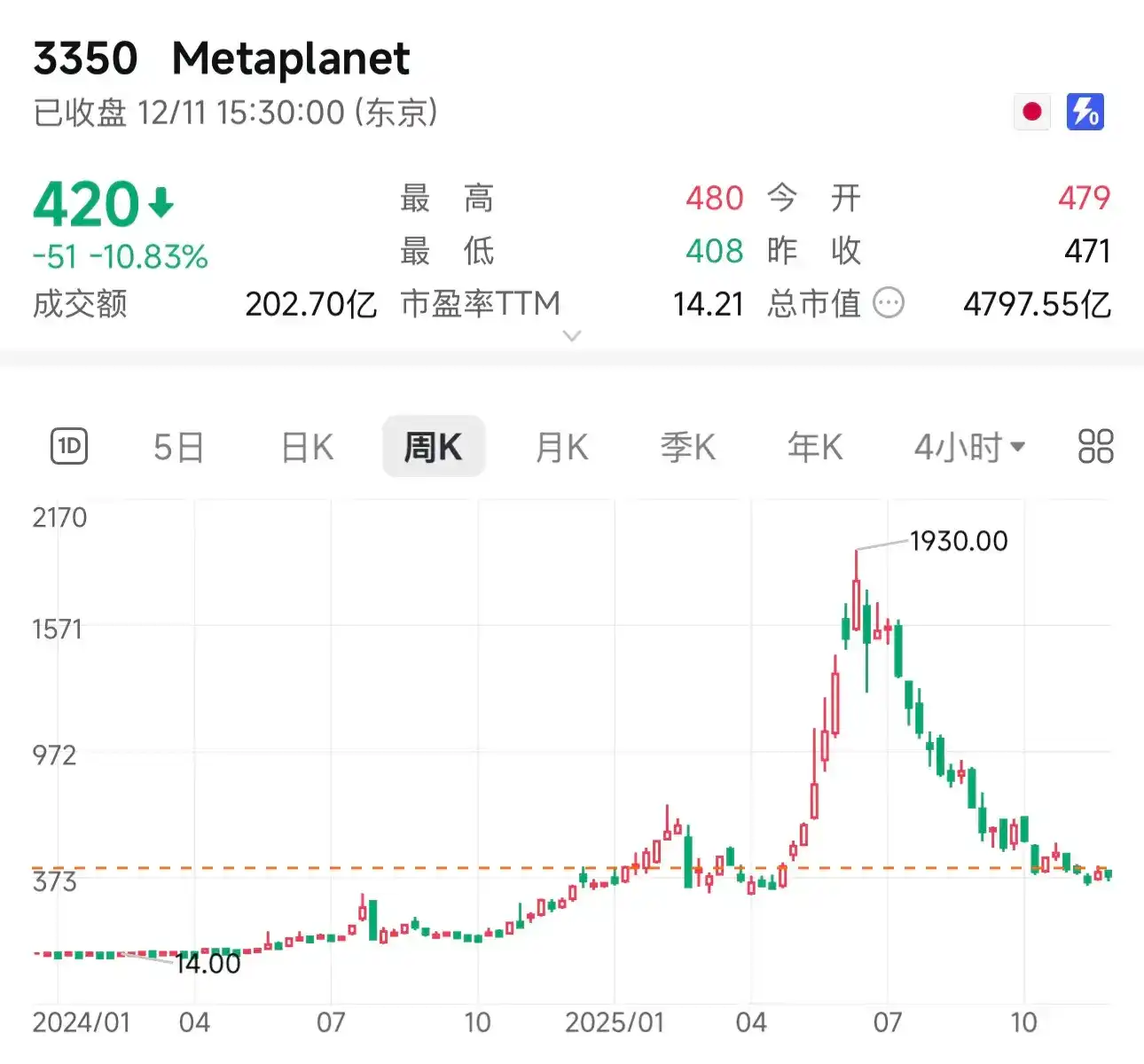
Faced with the continuous decline in stock price, Metaplanet CEO Simon Gerovich publicly responded to the stock volatility on October 2. He cited Amazon's case during the dot-com bubble, emphasizing that fundamentals and stock prices often diverge, and reiterated the company's commitment to continue accumulating Bitcoin.

Previously, in September, he stated that if the net asset value fell below the market capitalization (mNAV below 1x), issuing new shares would "destroy value mathematically" and be detrimental to the company's BTC yield. The company would prioritize evaluating options such as preferred shares and stock buybacks.

Therefore, when it faced a situation below net asset value in early October, Metaplanet quickly took action. It first announced authorization to repurchase up to 150 million shares and secured a $500 million credit line. Subsequently, it raised $100 million by pledging its Bitcoin assets to purchase more Bitcoin, expand revenue-generating businesses, and buy back shares. Part of the funds will also be used for yield-generating businesses. The company's mNAV has now recovered to above 1x.

From this perspective, the suspension of purchases is a tactical protection of its stock price and balance sheet health, prioritizing the value of existing shareholders rather than blindly expanding the balance sheet.

Furthermore, stopping purchases also avoids risks brought by Japan's conservative accounting standards. Given its average Bitcoin cost of approximately $108,000, the company has already accumulated over $500 million in unrealized losses on its books. To prevent excessive short-term impact on the income statement, it chose to proactively avoid exacerbating this book impairment risk.

Building an Asian "Moat" by Leveraging Low-Interest Advantages?

On the surface, suspending purchases is defensive. In reality, Metaplanet's true strategic intent may lie in upgrading and innovating its capital structure.

The company's Q3 financial report shows sales reached ¥2.401 billion, a 94% increase quarter-on-quarter; operating profit was ¥1.339 billion, up 64%; net profit was ¥12.7 billion; net assets were ¥532.9 billion, up 165%. Among these, the options business contributed $16.28 million in revenue, a 115% year-on-year increase. This revenue can cover daily operations and interest costs.

On this basis, Metaplanet is also trying to emulate MicroStrategy by planning to issue similar preferred shares like STRC to obtain capital more efficiently.

The company plans to launch two new digital credit instruments, "Mercury" and "Mars". "Mercury" will offer a 4.9% yield in Japanese Yen, approximately ten times the yield of Japanese bank deposits. 73% of the funds are designated for Bitcoin accumulation, including $107 million for direct purchases and $12 million for options trading. This allows the company to bypass equity dilution and turn to low-cost debt leverage, which is highly attractive to local investors.

Furthermore, since Japan does not allow at-the-market (ATM) offering mechanisms (similar to BitMine's current ATM model), which prevents listed companies from "dumping" shares in real-time on the secondary market, protecting investors from dilution shocks. Metaplanet uses a Moving Strike Warrant mechanism (MSW), cleverly bypassing this restriction while retaining the core advantage of flexible fundraising.

MSW is essentially a special stock acquisition warrant whose key feature is that the exercise price is not fixed but is dynamically adjusted periodically. Typically, every few trading days (early series of Metaplanet were every 3 trading days), the exercise price is reset to the average of the previous few days' closing prices, such as the simple moving average of the previous three days. Thus, when warrant holders choose to exercise their warrants, the company issues new common shares at a price close to the current market price, raising funds.

Later, the company may integrate this mechanism into the perpetual preferred share product Mercury: preferred shareholders could convert into common shares via conversion terms similar to MSW at a dynamic price, making the entire financing process smoother and more controllable.

Meanwhile, MicroStrategy Executive Chairman Michael Saylor has confirmed that the company will not launch similar products in Japan within the next 12 months. This time window provides Metaplanet with a valuable 12-month first-mover advantage.

The company successfully issued $150 million in Series B Perpetual Preferred Shares on November 20, indicating its financing strategy has begun to materialize. This series of actions shows that Metaplanet is leveraging Japan's low-interest-rate environment to build a unique financing "moat" for structural and sustainable expansion.

Local Advantages and MSCI Review

In fact, Metaplanet's core value lies in the unique Alpha provided by its Japanese ecosystem:

On one hand, the continuous depreciation of the Japanese Yen strengthens Bitcoin's role as an inflation hedge. Metaplanet's Bitcoin reserves provide Japanese domestic investors with an effective way to combat the decline in the Yen's purchasing power.

On the other hand, the tax-free advantage of Japan's Nippon Individual Savings Account (NISA) has attracted 63,000 Japanese domestic shareholders to Metaplanet. Compared to the 55% capital gains tax on directly holding crypto assets, investors can indirectly gain BTC exposure at a lower cost by buying Metaplanet stock through NISA.

Because of this, Metaplanet has gained recognition from international institutions. Capital Group increased its stake to 11.45%, becoming Metaplanet's largest shareholder. The current top five shareholders also include MMXX Capital, Vanguard, Evolution Capital, and Invesco Capital; Syz Capital partner Richard Byworth publicly divested from MicroStrategy and Bitcoin ETFs to invest in Metaplanet, believing the latter has lower financing costs and higher return elasticity.

An industry observer pointed out that companies like Metaplanet must prioritize ensuring financial resilience during downturns to maintain long-term accumulation goals.

However, although beneficial to structural health in the long run, Metaplanet still faces potential short-term selling pressure. For example, the MSCI index exclusion review affecting MicroStrategy has also impacted Metaplanet. It was included in the MSCI Japan Index this February. If excluded due to its high Bitcoin asset ratio, it could trigger a wave of selling by passive funds.

Conclusion

Overall, Metaplanet's suspension of Bitcoin purchases is not a failure of strategy or submission to the market. It can be seen as a strategic regrouping based on risk and efficiency considerations, also marking the maturation of the DAT track, shifting from aggressive accumulation to risk control priority.

Bitwise Chief Investment Officer Matt Hougan once stated that evaluating DAT companies using mNAV is incorrect because this valuation method does not consider the life cycle of listed companies. Most reasons for DAT trading at a discount are certain, while the reasons for premiums are often uncertain. Looking ahead, price differences among treasury companies will become more pronounced. Metaplanet might be reconstructing its valuation system.

Click to learn about open positions at ChainCatcher

Domande pertinenti

QWhy has Metaplanet, the Asian Bitcoin treasury company, paused its Bitcoin accumulation since September 30th?

AMetaplanet paused its Bitcoin accumulation to prioritize risk management, protect shareholder value amid stock price pressure, avoid exacerbating unrealized losses under Japan's conservative accounting standards, and focus on strategic financial restructuring like stock buybacks and innovative capital-raising tools.

QWhat strategic shift is occurring in the Digital Asset Treasury (DAT) company sector according to the article?

AThe DAT sector is shifting from aggressive Bitcoin accumulation to risk management prioritization, due to declining stock premiums, leveraged positions turning negative, and companies trading at discounts to their Bitcoin holdings, as highlighted by Galaxy's warning of a 'Darwin phase'.

QHow is Metaplanet leveraging Japan's financial environment to build a competitive advantage?

AMetaplanet is utilizing Japan's low-interest rates to develop innovative financing tools like perpetual preferred shares (e.g., 'Mercury' and 'Mars'), which offer high yen yields and avoid equity dilution, while also benefiting from tax advantages through NISA accounts and attracting local investors seeking Bitcoin exposure.

QWhat are the potential risks Metaplanet faces despite its strategic adjustments?

AMetaplanet faces short-term risks such as potential sell-off pressure if it is removed from the MSCI Japan Index due to its high Bitcoin asset allocation, which could trigger passive fund divestment.

QHow does Metaplanet's approach differ from MicroStrategy's in the current market context?

AUnlike MicroStrategy, which continues aggressive Bitcoin purchases, Metaplanet has paused accumulation to focus on financial stability, stock buybacks, and leveraging Japan-specific advantages like low-cost debt and innovative capital instruments, while also having a 12-month first-mover advantage in the Japanese market for such products.

Letture associate

a16z: AI's 'Amnesia', Can Continuous Learning Cure It?

The article "a16z: AI's 'Amnesia' – Can Continual Learning Cure It?" explores the limitations of current large language models (LLMs), which, like the protagonist in the film *Memento*, are trapped in a perpetual present—unable to form new memories after training. While methods like in-context learning (ICL), retrieval-augmented generation (RAG), and external scaffolding (e.g., chat history, prompts) provide temporary solutions, they fail to enable true internalization of new knowledge. The authors argue that compression—the core of learning during training—is halted at deployment, preventing models from generalizing, discovering novel solutions (e.g., mathematical proofs), or handling adversarial scenarios. The piece introduces *continual learning* as a critical research direction to address this, categorizing approaches into three paths: 1. **Context**: Scaling external memory via longer context windows, multi-agent systems, and smarter retrieval. 2. **Modules**: Using pluggable adapters or external memory layers for specialization without full retraining. 3. **Weights**: Enabling parameter updates through sparse training, test-time training, meta-learning, distillation, and reinforcement learning from feedback. Challenges include catastrophic forgetting, safety risks, and auditability, but overcoming these could unlock models that learn iteratively from experience. The conclusion emphasizes that while context-based methods are effective, true breakthroughs require models to compress new information into weights post-deployment, moving from mere retrieval to genuine learning.

marsbit2 h fa

a16z: AI's 'Amnesia', Can Continuous Learning Cure It?

marsbit2 h fa

Can a Hair Dryer Earn $34,000? Deciphering the Reflexivity Paradox in Prediction Markets

An individual manipulated a weather sensor at Paris Charles de Gaulle Airport with a portable heat source, causing a Polymarket weather market to settle at 22°C and earning $34,000. This incident highlights a fundamental issue in prediction markets: when a market aims to reflect reality, it also incentivizes participants to influence that reality. Prediction markets operate on two layers: platform rules (what outcome counts as a win) and data sources (what actually happened). While most focus on rules, the real vulnerability lies in the data source. If reality is recorded through a specific source, influencing that source directly affects market settlement. The article categorizes markets by their vulnerability: 1. **Single-point physical data sources** (e.g., weather stations): Easily manipulated through physical interference. 2. **Insider information markets** (e.g., MrBeast video details): Insiders like team members use non-public information to trade. Kalshi fined a剪辑师 $20,000 for insider trading. 3. **Actor-manipulated markets** (e.g., Andrew Tate’s tweet counts): The subject of the market can control the outcome. Evidence suggests Tate’sociated accounts coordinated to profit. 4. **Individual-action markets** (e.g., WNBA disruptions): A single person can execute an event to profit from their pre-placed bets. Kalshi and Polymarket handle these issues differently. Kalshi enforces strict KYC, publicly penalizes insider trading, and reports to regulators. Polymarket, with its anonymous wallet-based system, has historically been more permissive, arguing that insider information improves market accuracy. However, it cooperated with authorities in the "Van Dyke case," where a user traded on classified government information. The core paradox is reflexivity: prediction markets are designed to discover truth, but their financial incentives can distort reality. The more valuable a prediction becomes, the more likely participants are to influence the event itself. The market ceases to be a mirror of reality and instead shapes it.

marsbit3 h fa

Can a Hair Dryer Earn $34,000? Deciphering the Reflexivity Paradox in Prediction Markets

marsbit3 h fa

Trading

Spot
Futures

Articoli Popolari

Cosa è $S$

Comprendere SPERO: Una Panoramica Completa Introduzione a SPERO Mentre il panorama dell'innovazione continua a evolversi, l'emergere delle tecnologie web3 e dei progetti di criptovaluta gioca un ruolo fondamentale nel plasmare il futuro digitale. Un progetto che ha attirato l'attenzione in questo campo dinamico è SPERO, denotato come SPERO,$$s$. Questo articolo mira a raccogliere e presentare informazioni dettagliate su SPERO, per aiutare gli appassionati e gli investitori a comprendere le sue basi, obiettivi e innovazioni nei domini web3 e crypto. Che cos'è SPERO,$$s$? SPERO,$$s$ è un progetto unico all'interno dello spazio crypto che cerca di sfruttare i principi della decentralizzazione e della tecnologia blockchain per creare un ecosistema che promuove l'impegno, l'utilità e l'inclusione finanziaria. Il progetto è progettato per facilitare interazioni peer-to-peer in modi nuovi, fornendo agli utenti soluzioni e servizi finanziari innovativi. Al suo interno, SPERO,$$s$ mira a responsabilizzare gli individui fornendo strumenti e piattaforme che migliorano l'esperienza dell'utente nello spazio delle criptovalute. Questo include la possibilità di metodi di transazione più flessibili, la promozione di iniziative guidate dalla comunità e la creazione di percorsi per opportunità finanziarie attraverso applicazioni decentralizzate (dApps). La visione sottostante di SPERO,$$s$ ruota attorno all'inclusività, cercando di colmare le lacune all'interno della finanza tradizionale mentre sfrutta i vantaggi della tecnologia blockchain. Chi è il Creatore di SPERO,$$s$? L'identità del creatore di SPERO,$$s$ rimane piuttosto oscura, poiché ci sono risorse pubblicamente disponibili limitate che forniscono informazioni dettagliate sul suo fondatore o fondatori. Questa mancanza di trasparenza può derivare dall'impegno del progetto per la decentralizzazione—un ethos che molti progetti web3 condividono, dando priorità ai contributi collettivi rispetto al riconoscimento individuale. Centrando le discussioni attorno alla comunità e ai suoi obiettivi collettivi, SPERO,$$s$ incarna l'essenza dell'empowerment senza mettere in evidenza individui specifici. Pertanto, comprendere l'etica e la missione di SPERO rimane più importante che identificare un creatore singolo. Chi sono gli Investitori di SPERO,$$s$? SPERO,$$s$ è supportato da una varietà di investitori che vanno dai capitalisti di rischio agli investitori angelici dedicati a promuovere l'innovazione nel settore crypto. Il focus di questi investitori generalmente si allinea con la missione di SPERO—dando priorità a progetti che promettono avanzamenti tecnologici sociali, inclusività finanziaria e governance decentralizzata. Queste fondazioni di investitori sono tipicamente interessate a progetti che non solo offrono prodotti innovativi, ma contribuiscono anche positivamente alla comunità blockchain e ai suoi ecosistemi. Il supporto di questi investitori rafforza SPERO,$$s$ come un concorrente degno di nota nel dominio in rapida evoluzione dei progetti crypto. Come Funziona SPERO,$$s$? SPERO,$$s$ impiega un framework multifunzionale che lo distingue dai progetti di criptovaluta convenzionali. Ecco alcune delle caratteristiche chiave che sottolineano la sua unicità e innovazione: Governance Decentralizzata: SPERO,$$s$ integra modelli di governance decentralizzati, responsabilizzando gli utenti a partecipare attivamente ai processi decisionali riguardanti il futuro del progetto. Questo approccio favorisce un senso di proprietà e responsabilità tra i membri della comunità. Utilità del Token: SPERO,$$s$ utilizza il proprio token di criptovaluta, progettato per servire varie funzioni all'interno dell'ecosistema. Questi token abilitano transazioni, premi e la facilitazione dei servizi offerti sulla piattaforma, migliorando l'impegno e l'utilità complessivi. Architettura Stratificata: L'architettura tecnica di SPERO,$$s$ supporta la modularità e la scalabilità, consentendo un'integrazione fluida di funzionalità e applicazioni aggiuntive man mano che il progetto evolve. Questa adattabilità è fondamentale per mantenere la rilevanza nel panorama crypto in continua evoluzione. Coinvolgimento della Comunità: Il progetto enfatizza iniziative guidate dalla comunità, impiegando meccanismi che incentivano la collaborazione e il feedback. Nutrendo una comunità forte, SPERO,$$s$ può affrontare meglio le esigenze degli utenti e adattarsi alle tendenze di mercato. Focus sull'Inclusione: Offrendo basse commissioni di transazione e interfacce user-friendly, SPERO,$$s$ mira ad attrarre una base utenti diversificata, inclusi individui che potrebbero non aver precedentemente interagito nello spazio crypto. Questo impegno per l'inclusione si allinea con la sua missione generale di empowerment attraverso l'accessibilità. Cronologia di SPERO,$$s$ Comprendere la storia di un progetto fornisce preziose intuizioni sulla sua traiettoria di sviluppo e sui traguardi. Di seguito è riportata una cronologia suggerita che mappa eventi significativi nell'evoluzione di SPERO,$$s$: Fase di Concettualizzazione e Ideazione: Le idee iniziali che formano la base di SPERO,$$s$ sono state concepite, allineandosi strettamente con i principi di decentralizzazione e focus sulla comunità all'interno dell'industria blockchain. Lancio del Whitepaper del Progetto: Dopo la fase concettuale, è stato rilasciato un whitepaper completo che dettaglia la visione, gli obiettivi e l'infrastruttura tecnologica di SPERO,$$s$ per suscitare interesse e feedback dalla comunità. Costruzione della Comunità e Prime Interazioni: Sono stati effettuati sforzi attivi di outreach per costruire una comunità di early adopters e potenziali investitori, facilitando discussioni attorno agli obiettivi del progetto e ottenendo supporto. Evento di Generazione del Token: SPERO,$$s$ ha condotto un evento di generazione del token (TGE) per distribuire i propri token nativi ai primi sostenitori e stabilire una liquidità iniziale all'interno dell'ecosistema. Lancio della Prima dApp: La prima applicazione decentralizzata (dApp) associata a SPERO,$$s$ è stata attivata, consentendo agli utenti di interagire con le funzionalità principali della piattaforma. Sviluppo Continuo e Partnership: Aggiornamenti e miglioramenti continui alle offerte del progetto, inclusi partnership strategiche con altri attori nello spazio blockchain, hanno plasmato SPERO,$$s$ in un concorrente competitivo e in evoluzione nel mercato crypto. Conclusione SPERO,$$s$ rappresenta una testimonianza del potenziale del web3 e delle criptovalute di rivoluzionare i sistemi finanziari e responsabilizzare gli individui. Con un impegno per la governance decentralizzata, il coinvolgimento della comunità e funzionalità progettate in modo innovativo, apre la strada verso un panorama finanziario più inclusivo. Come per qualsiasi investimento nello spazio crypto in rapida evoluzione, si incoraggiano potenziali investitori e utenti a ricercare approfonditamente e a impegnarsi in modo riflessivo con gli sviluppi in corso all'interno di SPERO,$$s$. Il progetto mostra lo spirito innovativo dell'industria crypto, invitando a ulteriori esplorazioni delle sue innumerevoli possibilità. Mentre il percorso di SPERO,$$s$ è ancora in fase di sviluppo, i suoi principi fondamentali potrebbero effettivamente influenzare il futuro di come interagiamo con la tecnologia, la finanza e tra di noi in ecosistemi digitali interconnessi.

75 Totale visualizzazioniPubblicato il 2024.12.17Aggiornato il 2024.12.17

Cosa è $S$

Cosa è AGENT S

Agent S: Il Futuro dell'Interazione Autonoma in Web3 Introduzione Nel panorama in continua evoluzione di Web3 e criptovalute, le innovazioni stanno costantemente ridefinendo il modo in cui gli individui interagiscono con le piattaforme digitali. Uno di questi progetti pionieristici, Agent S, promette di rivoluzionare l'interazione uomo-computer attraverso il suo framework agentico aperto. Aprendo la strada a interazioni autonome, Agent S mira a semplificare compiti complessi, offrendo applicazioni trasformative nell'intelligenza artificiale (AI). Questa esplorazione dettagliata approfondirà le complessità del progetto, le sue caratteristiche uniche e le implicazioni per il dominio delle criptovalute. Cos'è Agent S? Agent S si presenta come un innovativo framework agentico aperto, progettato specificamente per affrontare tre sfide fondamentali nell'automazione dei compiti informatici: Acquisizione di Conoscenze Specifiche del Dominio: Il framework apprende in modo intelligente da varie fonti di conoscenza esterne ed esperienze interne. Questo approccio duale gli consente di costruire un ricco repository di conoscenze specifiche del dominio, migliorando le sue prestazioni nell'esecuzione dei compiti. Pianificazione su Lungo Orizzonte di Compiti: Agent S impiega una pianificazione gerarchica potenziata dall'esperienza, un approccio strategico che facilita la suddivisione e l'esecuzione efficiente di compiti complessi. Questa caratteristica migliora significativamente la sua capacità di gestire più sottocompiti in modo efficiente ed efficace. Gestione di Interfacce Dinamiche e Non Uniformi: Il progetto introduce l'Interfaccia Agente-Computer (ACI), una soluzione innovativa che migliora l'interazione tra agenti e utenti. Utilizzando Modelli Linguistici Multimodali di Grandi Dimensioni (MLLM), Agent S può navigare e manipolare senza sforzo diverse interfacce grafiche utente. Attraverso queste caratteristiche pionieristiche, Agent S fornisce un framework robusto che affronta le complessità coinvolte nell'automazione dell'interazione umana con le macchine, preparando il terreno per innumerevoli applicazioni nell'AI e oltre. Chi è il Creatore di Agent S? Sebbene il concetto di Agent S sia fondamentalmente innovativo, informazioni specifiche sul suo creatore rimangono elusive. Il creatore è attualmente sconosciuto, il che evidenzia sia la fase embrionale del progetto sia la scelta strategica di mantenere i membri fondatori sotto anonimato. Indipendentemente dall'anonimato, l'attenzione rimane sulle capacità e sul potenziale del framework. Chi sono gli Investitori di Agent S? Poiché Agent S è relativamente nuovo nell'ecosistema crittografico, informazioni dettagliate riguardanti i suoi investitori e sostenitori finanziari non sono documentate esplicitamente. La mancanza di approfondimenti pubblicamente disponibili sulle fondazioni di investimento o sulle organizzazioni che supportano il progetto solleva interrogativi sulla sua struttura di finanziamento e sulla roadmap di sviluppo. Comprendere il supporto è cruciale per valutare la sostenibilità del progetto e il suo potenziale impatto sul mercato. Come Funziona Agent S? Al centro di Agent S si trova una tecnologia all'avanguardia che gli consente di funzionare efficacemente in contesti diversi. Il suo modello operativo è costruito attorno a diverse caratteristiche chiave: Interazione Uomo-Computer Simile a Quella Umana: Il framework offre una pianificazione AI avanzata, cercando di rendere le interazioni con i computer più intuitive. Mimando il comportamento umano nell'esecuzione dei compiti, promette di elevare le esperienze degli utenti. Memoria Narrativa: Utilizzata per sfruttare esperienze di alto livello, Agent S utilizza la memoria narrativa per tenere traccia delle storie dei compiti, migliorando così i suoi processi decisionali. Memoria Episodica: Questa caratteristica fornisce agli utenti una guida passo-passo, consentendo al framework di offrire supporto contestuale mentre i compiti si sviluppano. Supporto per OpenACI: Con la capacità di funzionare localmente, Agent S consente agli utenti di mantenere il controllo sulle proprie interazioni e flussi di lavoro, allineandosi con l'etica decentralizzata di Web3. Facile Integrazione con API Esterne: La sua versatilità e compatibilità con varie piattaforme AI garantiscono che Agent S possa adattarsi senza problemi agli ecosistemi tecnologici esistenti, rendendolo una scelta attraente per sviluppatori e organizzazioni. Queste funzionalità contribuiscono collettivamente alla posizione unica di Agent S all'interno dello spazio crittografico, poiché automatizza compiti complessi e multi-fase con un intervento umano minimo. Man mano che il progetto evolve, le sue potenziali applicazioni in Web3 potrebbero ridefinire il modo in cui si svolgono le interazioni digitali. Cronologia di Agent S Lo sviluppo e le tappe di Agent S possono essere riassunti in una cronologia che evidenzia i suoi eventi significativi: 27 Settembre 2024: Il concetto di Agent S è stato lanciato in un documento di ricerca completo intitolato “Un Framework Agentico Aperto che Usa i Computer Come un Umano”, mostrando le basi per il progetto. 10 Ottobre 2024: Il documento di ricerca è stato reso pubblicamente disponibile su arXiv, offrendo un'esplorazione approfondita del framework e della sua valutazione delle prestazioni basata sul benchmark OSWorld. 12 Ottobre 2024: È stata rilasciata una presentazione video, fornendo un'idea visiva delle capacità e delle caratteristiche di Agent S, coinvolgendo ulteriormente potenziali utenti e investitori. Questi indicatori nella cronologia non solo illustrano i progressi di Agent S, ma indicano anche il suo impegno per la trasparenza e il coinvolgimento della comunità. Punti Chiave su Agent S Man mano che il framework Agent S continua a evolversi, diversi attributi chiave si distinguono, sottolineando la sua natura innovativa e il potenziale: Framework Innovativo: Progettato per fornire un uso intuitivo dei computer simile all'interazione umana, Agent S porta un approccio nuovo all'automazione dei compiti. Interazione Autonoma: La capacità di interagire autonomamente con i computer attraverso GUI segna un passo avanti verso soluzioni informatiche più intelligenti ed efficienti. Automazione di Compiti Complessi: Con la sua metodologia robusta, può automatizzare compiti complessi e multi-fase, rendendo i processi più veloci e meno soggetti a errori. Miglioramento Continuo: I meccanismi di apprendimento consentono ad Agent S di migliorare dalle esperienze passate, migliorando continuamente le sue prestazioni e la sua efficacia. Versatilità: La sua adattabilità attraverso diversi ambienti operativi come OSWorld e WindowsAgentArena garantisce che possa servire un'ampia gamma di applicazioni. Man mano che Agent S si posiziona nel panorama di Web3 e delle criptovalute, il suo potenziale per migliorare le capacità di interazione e automatizzare i processi segna un significativo avanzamento nelle tecnologie AI. Attraverso il suo framework innovativo, Agent S esemplifica il futuro delle interazioni digitali, promettendo un'esperienza più fluida ed efficiente per gli utenti in vari settori. Conclusione Agent S rappresenta un audace passo avanti nell'unione tra AI e Web3, con la capacità di ridefinire il modo in cui interagiamo con la tecnologia. Sebbene sia ancora nelle sue fasi iniziali, le possibilità per la sua applicazione sono vaste e coinvolgenti. Attraverso il suo framework completo che affronta sfide critiche, Agent S mira a portare le interazioni autonome al centro dell'esperienza digitale. Man mano che ci addentriamo nei regni delle criptovalute e della decentralizzazione, progetti come Agent S giocheranno senza dubbio un ruolo cruciale nel plasmare il futuro della tecnologia e della collaborazione uomo-computer.

420 Totale visualizzazioniPubblicato il 2025.01.14Aggiornato il 2025.01.14

Cosa è AGENT S

Come comprare S

Benvenuto in HTX.com! Abbiamo reso l'acquisto di Sonic (S) semplice e conveniente. Segui la nostra guida passo passo per intraprendere il tuo viaggio nel mondo delle criptovalute.Step 1: Crea il tuo Account HTXUsa la tua email o numero di telefono per registrarti il tuo account gratuito su HTX. Vivi un'esperienza facile e sblocca tutte le funzionalità,Crea il mio accountStep 2: Vai in Acquista crypto e seleziona il tuo metodo di pagamentoCarta di credito/debito: utilizza la tua Visa o Mastercard per acquistare immediatamente SonicS.Bilancio: Usa i fondi dal bilancio del tuo account HTX per fare trading senza problemi.Terze parti: abbiamo aggiunto metodi di pagamento molto utilizzati come Google Pay e Apple Pay per maggiore comodità.P2P: Fai trading direttamente con altri utenti HTX.Over-the-Counter (OTC): Offriamo servizi su misura e tassi di cambio competitivi per i trader.Step 3: Conserva Sonic (S)Dopo aver acquistato Sonic (S), conserva nel tuo account HTX. In alternativa, puoi inviare tramite trasferimento blockchain o scambiare per altre criptovalute.Step 4: Scambia Sonic (S)Scambia facilmente Sonic (S) nel mercato spot di HTX. Accedi al tuo account, seleziona la tua coppia di trading, esegui le tue operazioni e monitora in tempo reale. Offriamo un'esperienza user-friendly sia per chi ha appena iniziato che per i trader più esperti.

835 Totale visualizzazioniPubblicato il 2025.01.15Aggiornato il 2025.03.21

Come comprare S

Discussioni

Benvenuto nella Community HTX. Qui puoi rimanere informato sugli ultimi sviluppi della piattaforma e accedere ad approfondimenti esperti sul mercato. Le opinioni degli utenti sul prezzo di S S sono presentate come di seguito.

活动图片