When Big Tech Donates Stocks to the 'Trump Accounts', Which Assets Will Benefit?

Odaily星球日报Pubblicato 2026-07-07Pubblicato ultima volta 2026-07-07

Introduzione

"The 'Trump Accounts' program has officially launched, establishing tax-advantaged savings and investment accounts for children under 18 in the US. The accounts receive initial government funding and private donations, with Dell founder Michael Dell contributing $6.25 billion. Former President Trump publicly endorsed Dell at the launch event, boosting its stock price. The US Treasury now allows approved stock donations to these accounts, prompting a donation of SpaceX shares from its president. Account funds are primarily invested in ETFs tracking the S&P 500 index, creating a potential long-term capital inflow into US markets. Key operational partners include BNY Mellon as financial agent and Robinhood as the designated broker and app developer, positioning them to gain millions of potential lifelong financial customers. Early corporate donors, like Dell, are receiving significant presidential endorsement. The program aims to become a long-term wealth-building vehicle for American youth, similar to retirement accounts, with its ultimate impact dependent on future scale and participation."

Original | Odaily Planet Daily(@OdailyChina)

Author | Azuma(@azuma_eth)
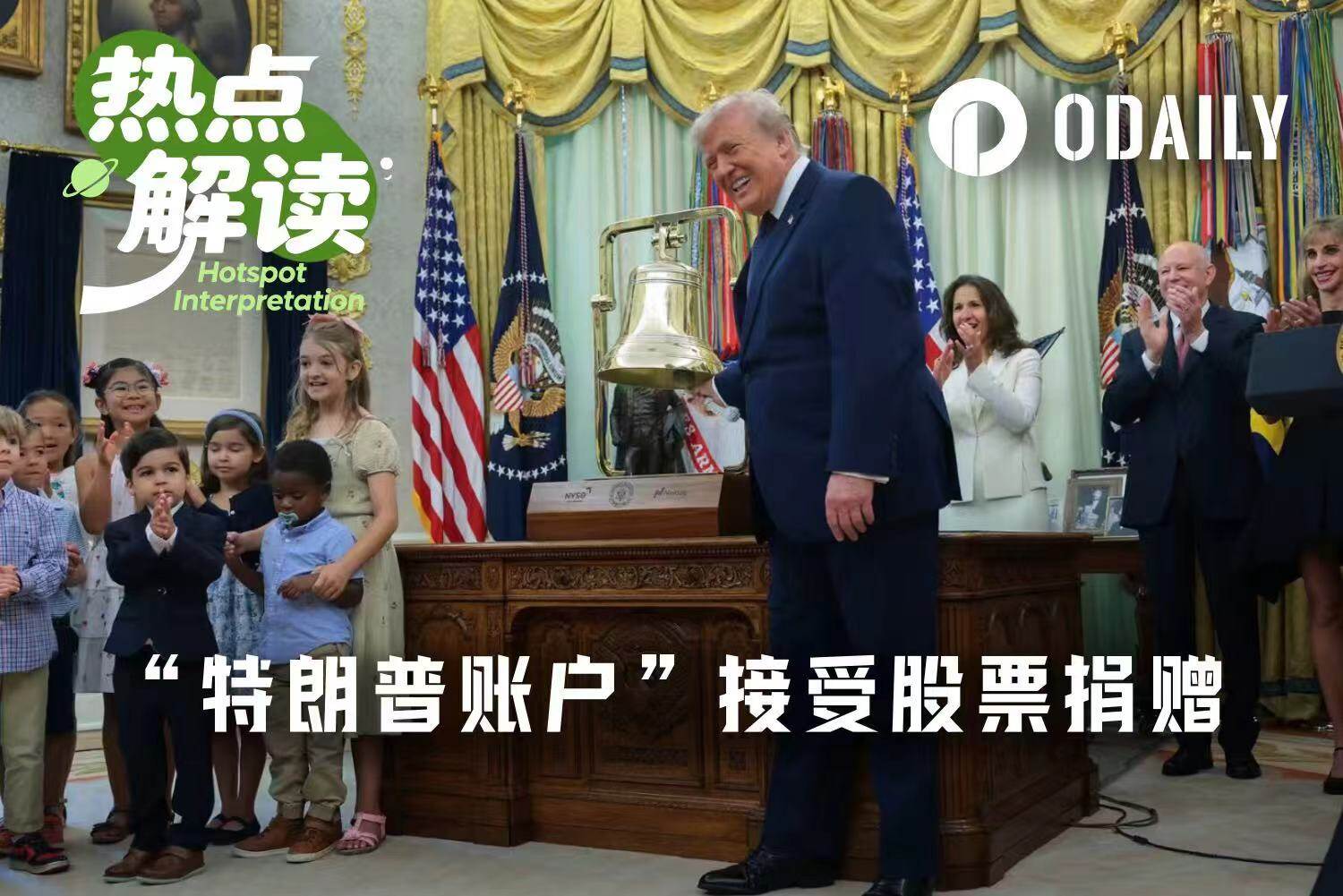
On July 4th, the U.S. Department of the Treasury officially announced that the long-anticipated "Trump Accounts" have officially launched. Parents and children across America can now download the app and access the accounts to view their balances or make donations in real-time.

  • Odaily Note: The so-called "Trump Accounts," also known as 530A accounts, were established under the "Big and Beautiful" Act authorized by current U.S. President Donald Trump on June 9, 2025. This tax-advantaged investment account plan is open to all U.S. minors under the age of 18 and aims to create government-funded savings accounts for the children of American citizens.

The initial funding for the "Trump Accounts" primarily comes from government appropriations, private donations, and family deposits. The federal government will provide $1,000 in initial funding for each child of a U.S. citizen born between January 1, 2025, and January 1, 2029. Additionally, Michael Dell and his wife, the largest donors and founders of Dell, announced last December a donation of $6.25 billion to open accounts for 25 million children from families with regional median household incomes below $150,000, injecting $250 into each account. Parents, friends, and other designated individuals can also deposit funds into specific accounts. For instance, through the "Employer Contribution" channel, over 50 companies have already pledged to make contributions for their employees' children.

According to current regulations, funds within the "Trump Accounts" will be invested in index funds tracking the U.S. stock market. Children can withdraw 50% of their account balance upon turning 18 and the full balance starting at age 25. Account earnings are taxed at the long-term capital gains tax rate or income tax rate.

Trump's Live "Call" Sends Dell Stock Soaring

On July 6th local time, Trump held a launch celebration for the "Trump Accounts" in the White House Oval Office and personally rang the opening bell for the New York Stock Exchange and Nasdaq last night to commemorate the first market opening following the full launch of the "Trump Accounts."

Trump declared at the event: "Today is a historic day. On the 250th anniversary of our nation's founding, we have launched the 'Trump Accounts'... to ensure every American child has an advantage to win at the starting line and a fair shot at achieving the American Dream."

At the event, Trump also praised Michael Dell and his wife, the largest donors to the "Trump Accounts," not only urging the public to "go buy a Dell computer" but also joking: "We'll always find a way to help him earn that money back."
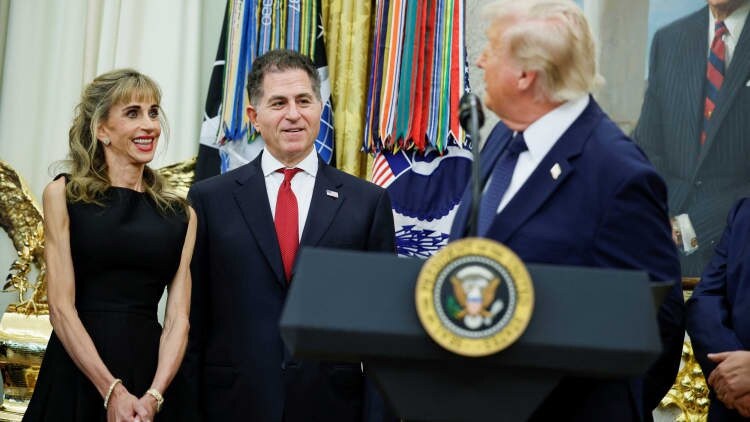
Influenced by the President's public endorsement, Dell's stock price surged over 3% intraday yesterday, closing at $411.8, up 4.43%.

Treasury Allows Stock Donations, SpaceX Follows Suit

Simultaneous with the launch of the "Trump Accounts," the U.S. Treasury Department has opened a new funding channel for these accounts.

On July 2nd, the Treasury Department officially announced that the "Trump Accounts" would begin accepting stock donations. Eligible charitable donors can donate approved publicly traded stocks to the accounts.

After the Treasury Department gave the green light, Trump publicly singled out Elon Musk, urging him to donate SpaceX stock to the "Trump Accounts." As of writing, while Musk himself has not publicly responded, SpaceX President and COO Gwynne Shotwell and her husband have announced they will donate a portion of their SpaceX stock to the Trump Accounts of over 2 million American children. The donation is expected to consist of approximately 2 million shares of SpaceX stock, with a total value of about $325 million.

Gwynne Shotwell stated that this donation will be specifically allocated to accounts for children aged 11 to 17 residing in areas with lower median household incomes, with a particular focus on children living near their home in central Texas.

From a corporate perspective, participating in the "Trump Accounts" is no longer just an act of philanthropy; it could also become a new channel for brand exposure. Especially after Trump's public endorsement of Dell last night, the market has begun to focus on a new logic — in a project that Trump highly prioritizes and personally promotes, companies that participate earlier are more likely to receive public endorsement from the President.

With SpaceX's involvement, it is anticipated that more technology companies, large corporations, and wealthy individuals may join this initiative in the future. For businesses, donating a portion of stock does not directly weaken operational capabilities but may yield long-term political exposure, brand value, and potential user reach. This is not a losing proposition.

Which Assets Might Benefit?

From an investment standpoint, the greatest significance of the "Trump Accounts" lies in creating a new pool of funds that could last for decades. Considering the operational mechanisms and access pathways of this fund pool, coupled with Trump's current active promotion, the potential beneficiaries of these accounts mainly include three levels.

The first is the direct capital flow of the "Trump Accounts" — the S&P 500 Index. According to the rules published by the U.S. Treasury Department, at the launch of the "Trump Accounts," all funds will be invested in the "State Street SPDR S&P 500 Index ETF" (SPYM), a low-cost exchange-traded fund (ETF) designed to track the performance of the S&P 500 Index. Additionally, the Treasury Department has selected other ETF index funds such as IVV, VTI, SRTM, and ITOT for the "Trump Accounts" investment portfolio.

According to data from Statista, the average annual number of births in the U.S. since 2020 has been approximately 3.6 million. Based on this estimate, the number of eligible newborns between January 1, 2025, and January 1, 2029, is about 14.4 million. If each child receives the $1,000 initial funding from the federal government, the government investment alone amounts to approximately $14.4 billion. Combined with donations from the Dell family, employer contributions, and subsequent family deposits, the account asset size could potentially expand to tens of billions of dollars in the future. If this plan continues long-term, it has the potential to become a new source of long-term incremental capital for the U.S. capital markets.

The second is the access path for the "Trump Accounts" — The Bank of New York Mellon (BNY Mellon) and Robinhood. As of now, only two partners have been disclosed for the "Trump Accounts": the designated financial agent, The Bank of New York Mellon (BNY Mellon), and the designated broker and initial trustee, Robinhood, which also developed the "Trump Accounts" application.

For these two companies, the core significance of the "Trump Accounts" lies in their long-term value — the U.S. will have a cohort of over ten million newborns. These accounts represent tens of millions of potential long-term clients, decades-long account lifecycles, and opportunities for investment, trading, and wealth management migration upon adulthood. This logic resembles past competition among financial institutions for IRA and 401(k) users. If the "Trump Accounts" ultimately become the default gateway for American children to enter the capital markets, then the platforms controlling the entry point may gain access to a user asset pool lasting for decades.

Among them, Robinhood, which interfaces directly with users, is particularly noteworthy. This could be a significant opportunity for its transformation from a "trading app for young people" into a "mass-market wealth management platform."

  • Odaily Note: Refer to "Robinhood Gains a Batch of New Investors, the Oldest is 1, the Youngest is -3."

The third category is the early-stage donating entities — whoever gives the President face first, the President likes them more. Referencing the Dell case, such donations can no longer be simply understood as pure philanthropy. Trump has already publicly praised Dell through a White House event and actively created exposure for its brand.

As Trump's current most valued "political chip," early participants may receive presidential-level public promotion as more companies join in the future, enhancing brand influence and potentially establishing closer ties with government resources.

Oh, and one more thing... During yesterday's event, Trump was asked if the accounts might include Bitcoin. His response was: "Possibly."

From Policy Dividend to Long-Term Capital Inflow

It is important to note that the "Trump Accounts" are still in their early launch phase. Their true scale of influence still depends on subsequent funding size, corporate participation, and policy continuity.

In the short term, the market is more inclined to trade on the emotional value brought by Trump's public endorsement and the exposure effects gained by early participating companies. However, from a longer-term perspective, if this plan can continue to be promoted, it could become a new type of wealth gateway connecting the next generation of American consumers, the capital markets, and financial institutions.

In a sense, the "Trump Accounts" are attempting to replicate the path of the U.S. retirement account system — creating an entry point through government policy, with financial institutions and capital markets then capturing the long-term funds. For investors, what might truly be worth watching is perhaps not the next company Trump names, but rather who can occupy the most central position within this decades-long pool of funds.


Domande pertinenti

QWhat is the primary investment vehicle for funds in the 'Trump Accounts' upon launch?

AAccording to the rules published by the U.S. Treasury, upon launch, all funds in the 'Trump Accounts' will be invested in the 'State Street SPDR S&P 500 Index ETF' (SPYM), which tracks the performance of the S&P 500 index.

QWhich two companies are mentioned as key partners for the operation and access of the 'Trump Accounts'?

AThe two disclosed partners for the 'Trump Accounts' are the designated financial agent, BNY Mellon (Bank of New York Mellon), and the designated broker and initial trustee, Robinhood, which also developed the program's application.

QAccording to the article, what was a key factor driving Dell's stock price increase by 4.43% on July 6th?

AThe key factor was President Trump publicly endorsing and praising Dell, the program's largest donor, during the 'Trump Accounts' launch celebration at the White House, even encouraging people to 'go buy a Dell computer.'

QBeyond government funding, what are the other initial capital sources for the 'Trump Accounts' as mentioned in the article?

ABesides the $1,000 initial government grant per eligible child, initial capital comes from private donations (like the $6.25 billion from Michael Dell and his wife) and family deposits. The article also mentions over 50 companies have pledged donations for their employees' children.

QWhat potential long-term benefit does the article suggest Robinhood might gain from its role in the 'Trump Accounts'?

AThe article suggests that managing the 'Trump Accounts' could be a crucial opportunity for Robinhood to transform from a 'young people's trading app' into a mainstream wealth management platform, by gaining access to a potential pool of millions of long-term clients over several decades.

Letture associate

Dialogue with Yihui Capital, SoundAI Technology, Ling Universe, and Zhongbo Jili: Opportunities and Challenges in the AI Smart Hardware Track

On June 28, 2026, an event titled "New Opportunities in AI Hardware: The Battle for Interactive Entry Points Begins" was held in Beijing. It featured a report from ITJuzi and discussions with experts from SoundAI, Ling Universe, One Reed Capital, and Zhongbo Juli on the opportunities and challenges in China's AI hardware sector. Key report findings highlight the sector's intense activity: 327 out of 431 startups founded post-2023 have secured funding, with 179 investments in H1 2026 alone. The landscape is dominated by embodied intelligent robots, while wearable tech like smart rings and AI glasses shows rapid growth. Geographically, Shenzhen leads, leveraging its superior hardware supply chain, followed by Beijing and Shanghai. The overarching trend is for companies to focus on micro-innovations within specific scenarios rather than reinventing foundational technology. Industry leaders shared several critical insights: 1. **Balancing Innovation & Market Readiness**: Entrepreneurs face the "hammer looking for a nail" dilemma. Success requires balancing technical capability with user acceptance, cost control, and incremental design improvements rather than chasing disruptive innovation. 2. **Competitive Landscape**: The future interactive entry point may not be a single super-device but a mix of universal terminals and specialized, scenario-specific hardware. While large companies have ecosystem advantages, startups can win by deeply targeting vertical markets and specific user groups. 3. **Core Challenges & Business Models**: Key hurdles include deep understanding of AI models and navigating non-transparent hardware supply chains. Viable business models may involve selling hardware at cost and generating revenue through software subscriptions, but this requires tight control over both hardware BOM and model inference costs. 4. **The Road to Commercialization**: The ultimate test is market validation—achieving sales growth and sustainable cash flow. Companies must find the right application scenario, use edge computing effectively, and close the loop from technology to commercial success. 5. **The Future of Interaction**: Proactive, context-aware interaction is the next frontier, though it's currently limited by issues like model hallucinations and environmental perception. The near-term focus should be on identifying target users and creating a coherent experience in specific domains, such as health wearables. In summary, to succeed in the competitive AI hardware arena, companies must strategically choose their niche, build a team with the right geographical advantages (e.g., leveraging Shenzhen's supply chain), and most importantly, execute a flawless commercialization strategy that translates technology into market-accepted products and sustainable business growth.

marsbit17 min fa

Dialogue with Yihui Capital, SoundAI Technology, Ling Universe, and Zhongbo Jili: Opportunities and Challenges in the AI Smart Hardware Track

marsbit17 min fa

CryptoQuant Founder: The Cost to Double BTC Has Increased by 20,000 Times, Where Will the $100 Billion Buying Power Come From?

CryptoQuant founder Ki Young Ju analyzes Bitcoin's current capital challenge. He notes that the cryptocurrency market has grown too large for retail-driven momentum alone to generate massive price increases as in past cycles. His calculations show that in 2011, approximately $2.7 million in capital inflow could push BTC's price up by 550x, whereas the current cycle requires an estimated $101 billion in new capital just for a 100% price increase. This shift underscores that sustaining a bull run now depends on attracting large-scale, long-term institutional capital rather than short-term speculative trading. Recent outflows from US spot Bitcoin ETFs, totaling nearly $10 billion since May, highlight the fragility of current demand and challenge the narrative of deep institutional support. While surveys indicate continued institutional interest, these entities prioritize regulated products, risk management, and portfolio integration over speculative gains. For the next significant bull market, Bitcoin must transition to being a core macro asset. The key drivers are no longer just more buyers, but capital allocation from larger, slower-moving entities like wealth advisors, corporate treasuries, banks, and sovereign wealth funds. This new phase pits Bitcoin against other major asset classes like AI for a share of institutional capital, making its growth trajectory dependent on sustained, high-quality inflows from diversified financial balance sheets.

marsbit21 min fa

CryptoQuant Founder: The Cost to Double BTC Has Increased by 20,000 Times, Where Will the $100 Billion Buying Power Come From?

marsbit21 min fa

Goldman Sachs Research Report Analysis: Circle and USDC Are Moving Beyond the Crypto World, Cross-Border Payments and AI Agents Become New Battlegrounds

Goldman Sachs published a summary of its meeting with Circle Internet Group (issuer of USDC) on July 5th. The core takeaway is that stablecoins, led by USDC, are evolving from a crypto-native tool into foundational infrastructure for traditional finance and the AI economy. USDC's use cases are rapidly expanding beyond crypto trading into cross-border payments, e-commerce, capital market settlements, and notably, payments for AI agents. Circle's management emphasized that stablecoin growth is now decoupled from crypto market cycles, driven by this diversification. They outlined five key application layers and highlighted USDC's network effects, global liquidity depth, and regulatory compliance as competitive moats. Circle distinguishes USDC from bank-issued tokenized deposits, arguing the former is an open, internet-native system without bank credit risk. Strategically, Circle is building a broader fintech platform with its Arc Layer 1 blockchain, the Circle Payments Network for cross-border transfers, and an "Agentic Stack" to serve AI agent economies, where USDC already dominates. Regarding regulation, Circle views potential U.S. legislation like the CLARITY Act as a catalyst for growth rather than a constraint, expecting it to encourage broader institutional adoption and active usage. Goldman Sachs maintains a Neutral rating on Circle with a $96 price target, noting the company's shift from a pure stablecoin issuer to a financial infrastructure provider. Key risks include competition from USDT and potential earnings pressure from declining interest rates on its reserve assets.

marsbit1 h fa

Goldman Sachs Research Report Analysis: Circle and USDC Are Moving Beyond the Crypto World, Cross-Border Payments and AI Agents Become New Battlegrounds

marsbit1 h fa

Trading

Spot
活动图片