Where Will DeFi Go Next?

marsbitPubblicato 2026-01-12Pubblicato ultima volta 2026-01-12

Introduzione

The DeFi sector has approached its previous all-time high in Total Value Locked (TVL), reaching $225 billion in late 2025, yet growth has stagnated with only a 10% increase over four years. This indicates that the current user base—largely crypto-native—may have reached saturation. The next phase of growth must come from attracting mainstream users. Stablecoins have seen significant expansion, with USDT and USDC surpassing $260 billion in combined market cap, exceeding the entire DeFi TVL. The rise of yield-bearing stablecoins and Real-World Assets (RWA), now over $20 billion, reflects strong demand for on-chain yield. However, these products remain largely confined to crypto-savvy users. Compared to the fintech sector, which manages over $2 trillion in customer assets, DeFi remains a niche. To break through, DeFi must prioritize simple, secure, and收益-focused products that appeal to ordinary users, rather than complex financial structures or speculative mechanisms. Embedded DeFi integrations within fintech apps could help bridge this gap, but consumer-facing protocols that simplify access to yield will be key to capturing the next wave of adoption.

Editor's Note: DeFi is once again approaching its historical high but has failed to break through significantly, revealing not a lack of products but a bottleneck in user growth. The expansion of stablecoins, yield-bearing stablecoins, and RWA indicates that the demand for moving funds on-chain and earning yields remains strong, yet it has not been truly brought to the mass market.

This article argues that the next step for DeFi lies not in more complex structures or speculative designs, but in simple, secure, yield-focused products, along with user-friendly access and distribution methods for ordinary users. Only when DeFi begins to target fintech users, rather than solely serving crypto-native audiences, can a new growth cycle truly begin.

Below is the original text:

Current Situation

In 2025, DeFi's total value locked (TVL) reached a new historical high, but it did not significantly exceed the peak of 2021. As the market gradually cools, a question worth revisiting is: where will the next wave of capital and users come from?

Driven by DeFi Summer, TVL climbed to $204 billion by the end of 2021. Subsequently, following the collapse of events like FTX and the market entering a bear phase, the capital scale declined steadily. Later, DeFi struggled to recover, reaching $225 billion in October 2025. However, a mere 10% growth over four years can hardly be considered explosive. The earliest participants in DeFi—primarily crypto-native users and traders—may have nearly reached the "ceiling."
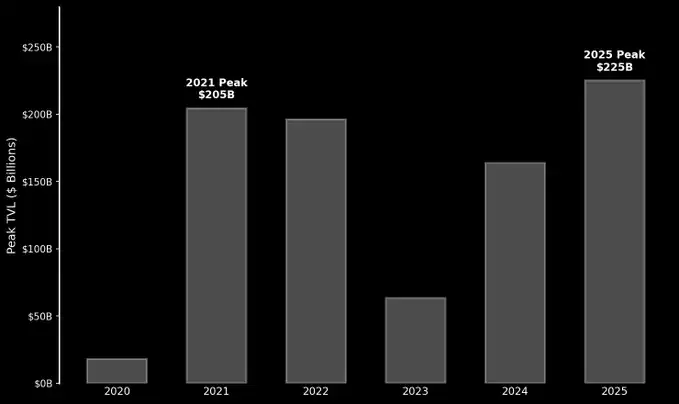
The proximity of these two peaks is indeed cause for caution, but it does not yet constitute a "survival crisis." The current user base—though highly engaged and loyal—is not large enough to propel DeFi to the next level on its own.

To achieve a breakthrough, DeFi needs to reach a larger audience. The good news is that such an audience does exist—it is still on the sidelines, waiting to be properly "onboarded" with the right tools and products.

A Glimmer of Hope

Over the past year, the stablecoin market has been one of the biggest beneficiaries. The amount of USD on-chain has reached a historical high, more than ever before. USDT and USDC have continued to grow steadily, with their combined market capitalization exceeding $260 billion—meaning that the scale of stablecoins alone is already larger than the entire DeFi market.
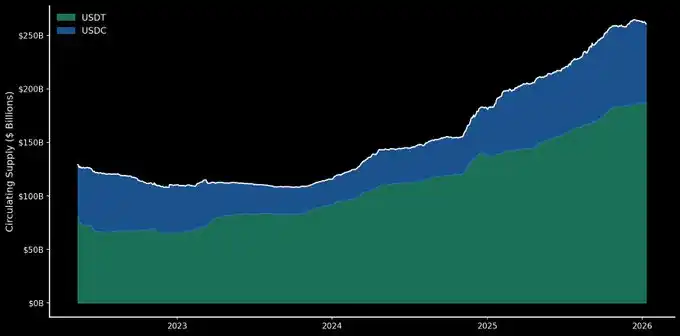
Even without parabolic growth in DeFi, people continue to mint stablecoins, indicating that the demand for moving funds on-chain remains strong. At the same time, an increasing number of users are beginning to access the yields provided by DeFi, and the growth in this area points to where the next breakthrough may come from.

The rise of yield-bearing stablecoins and RWA (real-world assets) further confirms this trend. According to @stablewatchHQ data, the scale of yield-bearing stablecoins has exceeded $20 billion, with products like sUSDS and sUSDe gaining significant adoption over the past year or so. Parallel to yield-bearing stablecoins, RWA has also made progress on-chain: these products, backed by traditional assets such as treasury bonds, offer real yields and are growing rapidly.

The problem is that they currently primarily cater to crypto-native users and large on-chain holders. As long as this remains the case, their potential will be underestimated. If they can be productized and packaged in a way that is more accessible to everyday users, yield-bearing stablecoins and RWA present enormous opportunities in the mass market.

Retail Has Not Yet Arrived

To understand the scale of this opportunity, it is helpful to compare DeFi with fintech. Currently, the entire DeFi TVL is approximately $164 billion. In contrast, global mobile fintech apps manage over $2 trillion in customer assets; the top 100 neobanks alone have assets totaling $2.4 trillion. By comparison, DeFi is currently almost a negligible fraction.
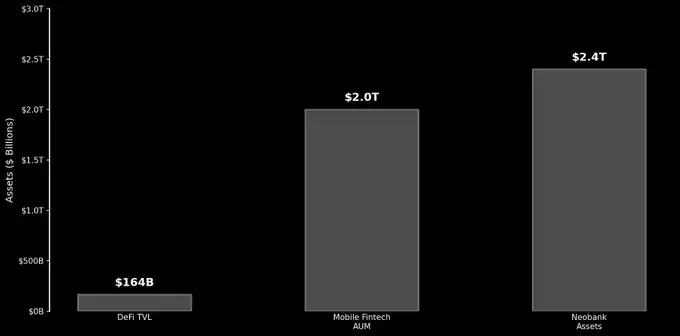
The notion that "if you build it, they will come" can only drive limited growth. If DeFi wants to continue expanding, it must compete for the ordinary users that have made fintech so vast.

In 2025, the success of protocols like Aave, Ethena, and Pendle has demonstrated a strong demand for yield among market participants. They were the highlights of the year, attracting significant capital and attention. If such products can be delivered to the masses in a clear, understandable, and low-barrier manner, the potential encompasses (literally) trillions of dollars in capital and tens of millions of potential users.

The Path Forward

The real test for DeFi in the coming year is whether it can make yield opportunities easily and safely accessible to ordinary people. Growth will not come from more complex financial structures, the 100th liquidity mining pool, the 100th perpetual futures DEX, or the millionth airdrop. Growth will come from simple, reliable products—built on decentralized protocols—that solve real problems for ordinary people. And yield should be center stage (ahem, Aave App, ahem).

Today, hundreds of millions of people use banking and fintech apps daily, already accustomed to managing their funds on their phones. If DeFi can capture even a small share of this, it will be enough to trigger a new wave of growth, and it will not once again stall at the $200 billion TVL level.

Embedded DeFi will play a crucial role in this—fintech companies and neobanks integrating on-chain yield capabilities directly into their products. But teams should not stop there. The protocols that are truly consumer-facing and at the forefront will capture the greatest upside; those that continue to optimize only for crypto-native users will ultimately be competing for a pie that may no longer be expanding.

DeFi will win.

Domande pertinenti

QWhat is the main reason DeFi has not experienced explosive growth despite reaching a new TVL high in 2025?

AThe main reason is that DeFi has primarily served crypto-native users and traders, who are nearing their 'ceiling,' and has failed to attract a broader audience of ordinary users.

QWhat evidence suggests that there is still strong demand for moving funds on-chain?

AThe stablecoin market has reached a new all-time high, with USDT and USDC combined市值 exceeding $260 billion, which is larger than the entire DeFi market.

QWhat types of products have shown significant growth and adoption in the past year, indicating potential for broader appeal?

AYield-bearing stablecoins (like sUSDS and sUSDe) and Real World Assets (RWA) have seen substantial growth, offering real yields and attracting significant adoption.

QHow does the size of DeFi's TVL compare to the assets managed by fintech applications and neobanks?

ADeFi's TVL is about $164 billion, while global mobile fintech apps manage over $2 trillion in customer assets, and the top 100 neobanks alone hold $2.4 trillion in assets, making DeFi a negligible fraction in comparison.

QWhat is the key challenge for DeFi to achieve its next growth cycle and attract mainstream users?

AThe key challenge is to create simple, secure, and收益-focused products that are easy for ordinary users to understand and use, rather than developing complex financial structures or relying solely on crypto-native optimizations.

Letture associate

From Theory to Countdown: Google Sounds the Blockchain Quantum Resistance Alarm with Zero-Knowledge Proofs

An article discusses the significant threat quantum computing poses to blockchain and classical encryption systems, triggered by Google's recent research. By optimizing Shor's algorithm, Google reduced the logical qubits required to break 256-bit elliptic curve encryption from around 6,000 to just 1,200—slashing computational costs by 20 times. This advancement sets a potential countdown, with Google estimating 2029 as the deadline for upgrading to quantum-resistant cryptography. Both Bitcoin and Ethereum face severe risks. About 25-35% of Bitcoin addresses have exposed public keys, making them vulnerable to attacks, especially during transaction processing. Ethereum’s design exposes public keys upon first use, jeopardizing its entire network if signatures aren’t updated. Historical blockchain data remains permanently available for future quantum attacks. The solution lies in adopting post-quantum cryptography (PQC). Ethereum is already implementing account abstraction and PQC-based signatures, leveraging its upgradeable architecture. Bitcoin is considering BIP-360 to introduce quantum-resistant algorithms like FALCON or CRYSTALS-Dilithium, though consensus may delay action. Notably, Google used zero-knowledge proofs to disclose this threat responsibly, aiming to prevent panic. Collaboration with Ethereum Foundation researchers suggests抗量子 (quantum resistance) could become a major narrative, aligning with crypto’s cryptographic roots.

marsbit3 min fa

From Theory to Countdown: Google Sounds the Blockchain Quantum Resistance Alarm with Zero-Knowledge Proofs

marsbit3 min fa

How is the 'Bottom Structure' of a Bear Market Formed, and Where Are We Now?

This article analyzes the formation of Bitcoin's bear market "bottom structure" by examining the relationship between cost basis and price action, particularly the behavior of short-term holders (STH). Historically, the cost basis of coins held for 1-3 months (1-3m_RP) has acted as a key resistance level during bear market rallies. This group's supply is often less committed; many entered the market expecting quick gains but were trapped. When the price rebounds to their break-even point, they tend to sell, creating resistance. Data shows that as of mid-April, the 1-3m_RP is approximately $75,400, a level Bitcoin is currently testing for the second time this cycle. The first test in mid-January failed, leading to a pullback. The author suggests a high probability of a similar outcome this time, as historical cycles show the second test rarely results in an immediate reversal. An alternative, less likely scenario is a break above this level, only to face stronger resistance at the broader STH-RP (average cost basis for all short-term holders) near $81,000, where a much larger supply of 2.31 million BTC resides. This could lead to price consolidation around the 1-3m_RP. A definitive bottom structure is confirmed only when the 1-3m_RP trend reverses from down to up, signaling a transition from a bear to a bull market. This process takes time, requiring patience to observe whether breakouts are genuine.

marsbit47 min fa

How is the 'Bottom Structure' of a Bear Market Formed, and Where Are We Now?

marsbit47 min fa

Bloomberg Terminal Earns Billions Annually from Data Intermediation, Now 6 Institutions Are Putting Data Directly On-Chain

Six major financial institutions — Fidelity, Euronext, Tradeweb, OTC Markets Group, Singapore Exchange (Forex), and Exchange Data International — have begun publishing proprietary market data directly on-chain via Pyth Network. This move bypasses traditional data intermediaries like Bloomberg, which has long dominated the financial data market with annual revenues of approximately $10 billion from its terminal business alone. The shift enables developers on over 100 blockchains to access high-quality, real-time financial data — including ETF valuations, fixed income data, FX rates, and OTC securities — without long-term contracts, steep fees, or proprietary hardware. This development is critical for the scalability of real-world asset (RWA) tokenization in DeFi, as reliable, institutional-grade data must be available on-chain before assets can be traded or used as collateral in decentralized protocols. Pyth’s model differs from earlier oracle solutions like Chainlink by sourcing data directly from institutional traders and exchanges rather than aggregating from third-party sources. While this approach offers higher speed and accuracy, it also involves a more centralized network of known publishers. The move challenges the decades-old monopoly of data middlemen and could significantly reduce barriers to entry for developers building DeFi products tied to traditional financial markets.

marsbit53 min fa

Bloomberg Terminal Earns Billions Annually from Data Intermediation, Now 6 Institutions Are Putting Data Directly On-Chain

marsbit53 min fa

Trading

Spot
Futures
活动图片