XRP Marks 14th Birthday While Ripple Expands DC Presence

bitcoinistPubblicato 2026-06-03Pubblicato ultima volta 2026-06-03

Introduzione

XRP marked its 14th anniversary on June 2, with founders and the community celebrating its origins. The date commemorates a key 2012 code commit that established its fixed 100 billion token supply. Concurrently, Ripple announced an expansion of its Washington, D.C. office, emphasizing a commitment to engaging with U.S. policymakers and regulators on digital asset frameworks. The company aims to help shape policy around market structure, stablecoins, and financial innovation. XRP traded at $1.24 at the time of reporting.

XRP marked its 14th anniversary on Tuesday, June 2, with Ripple executives and long-time community figures reflecting on the asset’s origins just as the company announced a larger footprint in Washington, D.C. The timing places XRP’s history and Ripple’s policy ambitions side by side, at a moment when US digital asset regulation remains a central issue for the industry.

XRP Celebrates 14 Years

David Schwartz, Ripple’s former chief technology officer and one of the most visible architects associated with the XRP Ledger, framed the anniversary as a broader community milestone rather than a founder-centric celebration.

“14 years ago, we got together with an idea to build a better way to move value. What happened next was something none of us could have built alone. And by ‘us,’ I don’t just mean the three of us. I mean the developers, validators, businesses, community members, and everyone who helped shape XRP into what it is today.”

Schwartz closed the post with a simple message: “Happy Birthday, XRP!” Ripple CEO Brad Garlinghouse echoed the sentiment, writing that “14 years later” it was “still the honor of a lifetime to be part of the XRP family.”

The anniversary refers to a specific early code change in the rippled repository. On June 2, 2012, Arthur Britto committed a patch titled “Fix starting number of XNS,” modifying the creation of the first ledger so that its starting balance was defined by SYSTEM_CURRENCY_START rather than a hardcoded number.

At the time, the system currency code was still listed as “XNS,” an early name before XRP became the standard market ticker. The constants added in the commit multiplied 1,000 by 100,000,000 by 1,000,000, creating 100,000,000,000,000,000 base units; with six decimal places, that corresponds to 100 billion XNS, the fixed supply later known as 100 billion XRP.

Ripple Expands Presence in Washington D.C.

The anniversary lands as Ripple is also sharpening its institutional and policy presence in the United States. In a separate announcement, Ripple said it has opened an expanded Washington, D.C. office, describing the move as a reinforcement of its long-term commitment to engagement with policymakers, regulators and industry partners in the capital.

Ripple Chief Legal Officer Stuart Alderoty said the larger office reflects the company’s effort to stay close to the policy process as lawmakers and agencies weigh digital asset frameworks.

“Ripple has always believed the future of digital assets should be built with policymakers and regulators, not around them,” Alderoty said. “Expanding our Washington, D.C. presence reflects our long-term commitment to constructive engagement, regulatory clarity, and US leadership in financial innovation. As blockchain and digital assets become more integrated into the financial system, Ripple is committed to helping shape policy that protects consumers, supports responsible innovation, and keeps America competitive.”

The company said the D.C. expansion comes at a “defining moment” for US digital asset policy, pointing to ongoing discussions around market structure, stablecoins, payments modernization and responsible blockchain innovation. Ripple positioned the new office as a hub for policy engagement and stakeholder convening, including conversations with policymakers, regulators, financial institutions, industry partners and other leaders involved in financial infrastructure.

For Ripple, the move is also consistent with its broader enterprise-facing posture. The company describes itself as a provider of blockchain-based solutions across traditional and digital finance, with products spanning global payments, custody, liquidity and treasury management. Ripple also cited its stablecoin RLUSD and XRP as assets underpinning parts of its product suite.

At press time, XRP traded at $1.24.
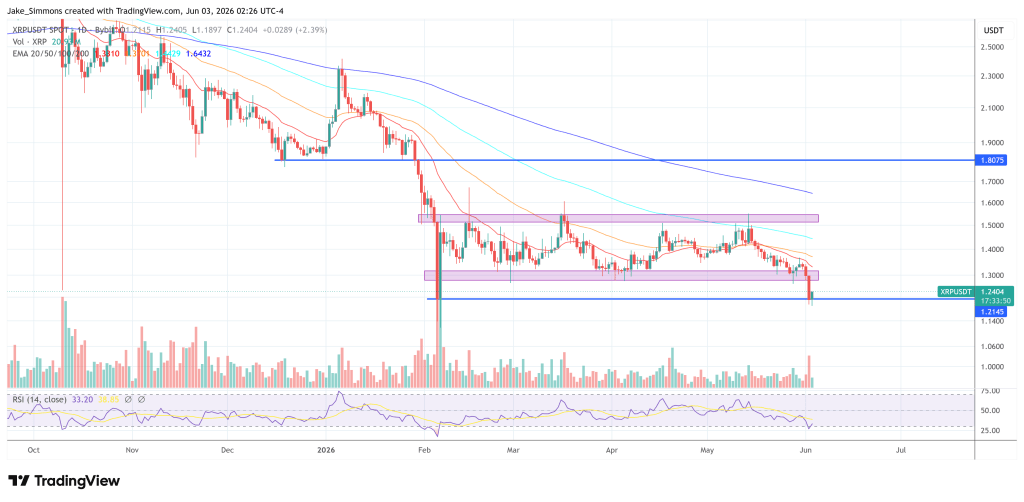
XRP falls below the range, 1-day chart | Source: XRPUSDT on TradingView.com

Crypto di tendenza

Domande pertinenti

QWhat specific event on June 2, 2012, is considered the birth of XRP according to the article?

AThe event considered the birth of XRP was a code commit by Arthur Britto in the rippled repository. The commit, titled 'Fix starting number of XNS,' modified the creation of the first ledger to define its starting balance using `SYSTEM_CURRENCY_START` instead of a hardcoded number, effectively setting the fixed supply of what would later be named XRP.

QHow did Ripple's former CTO David Schwartz describe the significance of XRP's 14th anniversary?

ADavid Schwartz described XRP's 14th anniversary as a broader community milestone, not a founder-centric celebration. He emphasized that the success was built by a collective 'us' including developers, validators, businesses, and community members, not just the original architects.

QWhat reason did Ripple give for expanding its Washington, D.C. office, and who commented on this move?

ARipple said the expansion of its Washington, D.C. office reinforces its long-term commitment to engagement with policymakers, regulators, and industry partners. Chief Legal Officer Stuart Alderoty commented, stating it reflects the company's effort to stay close to the policy process and help shape regulations that support innovation and competitiveness.

QWhat were the original system currency code and the final fixed supply amount established for XRP as mentioned in the article?

AThe original system currency code was 'XNS.' The final fixed supply established was 100,000,000,000,000,000 base units, which, with six decimal places, corresponds to 100 billion XRP.

QAccording to the article, what broader industry context does Ripple's D.C. expansion occur within?

ARipple's D.C. expansion occurs at a 'defining moment' for U.S. digital asset policy, amid ongoing discussions around market structure, stablecoins, payments modernization, and responsible blockchain innovation.

Letture associate

New Fire Research Institute: Inflation May Become a Stubborn Problem, Can Cryptocurrencies Achieve Independent Performance in the Short Term?

New Fire Research Institute argues that despite the recent U.S. June CPI decline to 3.5% year-on-year—primarily driven by energy—core goods inflation remains persistent, with core PCE likely showing slight growth. Federal Reserve Chairman Wash has emphasized the Fed's independence and a "zero tolerance" stance on inflation, suggesting a continued hawkish posture that will pressure risk assets, especially if energy prices rise again. Concurrently, the semiconductor memory sector faces structural pressures, as seen in significant sell-offs for Micron and SK Hynix. High leverage in markets like South Korea is triggering deleveraging, amplifying volatility. Investors are also questioning the sustainability of AI-related capital expenditures. In contrast, the crypto market showed relative stability last week, with BTC and ETH gaining slightly. Positive developments include a shift to net inflows for U.S. Bitcoin spot ETFs, a narrowing Coinbase discount, and strong activity on the Robinhood Chain ecosystem. The potential advancement of the U.S. CLARITY Act provides a policy catalyst. Overall, the probability of an independent crypto bull run in the short term is low, given overarching macro pressures. However, fundamentals are improving with ETF inflows and robust on-chain activity, providing solid support. Technically, BTC and ETH show strong support at key moving averages. New Fire Research maintains that Bitcoin around $60,000 represents a high-value allocation zone, with limited downside risk near current levels. The true bull market catalyst awaits a confirmed market bottom combined with a macro policy shift and legislative progress.

marsbit12 min fa

New Fire Research Institute: Inflation May Become a Stubborn Problem, Can Cryptocurrencies Achieve Independent Performance in the Short Term?

marsbit12 min fa

Base Under Pressure

**Title: The Pressure Mounts for Base** Base, the Ethereum Layer 2 scaling solution backed by Coinbase, is facing significant pressure and public scrutiny from its leadership following the launch of Robinhood Chain. Base co-founder Jesse Pollak recently acknowledged strategic missteps, admitting that the chain's past focus on social and creator tokens (e.g., through Farcaster, Zora) failed to deliver sustainable adoption. He has refocused on core infrastructure, handing leadership of the Base App back to Coinbase's Cobie. While Base remains a top L2 contender alongside OP Mainnet and Arbitrum, and boasts the highest TVL (nearly $12B), its weaknesses are being highlighted by the new competitor. Key criticisms include its slow progress on decentralization. Base has faced issues with its single sequencer causing block production halts, and L2BEAT is reportedly considering downgrading its decentralization rating from Stage 1 to Stage 0. This contrasts sharply with the rapid initial success of Robinhood Chain, whose DEX quickly entered the top five by volume. The leadership styles of the parent companies are also being compared: Robinhood's CEO actively engages with new projects, while a recent incident where Coinbase's Brian Armstrong briefly changed his profile picture—sparking and then crashing a related meme token—drew community ire and mockery. Pollak stated Base is working with Coinbase on tokenized stocks backed 1:1 by real equity, differentiating it from Robinhood's derivatives model. However, the article argues that Base's most urgent task is to address its long-standing technical and trust issues. With more traditional finance players likely to emulate Robinhood's path, Base must use this competitive pressure to solidify its position as long-term financial infrastructure.

Foresight News29 min fa

Base Under Pressure

Foresight News29 min fa

White House Concession Removes Ethical Hurdle, Clarity Act Races Against Final Window Before Recess?

On July 21st, industry sources reported that the Trump administration has agreed to include an ethics provision in the "Clarity Act" (Digital Asset Market Clarity Act of 2025). This concession addresses the long-standing conflict-of-interest concerns regarding government officials and the crypto industry, potentially removing the final major obstacle to the bill's progress. Additionally, Patrick Witt, the executive director of the White House's Digital Asset Advisory Committee, confirmed he will remain in his role to help finalize the bill, alleviating previous concerns about his potential departure. The Clarity Act aims to establish a unified federal regulatory framework for the U.S. digital asset market. Its core objective is to resolve regulatory ambiguity by defining different types of digital assets (digital commodities, investment contract assets, and permitted payment stablecoins) and clarifying the respective oversight roles of the SEC and CFTC. This would end the long-running jurisdictional dispute between the two agencies and provide clearer compliance paths for the industry. With the ethics issue moving toward resolution, the most urgent challenge now is time. The U.S. Congress is set to begin its August recess in mid-August, leaving only a few working weeks to finalize the text and advance the bill through the Senate. Industry advocates, like the Blockchain Association's Kristin Smith, stress that this is a critical moment. If negotiations conclude successfully in the coming weeks, the Clarity Act could pass a key hurdle before the recess; otherwise, it may face significant delays. If enacted, the Clarity Act could mark a historic turning point in crypto regulation. By providing a clearer and more predictable legal framework, it aims to reduce uncertainty for businesses, developers, and traditional financial institutions looking to enter the digital asset space, potentially setting a global benchmark for market structure regulation.

Odaily星球日报34 min fa

White House Concession Removes Ethical Hurdle, Clarity Act Races Against Final Window Before Recess?

Odaily星球日报34 min fa

Trading

Spot

Articoli Popolari

Cosa è XRP 2.0

XRP 2.0: Una Nuova Frontiera nel Paesaggio delle Criptovalute Introduzione a XRP 2.0 Nel mondo in continua evoluzione delle criptovalute, nuovi progetti emergono continuamente, cercando attenzione e adozione. Una tale iniziativa promettente è XRP 2.0, un nuovo progetto di criptovaluta progettato per sfruttare avanzate tecnologie blockchain e metodologie di crittografia robuste. Anche se il nome richiama alla mente l'XRP di Ripple, è fondamentale notare che XRP 2.0 opera in modo indipendente, concentrandosi sul miglioramento della sicurezza delle transazioni, della privacy e della scalabilità. Mentre il panorama finanziario digitale abbraccia sempre di più soluzioni decentralizzate, XRP 2.0 mira a contribuire in modo significativo al web3 e all'espansione generale dei progetti crypto. Cos'è XRP 2.0? Alla sua base, XRP 2.0 è un progetto di criptovaluta che mira a creare un ecosistema di valuta digitale sicuro e decentralizzato. La sua tecnologia fondamentale integra principi di blockchain sofisticati con tecniche di crittografia all'avanguardia. L'obiettivo principale di XRP 2.0 è quello di affermarsi come una piattaforma affidabile ed efficiente in grado di consentire un'esecuzione rapida delle transazioni, dando priorità a migliori protezioni della privacy per i suoi utenti. Il progetto è promosso come una soluzione a molte limitazioni affrontate dalle criptovalute esistenti, proponendo un sistema in grado di gestire un volume maggiore di transazioni con migliorata velocità e privacy. Questa versatilità pone XRP 2.0 come un significativo competitor in un mercato affollato di varie valute digitali. Chi è il Creatore di XRP 2.0? L'identità del creatore dietro XRP 2.0 è stata segnalata come 'Wilbur'. Tuttavia, i dettagli completi riguardanti Wilbur o l'entità associata rimangono sfuggenti. L'anonimato di molti creatori di criptovalute non è un fenomeno raro nel settore, spesso progettato per mantenere un certo grado di privacy e sicurezza. Chi sono gli Investitori di XRP 2.0? Al momento, informazioni specifiche relative alle fondazioni o organizzazioni di investimento a supporto di XRP 2.0 non sono disponibili pubblicamente. Nel settore delle criptovalute, il supporto di investitori rinomati può influenzare significativamente la credibilità e il successo di un progetto, tuttavia la trasparenza riguardo ai sostenitori finanziari di XRP 2.0 non è stata stabilita. Come Funziona XRP 2.0? XRP 2.0 si distingue per l'impiego di una combinazione di tecnologia blockchain e algoritmi di crittografia avanzati che garantiscono transazioni sicure e decentralizzate. La sua struttura innovativa include caratteristiche uniche progettate per promuovere il coinvolgimento degli utenti e ampliare le funzionalità oltre le transazioni convenzionali delle criptovalute. Tra queste caratteristiche, XRP 2.0 incorpora capacità alimentate da intelligenza artificiale, come funzionalità di testo in immagini e testo in voce. Queste aggiunte sono progettate per migliorare l'esperienza interattiva per gli utenti, promuovendo una maggiore applicabilità in vari settori. Unendo progressi tecnologici con design incentrati sugli utenti, XRP 2.0 mira a catturare l'attenzione di una vasta gamma di individui e aziende che cercano di integrare soluzioni di criptovaluta nei loro framework operativi. Cronologia di XRP 2.0 Comprendere XRP 2.0 richiede di esaminare i traguardi che hanno definito il suo percorso fino ad ora: 23 luglio 2023: XRP 2.0 viene introdotto come un nuovo progetto di criptovaluta, mirante a rivoluzionare le capacità di transazione sicura e decentralizzata nel dominio blockchain. 8 settembre 2023: Si verifica il lancio di un altro progetto, XRP20, marcando l'emergere di un token ERC-20 sulla blockchain di Ethereum che resta non correlato a XRP 2.0. 13 novembre 2023: Il ledger XRP subisce un significativo aggiornamento con il rilascio della versione 2.0.0 del software server rippled. È essenziale notare che questo sviluppo è scollegato dal progetto di criptovaluta XRP 2.0. Punti Chiave su XRP 2.0 Per distillare l'essenza di XRP 2.0, emergono diversi fattori critici: Caratteristiche Uniche: L'inclusione di funzionalità come il testo in immagini e testo in voce alimentato da intelligenza artificiale diversifica ulteriormente le potenziali applicazioni di XRP 2.0. Tecnologia Blockchain: Il framework utilizza meccanismi blockchain avanzati e protocolli di crittografia, garantendo un ambiente sicuro e decentralizzato per le transazioni. Scalabilità e Privacy: XRP 2.0 dà priorità a migliori protezioni della privacy nei processi di transazione e alla scalabilità necessaria per accogliere una base di utenti in crescita. Nessuna Affiliazione con Ripple: È importante notare che, nonostante il suo nome, XRP 2.0 non ha alcuna fedeltà o collaborazione con l'XRP di Ripple, distinguendo il proprio framework operativo e obiettivi all'interno dell'ecosistema delle criptovalute. Conclusione XRP 2.0 rappresenta un'ambiziosa venture nell'ambito delle criptovalute, mirante a offrire una combinazione di sicurezza, privacy ed efficienza nelle transazioni digitali. Integrando tecnologie sofisticate e caratteristiche user-friendly, il progetto si propone di ampliare gli orizzonti di ciò che le criptovalute possono realizzare nell'economia digitale odierna. Sebbene l'anonimato del suo creatore e la mancanza di investitori dichiarati possano sollevare domande per alcuni, il focus di XRP 2.0 su funzionalità avanzate e decentralizzazione ne amplifica l'appeal in un mercato crypto sempre più affollato. Man mano che il panorama delle criptovalute continua a evolversi, XRP 2.0 potrebbe emergere come un attore decisivo nell'espansione di soluzioni blockchain sicure e scalabili.

199 Totale visualizzazioniPubblicato il 2024.04.05Aggiornato il 2024.12.03

Cosa è XRP 2.0

Come comprare XRP

Benvenuto in HTX.com! Abbiamo reso l'acquisto di XRP (XRP) semplice e conveniente. Segui la nostra guida passo passo per intraprendere il tuo viaggio nel mondo delle criptovalute.Step 1: Crea il tuo Account HTXUsa la tua email o numero di telefono per registrarti il tuo account gratuito su HTX. Vivi un'esperienza facile e sblocca tutte le funzionalità,Crea il mio accountStep 2: Vai in Acquista crypto e seleziona il tuo metodo di pagamentoCarta di credito/debito: utilizza la tua Visa o Mastercard per acquistare immediatamente XRPXRP.Bilancio: Usa i fondi dal bilancio del tuo account HTX per fare trading senza problemi.Terze parti: abbiamo aggiunto metodi di pagamento molto utilizzati come Google Pay e Apple Pay per maggiore comodità.P2P: Fai trading direttamente con altri utenti HTX.Over-the-Counter (OTC): Offriamo servizi su misura e tassi di cambio competitivi per i trader.Step 3: Conserva XRP (XRP)Dopo aver acquistato XRP (XRP), conserva nel tuo account HTX. In alternativa, puoi inviare tramite trasferimento blockchain o scambiare per altre criptovalute.Step 4: Scambia XRP (XRP)Scambia facilmente XRP (XRP) nel mercato spot di HTX. Accedi al tuo account, seleziona la tua coppia di trading, esegui le tue operazioni e monitora in tempo reale. Offriamo un'esperienza user-friendly sia per chi ha appena iniziato che per i trader più esperti.

1.6k Totale visualizzazioniPubblicato il 2024.12.10Aggiornato il 2026.06.02

Come comprare XRP

Discussioni

Benvenuto nella Community HTX. Qui puoi rimanere informato sugli ultimi sviluppi della piattaforma e accedere ad approfondimenti esperti sul mercato. Le opinioni degli utenti sul prezzo di XRP XRP sono presentate come di seguito.

活动图片