US Treasury Sec To Wall Street: If You Hate Crypto Rules, El Salvador Is Waiting

bitcoinistPubblicato 2026-02-07Pubblicato ultima volta 2026-02-07

Introduzione

U.S. Treasury Secretary Scott Bessent warned crypto firms resistant to clear regulations to “move to El Salvador” during a Senate Banking Committee hearing. His comments highlighted a deepening divide between regulators and parts of the crypto industry, particularly as lawmakers debated the Digital Asset Market Clarity Act. Bessent criticized what he called a “nihilist” segment of crypto that opposes regulatory compromise. The hearing grew heated, with senators raising concerns about stablecoins threatening bank deposits, while crypto advocates warned that strict rules could hinder innovation. Bessent’s remark underscores a choice: operate under U.S. regulations or seek looser oversight elsewhere. Although El Salvador adopted Bitcoin as legal tender, it has since made its use voluntary and maintains a regulated approach, contradicting the idea of a “no rules” environment. Market participants are closely watching the debate, as regulatory clarity could reduce volatility and shape the future of crypto services in the U.S.

Treasury Secretary Scott Bessent put a spotlight on the growing rift between regulators and parts of the crypto industry this week, telling lawmakers that those who resist clear rules “should move to El Salvador.”

The line landed hard during a Senate Banking Committee hearing and was repeated across multiple news outlets as a sign the administration is pushing for firm oversight rather than tolerance for gray areas in markets.

Bessent’s Warning To Industry

Based on reports, Bessent called out what he described as a “nihilist” wing of crypto that would rather scuttle compromise than accept a legal framework.

His remarks came as senators debated the Digital Asset Market Clarity Act, a bill meant to spell out how digital assets fit into existing banking and securities rules.

The episode followed recent moves by major players — including a high-profile platform stepping back from support for the bill — which lawmakers say complicates chances for a quick fix.
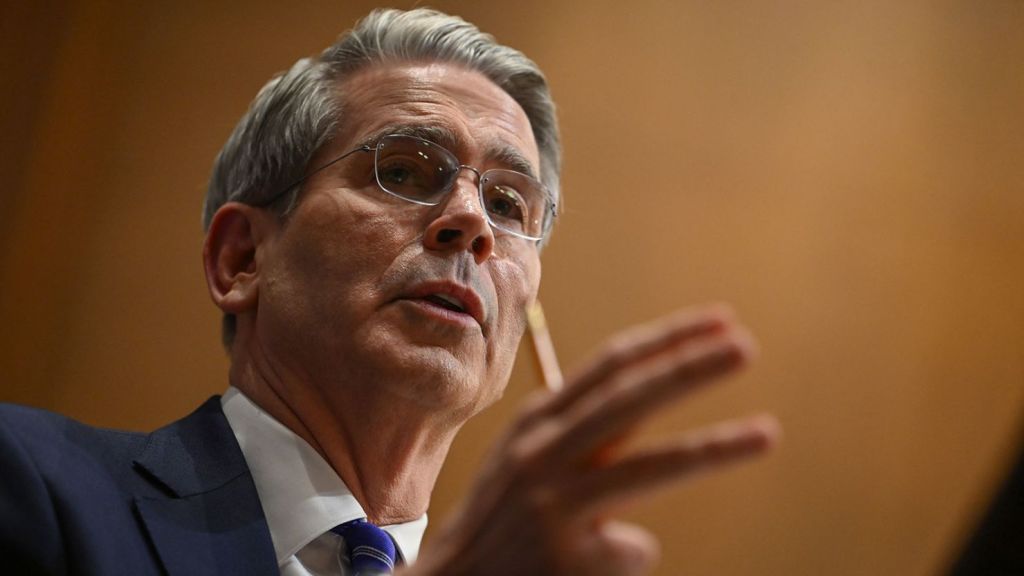
US Treasury Secretary Scott Bessent. Image: Andrew Caballero-Reynolds/AFP/Getty Images

Lawmakers And Lobbyists Take Sides

The hearing did not stay polite for long. Voices rose. Accusations flew. Some senators warned that unchecked stablecoin products could pull deposits out of banks, while crypto advocates argued that heavy-handed rules would stifle innovation.

Bessent suggested that if firms prefer places with looser oversight they can seek them out, naming El Salvador as an example. That rhetorical nudge is more than a talking point — it’s a signal about market access: do business under US guardrails, or accept limits on participation.

BTCUSD currently trading at $65,930. Chart: TradingView

What El Salvador Actually Offers

Reports note that El Salvador’s crypto stance has shifted since it became the first country to make bitcoin legal tender. Lawmakers there approved changes to make Bitcoin acceptance voluntary as part of an IMF-backed deal last year.

The move reduced the mandatory use of Bitcoin while the government said it would still hold and, on occasion, add to its reserves. Those choices mean El Salvador is not a simple “no rules” refuge, even if it appears friendlier to some crypto actors than the US.

Markets And Messaging

Traders watch words like these. Markets respond to certainty, and clarity tends to calm them. When policymakers argue publicly, volatility can spike.

At the same time, a clear path for regulation would let banks plan products and let crypto firms design services that can be sold widely, not just in select jurisdictions.

Some industry executives are lobbying for carve-outs; others want full regulatory recognition. The tension is real and it will shape who stays and who sails elsewhere.

Featured image from Unsplash, chart from TradingView

Domande pertinenti

QWhat did US Treasury Secretary Scott Bessent suggest to crypto firms that resist clear regulations?

AHe suggested that those who resist clear rules should move to El Salvador.

QDuring which congressional hearing did Secretary Bessent make his remarks about crypto regulations?

AHe made the remarks during a Senate Banking Committee hearing.

QWhat is the name of the bill that aims to clarify how digital assets fit into existing financial rules?

AThe bill is called the Digital Asset Market Clarity Act.

QHow has El Salvador's stance on Bitcoin changed since initially making it as legal tender?

AEl Salvador approved changes to make Bitcoin acceptance voluntary as part of an IMF-backed deal, reducing its mandatory use.

QAccording to the article, what is a potential market effect of public arguments among policymakers on crypto regulation?

APublic arguments among policymakers can cause market volatility to spike.

Letture associate

Analysis of the Latest Portfolio Adjustment by the "Top Player" in the U.S. Stock Market: $9 Billion Short on NVIDIA, Shifting Focus to Power and Memory Sectors

AI investor Leopold Aschenbrenner has made a significant portfolio shift, taking a $9 billion nominal short position against top AI infrastructure stocks like NVIDIA, ASML, and Oracle. Simultaneously, he is redirecting capital towards what he sees as the next critical bottlenecks in the AI boom: power, memory, and data center networking, alongside private investments in AI model companies like Anthropic. This move is interpreted not as a call that the AI bubble has burst, but as a rotation within the infrastructure stack. The analysis highlights NVIDIA's recent $25 billion bond issuance as a potential signal, questioning why a cash-rich company would seek external debt despite high profits and increased dividends/buybacks. The core investment thesis is that the initial, crowded "picks and shovels" trade in semiconductors is maturing. The next wave of capital is expected to flow into the physical and logistical constraints of AI expansion: electricity supply, memory chip capacity, data center construction, and enabling technologies like optical networking (fiber) for high-bandwidth communication, where copper remains crucial for short distances. Aschenbrenner's substantial (approx. 20% of fund) private stake in Anthropic is noted as a key part of his strategy—investing directly in the "mine" (AI models) rather than just the "shovels." The discussion concludes that while certain segments may be overvalued, the overarching AI infrastructure demand driven by real product usage remains robust. The most promising long-term investments are seen in essential, non-sexy infrastructure—particularly energy and power companies—whose demand is viewed as a global constant irrespective of AI's cyclicality.

marsbit23 min fa

Analysis of the Latest Portfolio Adjustment by the "Top Player" in the U.S. Stock Market: $9 Billion Short on NVIDIA, Shifting Focus to Power and Memory Sectors

marsbit23 min fa

BIT Research: Liquidity is Disappearing, Will Bitcoin Replay the Bottoming Pattern of 2022?

The crypto market is currently in an adjustment phase driven by policy expectations and liquidity shifts. Despite a brief rebound fueled by geopolitical easing and SpaceX's strong IPO performance, unexpectedly hawkish signals from new Fed Chair Kevin Warsh have removed anticipated easing support. Concurrently, stablecoin liquidity is shrinking, with insufficient new capital inflows, pushing the market into a typically quiet summer period. Pricing lacks catalysts for a sustained rally. Daily trading volume has significantly contracted, stablecoin growth has slowed markedly, and the supportive effect of Strategy's (formerly MicroStrategy) STRC preferred stock-financed Bitcoin purchases is fading. Amid policy uncertainty, seasonal weakness, and liquidity contraction, Bitcoin faces near-term downward pressure. Warsh's hawkish pivot and refusal to provide a clear policy outlook have increased risk premiums, historically unfavorable for Bitcoin. Technically, the trend remains bearish below $73,700, with $62,446 as critical support. A break below could accelerate declines, though a prolonged consolidation phase, similar to 2022's bottoming process, is possible. Liquidity is a core constraint. Current daily volume is around $500 billion, roughly 25% of the peak during the July-Oct 2025 rally. The 12-month growth rates for USDT and USDC have fallen to ~20%, with 6-month growth near zero, indicating weak new inflows. Bitcoin ETF and Strategy-driven inflows have also weakened, with a 30-day rolling net outflow. With inflation at 4.2% above the Fed's target, combined hawkish policy, seasonal factors, and liquidity shortages challenge Bitcoin's ability to hold above $60,000. However, this adjustment phase may be forming a cyclical low this summer, potentially setting the stage for the next bull cycle.

marsbit51 min fa

BIT Research: Liquidity is Disappearing, Will Bitcoin Replay the Bottoming Pattern of 2022?

marsbit51 min fa

Who Makes the Best Use of Claude Code? The Answer Might Not Be Programmers

Claude Code Usage Report Summary (Based on ~400k sessions) Core Finding: In agentic programming with Claude Code, a clear division of labor has emerged: humans primarily decide *what* to build (planning decisions), while Claude decides *how* to build it (execution decisions). Key Insights: 1. **Effectiveness is not limited to programmers.** In code-generation tasks, success rates for users in non-technical fields (law, finance, management, research) are nearing those of software engineers. What matters most is the user's domain expertise and understanding of the problem to be solved. 2. **Domain expertise drives success and efficiency.** Sessions where users exhibited "expert" proficiency in the task's domain saw verified success rates double compared to "novice" sessions. Experts also delegated more work per instruction, with Claude executing more actions and producing more output. 3. **AI is amplifying, not replacing, domain knowledge.** Claude Code lowers the *implementation* barrier, not the *judgment* barrier. The value of knowing the "what" and "why" is increasing relative to just knowing the "how" to code. 4. **Usage is evolving.** Over a 7-month period (Oct '25 - Apr '26), the share of sessions for debugging halved, while use for software operations, data analysis, and non-code writing roughly doubled. The estimated economic value of typical tasks increased by ~25%. Conclusion: The data suggests coding agents are making programming background less critical for completing technical tasks. However, they reward and amplify deep domain understanding. The ability to successfully direct an AI agent stems more from mastery of a specific field than from coding skill itself. The primary gains come from being competent in a domain; deep specialization adds only marginal additional advantage. This may signal a shift where software creation becomes integrated into various professions.

marsbit1 h fa

Who Makes the Best Use of Claude Code? The Answer Might Not Be Programmers

marsbit1 h fa

Trading

Spot
Futures
活动图片