Strategy's Preferred Stock STRC Unpegs by 11%, Can Its Perpetual Motion Machine Keep Spinning?

marsbitPubblicato 2026-06-20Pubblicato ultima volta 2026-06-20

Introduzione

The preferred stock STRC issued by Strategy (MicroStrategy) has depegged over 11% from its $100 target par value, raising questions about the sustainability of the company's capital flywheel strategy. STRC, a perpetual preferred stock designed to trade around $100, serves as a key engine for Strategy's expansion, allowing it to raise fiat currency via at-the-market offerings to buy Bitcoin without diluting common shareholder equity. Its depegging, despite dividend rate hikes, suggests market concerns extend beyond yield to the core stability of Strategy's model. Analysts point to potential leveraged unwinding and, more critically, worries about Strategy's liquidity. While the company cites its massive Bitcoin holdings as covering decades of dividends, a recent small BTC sale—a first—has shaken confidence in its "never sell" narrative. If STRC remains discounted, impairing Strategy's fundraising ability, fears may grow that the company could be forced to sell Bitcoin to meet obligations, potentially turning a major market buyer into a seller and exerting significant downward pressure on Bitcoin's price.

Author | Azuma, Odaily Planet Daily

Strategy's preferred stock, STRC, is experiencing sustained "unpegging."

U.S. stock market data shows that since May 15th, STRC has gradually deviated from its target par value of $100. Recently, the discount has intensified significantly, hitting a low of $83.26 during Thursday's session and closing at $88.59, representing an unpegging of over 11% from the target par value.

For an ordinary stock, an 11% decline might not be a big deal. But for STRC, its persistent deviation from the $100 target par value signals a severe challenge to the product's core design objective.

This is because, in Strategy's original design, STRC was created as an income-oriented security intended to trade around a $100 par value, not a highly volatile speculative asset. The widening gap between market price and target par value is leading more investors to re-examine the logic behind this product.

More importantly, as Strategy continues to expand its Bitcoin reserves, STRC has gradually grown into the company's most crucial financing channel. In a sense, the market pricing of STRC reflects not only investor sentiment towards a preferred stock but also market confidence in Strategy's entire capital operation model.

STRC: The Engine of Strategy's Capital Flywheel

To understand the severity of this unpegging, we must first clarify STRC's product structure and its unique anchoring mechanism.

STRC is an innovative financial derivative instrument launched by Strategy in 2025. Unlike Strategy's common stock, MSTR, STRC is positioned as a perpetual preferred stock with a fixed target par value ($100) and relatively stable dividend income, resembling a fixed-income security.

  • Odaily Note: Strategy founder Michael Saylor recently revealed that STRC was designed with the assistance of AI.

Within Strategy's balance sheet expansion cycle, STRC is not just an ordinary financing tool but the most powerful engine of its current capital flywheel.

Before STRC, Strategy primarily relied on issuing convertible notes and direct common stock offerings to raise funds for Bitcoin purchases. However, both models had limitations—convertible notes were constrained by maturity dates and debt leverage caps, while frequent common stock offerings diluted existing shareholders' equity.

STRC's emergence perfectly addressed this pain point. Its core utility in Strategy's strategy is primarily manifested in two dimensions:

  • Unlimited "At-the-Market" (ATM) Offering Program: As long as STRC's market price remains at or above $100, Strategy can continuously issue new STRC shares in the secondary market through the ATM mechanism, raising fiat currency.
  • Purchasing Power with Zero Equity Dilution: As a perpetual preferred stock, STRC has no legal maturity or principal repayment pressure and lacks the voting rights and residual asset claims of common stock. This means Strategy can create billions in fiat purchasing power out of thin air, channeling it entirely into Bitcoin accumulation, without diluting MSTR shareholder equity or increasing rigid debt interest expenses.

Through the "issue more STRC ➡️ raise fiat ➡️ buy BTC ➡️ increase company net assets ➡️ boost STRC trust" loop, Strategy successfully constructed what seemed like an infinitely cycleable capital flywheel.

However, a key prerequisite for this flywheel's smooth operation is that STRC must trade near its $100 par value. Once the market price falls significantly below $100, based on ATM fundraising terms and market arbitrage logic, Strategy will effectively be unable to absorb funds from the market through the discounted preferred shares, and its entire capital magic trick will factually grind to a halt.

At the design stage, to ensure STRC's secondary market price would consistently adhere to the $100 target par value, Strategy introduced a "monthly dynamic dividend rate adjustment" mechanism. Simply put, when STRC's market price is below $100, Strategy can increase the dividend rate to enhance the product's attractiveness; when the price is above $100, it can lower the dividend rate — in theory, through continuous dividend rate adjustments, STRC should be able to trade long-term around $100.

But now, even though Strategy has raised the dividend to a high of 11.5% and switched the payout frequency from monthly to bi-weekly, STRC's "unpegged" state hasn't been effectively corrected... Why is that?

Unpegging Reasons: Confidence, Confidence, and Still Confidence

The ineffectiveness of dividend corrections means the market is pricing in risks that go beyond STRC's yield itself. From current market discussions, risk concerns are primarily focused on two levels.

First, surface-level technical factors. Some market participants believe the recent decline largely stems from concentrated stampeding due to arbitrage capital deleveraging.

Over the past year, STRC traded consistently around $100, attracting significant yield-seeking arbitrage capital. Such funds often use leverage to amplify returns, capturing both dividend income and price convergence arbitrage. However, as STRC broke below $100 and continued to weaken, some leveraged accounts hit risk control limits, forcing them to sell holdings; price declines then triggered more leveraged capital to unwind, creating a chain reaction. In this process, selling pressure intensified, causing STRC's decline to far exceed what normal supply-demand changes would warrant.

Yet, explaining the current market performance solely through leverage-driven stampeding seems insufficient. For many investors, a deeper concern lies in Strategy's liquidity reserve situation.

Earlier this month, J.P. Morgan released a research report pointing out that Strategy has an annual dividend obligation of approximately $1.7 billion. Based on current cash reserve levels, its cash on hand is only sufficient to cover about 6.3 months of preferred stock dividend payments. This sparked market worries about Strategy's promised future liquidity coverage capability.

In response, Strategy offered a starkly different explanation. The company officially posted on X, emphasizing that if its massive Bitcoin reserves are taken into account, they are sufficient to cover 32 years of dividend payments.
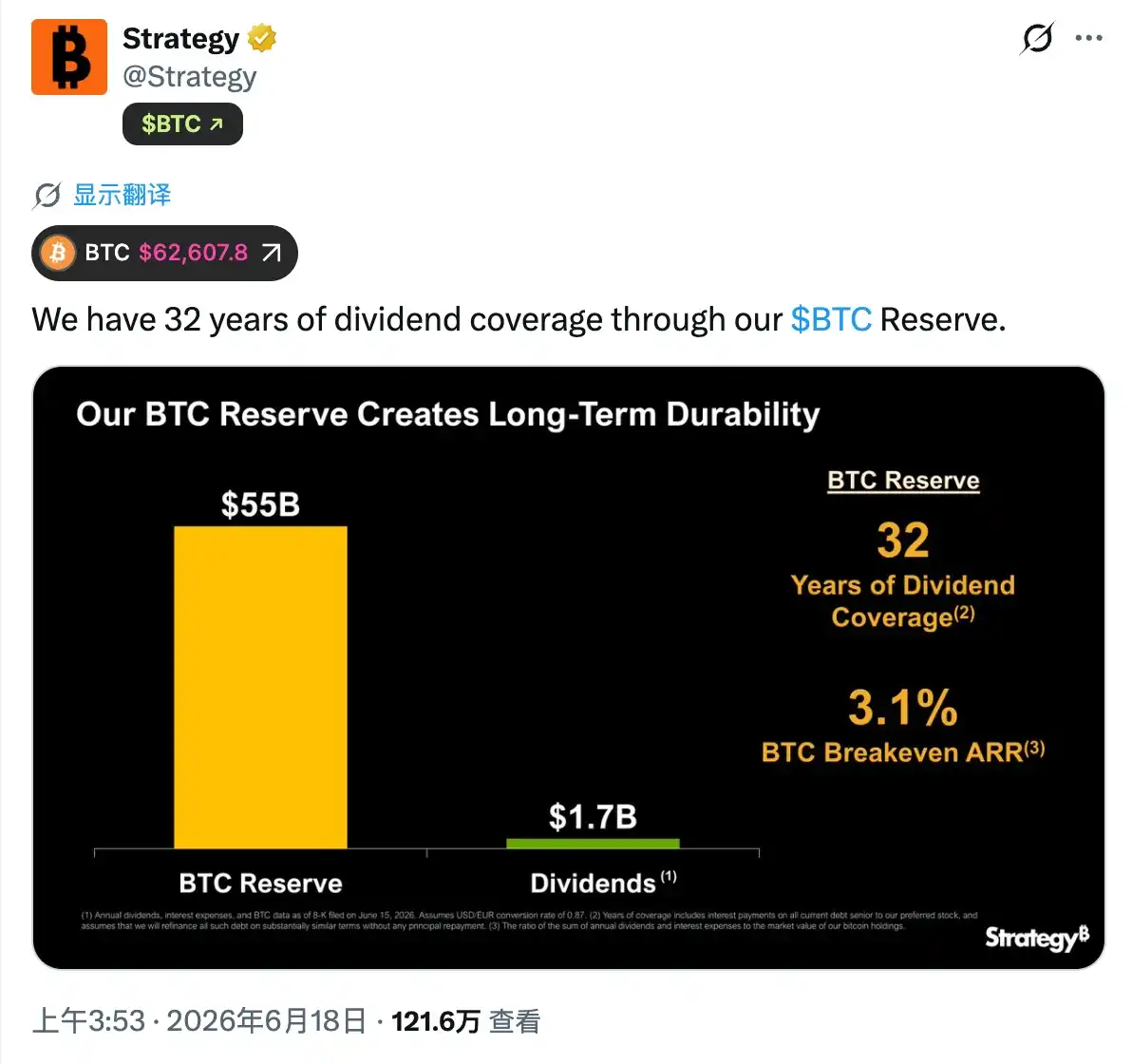
The issue, however, is that these two statements are based on different premises. J.P. Morgan focuses on Strategy's cash position, while Strategy's calculation implies a crucial assumption—if necessary, the company can obtain funds by selling Bitcoin.

This touches on the market's most sensitive nerve. Early this month, Strategy sold a portion of its Bitcoin holdings for the first time. Although the sale involved only 32 Bitcoins and was packaged by the company as "active market desensitization testing," with mention of "buying back more later," it still caused significant market shock. The reason is that over the past few years, Strategy and its founder Michael Saylor have consistently promoted a core narrative to the market—Bitcoin is a long-term strategic reserve asset, and the company will source operational funds through capital market financing, not by selling Bitcoin.

Therefore, when the market witnessed Strategy selling Bitcoin for the first time, it inevitably raised greater concerns—if financing conditions tighten in the future, will Strategy need to rely further on selling Bitcoin to meet dividend obligations? If the answer is not an absolute no, then investors must reassess the risk profile of related securities.

From this perspective, the persistent "unpegging" of STRC reflects the market re-evaluating the robustness of Strategy's entire capital structure.

Strategy's Buying Power Could Turn into Selling Pressure

For Strategy, the biggest impact of STRC's sustained unpegging is the weakening of its financing function.

Over the past few years, Strategy's ability to continuously expand its Bitcoin reserves hinged on a core logic: raising funds from capital markets by issuing stocks, convertible notes, and preferred shares, then using those funds to increase Bitcoin holdings. STRC is precisely Strategy's most important financing tool. When it trades persistently below its $100 target par value, it means the market is demanding higher risk compensation, and Strategy's financing ability consequently faces a temporary shutdown.

Going forward, STRC's re-pegging status may become a crucial indicator for the market to observe Strategy's risk profile. If STRC remains discounted for an extended period, leading to persistently constrained financing ability, while Strategy's cash reserves continue to deplete, market fears about Strategy potentially needing to sell more Bitcoin to meet dividend payments will inevitably intensify.

Once this expectation strengthens, its impact will extend beyond STRC itself. As one of the most significant marginal buyers in the Bitcoin market over recent years, Strategy's financing ability and accumulation pace have profoundly influenced market supply-demand expectations. If Strategy's buying power turns into selling pressure, it could exert unimaginable downward pressure on Bitcoin.


Crypto di tendenza

Domande pertinenti

QWhat is the core issue with Strategy's preferred stock STRC, and why is it significant?

AStrategy's preferred stock STRC has experienced a significant 'de-pegging' from its target par value of $100, with its price falling more than 11% below this level. This is significant because STRC is not meant to be a high-volatility speculative asset but a yield-oriented security designed to trade around $100. Its sustained discount threatens the core mechanism of Strategy's capital model, as it undermines the company's primary ability to raise funds through at-the-market (ATM) offerings of STRC, which are only viable when the stock trades at or above $100.

QHow did STRC function as the 'engine' of Strategy's capital flywheel, and what was the critical prerequisite for its operation?

ASTRC functioned as the engine by enabling Strategy to raise fiat currency through continuous at-the-market (ATM) share offerings without diluting the equity of common shareholders (MSTR holders) or incurring fixed debt obligations. The capital flywheel worked as follows: issue more STRC -> raise fiat -> buy Bitcoin -> increase the company's net assets -> boost confidence in STRC. The critical prerequisite for this flywheel to operate smoothly was that STRC's market price had to remain stable around its $100 target par value to facilitate new ATM issuances.

QAccording to the article, what are the two main reasons given for STRC's continued de-pegging despite high dividend adjustments?

AThe two main reasons are: 1) Technical factors involving a deleveraging cascade, where leveraged arbitrage funds were forced to sell their STRC holdings as the price fell below $100, creating a self-reinforcing cycle of selling pressure. 2) A deeper, fundamental loss of market confidence related to concerns about Strategy's liquidity. Investors are worried that if financing becomes tight, Strategy might need to sell its Bitcoin reserves to cover dividend payments, contradicting its long-standing 'hodl' narrative and increasing the perceived risk of STRC.

QWhat was the discrepancy between JPMorgan's analysis and Strategy's own statement regarding the company's ability to cover its dividend obligations?

AJPMorgan's analysis focused on Strategy's cash reserves, concluding they were only sufficient to cover about 6.3 months of preferred stock dividend payments. In contrast, Strategy's official statement argued that if its massive Bitcoin reserves were factored in, the company had enough assets to cover 32 years of dividend payments. The core discrepancy lies in the underlying assumption: JPMorgan considered immediate cash liquidity, while Strategy's calculation assumed the company could and would sell Bitcoin if necessary to generate funds for dividends.

QWhat broader market implication does the article suggest if STRC remains de-pegged and Strategy's financing ability weakens?

AThe article suggests that if STRC remains de-pegged, weakening Strategy's ability to raise new capital, market concerns will intensify that Strategy may be forced to sell portions of its Bitcoin holdings to meet its cash obligations (like dividend payments). As Strategy has been one of the most significant marginal buyers in the Bitcoin market, a shift from being a consistent buyer to a potential seller could create substantial downward pressure on the price of Bitcoin itself, impacting the broader market.

Letture associate

BIT Research: Liquidity is Disappearing, Will Bitcoin Replay the Bottoming Pattern of 2022?

The crypto market is currently in an adjustment phase driven by policy expectations and liquidity shifts. Despite a brief rebound fueled by geopolitical easing and SpaceX's strong IPO performance, unexpectedly hawkish signals from new Fed Chair Kevin Warsh have removed anticipated easing support. Concurrently, stablecoin liquidity is shrinking, with insufficient new capital inflows, pushing the market into a typically quiet summer period. Pricing lacks catalysts for a sustained rally. Daily trading volume has significantly contracted, stablecoin growth has slowed markedly, and the supportive effect of Strategy's (formerly MicroStrategy) STRC preferred stock-financed Bitcoin purchases is fading. Amid policy uncertainty, seasonal weakness, and liquidity contraction, Bitcoin faces near-term downward pressure. Warsh's hawkish pivot and refusal to provide a clear policy outlook have increased risk premiums, historically unfavorable for Bitcoin. Technically, the trend remains bearish below $73,700, with $62,446 as critical support. A break below could accelerate declines, though a prolonged consolidation phase, similar to 2022's bottoming process, is possible. Liquidity is a core constraint. Current daily volume is around $500 billion, roughly 25% of the peak during the July-Oct 2025 rally. The 12-month growth rates for USDT and USDC have fallen to ~20%, with 6-month growth near zero, indicating weak new inflows. Bitcoin ETF and Strategy-driven inflows have also weakened, with a 30-day rolling net outflow. With inflation at 4.2% above the Fed's target, combined hawkish policy, seasonal factors, and liquidity shortages challenge Bitcoin's ability to hold above $60,000. However, this adjustment phase may be forming a cyclical low this summer, potentially setting the stage for the next bull cycle.

marsbit4 min fa

BIT Research: Liquidity is Disappearing, Will Bitcoin Replay the Bottoming Pattern of 2022?

marsbit4 min fa

Who Makes the Best Use of Claude Code? The Answer Might Not Be Programmers

Claude Code Usage Report Summary (Based on ~400k sessions) Core Finding: In agentic programming with Claude Code, a clear division of labor has emerged: humans primarily decide *what* to build (planning decisions), while Claude decides *how* to build it (execution decisions). Key Insights: 1. **Effectiveness is not limited to programmers.** In code-generation tasks, success rates for users in non-technical fields (law, finance, management, research) are nearing those of software engineers. What matters most is the user's domain expertise and understanding of the problem to be solved. 2. **Domain expertise drives success and efficiency.** Sessions where users exhibited "expert" proficiency in the task's domain saw verified success rates double compared to "novice" sessions. Experts also delegated more work per instruction, with Claude executing more actions and producing more output. 3. **AI is amplifying, not replacing, domain knowledge.** Claude Code lowers the *implementation* barrier, not the *judgment* barrier. The value of knowing the "what" and "why" is increasing relative to just knowing the "how" to code. 4. **Usage is evolving.** Over a 7-month period (Oct '25 - Apr '26), the share of sessions for debugging halved, while use for software operations, data analysis, and non-code writing roughly doubled. The estimated economic value of typical tasks increased by ~25%. Conclusion: The data suggests coding agents are making programming background less critical for completing technical tasks. However, they reward and amplify deep domain understanding. The ability to successfully direct an AI agent stems more from mastery of a specific field than from coding skill itself. The primary gains come from being competent in a domain; deep specialization adds only marginal additional advantage. This may signal a shift where software creation becomes integrated into various professions.

marsbit39 min fa

Who Makes the Best Use of Claude Code? The Answer Might Not Be Programmers

marsbit39 min fa

Trading

Spot
Futures

Articoli Popolari

Cosa è $S$

Comprendere SPERO: Una Panoramica Completa Introduzione a SPERO Mentre il panorama dell'innovazione continua a evolversi, l'emergere delle tecnologie web3 e dei progetti di criptovaluta gioca un ruolo fondamentale nel plasmare il futuro digitale. Un progetto che ha attirato l'attenzione in questo campo dinamico è SPERO, denotato come SPERO,$$s$. Questo articolo mira a raccogliere e presentare informazioni dettagliate su SPERO, per aiutare gli appassionati e gli investitori a comprendere le sue basi, obiettivi e innovazioni nei domini web3 e crypto. Che cos'è SPERO,$$s$? SPERO,$$s$ è un progetto unico all'interno dello spazio crypto che cerca di sfruttare i principi della decentralizzazione e della tecnologia blockchain per creare un ecosistema che promuove l'impegno, l'utilità e l'inclusione finanziaria. Il progetto è progettato per facilitare interazioni peer-to-peer in modi nuovi, fornendo agli utenti soluzioni e servizi finanziari innovativi. Al suo interno, SPERO,$$s$ mira a responsabilizzare gli individui fornendo strumenti e piattaforme che migliorano l'esperienza dell'utente nello spazio delle criptovalute. Questo include la possibilità di metodi di transazione più flessibili, la promozione di iniziative guidate dalla comunità e la creazione di percorsi per opportunità finanziarie attraverso applicazioni decentralizzate (dApps). La visione sottostante di SPERO,$$s$ ruota attorno all'inclusività, cercando di colmare le lacune all'interno della finanza tradizionale mentre sfrutta i vantaggi della tecnologia blockchain. Chi è il Creatore di SPERO,$$s$? L'identità del creatore di SPERO,$$s$ rimane piuttosto oscura, poiché ci sono risorse pubblicamente disponibili limitate che forniscono informazioni dettagliate sul suo fondatore o fondatori. Questa mancanza di trasparenza può derivare dall'impegno del progetto per la decentralizzazione—un ethos che molti progetti web3 condividono, dando priorità ai contributi collettivi rispetto al riconoscimento individuale. Centrando le discussioni attorno alla comunità e ai suoi obiettivi collettivi, SPERO,$$s$ incarna l'essenza dell'empowerment senza mettere in evidenza individui specifici. Pertanto, comprendere l'etica e la missione di SPERO rimane più importante che identificare un creatore singolo. Chi sono gli Investitori di SPERO,$$s$? SPERO,$$s$ è supportato da una varietà di investitori che vanno dai capitalisti di rischio agli investitori angelici dedicati a promuovere l'innovazione nel settore crypto. Il focus di questi investitori generalmente si allinea con la missione di SPERO—dando priorità a progetti che promettono avanzamenti tecnologici sociali, inclusività finanziaria e governance decentralizzata. Queste fondazioni di investitori sono tipicamente interessate a progetti che non solo offrono prodotti innovativi, ma contribuiscono anche positivamente alla comunità blockchain e ai suoi ecosistemi. Il supporto di questi investitori rafforza SPERO,$$s$ come un concorrente degno di nota nel dominio in rapida evoluzione dei progetti crypto. Come Funziona SPERO,$$s$? SPERO,$$s$ impiega un framework multifunzionale che lo distingue dai progetti di criptovaluta convenzionali. Ecco alcune delle caratteristiche chiave che sottolineano la sua unicità e innovazione: Governance Decentralizzata: SPERO,$$s$ integra modelli di governance decentralizzati, responsabilizzando gli utenti a partecipare attivamente ai processi decisionali riguardanti il futuro del progetto. Questo approccio favorisce un senso di proprietà e responsabilità tra i membri della comunità. Utilità del Token: SPERO,$$s$ utilizza il proprio token di criptovaluta, progettato per servire varie funzioni all'interno dell'ecosistema. Questi token abilitano transazioni, premi e la facilitazione dei servizi offerti sulla piattaforma, migliorando l'impegno e l'utilità complessivi. Architettura Stratificata: L'architettura tecnica di SPERO,$$s$ supporta la modularità e la scalabilità, consentendo un'integrazione fluida di funzionalità e applicazioni aggiuntive man mano che il progetto evolve. Questa adattabilità è fondamentale per mantenere la rilevanza nel panorama crypto in continua evoluzione. Coinvolgimento della Comunità: Il progetto enfatizza iniziative guidate dalla comunità, impiegando meccanismi che incentivano la collaborazione e il feedback. Nutrendo una comunità forte, SPERO,$$s$ può affrontare meglio le esigenze degli utenti e adattarsi alle tendenze di mercato. Focus sull'Inclusione: Offrendo basse commissioni di transazione e interfacce user-friendly, SPERO,$$s$ mira ad attrarre una base utenti diversificata, inclusi individui che potrebbero non aver precedentemente interagito nello spazio crypto. Questo impegno per l'inclusione si allinea con la sua missione generale di empowerment attraverso l'accessibilità. Cronologia di SPERO,$$s$ Comprendere la storia di un progetto fornisce preziose intuizioni sulla sua traiettoria di sviluppo e sui traguardi. Di seguito è riportata una cronologia suggerita che mappa eventi significativi nell'evoluzione di SPERO,$$s$: Fase di Concettualizzazione e Ideazione: Le idee iniziali che formano la base di SPERO,$$s$ sono state concepite, allineandosi strettamente con i principi di decentralizzazione e focus sulla comunità all'interno dell'industria blockchain. Lancio del Whitepaper del Progetto: Dopo la fase concettuale, è stato rilasciato un whitepaper completo che dettaglia la visione, gli obiettivi e l'infrastruttura tecnologica di SPERO,$$s$ per suscitare interesse e feedback dalla comunità. Costruzione della Comunità e Prime Interazioni: Sono stati effettuati sforzi attivi di outreach per costruire una comunità di early adopters e potenziali investitori, facilitando discussioni attorno agli obiettivi del progetto e ottenendo supporto. Evento di Generazione del Token: SPERO,$$s$ ha condotto un evento di generazione del token (TGE) per distribuire i propri token nativi ai primi sostenitori e stabilire una liquidità iniziale all'interno dell'ecosistema. Lancio della Prima dApp: La prima applicazione decentralizzata (dApp) associata a SPERO,$$s$ è stata attivata, consentendo agli utenti di interagire con le funzionalità principali della piattaforma. Sviluppo Continuo e Partnership: Aggiornamenti e miglioramenti continui alle offerte del progetto, inclusi partnership strategiche con altri attori nello spazio blockchain, hanno plasmato SPERO,$$s$ in un concorrente competitivo e in evoluzione nel mercato crypto. Conclusione SPERO,$$s$ rappresenta una testimonianza del potenziale del web3 e delle criptovalute di rivoluzionare i sistemi finanziari e responsabilizzare gli individui. Con un impegno per la governance decentralizzata, il coinvolgimento della comunità e funzionalità progettate in modo innovativo, apre la strada verso un panorama finanziario più inclusivo. Come per qualsiasi investimento nello spazio crypto in rapida evoluzione, si incoraggiano potenziali investitori e utenti a ricercare approfonditamente e a impegnarsi in modo riflessivo con gli sviluppi in corso all'interno di SPERO,$$s$. Il progetto mostra lo spirito innovativo dell'industria crypto, invitando a ulteriori esplorazioni delle sue innumerevoli possibilità. Mentre il percorso di SPERO,$$s$ è ancora in fase di sviluppo, i suoi principi fondamentali potrebbero effettivamente influenzare il futuro di come interagiamo con la tecnologia, la finanza e tra di noi in ecosistemi digitali interconnessi.

80 Totale visualizzazioniPubblicato il 2024.12.17Aggiornato il 2024.12.17

Cosa è $S$

Cosa è AGENT S

Agent S: Il Futuro dell'Interazione Autonoma in Web3 Introduzione Nel panorama in continua evoluzione di Web3 e criptovalute, le innovazioni stanno costantemente ridefinendo il modo in cui gli individui interagiscono con le piattaforme digitali. Uno di questi progetti pionieristici, Agent S, promette di rivoluzionare l'interazione uomo-computer attraverso il suo framework agentico aperto. Aprendo la strada a interazioni autonome, Agent S mira a semplificare compiti complessi, offrendo applicazioni trasformative nell'intelligenza artificiale (AI). Questa esplorazione dettagliata approfondirà le complessità del progetto, le sue caratteristiche uniche e le implicazioni per il dominio delle criptovalute. Cos'è Agent S? Agent S si presenta come un innovativo framework agentico aperto, progettato specificamente per affrontare tre sfide fondamentali nell'automazione dei compiti informatici: Acquisizione di Conoscenze Specifiche del Dominio: Il framework apprende in modo intelligente da varie fonti di conoscenza esterne ed esperienze interne. Questo approccio duale gli consente di costruire un ricco repository di conoscenze specifiche del dominio, migliorando le sue prestazioni nell'esecuzione dei compiti. Pianificazione su Lungo Orizzonte di Compiti: Agent S impiega una pianificazione gerarchica potenziata dall'esperienza, un approccio strategico che facilita la suddivisione e l'esecuzione efficiente di compiti complessi. Questa caratteristica migliora significativamente la sua capacità di gestire più sottocompiti in modo efficiente ed efficace. Gestione di Interfacce Dinamiche e Non Uniformi: Il progetto introduce l'Interfaccia Agente-Computer (ACI), una soluzione innovativa che migliora l'interazione tra agenti e utenti. Utilizzando Modelli Linguistici Multimodali di Grandi Dimensioni (MLLM), Agent S può navigare e manipolare senza sforzo diverse interfacce grafiche utente. Attraverso queste caratteristiche pionieristiche, Agent S fornisce un framework robusto che affronta le complessità coinvolte nell'automazione dell'interazione umana con le macchine, preparando il terreno per innumerevoli applicazioni nell'AI e oltre. Chi è il Creatore di Agent S? Sebbene il concetto di Agent S sia fondamentalmente innovativo, informazioni specifiche sul suo creatore rimangono elusive. Il creatore è attualmente sconosciuto, il che evidenzia sia la fase embrionale del progetto sia la scelta strategica di mantenere i membri fondatori sotto anonimato. Indipendentemente dall'anonimato, l'attenzione rimane sulle capacità e sul potenziale del framework. Chi sono gli Investitori di Agent S? Poiché Agent S è relativamente nuovo nell'ecosistema crittografico, informazioni dettagliate riguardanti i suoi investitori e sostenitori finanziari non sono documentate esplicitamente. La mancanza di approfondimenti pubblicamente disponibili sulle fondazioni di investimento o sulle organizzazioni che supportano il progetto solleva interrogativi sulla sua struttura di finanziamento e sulla roadmap di sviluppo. Comprendere il supporto è cruciale per valutare la sostenibilità del progetto e il suo potenziale impatto sul mercato. Come Funziona Agent S? Al centro di Agent S si trova una tecnologia all'avanguardia che gli consente di funzionare efficacemente in contesti diversi. Il suo modello operativo è costruito attorno a diverse caratteristiche chiave: Interazione Uomo-Computer Simile a Quella Umana: Il framework offre una pianificazione AI avanzata, cercando di rendere le interazioni con i computer più intuitive. Mimando il comportamento umano nell'esecuzione dei compiti, promette di elevare le esperienze degli utenti. Memoria Narrativa: Utilizzata per sfruttare esperienze di alto livello, Agent S utilizza la memoria narrativa per tenere traccia delle storie dei compiti, migliorando così i suoi processi decisionali. Memoria Episodica: Questa caratteristica fornisce agli utenti una guida passo-passo, consentendo al framework di offrire supporto contestuale mentre i compiti si sviluppano. Supporto per OpenACI: Con la capacità di funzionare localmente, Agent S consente agli utenti di mantenere il controllo sulle proprie interazioni e flussi di lavoro, allineandosi con l'etica decentralizzata di Web3. Facile Integrazione con API Esterne: La sua versatilità e compatibilità con varie piattaforme AI garantiscono che Agent S possa adattarsi senza problemi agli ecosistemi tecnologici esistenti, rendendolo una scelta attraente per sviluppatori e organizzazioni. Queste funzionalità contribuiscono collettivamente alla posizione unica di Agent S all'interno dello spazio crittografico, poiché automatizza compiti complessi e multi-fase con un intervento umano minimo. Man mano che il progetto evolve, le sue potenziali applicazioni in Web3 potrebbero ridefinire il modo in cui si svolgono le interazioni digitali. Cronologia di Agent S Lo sviluppo e le tappe di Agent S possono essere riassunti in una cronologia che evidenzia i suoi eventi significativi: 27 Settembre 2024: Il concetto di Agent S è stato lanciato in un documento di ricerca completo intitolato “Un Framework Agentico Aperto che Usa i Computer Come un Umano”, mostrando le basi per il progetto. 10 Ottobre 2024: Il documento di ricerca è stato reso pubblicamente disponibile su arXiv, offrendo un'esplorazione approfondita del framework e della sua valutazione delle prestazioni basata sul benchmark OSWorld. 12 Ottobre 2024: È stata rilasciata una presentazione video, fornendo un'idea visiva delle capacità e delle caratteristiche di Agent S, coinvolgendo ulteriormente potenziali utenti e investitori. Questi indicatori nella cronologia non solo illustrano i progressi di Agent S, ma indicano anche il suo impegno per la trasparenza e il coinvolgimento della comunità. Punti Chiave su Agent S Man mano che il framework Agent S continua a evolversi, diversi attributi chiave si distinguono, sottolineando la sua natura innovativa e il potenziale: Framework Innovativo: Progettato per fornire un uso intuitivo dei computer simile all'interazione umana, Agent S porta un approccio nuovo all'automazione dei compiti. Interazione Autonoma: La capacità di interagire autonomamente con i computer attraverso GUI segna un passo avanti verso soluzioni informatiche più intelligenti ed efficienti. Automazione di Compiti Complessi: Con la sua metodologia robusta, può automatizzare compiti complessi e multi-fase, rendendo i processi più veloci e meno soggetti a errori. Miglioramento Continuo: I meccanismi di apprendimento consentono ad Agent S di migliorare dalle esperienze passate, migliorando continuamente le sue prestazioni e la sua efficacia. Versatilità: La sua adattabilità attraverso diversi ambienti operativi come OSWorld e WindowsAgentArena garantisce che possa servire un'ampia gamma di applicazioni. Man mano che Agent S si posiziona nel panorama di Web3 e delle criptovalute, il suo potenziale per migliorare le capacità di interazione e automatizzare i processi segna un significativo avanzamento nelle tecnologie AI. Attraverso il suo framework innovativo, Agent S esemplifica il futuro delle interazioni digitali, promettendo un'esperienza più fluida ed efficiente per gli utenti in vari settori. Conclusione Agent S rappresenta un audace passo avanti nell'unione tra AI e Web3, con la capacità di ridefinire il modo in cui interagiamo con la tecnologia. Sebbene sia ancora nelle sue fasi iniziali, le possibilità per la sua applicazione sono vaste e coinvolgenti. Attraverso il suo framework completo che affronta sfide critiche, Agent S mira a portare le interazioni autonome al centro dell'esperienza digitale. Man mano che ci addentriamo nei regni delle criptovalute e della decentralizzazione, progetti come Agent S giocheranno senza dubbio un ruolo cruciale nel plasmare il futuro della tecnologia e della collaborazione uomo-computer.

552 Totale visualizzazioniPubblicato il 2025.01.14Aggiornato il 2025.01.14

Cosa è AGENT S

Come comprare S

Benvenuto in HTX.com! Abbiamo reso l'acquisto di Sonic (S) semplice e conveniente. Segui la nostra guida passo passo per intraprendere il tuo viaggio nel mondo delle criptovalute.Step 1: Crea il tuo Account HTXUsa la tua email o numero di telefono per registrarti il tuo account gratuito su HTX. Vivi un'esperienza facile e sblocca tutte le funzionalità,Crea il mio accountStep 2: Vai in Acquista crypto e seleziona il tuo metodo di pagamentoCarta di credito/debito: utilizza la tua Visa o Mastercard per acquistare immediatamente SonicS.Bilancio: Usa i fondi dal bilancio del tuo account HTX per fare trading senza problemi.Terze parti: abbiamo aggiunto metodi di pagamento molto utilizzati come Google Pay e Apple Pay per maggiore comodità.P2P: Fai trading direttamente con altri utenti HTX.Over-the-Counter (OTC): Offriamo servizi su misura e tassi di cambio competitivi per i trader.Step 3: Conserva Sonic (S)Dopo aver acquistato Sonic (S), conserva nel tuo account HTX. In alternativa, puoi inviare tramite trasferimento blockchain o scambiare per altre criptovalute.Step 4: Scambia Sonic (S)Scambia facilmente Sonic (S) nel mercato spot di HTX. Accedi al tuo account, seleziona la tua coppia di trading, esegui le tue operazioni e monitora in tempo reale. Offriamo un'esperienza user-friendly sia per chi ha appena iniziato che per i trader più esperti.

1.1k Totale visualizzazioniPubblicato il 2025.01.15Aggiornato il 2026.06.02

Come comprare S

Discussioni

Benvenuto nella Community HTX. Qui puoi rimanere informato sugli ultimi sviluppi della piattaforma e accedere ad approfondimenti esperti sul mercato. Le opinioni degli utenti sul prezzo di S S sono presentate come di seguito.

活动图片