U.S. CFTC Launches Extensive Investigation into Polymarket, Is the Prediction Market Frenzy Season Cooling Down?

Odaily星球日报Pubblicato 2026-06-30Pubblicato ultima volta 2026-06-30

Introduzione

The U.S. Commodity Futures Trading Commission (CFTC) has launched a broad investigation into the prediction market platform Polymarket, focusing on its business practices including social media activities. This follows a bipartisan letter from U.S. senators urging the CFTC to probe allegations of paid influencer false marketing and fraudulent promotion of gambling-like products to American users. The investigation comes as the prediction market sector experiences explosive growth, largely driven by the World Cup. Weekly trading volumes have hit record highs, exceeding $14.4 billion, with platforms like Kalshi and Robinhood's new venture seeing significant activity. Major firms like Meta are also showing interest in the space. This regulatory scrutiny signals a potential end to the sector's "wild growth" phase. The CFTC's move also highlights an escalating jurisdictional conflict between federal regulators and state authorities. Over a dozen states, including Kentucky and New York, have sued platforms like Polymarket and Kalshi, accusing them of operating illegal sports betting, which threatens state gambling tax revenues. The CFTC is countersuing to assert its exclusive federal jurisdiction over these "event contracts" as derivatives. Furthermore, the CFTC's approval of Kalshi's Bitcoin perpetual futures contract has sparked a lawsuit from traditional exchange CME, alleging regulatory overreach. The political and capital landscape is intricate, with Donald Trump Jr. holdi...

Original | Odaily Planet Daily (@OdailyChina)

Author | Wenser(@wenser2010 )

The deceptive marketing of Polymarket has finally attracted the attention of regulatory iron fists.

Recently, the U.S. Commodity Futures Trading Commission (CFTC) has launched an extensive investigation into the prediction market platform Polymarket, covering its business aspects including social media activities. Previously, U.S. Republican Senator John Curtis and Democratic Senator Adam Schiff jointly sent a letter to CFTC Chairman Mike Selig, urging an investigation into Polymarket's practices of paid false marketing by KOLs and the use of fraudulent marketing tactics to promote gambling-like products to U.S. audiences.

At a time when the World Cup is driving a surge in prediction market trading volume, this move may pour cold water on the development of this sector. More importantly, the CFTC's investigation into Polymarket reveals conflicts of interest between the U.S. federal and state governments, as well as between officials and capital. (Recommended reading: "WSJ: Fake Websites, Fake Trades, Real Promotion, The Traffic Scam of Polymarket").

End of the Prediction Market's Wild Marketing Era, Regulatory Policies May Enter Deep Waters

If the previous incidents of Polymarket using college students to post fake profit videos and paying KOLs to exaggerate prediction profits were the wild attempts of the prediction market's early expansion, then the formal investigation by the U.S. CFTC is clear evidence of the end of this wild growth period.

Prediction Market Platform Data Experiences Explosive Growth, Traditional Internet Giants Show Strong Interest

As we enter June 2026, with the official start of the World Cup, prediction markets have received unprecedented attention, and trading volume has soared accordingly.

Data from a16z crypto shows that prediction market trading volume has set new historical highs for the third consecutive week. The total market trading volume exceeded $144 billion last week, a significant increase from the approximately $50–60 billion at the beginning of the year, and the previous historical high of around $100 billion was just refreshed a week ago. From the platform side, their data has also seen substantial growth:

  • Latest data shows that Kalshi's weekly nominal trading volume broke $100 billion for the first time.
  • Polymarket officially stated that its annualized revenue has significantly exceeded $1 billion, a progress achieved just six weeks after its U.S. trading platform lifted the waitlist; data shows that daily trading volume on the U.S. platform has grown from around $50 million in mid-May to over $200 million on June 20th (based on Dune Analytics data).
  • The prediction market platform business under Robinhood is growing rapidly, with annualized revenue reaching $500 million. In the Q2 quarter up to June 25th, Robinhood's active contract trading volume reached approximately 12.3 billion trades. Based on a standard fee of 1 cent per contract, the prediction market revenue for the quarter is estimated to be at least $123 million. Its recently launched Rothera prediction market platform achieved over 900 million trades in its first week, contributing to nearly 60% of Robinhood's growth in active contract trading volume.
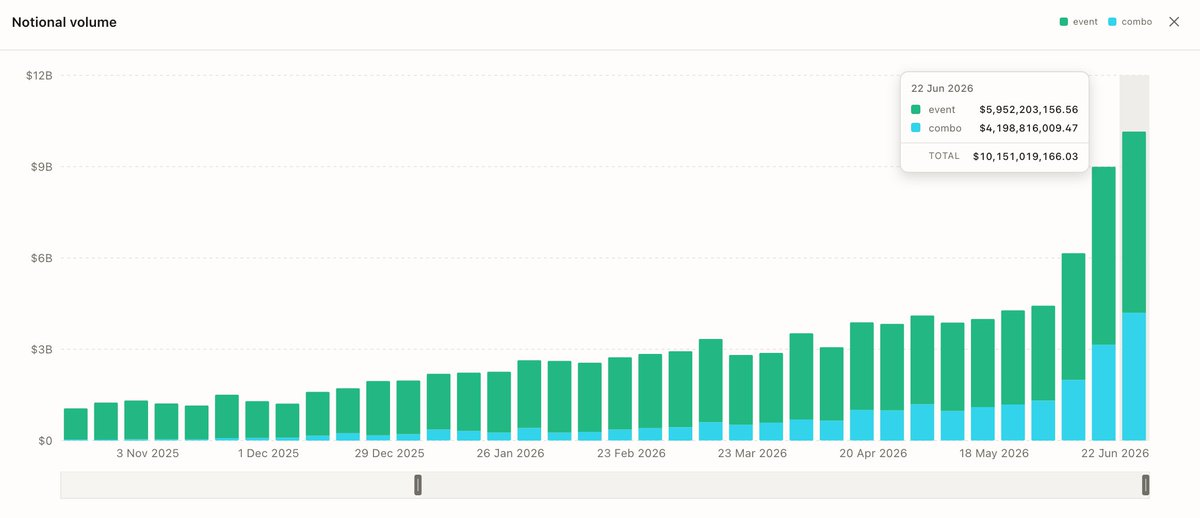
Such impressive data has also attracted the attention of the U.S. stock market giant Meta. According to media reports, Meta CEO Mark Zuckerberg has urged the company to explore partnerships with prediction markets Polymarket and Kalshi. Meanwhile, Meta is developing a similar prediction market application called Arena.

All signs indicate that prediction markets have evolved from a niche sector a few years ago into a hot industry experiencing exponential expansion. In the face of this trend, regulatory bodies will certainly not stand idly by. The recent false marketing incident at Polymarket acts like a perfectly timed "soft knife," providing an opportunity for regulatory intervention. The author believes that subsequent regulators may gradually clarify the regulatory boundaries for prediction market platforms regarding marketing, event contract content, and trading fees, aiming to strengthen investor protection and clearly distinguish them from traditional gambling businesses.

Simultaneously, as the investigation deepens, the power struggle between federal regulatory agencies represented by the U.S. CFTC and state-level regulators is also coming to light.

When the U.S. CFTC Clashes with Nine U.S. States: The Battle for Prediction Market Regulatory Authority

Last Tuesday, the U.S. CFTC formally filed a lawsuit against the state of Kentucky, attempting to reassert the agency's jurisdiction over prediction market platforms.

In the complaint filed with the U.S. District Court for the Eastern District of Kentucky, the CFTC stated that Kentucky's attempt to shut down federally regulated designated contract markets interferes with the federal regulatory system established by Congress for the national swaps market. It claims "exclusive jurisdiction" over related event contracts and prediction market products.

Previously, the state of Kentucky sued platforms like Kalshi and Polymarket, accusing them of operating unlicensed illegal sports betting and gambling businesses within the state. As of June, over 12 U.S. states, including Kentucky and New York, have taken legal action against Polymarket and Kalshi, accusing them of operating illegal sports betting. Kentucky has become the ninth state sued by the CFTC in the prediction market regulatory dispute.

This action highlights the escalating conflict between federal derivatives regulation and state-level gambling regulation.

The main reasons behind the dispute are twofold:

  • Firstly, there are the practical interests of state and local governments, such as taxes from the gambling industry. Previously, traditional sports betting brought significant tax revenue to various states (e.g., high-tax-rate online gambling). If prediction markets were to completely replace the gambling industry, potential annual tax losses for states could reach hundreds of millions of dollars (some say around $600 million).
  • Secondly, there is the definition of the regulatory boundary between the gambling industry and the emerging prediction market industry. What the U.S. CFTC aims to uphold is categorizing "event contracts" as commodity derivatives, futures, or swaps, enforcing a federal law supremacy policy.

Ultimately, the specific outcome may depend on the interpretation and judgment of the Commodity Exchange Act (CEA) by state courts and even the U.S. Supreme Court.

Furthermore, the battle between exchanges and the U.S. CFTC has also ignited. The CFTC previously approved Kalshi's application for perpetual futures trading, which led to CME Group suing the former—

It is reported that CME Group has sued the U.S. Commodity Futures Trading Commission and its Chairman, Michael Selig, in the U.S. District Court for the District of Columbia. In response to the CFTC's approval on May 29th for prediction market platform Kalshi to launch perpetual futures contracts linked to the spot price of Bitcoin, among other actions, the CFTC treated "futures" with expiration dates as "swaps," violating U.S. Congressional directives and the Commodity Exchange Act, and requested the court to revoke the related perpetual futures actions. CME also claimed that Selig acted unilaterally without a full panel of five commissioners.

A CFTC spokesperson responded that CME is waging a "legal war" against the agency and the government's crypto policies, stating that "filing the lawsuit is extremely frivolous." (Almost writing "your case is initiated too recklessly" on their foreheads).

Of course, it's no wonder CME is so agitated, as the CFTC's move to open up crypto perpetual contract trading for Kalshi essentially allows prediction market platforms like Kalshi and crypto exchanges like Coinbase and Kraken to encroach upon CME's "trading territory." The driving force behind this may also have some connection to the Trump family.

The Trump Family's Prediction Market "Double Betting Method": Donald Trump Jr. Bets on Both Kalshi and Polymarket

Recently, Kalshi was revealed to be negotiating a new round of financing at a valuation of approximately $40 billion, with the deal potentially closing as early as Q3. After completing a $1 billion financing in May (with investors including Sequoia Capital, Andreessen Horowitz, Coatue, and Morgan Stanley), Kalshi's valuation rose from $12 billion to $22 billion, and now this number is about to double.

Kalshi CEO Tarek Mansour stated that the company is considering an IPO no earlier than late 2027 or 2028. Kalshi officially announced that as of April 2026, its annualized trading volume reached $178 billion, a 32-fold increase year-over-year.

Such impressive market data and high enthusiasm from the capital markets are hard to separate from Donald Trump Jr., one of the prominent figures of the Trump family.

It is understood that Donald Trump Jr. essentially "eats from both sides" in the prediction market sector:

On one hand, he served as a paid strategic advisor at Kalshi in early 2025 and received approximately $300,000 in company equity at that time. Kalshi's valuation was less than $2 billion then, and this investment alone has yielded over a 10x return;

On the other hand, he also serves as an advisor at Polymarket and made a strategic investment in the latter through his venture capital firm, 1789 Capital, where he is a partner.

Coupled with Trump's previous emphasis on the regulatory authority of federal departments over prediction markets, and his statement: "Kalshi and Polymarket will thrive under his leadership."

To some extent, the conflict of interest between capital and official regulatory agencies has been mitigated; and the Trump family is the "best lubricant" in this contradictory event.

Thus, a network of interests connecting U.S. federal regulatory agencies like the CFTC, U.S. state governments, and Trump family investment institutions is gradually taking shape.

As for the CFTC's investigation activities into Polymarket, they may just be a necessary step in regulating the prediction market industry.

The era of wild growth, the "Spring of Prediction Markets," is coming to an end, while the "Prosperous Summer" for the prediction market industry is slowly arriving.


Domande pertinenti

QWhat is the main regulatory action discussed in the article against Polymarket?

AThe main regulatory action is a widespread investigation launched by the U.S. Commodity Futures Trading Commission (CFTC) into Polymarket. The investigation covers various aspects of its business, including its social media activities. This action was prompted by a bipartisan letter from U.S. Senators John Curtis and Adam Schiff urging the CFTC to investigate allegations of paid false marketing by Key Opinion Leaders (KOLs) and deceptive promotional tactics targeting U.S. audiences for gambling-like products.

QWhat significant event contributed to the surge in prediction market trading volume in mid-2026 according to the article?

AAccording to the article, the significant event was the commencement of the World Cup in June 2026. This event drove unprecedented attention to prediction markets, leading to a sharp rise in trading volumes. Data showed that the sector's weekly trading volume hit a record high of $14.4 billion, a substantial increase from the approximately $5-6 billion at the beginning of the year.

QWhy is there a conflict between the U.S. CFTC and various states regarding the regulation of prediction markets?

AThe conflict stems from two primary reasons. First, states have a direct financial interest in the taxation revenue from traditional sports betting, which could face significant losses if prediction markets replace it. Second, there is a jurisdictional dispute over the regulatory classification of prediction markets. The CFTC seeks to assert federal authority by defining event contracts as derivatives, futures, or swaps under the Commodity Exchange Act, while states view them as illegal sports betting or gambling operating without a state license.

QWhat role does Donald Trump Jr. play in the prediction market industry as described in the article?

ADonald Trump Jr. plays a significant role as an investor and advisor on both sides of the prediction market industry. He holds a paid strategic advisor role and company equity in Kalshi, and also serves as an advisor to Polymarket through a strategic investment from his venture capital firm, 1789 Capital. His involvement and his father's political stance are seen as influencing factors that potentially ease tensions between capital, regulatory bodies, and state governments.

QWhat legal action did CME Group take against the U.S. CFTC, and what was the reason?

ACME Group sued the U.S. Commodity Futures Trading Commission (CFTC) and its Chairman Michael Selig in the U.S. District Court for the District of Columbia. The lawsuit challenges the CFTC's approval for Kalshi to offer perpetual futures contracts linked to Bitcoin's spot price. CME alleges the CFTC violated Congressional directives and the Commodity Exchange Act by treating these 'futures' with an expiration date as 'swaps,' and that Chairman Selig acted unilaterally without a full commission. The core reason is CME's view that this move allows prediction market platforms like Kalshi to encroach on its trading territory.

Letture associate

$2 Trillion: Countdown to AI's Largest IPO in History

The countdown for the largest IPO in AI history, a potential $2 trillion listing for Anthropic, is underway for October. The staggering valuation, reportedly projected by several investors, contrasts with the company's own internal restraint on setting a public target. Founded five years ago by former OpenAI core members, Anthropic's growth has been meteoric. Annual recurring revenue (ARR) surged from ~$9B in late 2025 to $47B by May 2026, with Q2 2026 revenue of $11.5B marking a 14x year-over-year increase. Bank valuations are even based on internal 2028 revenue forecasts of $190-200B. A key growth driver is Claude Code, its AI coding assistant. Its ARR quintupled in five months to $2.5B by February 2026, now constituting nearly 20% of total revenue. Surveys indicate Anthropic commands roughly 40% of enterprise LLM spending, doubling OpenAI's share in programming-specific use. However, alongside this explosive growth, reports detail significant internal cultural strife. Critics describe a divisive "priesthood" of PhD executives, led by CEO Dario Amodei, who promote a "save humanity" narrative that some employees find cult-like and alienating. This has reportedly created a demoralized workforce and a covert "underground network" of dissent among engineers torn between lucrative pre-IPO equity and a toxic work environment. Anthropic now faces a pivotal paradox: pursuing its mission of "safe" AI requires immense capital for compute, yet that capital demands relentless commercial growth. As it approaches its historic IPO, the company must navigate intense regulatory scrutiny, soaring operational costs, and internal tensions—any of which could destabilize its post-listing trajectory, much like SpaceX's significant post-IPO stock drop. The stage is set for a defining moment in tech history.

marsbit59 min fa

$2 Trillion: Countdown to AI's Largest IPO in History

marsbit59 min fa

AI Boosting Efficiency and Cutting Costs Makes VC Increasingly Expensive

"AI for Cost Reduction Makes VC Funding More Expensive" Despite the "cost-reduction and efficiency" narrative of AI, venture capital (VC) investment in the AI sector is becoming increasingly costly. While AI tools lower the initial costs for many startups—with team sizes shrinking across funding stages—the market is polarizing. For top-tier AI teams, especially those from leading companies like Google and OpenAI, funding rounds are now larger and valuations are higher than ever at the seed and early stages. For example, new ventures by prominent researchers are securing billions in funding with valuations reaching tens of billions before having a mature product. This creates a "barbell" market: lightweight startups need less capital, while elite AI firms attract massive investments early on. This dynamic raises the cost for VCs to acquire and maintain meaningful ownership stakes. As valuations soar early, securing the same equity percentage requires significantly larger capital commitments. VCs must now invest more upfront and reserve substantial funds for follow-on rounds to avoid dilution, prompting large firms like Accel and a16z to raise massive new funds. Consequently, capital is concentrating intensely in a few perceived winners like OpenAI and Anthropic, widening the gap between large and small VC funds. While high valuations bake in future growth expectations, they also compress potential returns, demanding that portfolio companies achieve unprecedented scale. For major VCs, the core strategy is clear: secure early positions in potential winners and maintain the capital to keep investing as valuations rapidly escalate.

marsbit1 h fa

AI Boosting Efficiency and Cutting Costs Makes VC Increasingly Expensive

marsbit1 h fa

An Eight-Year Investment Takes a Sharp Turn: Why Did Ethereum Suddenly Abandon Poseidon?

On August 13, Ethereum researcher Justin Drake announced a significant shift in Ethereum's Layer-1 cryptographic roadmap: abandoning the SNARK-friendly hash function Poseidon in favor of traditional functions like SHA2 or BLAKE2. This decision ends eight years of research and investment, marking a major revision to the post-quantum security strategy. Poseidon, introduced in 2019, was highly efficient for zkRollups and zkVMs within SNARK circuits. However, its need for prolonged cryptanalysis and the pressing timeline for quantum resistance revealed limitations. Recent breakthroughs in SNARK design, specifically using binary fields, now enable traditional, battle-tested hash functions to perform as efficiently as Poseidon within SNARKs. Benchmarks show modern laptops can now verify over a million traditional hash calls per second. This change is partly driven by accelerated concerns over quantum computing threats. Reports warn that "Cryptographically Relevant Quantum Computers" could break current blockchain signatures like ECDSA by the early 2030s, risking trillions in assets. Ethereum's response focuses on hash-based post-quantum signature schemes, deemed more quantum-resistant than some lattice-based alternatives under pressure from AI cryptanalysis. Ethereum's updated post-quantum roadmap targets a production-ready "leanVM" for signature aggregation by 2027, with full deployment across consensus, execution, and data layers by 2028. The shift to mature hash functions like SHA2 reduces reliance on newer algorithms and aligns with the goal of using widely analyzed cryptographic primitives. Other major blockchains are also preparing. Solana's core teams have independently chosen the NIST-standardized Falcon signature scheme for its compact size. Starknet plans a phased migration, starting with replacing its Pedersen hash with BLAKE2. Ethereum's move signifies a strategic pivot towards proven security foundations for the quantum era.

marsbit2 h fa

An Eight-Year Investment Takes a Sharp Turn: Why Did Ethereum Suddenly Abandon Poseidon?

marsbit2 h fa

Programmers Worldwide Are Wasting Money on Anthropic! The Company Can't Stand It Anymore

Anthropic recently published guidelines to help developers using Claude Code reduce unnecessary token costs. The key recommendations include: 1) Clear (/clear) conversations after completing a task to avoid carrying irrelevant file reads and command outputs into the next task. 2) Set the model and reasoning effort level at the start of a session, as switching mid-session invalidates the prompt cache, requiring a full-price recalculation of the entire dialog history. 3) Attach files using @ references instead of typing paths manually to avoid extra tool calls and searches that bloat the context. 4) Add quiet flags to verbose commands (e.g., in CLAUDE.md) to minimize lengthy output in the dialog history. 5) Use /compact while the session cache is still warm (before breaks) to compress the dialog at one-tenth the cost. 6) Offload large-output tasks to a sub-agent, which runs in an isolated context and only returns conclusions, preventing intermediate outputs from polluting the main dialog. The article explains token pricing: input tokens (prefill) are processed in parallel, while output tokens (decode) are generated serially, making output tokens five times more expensive. Caching is crucial for savings—if a request's prefix (system prompt, CLAUDE.md, dialog history) matches the previous one byte-for-byte, reading it costs only 10% of the standard input price. However, cache invalidation occurs when changing models, effort levels, fast mode, compressing dialogs, after cache expiration, or when resuming old sessions. Dialog history also grows quadratically (O(n²)) as file contents and command outputs accumulate, increasing costs per round. Proactive context management—like isolating noisy tasks, using /rewind to trim unproductive turns, and task-based session clearing—is becoming an essential skill for cost-effective AI-assisted development.

marsbit4 h fa

Programmers Worldwide Are Wasting Money on Anthropic! The Company Can't Stand It Anymore

marsbit4 h fa

Pax Silica vs. WAICO: The US Wants to Prohibit Europe from Using Chinese Artificial Intelligence

The United States is preparing to demand that European and other partners abandon Chinese artificial intelligence initiatives, threatening exclusion from the American-led "Pax Silica" coalition, according to a leaked U.S. State Department document. This ultimatum forces signatories of the "AI Opportunity Statement" to choose between the Western technological ecosystem and alternative frameworks, with China not explicitly named but clearly targeted. Pax Silica is a U.S. strategy for AI and semiconductor hegemony, launched in late 2025. Its European presence expanded significantly in mid-2026. Concurrently, China, Russia, and 27 other nations established the World AI Cooperation Organization (WAICO) in July 2026 as an independent intergovernmental platform promoting AI governance based on UN principles. This situation creates a difficult choice, especially for European nations balancing strategic autonomy with dependence on U.S. tech and security. It also pressures Global South countries with pragmatic ties to both Washington and Beijing. The formation of competing blocks risks fragmenting the global tech landscape, forcing companies to split supply chains, increasing costs, and potentially leading to incompatible standards and protocols. The era of open globalization in AI may be ending, replaced by geopolitical confrontation where technological sovereignty trumps economic efficiency. The decisions made will shape the global digital economy for decades.

cryptonews.ru6 h fa

Pax Silica vs. WAICO: The US Wants to Prohibit Europe from Using Chinese Artificial Intelligence

cryptonews.ru6 h fa

Trading

Spot
活动图片