Trump Administration Backs Kalshi and Polymarket as Nevada Moves to Enforce Ban

bitcoinistPubblicato 2026-02-19Pubblicato ultima volta 2026-02-19

Introduzione

A legal battle over prediction markets is intensifying in the U.S. as federal regulators, backed by the Trump administration, support operators Kalshi and Polymarket, while Nevada moves to enforce a ban. The dispute centers on whether prediction markets are financial products under federal oversight or a form of gambling subject to state regulation. Nevada’s Gaming Control Board filed a lawsuit to block Kalshi from offering sports-related event contracts, arguing they constitute unlicensed gambling. Kalshi contends its contracts are financial derivatives regulated by the CFTC, which has filed a brief supporting federal jurisdiction. The outcome could define the regulatory boundary between financial markets and gambling nationwide.

A growing legal clash over prediction markets in the United States is intensifying after federal regulators aligned with the Trump administration stepped in to support industry operators Kalshi and Polymarket, even as Nevada moves forward with enforcement action to shut down parts of their businesses.

The dispute raises a broader question facing courts and regulators: whether prediction markets are financial products governed by federal law or a form of online gambling subject to state control.

The latest developments came after the U.S. Court of Appeals for the Ninth Circuit rejected Kalshi’s request to pause enforcement actions by Nevada regulators. Within hours of the decision, the Nevada Gaming Control Board filed a civil lawsuit seeking to block the platform from offering sports-related event contracts to state residents.
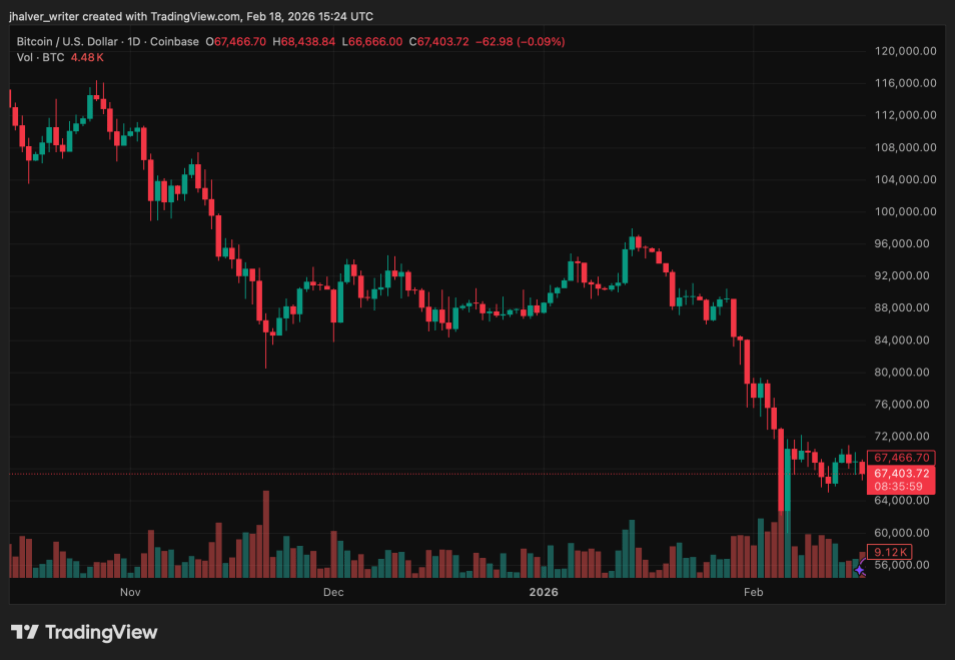
BTC's price trends to the downside on the daily chart. Source: BTCUSD on Tradingview 

Nevada Pushes Gambling Enforcement

Nevada regulators argue that Kalshi’s event contracts, which allow users to trade on outcomes such as sports results, function similarly to traditional sports betting and therefore require a state gaming license.

Officials say the company is offering unlicensed wagering that violates Nevada’s gaming laws and undermines the state’s tightly regulated betting market.

The lawsuit seeks an injunction that could force Kalshi to halt its local operations while litigation continues. The state has taken similar action against other platforms, reflecting a wider effort by multiple jurisdictions to limit prediction markets they view as gambling products.

Kalshi disputes that characterization, maintaining that its contracts are financial derivatives, not bets. The company operates as a federally regulated exchange and has moved to have the case transferred to federal court, arguing that state laws are preempted by federal oversight.

Federal Regulators Enter the Fight

At the center of the dispute is the Commodity Futures Trading Commission (CFTC), which, under Chairman Michael Selig, has taken a more active stance in defending prediction markets. The agency filed an amicus brief supporting federal jurisdiction, arguing that states cannot reclassify federally regulated derivatives trading as illegal gambling.

The Trump administration’s backing of Kalshi and Polymarket shows a broader policy shift toward treating prediction markets as part of the financial system rather than the gambling industry. Federal officials argue that allowing individual states to impose bans could create fragmented regulation and undermine national derivatives markets.

Prediction platforms allow participants to buy contracts priced between one and 99 cents based on the probability of real-world events occurring. While markets cover politics, economics, and weather outcomes, sports-related contracts account for the majority of trading volume.

What Comes Next for Prediction Markets

The legal battle is unfolding across several courts and could ultimately determine who regulates prediction markets nationwide. States, including Massachusetts, Tennessee, and others, have issued lawsuits or cease-and-desist orders, while operators continue to argue for federal protection.

Nevada’s enforcement action increases immediate pressure on Kalshi, though appeals, including a potential emergency request to the U.S. Supreme Court, remain possible.

The outcome could reshape how Americans participate in event-based trading and define the boundary between financial speculation and online gambling for years to come.

Cover image from ChatGPT, BTCUSD chart from Tradingview

Crypto di tendenza

Domande pertinenti

QWhat is the core legal dispute surrounding prediction markets like Kalshi and Polymarket in the United States?

AThe core legal dispute is whether prediction markets are financial products governed by federal law (specifically, as derivatives regulated by the CFTC) or a form of online gambling subject to state control and licensing.

QWhich federal agency has intervened to support Kalshi and Polymarket, and what is its argument?

AThe Commodity Futures Trading Commission (CFTC), under Chairman Michael Selig, has intervened. It filed an amicus brief arguing that states cannot reclassify federally regulated derivatives trading as illegal gambling, as this would undermine national derivatives markets and create fragmented regulation.

QWhat specific action did Nevada regulators take against Kalshi, and what is their justification?

ANevada regulators filed a civil lawsuit seeking an injunction to block Kalshi from offering sports-related event contracts to state residents. They argue these contracts function like traditional sports betting and therefore require a state gaming license, making their current operation unlicensed wagering that violates state law.

QHow does Kalshi define its own event contracts, and what action has it taken in response to Nevada's lawsuit?

AKalshi defines its event contracts as financial derivatives, not bets. In response to Nevada's lawsuit, the company has moved to have the case transferred to federal court, arguing that state laws are preempted by federal oversight.

QWhat broader policy shift does the Trump administration's backing of these prediction markets represent?

AIt represents a policy shift toward treating prediction markets as part of the financial system rather than the gambling industry, aiming to prevent fragmented state-level regulation that could undermine the national derivatives market.

Letture associate

Analysis of the Latest Portfolio Adjustment by the "Top Player" in the U.S. Stock Market: $9 Billion Short on NVIDIA, Shifting Focus to Power and Memory Sectors

AI investor Leopold Aschenbrenner has made a significant portfolio shift, taking a $9 billion nominal short position against top AI infrastructure stocks like NVIDIA, ASML, and Oracle. Simultaneously, he is redirecting capital towards what he sees as the next critical bottlenecks in the AI boom: power, memory, and data center networking, alongside private investments in AI model companies like Anthropic. This move is interpreted not as a call that the AI bubble has burst, but as a rotation within the infrastructure stack. The analysis highlights NVIDIA's recent $25 billion bond issuance as a potential signal, questioning why a cash-rich company would seek external debt despite high profits and increased dividends/buybacks. The core investment thesis is that the initial, crowded "picks and shovels" trade in semiconductors is maturing. The next wave of capital is expected to flow into the physical and logistical constraints of AI expansion: electricity supply, memory chip capacity, data center construction, and enabling technologies like optical networking (fiber) for high-bandwidth communication, where copper remains crucial for short distances. Aschenbrenner's substantial (approx. 20% of fund) private stake in Anthropic is noted as a key part of his strategy—investing directly in the "mine" (AI models) rather than just the "shovels." The discussion concludes that while certain segments may be overvalued, the overarching AI infrastructure demand driven by real product usage remains robust. The most promising long-term investments are seen in essential, non-sexy infrastructure—particularly energy and power companies—whose demand is viewed as a global constant irrespective of AI's cyclicality.

marsbit21 min fa

Analysis of the Latest Portfolio Adjustment by the "Top Player" in the U.S. Stock Market: $9 Billion Short on NVIDIA, Shifting Focus to Power and Memory Sectors

marsbit21 min fa

BIT Research: Liquidity is Disappearing, Will Bitcoin Replay the Bottoming Pattern of 2022?

The crypto market is currently in an adjustment phase driven by policy expectations and liquidity shifts. Despite a brief rebound fueled by geopolitical easing and SpaceX's strong IPO performance, unexpectedly hawkish signals from new Fed Chair Kevin Warsh have removed anticipated easing support. Concurrently, stablecoin liquidity is shrinking, with insufficient new capital inflows, pushing the market into a typically quiet summer period. Pricing lacks catalysts for a sustained rally. Daily trading volume has significantly contracted, stablecoin growth has slowed markedly, and the supportive effect of Strategy's (formerly MicroStrategy) STRC preferred stock-financed Bitcoin purchases is fading. Amid policy uncertainty, seasonal weakness, and liquidity contraction, Bitcoin faces near-term downward pressure. Warsh's hawkish pivot and refusal to provide a clear policy outlook have increased risk premiums, historically unfavorable for Bitcoin. Technically, the trend remains bearish below $73,700, with $62,446 as critical support. A break below could accelerate declines, though a prolonged consolidation phase, similar to 2022's bottoming process, is possible. Liquidity is a core constraint. Current daily volume is around $500 billion, roughly 25% of the peak during the July-Oct 2025 rally. The 12-month growth rates for USDT and USDC have fallen to ~20%, with 6-month growth near zero, indicating weak new inflows. Bitcoin ETF and Strategy-driven inflows have also weakened, with a 30-day rolling net outflow. With inflation at 4.2% above the Fed's target, combined hawkish policy, seasonal factors, and liquidity shortages challenge Bitcoin's ability to hold above $60,000. However, this adjustment phase may be forming a cyclical low this summer, potentially setting the stage for the next bull cycle.

marsbit50 min fa

BIT Research: Liquidity is Disappearing, Will Bitcoin Replay the Bottoming Pattern of 2022?

marsbit50 min fa

Who Makes the Best Use of Claude Code? The Answer Might Not Be Programmers

Claude Code Usage Report Summary (Based on ~400k sessions) Core Finding: In agentic programming with Claude Code, a clear division of labor has emerged: humans primarily decide *what* to build (planning decisions), while Claude decides *how* to build it (execution decisions). Key Insights: 1. **Effectiveness is not limited to programmers.** In code-generation tasks, success rates for users in non-technical fields (law, finance, management, research) are nearing those of software engineers. What matters most is the user's domain expertise and understanding of the problem to be solved. 2. **Domain expertise drives success and efficiency.** Sessions where users exhibited "expert" proficiency in the task's domain saw verified success rates double compared to "novice" sessions. Experts also delegated more work per instruction, with Claude executing more actions and producing more output. 3. **AI is amplifying, not replacing, domain knowledge.** Claude Code lowers the *implementation* barrier, not the *judgment* barrier. The value of knowing the "what" and "why" is increasing relative to just knowing the "how" to code. 4. **Usage is evolving.** Over a 7-month period (Oct '25 - Apr '26), the share of sessions for debugging halved, while use for software operations, data analysis, and non-code writing roughly doubled. The estimated economic value of typical tasks increased by ~25%. Conclusion: The data suggests coding agents are making programming background less critical for completing technical tasks. However, they reward and amplify deep domain understanding. The ability to successfully direct an AI agent stems more from mastery of a specific field than from coding skill itself. The primary gains come from being competent in a domain; deep specialization adds only marginal additional advantage. This may signal a shift where software creation becomes integrated into various professions.

marsbit1 h fa

Who Makes the Best Use of Claude Code? The Answer Might Not Be Programmers

marsbit1 h fa

Trading

Spot
Futures

Articoli Popolari

Come comprare BAN

Benvenuto in HTX.com! Abbiamo reso l'acquisto di Comedian (BAN) semplice e conveniente. Segui la nostra guida passo passo per intraprendere il tuo viaggio nel mondo delle criptovalute.Step 1: Crea il tuo Account HTXUsa la tua email o numero di telefono per registrarti il tuo account gratuito su HTX. Vivi un'esperienza facile e sblocca tutte le funzionalità,Crea il mio accountStep 2: Vai in Acquista crypto e seleziona il tuo metodo di pagamentoCarta di credito/debito: utilizza la tua Visa o Mastercard per acquistare immediatamente ComedianBAN.Bilancio: Usa i fondi dal bilancio del tuo account HTX per fare trading senza problemi.Terze parti: abbiamo aggiunto metodi di pagamento molto utilizzati come Google Pay e Apple Pay per maggiore comodità.P2P: Fai trading direttamente con altri utenti HTX.Over-the-Counter (OTC): Offriamo servizi su misura e tassi di cambio competitivi per i trader.Step 3: Conserva Comedian (BAN)Dopo aver acquistato Comedian (BAN), conserva nel tuo account HTX. In alternativa, puoi inviare tramite trasferimento blockchain o scambiare per altre criptovalute.Step 4: Scambia Comedian (BAN)Scambia facilmente Comedian (BAN) nel mercato spot di HTX. Accedi al tuo account, seleziona la tua coppia di trading, esegui le tue operazioni e monitora in tempo reale. Offriamo un'esperienza user-friendly sia per chi ha appena iniziato che per i trader più esperti.

509 Totale visualizzazioniPubblicato il 2024.12.11Aggiornato il 2026.06.02

Come comprare BAN

Discussioni

Benvenuto nella Community HTX. Qui puoi rimanere informato sugli ultimi sviluppi della piattaforma e accedere ad approfondimenti esperti sul mercato. Le opinioni degli utenti sul prezzo di BAN BAN sono presentate come di seguito.

活动图片