The World Cup Has Only Just Begun, But AI Predictions Already Have Models Hailed as 'Godly' and Others Flipping Over

Odaily星球日报Pubblicato 2026-06-15Pubblicato ultima volta 2026-06-15

Introduzione

After only a few days of the World Cup, AI models are being widely used for match predictions, with mixed early results. These models analyze details like scores, upsets, red cards, and key players, offering users in prediction markets an extra layer of analysis beyond odds and news. Qwen gained early attention for its remarkably accurate calls on the opening day, correctly predicting Mexico's 2-0 win over South Africa and Korea's 2-1 victory over the Czech Republic, while also highlighting red card risks and match flow. Copilot had its own highlights, accurately forecasting the Mexico 2-0 result, the Korea 2-1 win, and a surprising 1-1 draw between Brazil and Morocco. However, it also misjudged several matches, like predicting a Swiss win that ended in a draw with Qatar and missing Australia's upset over Turkey. ChatGPT provided detailed pre-match analysis and correctly called the Mexico 2-0 score, explaining factors like home-field advantage. Yet, it struggled to anticipate upsets, often siding with the stronger team on paper, as seen in its missed calls for the Australia-Turkey and Japan-Netherlands matches. Social media tests pitted models like Gemini, Grok, and Claude against each other for the same games, revealing different predictive "scripts" even for the same fixture. Overall, while AI models like Qwen and Copilot have shown promising, high-profile successes in early matches, their consistency and ability to predict genuine upsets remain in question. As the tour...

Original | Odaily Planet Daily (@OdailyChina)

Author | Asher(@Asher_ 0210)

The most lively place in this World Cup isn't just on the pitch.

As the heat around World Cup prediction events rises, more and more users are starting to participate in trading with real money. Who will win, what will the score be, will there be an upset, will there be a red card, which player will score—topics that originally belonged to pre-match fan chatter have now been broken down into tradable prediction events.

And when predictions become trades, what users need is more than just emotion and intuition: odds movements, team form, injury news, historical matchups, market sentiment, all become references before a trade. In this process, AI models are being frequently pulled into World Cup prediction scenarios.

Large models like Qwen, ChatGPT, Gemini, Claude, DeepSeek, Qwen, and Copilot can not only answer "which team is more likely to win," but also give score predictions, upset possibilities, red card risks, key player performance, and match flow analysis. For prediction market participants, AI's pre-match deduction is becoming another layer of reference beyond odds, news, team data, and market sentiment.

However, predictions ultimately have to return to the matches themselves.

As the World Cup officially kicks off and the results of the first few matches come out one after another, those AI analyses that users used to aid their judgment before the matches finally have answers to compare against: Was the score predicted, were upsets spotted in advance, how many details like red cards, last-minute winners, and match flow were truly captured by the models.

The First to Go Viral Was, Unexpectedly, Qwen

The most dramatic performance on the first day of the World Cup was undoubtedly Qwen's.

For the opening match between Mexico and South Africa, Qwen's pre-match prediction was Mexico 2:0 South Africa. After the match ended, the score was indeed 2:0. What's more interesting is that the total of three red cards in the match also basically matched Qwen's pre-match risk assessment of "South Africa's overly physical defending, possibly getting into an early one-man-down situation."
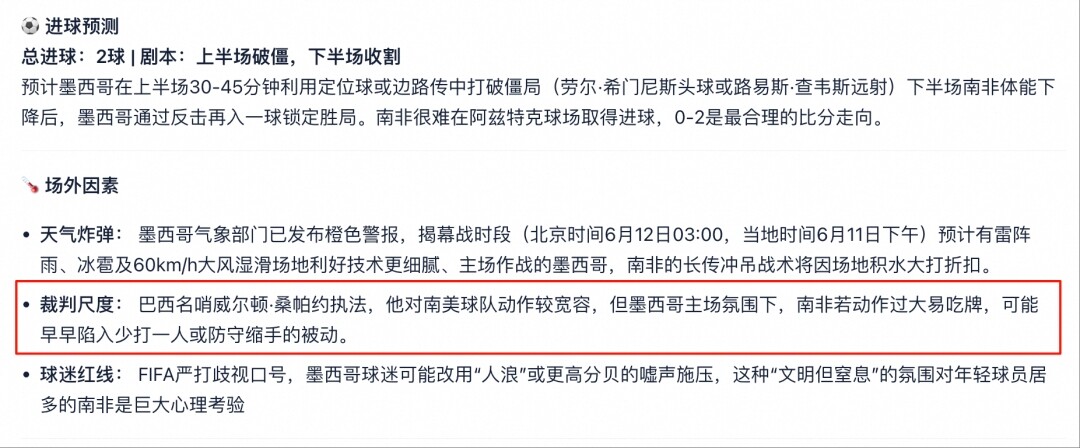
If it were just predicting a Mexico win, that wouldn't be too surprising. As one of the hosts, Mexico was already favored. But what Qwen hit this time were more specific match details: the 2:0 scoreline, South Africa's red card risk, and the gradually widening gap in the latter stages of the match.

Immediately after, for the South Korea vs. Czech Republic match, Qwen gave another prediction of South Korea 2:1.

This match wasn't easy to call pre-match. The Czechs have physicality, set-piece threats, and the usual big-tournament experience of European teams. The match process was indeed not one-sided—the Czechs took the lead first, South Korea equalized later, and the match was deadlocked at 1:1 for a long time. Until the final stage, South Korea scored the winning goal, and the final score became 2:1.

At this point, Qwen's prediction gained a stronger "scripted" feel. Judging the winner can rely on paper strength, score prediction can have luck involved, but it's process details like red cards, comebacks, and last-stage winners that truly make people feel "there's something to it." After two matches on the first day, Qwen first pulled up the attention on AI World Cup predictions.

Copilot: Moments of Genius, and Clear Flops

Before the tournament, USA Today had Copilot predict all 104 matches of this World Cup. Looking at the matches that have concluded so far, this prediction has both highlights and clear misses.

Three match predictions stood out the most.

For the opening match Mexico vs. South Africa, Copilot predicted Mexico 2:0, which hit the final score exactly. For South Korea vs. Czech Republic, it predicted South Korea 2:1, again matching the result. For Brazil vs. Morocco, Copilot gave a 1:1 prediction, and Brazil was indeed held to a draw by Morocco.

Especially the Brazil 1:1 Morocco match, the prediction had considerable merit. Brazil, after all, is a traditional powerhouse, with squad strength and attention in the top tier. Although Morocco reached the semi-finals in the last World Cup, directly predicting a draw against Brazil pre-match wasn't a particularly safe choice. After the match, Brazil didn't get a winning start, and Morocco continued its tournament resilience. Copilot's prediction for this match was indeed a "stroke of genius."

But Copilot's issues also quickly surfaced.

It predicted Canada would beat Bosnia and Herzegovina 2:1, but they drew 1:1; predicted Switzerland would narrowly beat Qatar 1:0, but Switzerland was also held to a draw; predicted the USA would beat Paraguay 2:0—the direction was correct, but the actual score was 4:1, significantly underestimating the offensive intensity.

More obvious flops appeared in several upset matches and matches where strong teams were held back.

For Turkey vs. Australia, Copilot predicted Turkey to win 2:1, but Australia pulled off a 2:0 upset win. For Ecuador vs. Ivory Coast, it predicted Ecuador 2:1, but Ivory Coast won 1:0. For Netherlands vs. Japan, it predicted Netherlands 2:1, but Japan equalized twice, resulting in a 2:2 draw. For Sweden vs. Tunisia, it predicted 1:1, but Sweden directly won 5:1.

That Copilot could nail the exact scores for Mexico, South Korea, and Brazil matches shows it's not just giving answers favoring the favorites. But matches like Australia beating Turkey, Qatar drawing with Switzerland, and Japan drawing with Netherlands also expose that its judgment on upsets and draws is still relatively conservative.

ChatGPT: Analysis Is Comprehensive, But Not Sharp Enough on Upsets

Compared to Copilot's full schedule prediction, ChatGPT is more of a "pre-match analysis player."

In the opening match prediction, ChatGPT predicted Mexico 2:0 South Africa, hitting the final score. The reasoning it gave was also quite comprehensive, including Mexico's home advantage, recent form, South Africa's lack of attacking power, and factors like Mexico City's high altitude and home atmosphere. In this prediction, ChatGPT didn't just give a result; the underlying judgment logic also aligned with the match outcome.
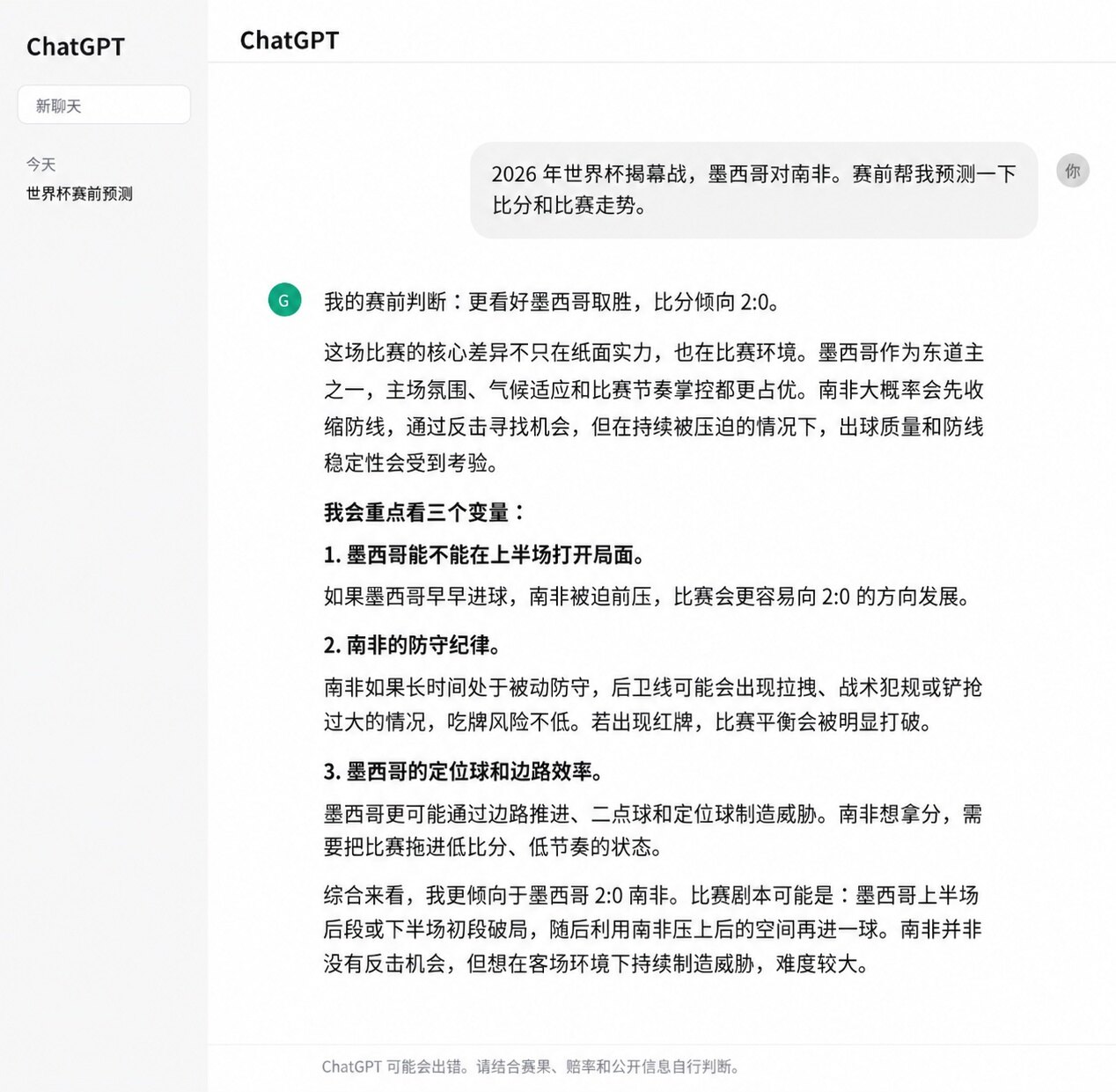
But when it comes to full World Cup schedule predictions, ChatGPT's stability isn't as strong. While it hit Mexico 2:0 South Africa and Brazil 1:1 Morocco, and correctly called the winner in several matches like Scotland, Germany, and Sweden, in matches like South Korea 2:1 Czech Republic, Qatar 1:1 Switzerland, Australia 2:0 Turkey, and Japan 2:2 Netherlands, ChatGPT's judgments all predicted the team with stronger paper strength. For example, Switzerland should beat Qatar, Turkey should beat Australia, the Netherlands should narrowly beat Japan.

ChatGPT isn't without predictive ability; it can break down team strength, home environment, and recent form clearly, and can hit the score in some matches. But based on current results, it's better at explaining "why the favorite is more reasonable" than identifying in advance which matches might deviate from the favorite's script.

Gemini, Grok, Claude: Different Models Write Different Scripts for the Same Match

Besides Qwen, Copilot, and ChatGPT, some social media users fed the same match to multiple models for pre-match predictions.

Taking the opening match Mexico vs. South Africa as an example, a blogger tested four AI models—ChatGPT, Gemini, Grok, and Claude—simultaneously for pre-match predictions. The results showed that ChatGPT and Gemini both predicted Mexico 2:0 South Africa, hitting the final score exactly; Grok predicted Mexico 2:1, Claude predicted Mexico 3:1; while both correctly saw Mexico winning, they didn't nail the exact score.

For this opening match prediction, different models gave three different "scripts." ChatGPT and Gemini Pro were closer to the actual match: Mexico dominant, South Africa lacking in attack, eventually kept scoreless. Grok seemed to give a more open scoreline, thinking South Africa would get a goal back from a counter. Claude Sonnet raised expectations for Mexico's attack higher, giving a more open 3:1 result.

Summary

Since the currently reviewable sample of AI predictions is still limited, we can't directly judge which model is the most "football-savvy" at this stage.

But just looking at the few matches that have concluded, differences are starting to show. Qwen currently has the most memorable performance, hitting Mexico 2:0 South Africa and South Korea 2:1 Czech Republic on the first day, and also stepping on red card risks and match flow, a highlight in a small sample. However, whether it can sustain accuracy needs more matches to verify.

Copilot and ChatGPT both have highlights of hitting exact scores, but also expose a common problem—their judgment still isn't sensitive enough when facing matches that deviate from paper strength, like Australia beating Turkey, Qatar drawing Switzerland, or Japan drawing the Netherlands.

As for models like Gemini, Grok, and Claude, currently public samples are more concentrated on single matches or social media comparisons, having reference value but not yet suitable for direct ranking.

AI can already serve as a layer of reference for World Cup prediction market users, but it's far from a standard answer. Next, Odaily Planet Daily will continue to collect pre-match predictions from various models and keep reviewing them as the tournament progresses: which models just had good luck at the start, and which models can truly withstand the test of results across more matches.


Domande pertinenti

QWhich AI model achieved a notable success in predicting the first two matches of the World Cup, including specific scores and details like red cards?

AThe AI model Qwen (千问) successfully predicted the exact scores of Mexico 2:0 South Africa and South Korea 2:1 Czech Republic in the first two matches. It also correctly identified the risk of red cards for South Africa.

QWhat were the major strengths and weaknesses of Copilot's World Cup match predictions according to the article?

ACopilot's strengths included accurately predicting the exact scores of Mexico 2:0 South Africa, South Korea 2:1 Czech Republic, and Brazil 1:1 Morocco. Its weaknesses were significant misses on several matches, such as incorrectly predicting wins for Turkey against Australia and for Switzerland against Qatar, showing a conservative bias against upsets and draws.

QHow did ChatGPT's approach to World Cup prediction differ from a model like Copilot?

AChatGPT functioned more as a 'pre-match analytical player,' providing detailed reasoning behind its predictions (e.g., considering Mexico's home advantage and altitude). While it accurately predicted some scores like Mexico 2:0, its full-tournament predictions showed less stability and a tendency to favor the stronger team on paper, missing several upsets and draws.

QWhat were the different predictions made by ChatGPT, Gemini, Grok, and Claude for the opening match between Mexico and South Africa?

AFor the opening match Mexico vs. South Africa, ChatGPT and Gemini predicted a 2:0 win for Mexico. Grok predicted a 2:1 win for Mexico, and Claude predicted a 3:1 win for Mexico. Only ChatGPT and Gemini predicted the exact final score of 2:0.

QWhat is the article's overall conclusion about the current reliability of AI models for World Cup predictions?

AThe article concludes that while AI models can provide an additional layer of reference for prediction market participants, they are far from being a standard answer. Their reliability varies, with some showing promising initial results but needing more matches for validation, and most models currently showing a lack of sensitivity in predicting upsets and unexpected draws.

Letture associate

STAR 50 Soars 10.73%, Why Did A-Shares Stage a "V-Shaped Reversal"?

After a prolonged decline, the Chinese A-share market staged a strong rally on July 21. The STAR 50 index surged 10.73%, its largest single-day gain in nearly a year, leading a broad-based "V-shaped" reversal. The Shanghai Composite Index rose 1.79%, the Shenzhen Component Index gained 4.81%, and the ChiNext Index jumped 7.05%. Total market turnover reached 2.97 trillion yuan, an increase of 256.1 billion yuan from the previous session, with over 3,100 stocks advancing. The semiconductor sector spearheaded the rebound, with related ETFs posting significant gains. Analysts attribute the surge to three converging factors. First, coordinated capital inflows from "national team" institutions, insurance funds, listed company buybacks, and fund house self-purchases have bolstered market liquidity and confidence. Second, supportive policy signals, including commitments from regulators to ensure stable market operations, provided a favorable backdrop. Third, a stabilization and recovery in overseas markets, notably South Korea, created a positive external environment. Institutions suggest the most severe panic selling phase for the tech sector has likely passed, following a significant digestion of crowded positions and leveraged funds. While short-term volatility may persist, the medium to long-term outlook remains underpinned by enduring trends like AI computing demand expansion and semiconductor localization. The market's focus now shifts to the sustainability of supportive fund flows, earnings reports, and upcoming catalysts from the global AI industry chain.

marsbit16 min fa

STAR 50 Soars 10.73%, Why Did A-Shares Stage a "V-Shaped Reversal"?

marsbit16 min fa

U.S. Tech Momentum Stocks Post Largest Single-Day Gain Ever, But Is the Plunge Over?

US tech momentum stocks staged a sharp rebound on Tuesday (July 21st). Morgan Stanley's TMT Momentum Factor surged over 12%, marking its largest single-day gain on record, exceeding even peaks from the 2000 dot-com bubble. Key momentum indices from Goldman Sachs also posted their strongest daily performances in years. The rally was led by semiconductors, with the Philadelphia Semiconductor Index jumping 4.6%. This rebound followed three consecutive down days and a cumulative 33% plunge in momentum stocks, one of the steepest drawdowns since the dot-com era. Analysts attribute the surge largely to a short squeeze. Heavy selling had pushed high-beta momentum stocks into deeply oversold territory, forcing many short sellers, particularly in Asia, to cover their positions, creating a self-reinforcing buying spiral. However, the rebound's internals appear weak. Trading volume was notably low, and advancing stocks still lagged decliners on the S&P 500, indicating a narrow, concentrated rally rather than broad market participation. Diverging views emerge on the outlook. BTIG warns the bounce has hit key resistance and recommends selling into strength, citing extreme volatility and historical parallels to past market tops. Conversely, Goldman Sachs and UBS believe the momentum unwind is nearing its end, suggesting it may be time to gradually add exposure, as positioning has been significantly reduced. They caution, however, that high volatility warrants a measured approach, potentially using defined-risk strategies. The upcoming earnings season, particularly reports from major tech firms like Alphabet, is seen as a critical test for the rally's sustainability. Simultaneously, bond markets flashed a warning, with yields rising partly due to spiking oil prices. Analysts note that if long-term Treasury yields break decisively higher, it could pose a significant headwind for equities, especially growth stocks.

marsbit23 min fa

U.S. Tech Momentum Stocks Post Largest Single-Day Gain Ever, But Is the Plunge Over?

marsbit23 min fa

U.S. Tech Momentum Stocks Record Largest Single-Day Gain Ever, but Has the Rout Ended?

U.S. tech momentum stocks staged a dramatic rebound on Tuesday, July 21st. Key momentum indices like the Morgan Stanley TMT Momentum Factor and Goldman Sachs' High Beta Momentum Long Index posted historic or near-historic single-day gains, fueled largely by semiconductor stocks. This sharp rally followed a severe three-day sell-off that saw momentum stocks plunge 33%, marking one of the steepest pullbacks since the dot-com bubble. Analysts attribute the bounce primarily to a short squeeze, as forced covering from over-leveraged traders, particularly in Asia, created a buying spiral. However, the rally's health is questioned due to weak market breadth—overall trading volume was low, and decliners outnumbered advancers in the S&P 500 despite the index's gain—suggesting a narrow, concentrated surge rather than broad recovery. Opinions on the sustainability diverge. BTIG strategists warn the rebound has hit key resistance levels, citing extreme volatility and historic stock dispersion as signs of an ongoing broader correction, and recommend selling into strength. Conversely, Goldman Sachs and UBS view the aggressive momentum unwinding as nearing its end, noting reduced positioning and a lack of new fundamental catalysts. They suggest the sell-off presents a selective opportunity to add exposure, albeit cautiously and gradually using defined-risk strategies. The immediate trajectory hinges on the ongoing earnings season, with market focus on Alphabet's capital expenditure guidance for AI investment clarity. Meanwhile, bond markets present a risk, with rising Treasury yields—potentially heading toward 5.5%—and widening credit spreads for mega-cap tech companies posing a threat to equity valuations. The combination of technical factors, earnings results, and macro conditions leaves the durability of the rebound in doubt.

链捕手26 min fa

U.S. Tech Momentum Stocks Record Largest Single-Day Gain Ever, but Has the Rout Ended?

链捕手26 min fa

Long-Divided Must Unite, Long-United Must Divide: When L1 Becomes Its Own Rollup, What Is Ethereum's Endgame?

"The Inevitable Cycle: When L1 Becomes Its Own Rollup – What is Ethereum's Endgame?" For years, the Ethereum community grappled with concerns that L2s were fragmenting the ecosystem and eroding L1's value. While L2s provided cheaper execution, they also splintered liquidity and the unified user experience of a single chain. This has prompted a fundamental reassessment of the relationship between L1 and L2. Ethereum's roadmap is evolving. The "Scale" initiative merges L1 and L2 expansion into a holistic framework. L1 itself is advancing with higher gas limits, statelessness, and zkEVM verification, no longer content to be just a low-throughput settlement layer. Consequently, the primary value proposition of L2s is shifting from merely providing cheap blockspace to offering L1 cannot easily provide: application-specific optimizations, privacy features, and flexible governance models. L2s are becoming a spectrum of execution environments with varying degrees of security inheritance from Ethereum. A critical challenge in this multi-chain future is interoperability. The vision is to make Ethereum "feel like one chain again." This relies on advancements in native account abstraction (like EIP-7702) and intent-based architectures (Open Intents Framework), where users declare desired outcomes, and solvers handle the complex cross-chain execution. Furthermore, shortening Ethereum's finality time from minutes to seconds is crucial, as it underpins trust between chains for bridges, stablecoins, and cross-chain applications. Perhaps the most provocative idea is that Ethereum L1 itself could become a form of "its own Rollup." As zkEVM and proof systems mature, high-performance nodes could execute transactions and generate validity proofs. Regular validators would then verify these proofs instead of re-executing all transactions. This blurs the traditional L1/L2 hierarchy, making "Rollup" more of a general execution-verification architecture. Native Rollup aims to integrate L2 validation more directly into the Ethereum protocol, allowing L2s to inherit L1's security more fully and move away from reliance on security councils. In the end, L2s are not destined to replace L1 or be made obsolete by it. The likely future is a unified system where diverse execution environments—each optimized for specific use cases like DeFi, gaming, or privacy—coexist. They will share a common foundation of security, liquidity, and verifiable state, seamlessly connected to restore a cohesive user experience. The next phase for Ethereum is not just about scaling through separation, but about intelligently reintegrating what was separated back into a coherent whole.

链捕手42 min fa

Long-Divided Must Unite, Long-United Must Divide: When L1 Becomes Its Own Rollup, What Is Ethereum's Endgame?

链捕手42 min fa

Trading

Spot
活动图片




