Long-Divided Must Unite, Long-United Must Divide: When L1 Becomes Its Own Rollup, What Is Ethereum's Endgame?

链捕手Pubblicato 2026-07-22Pubblicato ultima volta 2026-07-22

Introduzione

"The Inevitable Cycle: When L1 Becomes Its Own Rollup – What is Ethereum's Endgame?" For years, the Ethereum community grappled with concerns that L2s were fragmenting the ecosystem and eroding L1's value. While L2s provided cheaper execution, they also splintered liquidity and the unified user experience of a single chain. This has prompted a fundamental reassessment of the relationship between L1 and L2. Ethereum's roadmap is evolving. The "Scale" initiative merges L1 and L2 expansion into a holistic framework. L1 itself is advancing with higher gas limits, statelessness, and zkEVM verification, no longer content to be just a low-throughput settlement layer. Consequently, the primary value proposition of L2s is shifting from merely providing cheap blockspace to offering L1 cannot easily provide: application-specific optimizations, privacy features, and flexible governance models. L2s are becoming a spectrum of execution environments with varying degrees of security inheritance from Ethereum. A critical challenge in this multi-chain future is interoperability. The vision is to make Ethereum "feel like one chain again." This relies on advancements in native account abstraction (like EIP-7702) and intent-based architectures (Open Intents Framework), where users declare desired outcomes, and solvers handle the complex cross-chain execution. Furthermore, shortening Ethereum's finality time from minutes to seconds is crucial, as it underpins trust between chains for bridges, s...

"Are L2s cannibalizing L1's value?" "Is Ethereum losing its global composability?" During the years when L2s were at the peak of their popularity, such anxieties almost permeated the entire Ethereum community.

In Ethereum's scaling framework at that time, L1 was the stable but expensive settlement layer, while L2s, as cheap and efficient execution layers, indeed granted Ethereum more block space, but also gradually eroded the experience of a "unified chain."

Therefore, over the past two years, these questions have continuously driven Ethereum to re-examine the relationship between L1 and L2.

On one hand, Ethereum L1 persistently increased the Gas Limit, advanced statelessness and zkEVM verification, no longer content with merely being a low-throughput settlement base; on the other hand, community discussions intensified. Early this year, Vitalik explicitly stated that as Ethereum's own scaling capabilities improve, some premises of the roadmap established five years ago—which viewed L2s as the primary scaling solution—had already changed.

More recently, Ethereum researcher Barnabé Monnot further expressed the need to re-evaluate the long-term relationship between L1 and L2, including how L2s should create value in the future, why finality needs to be dramatically shortened, and whether L1 could also become a sort of "rollup of itself" as proof systems gradually enter the mainnet validation process.

While these viewpoints do not yet equate to a confirmed protocol roadmap, they provide a valuable lens for observation.

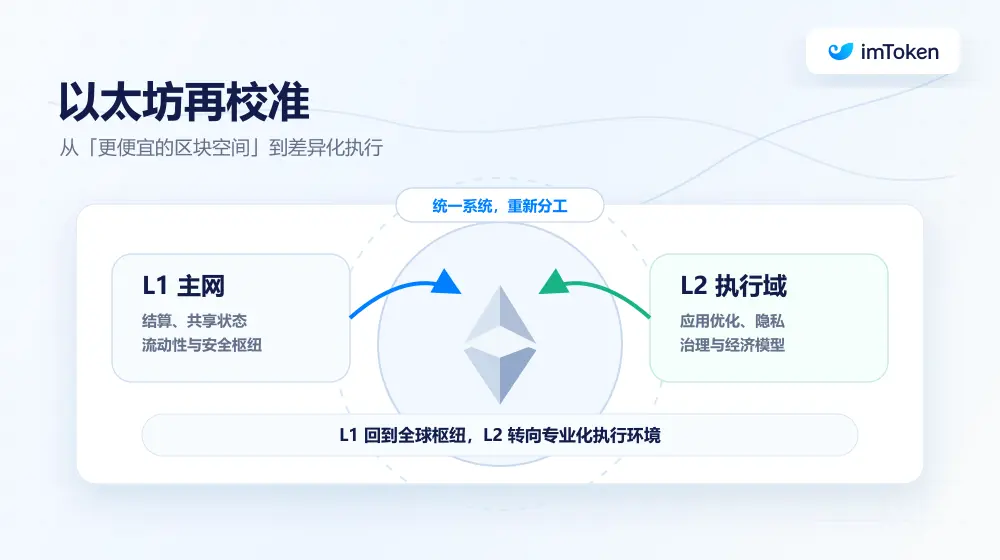
Ultimately, the problem Ethereum faces today is not just about continuing to increase block space, but rather how to re-divide labor among L1, L2, execution layers, and settlement layers as transactions, assets, and user states are dispersed across an increasing number of execution environments.
1. Ethereum Hasn't "Abandoned" L2, But Must Find a New Positioning

To be realistic, when the Ethereum scaling roadmap centered around Rollups was initially formed, L2's most important task was relatively singular: to provide Ethereum with more and cheaper transaction space.

Under the technological conditions of that time, this division of labor was quite reasonable.

Because Ethereum validators all needed to re-execute L1 transactions, mainnet throughput couldn't be aggressively increased in the short term. Rollups, however, could execute transactions in batches off-chain, submitting only compressed data or state commitments back to the mainnet, retaining a degree of Ethereum's security properties while significantly reducing unit transaction costs.

Thus, scaling gradually formed two parallel paths: L1 remained restrained, prioritizing decentralization and security, while L2s accommodated new transactions, continuously reducing costs through Blobs, data compression, and proof technologies.

But now, the premises of this division have changed.

In 2026, the Ethereum Foundation consolidated its protocol work, merging the previously separate "Scaling L1" and "Scaling Blobs" into a unified Scale roadmap. Increasing the Gas Limit, expanding data availability, optimizing execution clients, advancing statelessness, and zkEVM attester clients were all placed within the same scaling framework.

In other words, Ethereum no longer views L1 and L2 scaling as two separate tasks but has begun to reallocate execution, consensus, and data capacity from a system-wide perspective.

This change does not mean Ethereum is preparing to abandon L2s or pull all activity back to the mainnet. On the contrary, it means L2s can no longer easily justify their long-term value merely by being "faster and cheaper."

After all, if L1 itself can increase execution capacity by several orders of magnitude while maintaining security and decentralization, then ordinary EVM execution and low-cost block space will no longer be capabilities unique to L2s; L2s will need to shift focus towards providing differentiated needs that L1 cannot uniformly satisfy, such as application-specific optimizations, privacy features, and more flexible governance and economic models.

The Ethereum Foundation's latest statement this year on the L1-L2 relationship also explicitly emphasizes this. Previously, L2's primary goal was to scale Ethereum, with differentiation and customization as secondary values; now, it's about providing differentiated functionality while continuing to contribute additional scaling capacity.

Correspondingly, L1 needs to become a sufficiently powerful, permissionless, and highly resilient global hub, carrying settlement, shared state, liquidity, and DeFi.

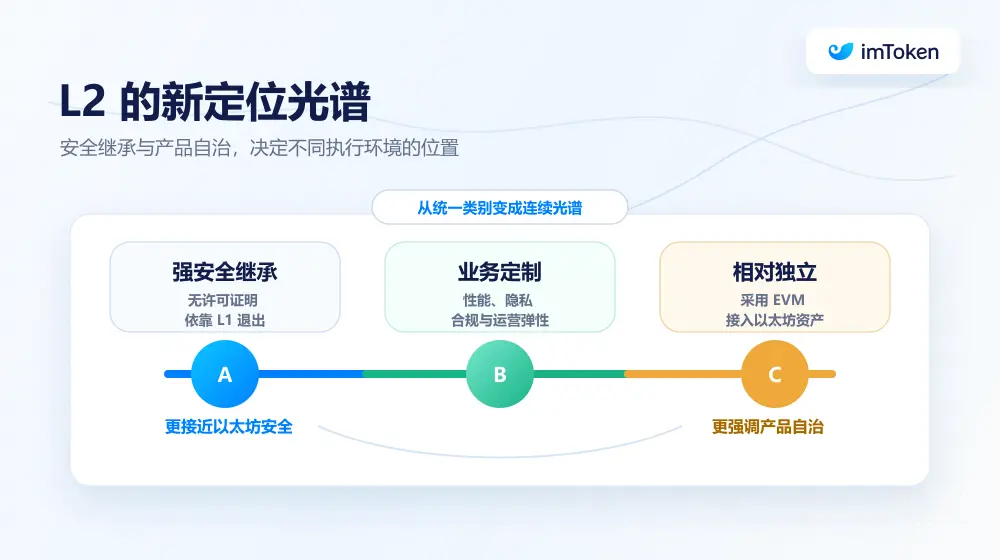
This essentially pushes L2 from a uniform technical category towards a more complex continuum:

  • At one end of the spectrum are Rollups that aim to inherit as many of Ethereum's security properties as possible, seeking to reduce multisig security committees, open permissionless proof mechanisms, and ensure users can still exit to L1 even if operators cease functioning.
  • In the middle are execution environments that inherit some Ethereum properties based on business needs, potentially possessing stronger management permissions, independent sequencers, or specific compliance designs in exchange for performance, privacy, and operational flexibility.
  • At the other end might be chains that adopt EVM, use Ethereum assets, or connect to some cross-chain facilities, but are relatively independent in terms of security and settlement.

This is why Ethereum isn't abandoning L2s, but rather redefining the division of labor. Essentially, over the past 3-5 years, L2 first and foremost represented a scaling technology; in the future, it is more likely to represent a set of execution environments that establish different security, settlement, and liquidity relationships with Ethereum.
2. Interoperability Isn't Just About Cross-Chain, But How States Trust Each Other

However, as Ethereum scales into a system comprising numerous L2s, another perennial issue gradually surfaces: the proliferation of L2s inevitably fragments liquidity, account states, and application experiences.

This has been vividly demonstrated in actual usage over the past few years. For instance, users might hold assets on one chain, use applications on another, and need to go to a third chain to complete a transaction. This results in the same stable币 having different versions across networks, and the same account needing to handle different Gas Tokens, bridges, and asset entry points.

Therefore, interoperability has become an increasingly important part of Ethereum's roadmap.

The Ethereum protocol team has focused its 2026 "Improve UX" roadmap on two directions: native account abstraction and interoperability, believing the core to solving L2 fragmentation lies in making Ethereum "feel like one chain again." This vision relies on the maturation of intent-based architecture.

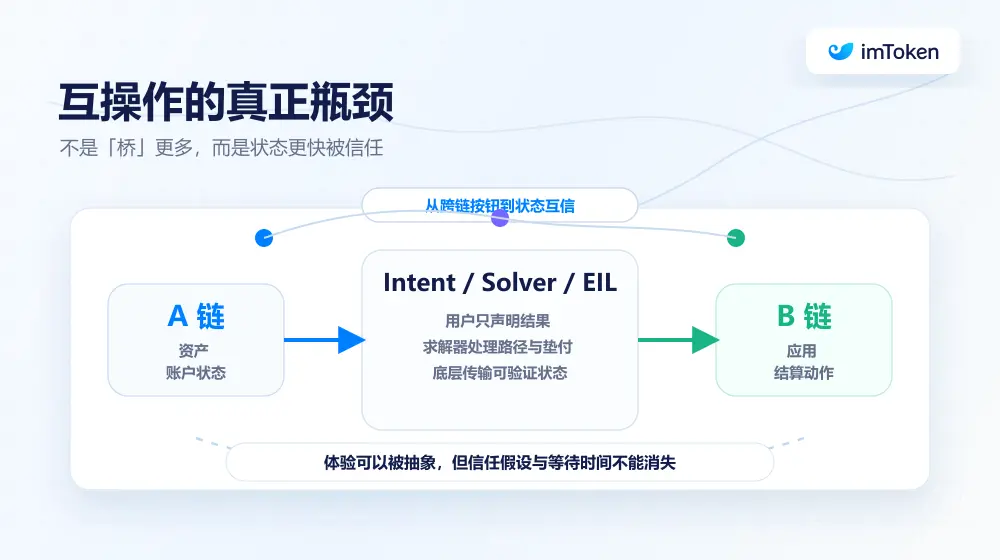
  • Among them, the Open Intents Framework allows users to simply declare their desired outcome, such as "convert a certain asset on Chain A to USDC on Chain B," with solvers handling path computation, bridging, execution, and fund rebalancing behind the scenes.
  • A step further, the Ethereum Interoperability Layer (EIL) attempts to build a trustless transport layer, aiming for cross-L2 transactions to have an experience indistinguishable from single-chain transactions.

On the account side, EIP-7702 in the Pectra upgrade already allows traditional EOAs to temporarily execute smart contract code, supporting transaction batching, gas sponsorship, and recovery mechanisms. Subsequent native account abstraction proposals, represented by EIP-8141, aim to further embed smart account logic into the protocol, making smart contract wallets the default account form and reducing reliance on additional Bundlers, Relayers, and intermediary services.

The L1 Fast Finality proposal attempts to provide a stronger confirmation signal within tens of seconds, before full finality is achieved, significantly shortening application wait times in most normal scenarios. This directly benefits all cross-chain applications relying on L1 finality, which is crucial for bridges, stablecoin settlement, and RWA asset trading.

Because the real bottleneck for many cross-chain interactions isn't whether a message can be sent, but when the target chain can be sufficiently confident that the state on the source chain will not be reverted.

A commonly overlooked point is that a transaction being included in a block does not mean it has achieved finality—from a user's perspective, a transaction might show success within seconds, but for bridges, exchanges, lending protocols, and cross-chain solvers, they still need to assess the possibility of this transaction being affected by a chain reorganization, and whether they can release assets or execute the next operation on another chain based on it.

This is why many cross-chain services today that appear "instant" do not actually wait for the source chain to achieve finality; rather, solvers or liquidity providers advance the funds. This mechanism optimizes user experience but doesn't make the underlying wait time disappear.
Therefore, Ethereum's long-term goal is to gradually shorten finality itself from minutes to seconds. However, this is not a single upgrade scheduled for deployment, but a set of research tasks requiring phased advancement, including decoupling finality votes from fork choice, optimizing validator sets, vote aggregation and network propagation, and gradually changing the consensus protocol.

Overall, good interoperability experience is not about giving dozens of chains the same cross-chain button, but about enabling different execution environments to trust each other's states faster and at lower cost.

3. When L1 Becomes a Rollup, Does the Layered Boundary Still Exist?

If the repositioning of L2s and shortening finality are adjustments within the existing layered architecture, then another point raised by Barnabé touches the very definition of L1 and L2: with proof systems entering the Ethereum mainnet, L1 may eventually also become a sort of "rollup of itself."

This sounds somewhat counterintuitive.

After all, a rollup is typically understood as a scaling network built on top of L1; it executes transactions externally, with L1 validating the state results. So how could Ethereum, being the underlying consensus and settlement network, become its own L2?

Understanding this viewpoint requires first separating "Rollup" from the hierarchical relationship. In today's Ethereum, after a node receives a block, it needs to re-execute all transactions within, independently compute state changes, and judge whether the block adheres to protocol rules.

This model ensures nodes can verify independently, but it also means the network's overall execution capacity must be constrained by ordinary nodes' hardware capabilities. The more computation in a block, the more hardware and time validators need to complete execution.

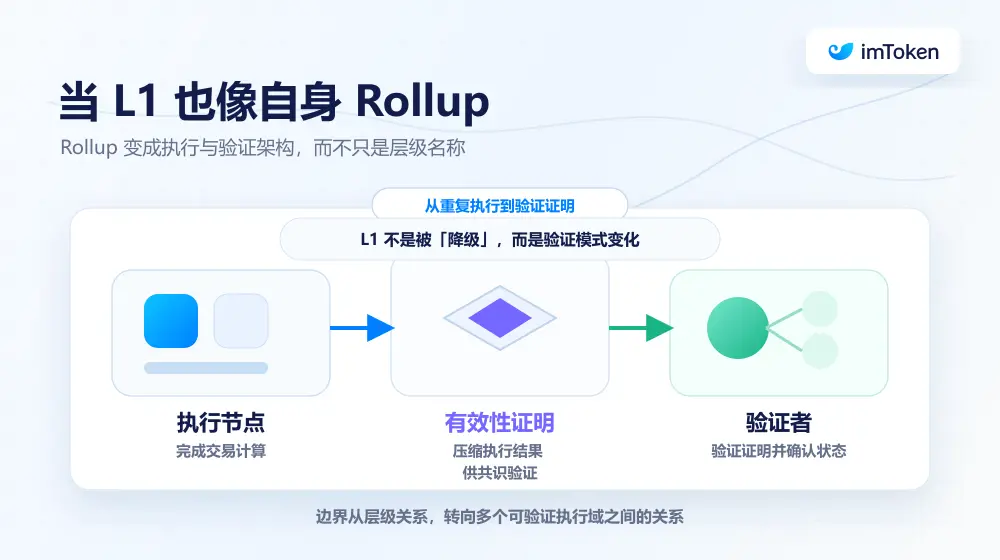
In the future, as real-time proofs and L1 zkEVM mature, transactions can still be computed by high-performance execution nodes, but ordinary validators may not need to personally re-execute every transaction. For instance, after an execution node completes computation and generates a validity proof, other validators only need to verify the smaller, cheaper proof to confirm the state transition is correct.

From the perspective of the relationship between execution and verification, this indeed shares similarities with Rollups: a subset of participants is responsible for high-performance execution, execution results are compressed into cryptographic proofs, and a broader set of consensus participants no longer repeats all computations, but verifies proofs and confirms the final state.

Therefore, Barnabé's phrase "L1 becoming its own rollup" is better understood as a summary of this verification paradigm, not that the Ethereum mainnet will be placed on another underlying chain or be "demoted" to its own L2.

His point is that when proofs gradually replace repeated execution by all nodes, a rollup may no longer be just a layer name above L1, but become a more general execution and verification architecture.
This will further blur the traditional boundary between L1 and L2.

On one hand, L1 can expand its own execution capacity with zkEVM proofs; on the other hand, Native Rollups aim to allow L2s to more directly invoke validation capabilities within the Ethereum protocol, with L1 validating L2 state transitions in a more native, unified manner.

Today, different Rollups typically need to build their own proof systems, verification contracts, upgrade mechanisms, and security committees. Once a proof system has errors, a protocol needs emergency upgrades, or an operator fails, users often still rely on additional governance and trust structures. The long-term direction of Native Rollups is to turn part of the Rollup validation logic into a native Ethereum capability, allowing L2s to reduce self-built security structures, inherit L1's state transition rules more completely, and potentially move away from security committees.

Going a step further, when multiple L2s can rely on faster L1 confirmation, unified proof mechanisms, and synchronous composability to access each other's states, their relationship with the mainnet may no longer be connected by bridges as it is today.

They would be more like multiple execution domains under the same Ethereum consensus, some responsible for general finance, some for gaming, social, or payments, some providing privacy or special compliance capabilities. They have different execution logics and product forms, yet collectively rely on a set of verifiable state, security foundations, and asset settlement systems.

Of course, this remains a long-term direction.

But regardless of the final form these technologies take, they have already transformed the L1-L2 boundary from a clear architectural line into a spectrum of different degrees of security inheritance.

In Conclusion

Long-divided, must unite; long-united, must divide.

Ethereum once gained global composability through shared state; later, it split execution out via Rollups to gain greater capacity. Now, its task is to reconnect the fragmented assets, accounts, and applications without undoing the scaling achievements.

For ordinary users, the ideal Ethereum should never be a network map of dozens of chains, different Gas tokens, and bridges. Where transactions execute, where liquidity comes from, and who ultimately settles can gradually be handled by wallets, applications, and underlying protocols. However, the trust assumptions, security boundaries, and exit paths involved cannot be hidden along with the operational experience.

Therefore, the endgame for L2s is perhaps neither replacing L1 nor being made obsolete by an increasingly scalable L1. Instead, it is to become a set of execution environments with different functionalities and performances, yet sharing security, liquidity, and state relationships.

In the past, Ethereum gained greater capacity by splitting execution apart.

In the next phase, let's see if, after being split apart, it can still be put back together as one Ethereum.


Crypto di tendenza

Domande pertinenti

QAccording to the article, what is the main reason for the shift in the division of roles between L1 and L2?

AThe shift is driven by the premise that L1 is no longer just a low-throughput settlement layer. With advancements like increased Gas Limit, statelessness, and zkEVM verification, Ethereum L1 is enhancing its own scalability. This means L2 can no longer justify its long-term value solely based on being 'faster and cheaper.' L2 must now focus on providing differentiated needs that L1 cannot uniformly satisfy, such as application-specific optimizations, privacy features, and more flexible governance and economic models.

QWhat is the primary goal of the 'Scale' roadmap that merged the previously separate 'Expanding L1' and 'Expanding Blob' workstreams?

AThe primary goal of the unified 'Scale' roadmap is to approach L1 and L2 scaling not as two separate tasks, but from the perspective of the entire system. It aims to reallocate execution, consensus, and data capacity holistically, allowing Ethereum to become a more powerful, permissionless, and resilient global hub for settlement, shared state, liquidity, and DeFi.

QHow does the article define the spectrum of future L2 roles in relation to Ethereum L1?

AThe article defines a complex continuous spectrum for L2 roles. At one end are Rollups that inherit as much of Ethereum's security properties as possible. In the middle are execution environments that inherit some Ethereum properties for specific business needs like performance or privacy. At the other end are chains that are relatively independent in security and settlement but might use EVM, Ethereum assets, or cross-chain facilities. Thus, L2 will represent a set of execution environments with different security, settlement, and liquidity relationships with Ethereum.

QWhat does the researcher Barnabé Monnot suggest about the future relationship between L1 and Rollup architecture?

ABarnabé Monnot suggests that as proof systems gradually enter the mainnet validation process, L1 itself could become a 'rollup of itself' in a sense. This means that with technologies like real-time proofs and L1 zkEVM, high-performance nodes could execute transactions and generate validity proofs. Other validators would then verify these proofs instead of re-executing every transaction, blurring the traditional boundary between L1 and L2. In this future, 'Rollup' might become a more generic execution and verification architecture rather than just a layer above L1.

QWhat are the two key directions of Ethereum's 'Improve UX' roadmap for 2026, as mentioned in the article, to address L2 fragmentation?

AThe two key directions are native account abstraction and interoperability. The goal is to make Ethereum 'feel like one chain again.' This relies on the maturity of intent-based architectures like the Open Intents Framework (which lets users declare desired outcomes) and the Ethereum Interoperability Layer (EIL), which aims to build a trustless transport layer for seamless cross-L2 transactions.

Letture associate

Are Kalshi and Polymarket Founders at Odds? This Business Rivalry Is More Brutal Than You Think

"The Rivalry Between Kalshi and Polymarket Founders Turns Bitter and Litigious" The intense feud between Tarek Mansour, CEO of Kalshi, and Shayne Coplan, founder of Polymarket, has escalated far beyond typical business competition into personal animosity and regulatory battles. Both lead billion-dollar prediction market platforms, but their approaches differ sharply. Kalshi positions itself as the compliant operator, securing U.S. regulatory approval before launching. In contrast, Polymarket initially operated offshore, allowing U.S. users to access its platform via VPN, which drew regulatory scrutiny. The conflict reached a peak in November 2024 when FBI agents raided Coplan's New York apartment. While Coplan publicly blamed political motives, his team privately suspected Kalshi was involved. According to sources, Kalshi's lawyers had previously reported Polymarket's operations to federal prosecutors, highlighting its accessibility to U.S. users despite a ban. This incident fueled mutual accusations and underhanded tactics, including social media smear campaigns and attempts to sabotage each other's major business deals. Their rivalry also played out in Washington, influencing regulatory debates. Kalshi actively lobbied against Polymarket's practices, framing them as illegal and unethical. Polymarket, after facing a CFTC fine and investigation, later acquired a licensed U.S. firm to launch a domestic app, regaining a foothold. Despite the hostility, both companies have seen massive growth, with combined trading volumes soaring. However, increased regulatory scrutiny, particularly around insider trading on Polymarket's platform, continues to pose challenges. The founders' deep-seated mutual disdain ensures their battle for market dominance remains as much a personal vendetta as a commercial one.

marsbit6 min fa

Are Kalshi and Polymarket Founders at Odds? This Business Rivalry Is More Brutal Than You Think

marsbit6 min fa

Bank of America Quietly Positions: Could $6 Trillion in Bank Deposits Flow into Stablecoins?

Bank of America (BofA) is making strategic moves in digital assets, appointing senior leaders to advance a platform covering stablecoins, tokenized deposits, custody, and crypto settlement. This comes amid a broader discussion about the potential migration of trillions in bank deposits to stablecoins. A cited TBAC report estimated up to $6.6 trillion in transactional deposits could be at risk of moving to stablecoins long-term, a point BofA's CEO previously conditioned on stablecoins being allowed to pay interest. The regulatory landscape is evolving, with the GENIUS Act setting a final implementation deadline for January 2027. Major banks, however, are not waiting; JPMorgan, Citi, BofA, and others are already developing tokenized deposit networks and services. Industry observers note that while retail crypto trading is sluggish, institutional adoption of stablecoins for real-world use cases is driving growth. Despite the activity, some analysts remain cautious, noting banks have a long history of blockchain announcements and that true structural change is slow. The stablecoin market itself has seen a recent dip from its peak. Optimistic projections, however, foresee significant growth, with stablecoin settlement volume already reaching $33 trillion in 2025. The race is on for the post-January 2027 landscape, where regulatory clarity is expected to accelerate the fusion of traditional finance and crypto.

marsbit11 min fa

Bank of America Quietly Positions: Could $6 Trillion in Bank Deposits Flow into Stablecoins?

marsbit11 min fa

STAR 50 Soars 10.73%, Why Did A-Shares Stage a "V-Shaped Reversal"?

After a prolonged decline, the Chinese A-share market staged a strong rally on July 21. The STAR 50 index surged 10.73%, its largest single-day gain in nearly a year, leading a broad-based "V-shaped" reversal. The Shanghai Composite Index rose 1.79%, the Shenzhen Component Index gained 4.81%, and the ChiNext Index jumped 7.05%. Total market turnover reached 2.97 trillion yuan, an increase of 256.1 billion yuan from the previous session, with over 3,100 stocks advancing. The semiconductor sector spearheaded the rebound, with related ETFs posting significant gains. Analysts attribute the surge to three converging factors. First, coordinated capital inflows from "national team" institutions, insurance funds, listed company buybacks, and fund house self-purchases have bolstered market liquidity and confidence. Second, supportive policy signals, including commitments from regulators to ensure stable market operations, provided a favorable backdrop. Third, a stabilization and recovery in overseas markets, notably South Korea, created a positive external environment. Institutions suggest the most severe panic selling phase for the tech sector has likely passed, following a significant digestion of crowded positions and leveraged funds. While short-term volatility may persist, the medium to long-term outlook remains underpinned by enduring trends like AI computing demand expansion and semiconductor localization. The market's focus now shifts to the sustainability of supportive fund flows, earnings reports, and upcoming catalysts from the global AI industry chain.

marsbit49 min fa

STAR 50 Soars 10.73%, Why Did A-Shares Stage a "V-Shaped Reversal"?

marsbit49 min fa

U.S. Tech Momentum Stocks Post Largest Single-Day Gain Ever, But Is the Plunge Over?

US tech momentum stocks staged a sharp rebound on Tuesday (July 21st). Morgan Stanley's TMT Momentum Factor surged over 12%, marking its largest single-day gain on record, exceeding even peaks from the 2000 dot-com bubble. Key momentum indices from Goldman Sachs also posted their strongest daily performances in years. The rally was led by semiconductors, with the Philadelphia Semiconductor Index jumping 4.6%. This rebound followed three consecutive down days and a cumulative 33% plunge in momentum stocks, one of the steepest drawdowns since the dot-com era. Analysts attribute the surge largely to a short squeeze. Heavy selling had pushed high-beta momentum stocks into deeply oversold territory, forcing many short sellers, particularly in Asia, to cover their positions, creating a self-reinforcing buying spiral. However, the rebound's internals appear weak. Trading volume was notably low, and advancing stocks still lagged decliners on the S&P 500, indicating a narrow, concentrated rally rather than broad market participation. Diverging views emerge on the outlook. BTIG warns the bounce has hit key resistance and recommends selling into strength, citing extreme volatility and historical parallels to past market tops. Conversely, Goldman Sachs and UBS believe the momentum unwind is nearing its end, suggesting it may be time to gradually add exposure, as positioning has been significantly reduced. They caution, however, that high volatility warrants a measured approach, potentially using defined-risk strategies. The upcoming earnings season, particularly reports from major tech firms like Alphabet, is seen as a critical test for the rally's sustainability. Simultaneously, bond markets flashed a warning, with yields rising partly due to spiking oil prices. Analysts note that if long-term Treasury yields break decisively higher, it could pose a significant headwind for equities, especially growth stocks.

marsbit56 min fa

U.S. Tech Momentum Stocks Post Largest Single-Day Gain Ever, But Is the Plunge Over?

marsbit56 min fa

Trading

Spot

Articoli Popolari

Cosa è $S$

Comprendere SPERO: Una Panoramica Completa Introduzione a SPERO Mentre il panorama dell'innovazione continua a evolversi, l'emergere delle tecnologie web3 e dei progetti di criptovaluta gioca un ruolo fondamentale nel plasmare il futuro digitale. Un progetto che ha attirato l'attenzione in questo campo dinamico è SPERO, denotato come SPERO,$$s$. Questo articolo mira a raccogliere e presentare informazioni dettagliate su SPERO, per aiutare gli appassionati e gli investitori a comprendere le sue basi, obiettivi e innovazioni nei domini web3 e crypto. Che cos'è SPERO,$$s$? SPERO,$$s$ è un progetto unico all'interno dello spazio crypto che cerca di sfruttare i principi della decentralizzazione e della tecnologia blockchain per creare un ecosistema che promuove l'impegno, l'utilità e l'inclusione finanziaria. Il progetto è progettato per facilitare interazioni peer-to-peer in modi nuovi, fornendo agli utenti soluzioni e servizi finanziari innovativi. Al suo interno, SPERO,$$s$ mira a responsabilizzare gli individui fornendo strumenti e piattaforme che migliorano l'esperienza dell'utente nello spazio delle criptovalute. Questo include la possibilità di metodi di transazione più flessibili, la promozione di iniziative guidate dalla comunità e la creazione di percorsi per opportunità finanziarie attraverso applicazioni decentralizzate (dApps). La visione sottostante di SPERO,$$s$ ruota attorno all'inclusività, cercando di colmare le lacune all'interno della finanza tradizionale mentre sfrutta i vantaggi della tecnologia blockchain. Chi è il Creatore di SPERO,$$s$? L'identità del creatore di SPERO,$$s$ rimane piuttosto oscura, poiché ci sono risorse pubblicamente disponibili limitate che forniscono informazioni dettagliate sul suo fondatore o fondatori. Questa mancanza di trasparenza può derivare dall'impegno del progetto per la decentralizzazione—un ethos che molti progetti web3 condividono, dando priorità ai contributi collettivi rispetto al riconoscimento individuale. Centrando le discussioni attorno alla comunità e ai suoi obiettivi collettivi, SPERO,$$s$ incarna l'essenza dell'empowerment senza mettere in evidenza individui specifici. Pertanto, comprendere l'etica e la missione di SPERO rimane più importante che identificare un creatore singolo. Chi sono gli Investitori di SPERO,$$s$? SPERO,$$s$ è supportato da una varietà di investitori che vanno dai capitalisti di rischio agli investitori angelici dedicati a promuovere l'innovazione nel settore crypto. Il focus di questi investitori generalmente si allinea con la missione di SPERO—dando priorità a progetti che promettono avanzamenti tecnologici sociali, inclusività finanziaria e governance decentralizzata. Queste fondazioni di investitori sono tipicamente interessate a progetti che non solo offrono prodotti innovativi, ma contribuiscono anche positivamente alla comunità blockchain e ai suoi ecosistemi. Il supporto di questi investitori rafforza SPERO,$$s$ come un concorrente degno di nota nel dominio in rapida evoluzione dei progetti crypto. Come Funziona SPERO,$$s$? SPERO,$$s$ impiega un framework multifunzionale che lo distingue dai progetti di criptovaluta convenzionali. Ecco alcune delle caratteristiche chiave che sottolineano la sua unicità e innovazione: Governance Decentralizzata: SPERO,$$s$ integra modelli di governance decentralizzati, responsabilizzando gli utenti a partecipare attivamente ai processi decisionali riguardanti il futuro del progetto. Questo approccio favorisce un senso di proprietà e responsabilità tra i membri della comunità. Utilità del Token: SPERO,$$s$ utilizza il proprio token di criptovaluta, progettato per servire varie funzioni all'interno dell'ecosistema. Questi token abilitano transazioni, premi e la facilitazione dei servizi offerti sulla piattaforma, migliorando l'impegno e l'utilità complessivi. Architettura Stratificata: L'architettura tecnica di SPERO,$$s$ supporta la modularità e la scalabilità, consentendo un'integrazione fluida di funzionalità e applicazioni aggiuntive man mano che il progetto evolve. Questa adattabilità è fondamentale per mantenere la rilevanza nel panorama crypto in continua evoluzione. Coinvolgimento della Comunità: Il progetto enfatizza iniziative guidate dalla comunità, impiegando meccanismi che incentivano la collaborazione e il feedback. Nutrendo una comunità forte, SPERO,$$s$ può affrontare meglio le esigenze degli utenti e adattarsi alle tendenze di mercato. Focus sull'Inclusione: Offrendo basse commissioni di transazione e interfacce user-friendly, SPERO,$$s$ mira ad attrarre una base utenti diversificata, inclusi individui che potrebbero non aver precedentemente interagito nello spazio crypto. Questo impegno per l'inclusione si allinea con la sua missione generale di empowerment attraverso l'accessibilità. Cronologia di SPERO,$$s$ Comprendere la storia di un progetto fornisce preziose intuizioni sulla sua traiettoria di sviluppo e sui traguardi. Di seguito è riportata una cronologia suggerita che mappa eventi significativi nell'evoluzione di SPERO,$$s$: Fase di Concettualizzazione e Ideazione: Le idee iniziali che formano la base di SPERO,$$s$ sono state concepite, allineandosi strettamente con i principi di decentralizzazione e focus sulla comunità all'interno dell'industria blockchain. Lancio del Whitepaper del Progetto: Dopo la fase concettuale, è stato rilasciato un whitepaper completo che dettaglia la visione, gli obiettivi e l'infrastruttura tecnologica di SPERO,$$s$ per suscitare interesse e feedback dalla comunità. Costruzione della Comunità e Prime Interazioni: Sono stati effettuati sforzi attivi di outreach per costruire una comunità di early adopters e potenziali investitori, facilitando discussioni attorno agli obiettivi del progetto e ottenendo supporto. Evento di Generazione del Token: SPERO,$$s$ ha condotto un evento di generazione del token (TGE) per distribuire i propri token nativi ai primi sostenitori e stabilire una liquidità iniziale all'interno dell'ecosistema. Lancio della Prima dApp: La prima applicazione decentralizzata (dApp) associata a SPERO,$$s$ è stata attivata, consentendo agli utenti di interagire con le funzionalità principali della piattaforma. Sviluppo Continuo e Partnership: Aggiornamenti e miglioramenti continui alle offerte del progetto, inclusi partnership strategiche con altri attori nello spazio blockchain, hanno plasmato SPERO,$$s$ in un concorrente competitivo e in evoluzione nel mercato crypto. Conclusione SPERO,$$s$ rappresenta una testimonianza del potenziale del web3 e delle criptovalute di rivoluzionare i sistemi finanziari e responsabilizzare gli individui. Con un impegno per la governance decentralizzata, il coinvolgimento della comunità e funzionalità progettate in modo innovativo, apre la strada verso un panorama finanziario più inclusivo. Come per qualsiasi investimento nello spazio crypto in rapida evoluzione, si incoraggiano potenziali investitori e utenti a ricercare approfonditamente e a impegnarsi in modo riflessivo con gli sviluppi in corso all'interno di SPERO,$$s$. Il progetto mostra lo spirito innovativo dell'industria crypto, invitando a ulteriori esplorazioni delle sue innumerevoli possibilità. Mentre il percorso di SPERO,$$s$ è ancora in fase di sviluppo, i suoi principi fondamentali potrebbero effettivamente influenzare il futuro di come interagiamo con la tecnologia, la finanza e tra di noi in ecosistemi digitali interconnessi.

130 Totale visualizzazioniPubblicato il 2024.12.17Aggiornato il 2024.12.17

Cosa è $S$

Cosa è AGENT S

Agent S: Il Futuro dell'Interazione Autonoma in Web3 Introduzione Nel panorama in continua evoluzione di Web3 e criptovalute, le innovazioni stanno costantemente ridefinendo il modo in cui gli individui interagiscono con le piattaforme digitali. Uno di questi progetti pionieristici, Agent S, promette di rivoluzionare l'interazione uomo-computer attraverso il suo framework agentico aperto. Aprendo la strada a interazioni autonome, Agent S mira a semplificare compiti complessi, offrendo applicazioni trasformative nell'intelligenza artificiale (AI). Questa esplorazione dettagliata approfondirà le complessità del progetto, le sue caratteristiche uniche e le implicazioni per il dominio delle criptovalute. Cos'è Agent S? Agent S si presenta come un innovativo framework agentico aperto, progettato specificamente per affrontare tre sfide fondamentali nell'automazione dei compiti informatici: Acquisizione di Conoscenze Specifiche del Dominio: Il framework apprende in modo intelligente da varie fonti di conoscenza esterne ed esperienze interne. Questo approccio duale gli consente di costruire un ricco repository di conoscenze specifiche del dominio, migliorando le sue prestazioni nell'esecuzione dei compiti. Pianificazione su Lungo Orizzonte di Compiti: Agent S impiega una pianificazione gerarchica potenziata dall'esperienza, un approccio strategico che facilita la suddivisione e l'esecuzione efficiente di compiti complessi. Questa caratteristica migliora significativamente la sua capacità di gestire più sottocompiti in modo efficiente ed efficace. Gestione di Interfacce Dinamiche e Non Uniformi: Il progetto introduce l'Interfaccia Agente-Computer (ACI), una soluzione innovativa che migliora l'interazione tra agenti e utenti. Utilizzando Modelli Linguistici Multimodali di Grandi Dimensioni (MLLM), Agent S può navigare e manipolare senza sforzo diverse interfacce grafiche utente. Attraverso queste caratteristiche pionieristiche, Agent S fornisce un framework robusto che affronta le complessità coinvolte nell'automazione dell'interazione umana con le macchine, preparando il terreno per innumerevoli applicazioni nell'AI e oltre. Chi è il Creatore di Agent S? Sebbene il concetto di Agent S sia fondamentalmente innovativo, informazioni specifiche sul suo creatore rimangono elusive. Il creatore è attualmente sconosciuto, il che evidenzia sia la fase embrionale del progetto sia la scelta strategica di mantenere i membri fondatori sotto anonimato. Indipendentemente dall'anonimato, l'attenzione rimane sulle capacità e sul potenziale del framework. Chi sono gli Investitori di Agent S? Poiché Agent S è relativamente nuovo nell'ecosistema crittografico, informazioni dettagliate riguardanti i suoi investitori e sostenitori finanziari non sono documentate esplicitamente. La mancanza di approfondimenti pubblicamente disponibili sulle fondazioni di investimento o sulle organizzazioni che supportano il progetto solleva interrogativi sulla sua struttura di finanziamento e sulla roadmap di sviluppo. Comprendere il supporto è cruciale per valutare la sostenibilità del progetto e il suo potenziale impatto sul mercato. Come Funziona Agent S? Al centro di Agent S si trova una tecnologia all'avanguardia che gli consente di funzionare efficacemente in contesti diversi. Il suo modello operativo è costruito attorno a diverse caratteristiche chiave: Interazione Uomo-Computer Simile a Quella Umana: Il framework offre una pianificazione AI avanzata, cercando di rendere le interazioni con i computer più intuitive. Mimando il comportamento umano nell'esecuzione dei compiti, promette di elevare le esperienze degli utenti. Memoria Narrativa: Utilizzata per sfruttare esperienze di alto livello, Agent S utilizza la memoria narrativa per tenere traccia delle storie dei compiti, migliorando così i suoi processi decisionali. Memoria Episodica: Questa caratteristica fornisce agli utenti una guida passo-passo, consentendo al framework di offrire supporto contestuale mentre i compiti si sviluppano. Supporto per OpenACI: Con la capacità di funzionare localmente, Agent S consente agli utenti di mantenere il controllo sulle proprie interazioni e flussi di lavoro, allineandosi con l'etica decentralizzata di Web3. Facile Integrazione con API Esterne: La sua versatilità e compatibilità con varie piattaforme AI garantiscono che Agent S possa adattarsi senza problemi agli ecosistemi tecnologici esistenti, rendendolo una scelta attraente per sviluppatori e organizzazioni. Queste funzionalità contribuiscono collettivamente alla posizione unica di Agent S all'interno dello spazio crittografico, poiché automatizza compiti complessi e multi-fase con un intervento umano minimo. Man mano che il progetto evolve, le sue potenziali applicazioni in Web3 potrebbero ridefinire il modo in cui si svolgono le interazioni digitali. Cronologia di Agent S Lo sviluppo e le tappe di Agent S possono essere riassunti in una cronologia che evidenzia i suoi eventi significativi: 27 Settembre 2024: Il concetto di Agent S è stato lanciato in un documento di ricerca completo intitolato “Un Framework Agentico Aperto che Usa i Computer Come un Umano”, mostrando le basi per il progetto. 10 Ottobre 2024: Il documento di ricerca è stato reso pubblicamente disponibile su arXiv, offrendo un'esplorazione approfondita del framework e della sua valutazione delle prestazioni basata sul benchmark OSWorld. 12 Ottobre 2024: È stata rilasciata una presentazione video, fornendo un'idea visiva delle capacità e delle caratteristiche di Agent S, coinvolgendo ulteriormente potenziali utenti e investitori. Questi indicatori nella cronologia non solo illustrano i progressi di Agent S, ma indicano anche il suo impegno per la trasparenza e il coinvolgimento della comunità. Punti Chiave su Agent S Man mano che il framework Agent S continua a evolversi, diversi attributi chiave si distinguono, sottolineando la sua natura innovativa e il potenziale: Framework Innovativo: Progettato per fornire un uso intuitivo dei computer simile all'interazione umana, Agent S porta un approccio nuovo all'automazione dei compiti. Interazione Autonoma: La capacità di interagire autonomamente con i computer attraverso GUI segna un passo avanti verso soluzioni informatiche più intelligenti ed efficienti. Automazione di Compiti Complessi: Con la sua metodologia robusta, può automatizzare compiti complessi e multi-fase, rendendo i processi più veloci e meno soggetti a errori. Miglioramento Continuo: I meccanismi di apprendimento consentono ad Agent S di migliorare dalle esperienze passate, migliorando continuamente le sue prestazioni e la sua efficacia. Versatilità: La sua adattabilità attraverso diversi ambienti operativi come OSWorld e WindowsAgentArena garantisce che possa servire un'ampia gamma di applicazioni. Man mano che Agent S si posiziona nel panorama di Web3 e delle criptovalute, il suo potenziale per migliorare le capacità di interazione e automatizzare i processi segna un significativo avanzamento nelle tecnologie AI. Attraverso il suo framework innovativo, Agent S esemplifica il futuro delle interazioni digitali, promettendo un'esperienza più fluida ed efficiente per gli utenti in vari settori. Conclusione Agent S rappresenta un audace passo avanti nell'unione tra AI e Web3, con la capacità di ridefinire il modo in cui interagiamo con la tecnologia. Sebbene sia ancora nelle sue fasi iniziali, le possibilità per la sua applicazione sono vaste e coinvolgenti. Attraverso il suo framework completo che affronta sfide critiche, Agent S mira a portare le interazioni autonome al centro dell'esperienza digitale. Man mano che ci addentriamo nei regni delle criptovalute e della decentralizzazione, progetti come Agent S giocheranno senza dubbio un ruolo cruciale nel plasmare il futuro della tecnologia e della collaborazione uomo-computer.

584 Totale visualizzazioniPubblicato il 2025.01.14Aggiornato il 2025.01.14

Cosa è AGENT S

Come comprare S

Benvenuto in HTX.com! Abbiamo reso l'acquisto di Sonic (S) semplice e conveniente. Segui la nostra guida passo passo per intraprendere il tuo viaggio nel mondo delle criptovalute.Step 1: Crea il tuo Account HTXUsa la tua email o numero di telefono per registrarti il tuo account gratuito su HTX. Vivi un'esperienza facile e sblocca tutte le funzionalità,Crea il mio accountStep 2: Vai in Acquista crypto e seleziona il tuo metodo di pagamentoCarta di credito/debito: utilizza la tua Visa o Mastercard per acquistare immediatamente SonicS.Bilancio: Usa i fondi dal bilancio del tuo account HTX per fare trading senza problemi.Terze parti: abbiamo aggiunto metodi di pagamento molto utilizzati come Google Pay e Apple Pay per maggiore comodità.P2P: Fai trading direttamente con altri utenti HTX.Over-the-Counter (OTC): Offriamo servizi su misura e tassi di cambio competitivi per i trader.Step 3: Conserva Sonic (S)Dopo aver acquistato Sonic (S), conserva nel tuo account HTX. In alternativa, puoi inviare tramite trasferimento blockchain o scambiare per altre criptovalute.Step 4: Scambia Sonic (S)Scambia facilmente Sonic (S) nel mercato spot di HTX. Accedi al tuo account, seleziona la tua coppia di trading, esegui le tue operazioni e monitora in tempo reale. Offriamo un'esperienza user-friendly sia per chi ha appena iniziato che per i trader più esperti.

1.2k Totale visualizzazioniPubblicato il 2025.01.15Aggiornato il 2026.06.02

Come comprare S

Discussioni

Benvenuto nella Community HTX. Qui puoi rimanere informato sugli ultimi sviluppi della piattaforma e accedere ad approfondimenti esperti sul mercato. Le opinioni degli utenti sul prezzo di S S sono presentate come di seguito.

活动图片