The DAO Returns After a Decade, Establishes a $220 Million Security Fund

marsbitPubblicato 2026-02-02Pubblicato ultima volta 2026-02-02

Introduzione

The DAO, the record-breaking 2016 Ethereum crowdfunding project that led to a major hack and the Ethereum Classic split, is making a symbolic return a decade later. Over 75,109 ETH (worth approximately $220 million) from the incident’s unresolved funds will be used to establish The DAO Security Fund. This fund, managed by a multisig group including key figures like Vitalik Buterin and Taylor Monahan, will focus entirely on enhancing Ethereum’s security. The majority of the ETH (around 69,420) will be staked to create a perpetual endowment, with staking yields and remaining assets funding security efforts such as smart contract audits, core protocol upgrades, and wallet safety improvements. While the initiative aims to turn a historic failure into long-term ecosystem protection, it remains controversial. Questions persist around the legitimacy of repurposing what some consider original token holders' assets and the degree of decentralization in the fund’s governance. Nonetheless, The DAO’s evolution reflects Ethereum’s maturation and the resilience of its community.

In the history of Ethereum's development, nothing is more iconic than the "The DAO" incident in 2016. It was not only the most astonishing crowdfunding project in Ethereum's history but also the protagonist of the hacker attack that led to the split of the Ethereum community and the birth of "Ethereum Classic (ETC)".

After a decade, this name that once nearly destroyed Ethereum—The DAO—is making a comeback in another form. It will launch "TheDAO Security Fund," transforming the remaining over 75,109 ETH (worth more than $220 million) from the incident into a long-term fund focused on Ethereum's security development.

Historical Retrospective: A Crowdfunding Myth That Led to an Ecosystem Crisis

Rewind to 2016. At that time, TheDAO set a crowdfunding record with $150 million in financing, attracting a staggering 14% of Ethereum's total supply.

The vision of this decentralized autonomous organization excited the entire crypto ecosystem, but it soon encountered a catastrophic attack. Hackers exploited a recursive call vulnerability in the smart contract to steal a large amount of funds, prompting the Ethereum community to make a highly controversial decision—implement a hard fork to recover the stolen assets. This move directly led to a split in the community's philosophy, giving birth to Ethereum Classic (ETC).

But fund recovery was never simple. Although the hard fork resolved the redemption of standard DAO tokens, it could not handle all edge cases. Thus, a group of veteran Ethereum community members voluntarily formed the "TheDAO Curator Multisig Wallet" to take on the responsibility of resolving these complex legacy issues.

TheDAO Security Fund Emerges

Griff Green, who served as TheDAO's community manager and is now a co-founder of Giveth, was one of the core members of the "TheDAO Curator Multisig Wallet" back then. According to the official announcement, as early as August 2016, these core administrators clearly stated an important plan: if the leftover funds from these edge cases remained unclaimed after January 31, 2017, they would be used to support Ethereum smart contract security development.

Then, these funds lay "dormant" for nearly a decade. Griff Green said in an interview with Unchained: "As of 2026, we have never touched these funds, and the rise in Ethereum's price has led to substantial appreciation. This is an extremely dramatic turn of events—the 'leftover funds' from back then are now worth far more than TheDAO's original $150 million crowdfunding total."

The DAO Fund's Goal: Safeguarding Ethereum Security

According to the official announcement, the funding sources for TheDAO Security Fund are mainly divided into two parts, totaling over 75,109 ETH (worth $220 million):

· Approximately 70,500 ETH in the ExtraBalance contract, which can still be claimed by eligible individuals.

· Approximately 4,600 ETH and some DAO tokens in TheDAO Curator Multisig, worth about $13.5 million, for which there are no clear claimants.
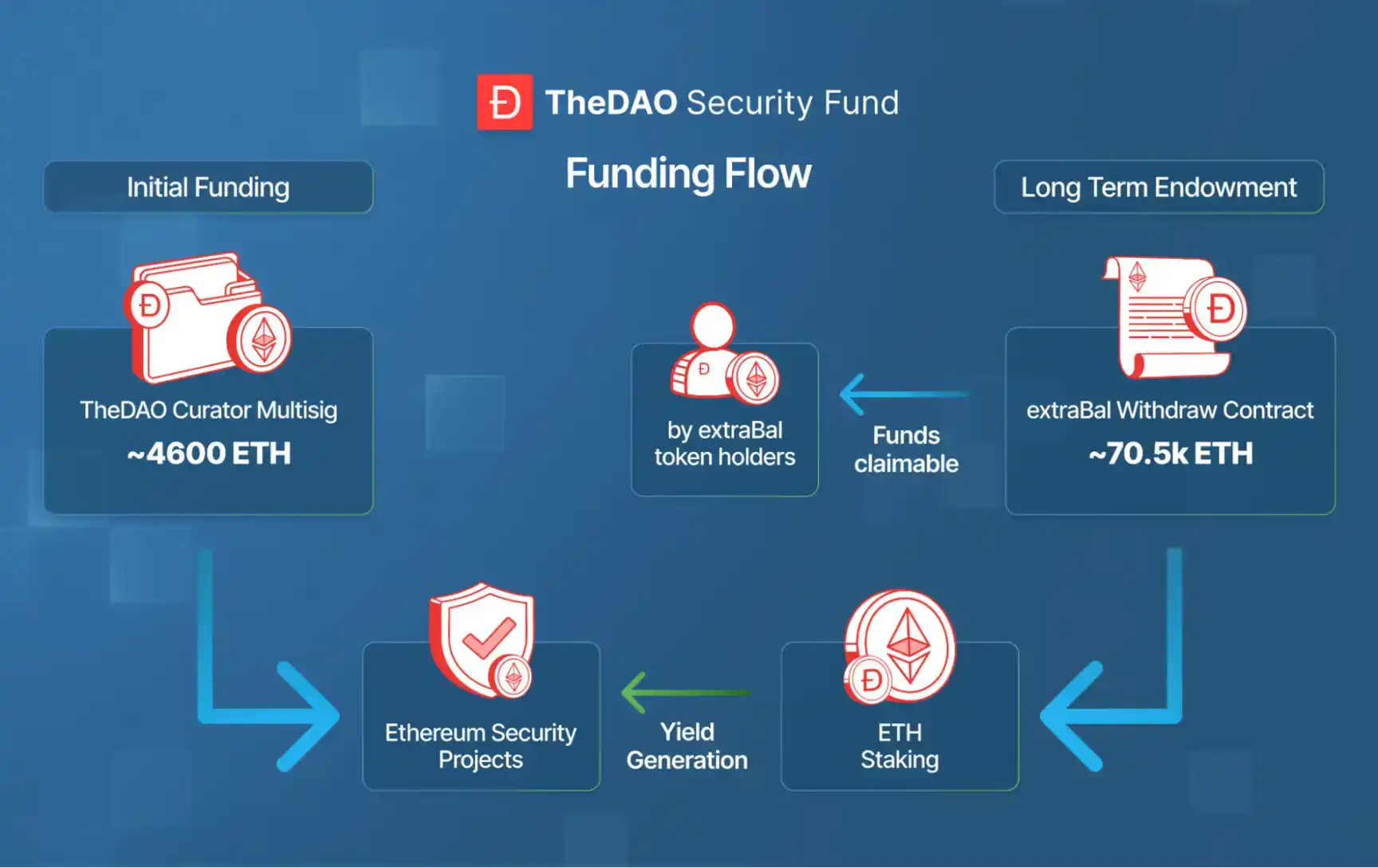
The operation and usage plan for TheDAO Security Fund's funds are clear and specific: 69,420 ETH allocated from the ExtraBalance contract will be staked, generating staking rewards to form a perpetual endowment fund, providing long-term financial support for Ethereum security development. The staking rewards will be combined with the 4,600 ETH from TheDAO Curator Multisig to jointly fund various Ethereum security-related projects. Simultaneously, the ExtraBalance withdrawal contract will retain a portion of ETH to ensure the rights of legitimate claimants are unaffected.

Regarding the scope of funding, TheDAO Security Fund's core objective is very specific—prioritizing the security of the entire Ethereum ecosystem, covering all dimensions of security development: from wallet user experience optimization and smart contract security audits, to emergency response for security incidents and security upgrades for the Ethereum core protocol, to security protection for Layer 2 networks and cross-chain bridge ecosystems. All work contributing to enhancing Ethereum's security level falls within the fund's funding scope.
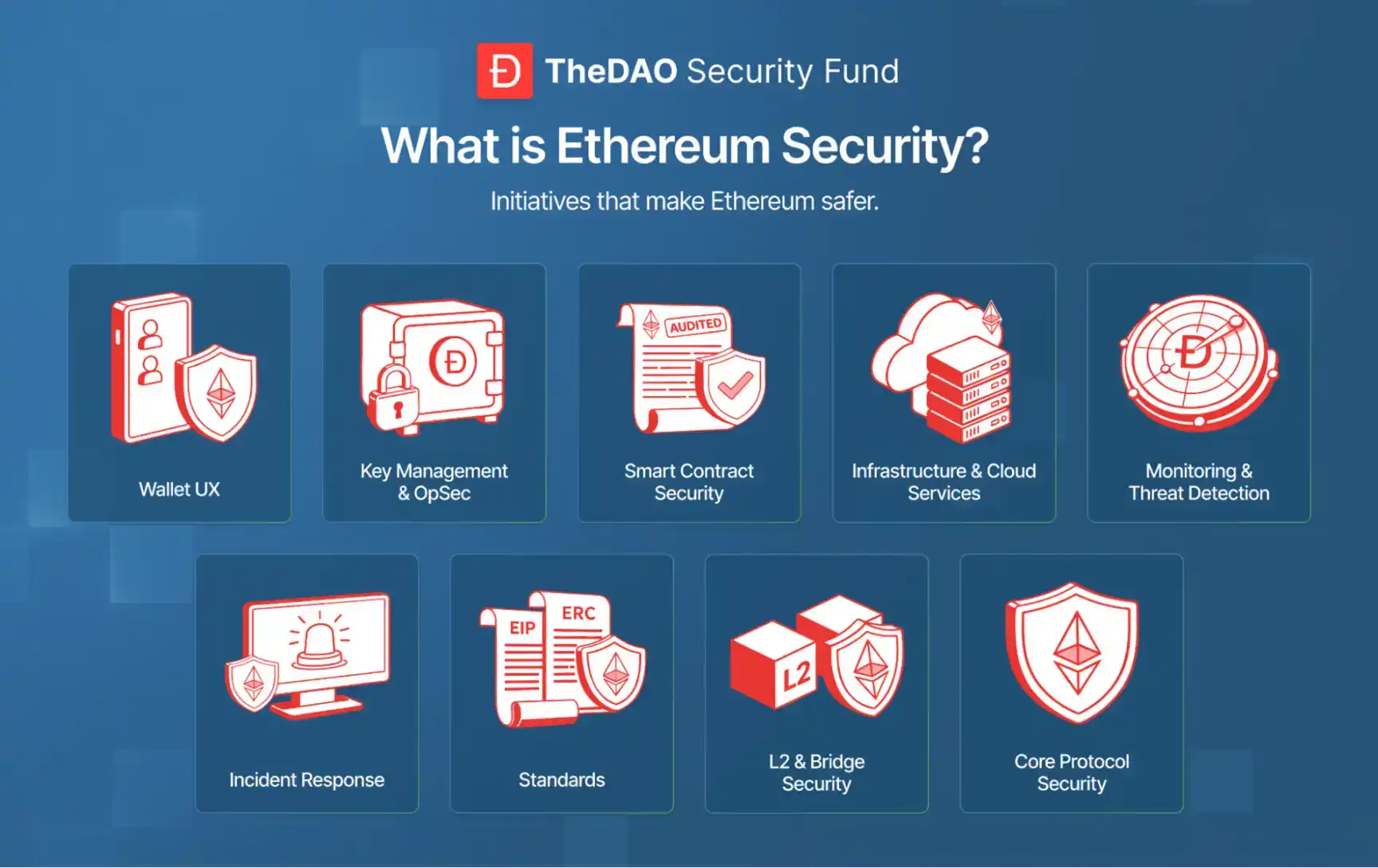
Additionally, the fund will rely on the optimization directions and opportunities in the current security landscape outlined by the Ethereum Foundation's Trillion Dollar Security initiative, combined with ongoing communication with ecosystem partners, to determine the specific scope and focus of each funding round.

In terms of the fund allocation mechanism, TheDAO Security Fund adheres to open, bottom-up governance principles. It will employ diverse methods such as quadratic funding, retroactive funding, and request for proposal (RFP)-based ranking votes to carry out funding work in rounds, allowing ecosystem participants to jointly participate in fund allocation decisions.

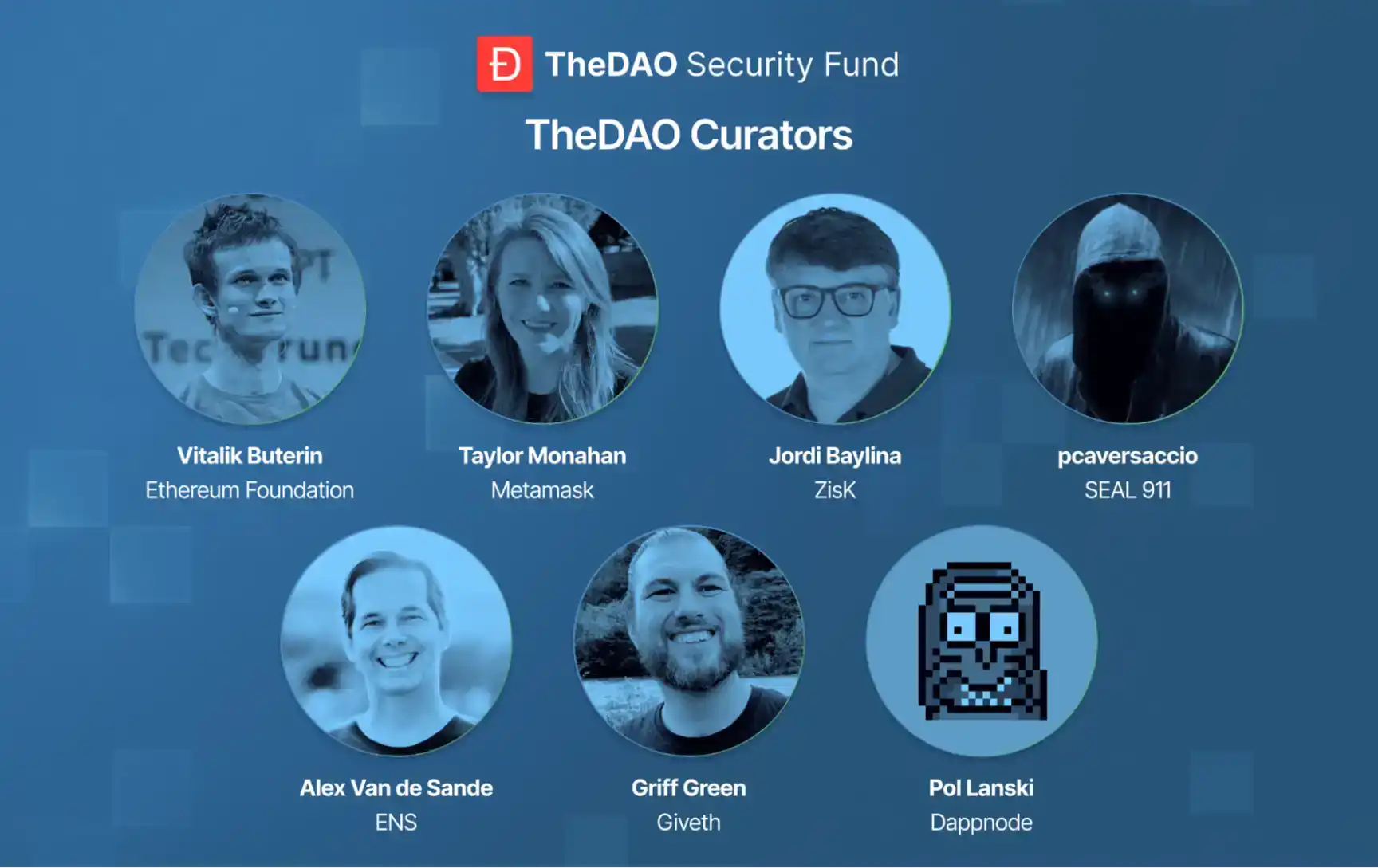
Currently, the fund has assembled a professional curator team to provide expert guidance and supervision for the fund's operation and funding decisions. Team members are all veteran practitioners and security experts in the crypto ecosystem: including Ethereum founder Vitalik Buterin, MetaMask security engineer Taylor Monahan, Zisk, Giveth co-founder Jordi Baylina, security expert pcaversaccio, ENS co-founder Alex Van de Sande, and Dappnode CEO Pol Lanski.
Summary

TheDAO Security Fund is not without controversy. Its core disputes still revolve around two main issues: first, the "legitimacy of the purpose" of using these leftover funds for a security fund, and second, the "degree of decentralization" of the fund's governance mechanism.

Should this huge asset be considered the "private property" of all original token holders, or has it already been deemed ownerless property to be used for the "public good"?

These controversies not only continue the philosophical divide within the Ethereum community sparked by the 2016 The DAO incident but also reflect the deep-seated contradictions in the current crypto ecosystem at the governance level—the balance between the ideal of decentralization and the efficiency of actual operations, as well as the compliance of asset disposal, remains a subject that the entire industry needs to continuously explore.

But setting aside the controversies, from the 2016 crowdfunding myth and ecosystem crisis to the 2026 security fund and ecosystem safeguarding, the decade-long cycle of The DAO is itself a microcosm of Ethereum's ecosystem development. It witnesses Ethereum's growth from immaturity to maturity and confirms the resilience and community strength of the crypto ecosystem.


Crypto di tendenza

Domande pertinenti

QWhat was the original purpose of The DAO in 2016 and what major event occurred?

AThe DAO was a decentralized autonomous organization launched in 2016 that raised a record $150 million in crowdfunding, attracting 14% of the total Ethereum supply. However, it suffered a catastrophic hack where attackers exploited a recursive call vulnerability in its smart contract, leading to a major theft of funds.

QHow is The DAO returning after ten years and what is the value of the new initiative?

AThe DAO is returning through the launch of 'The DAO Security Fund,' which repurposes over 75,109 ETH (worth more than $220 million) from the 2016 incident into a long-term fund dedicated to Ethereum security development.

QWhat are the two main sources of funding for The DAO Security Fund?

AThe funding comes from two sources: approximately 70,500 ETH from the ExtraBalance contract (which can still be claimed by eligible individuals) and about 4,600 ETH and some DAO tokens from The DAO Curator Multisig (valued around $13.5 million, with no clear claimants).

QHow will The DAO Security Fund allocate and use its resources to support Ethereum security?

AThe fund will stake 69,420 ETH from the ExtraBalance to generate yield for a perpetual endowment, while the staking rewards and the 4,600 ETH from the multisig will be used to fund Ethereum security projects. It will support areas like wallet UX, smart contract audits, emergency response, core protocol upgrades, and L2/cross-chain security.

QWho are some of the key members of the guardian team overseeing The DAO Security Fund?

AThe guardian team includes Ethereum founder Vitalik Buterin, MetaMask security engineer Taylor Monahan, Zisk, Giveth co-founder Jordi Baylina, security expert pcaversaccio, ENS co-founder Alex Van de Sande, and Dappnode CEO Pol Lanski.

Letture associate

STAR 50 Soars 10.73%, Why Did A-Shares Stage a "V-Shaped Reversal"?

After a prolonged decline, the Chinese A-share market staged a strong rally on July 21. The STAR 50 index surged 10.73%, its largest single-day gain in nearly a year, leading a broad-based "V-shaped" reversal. The Shanghai Composite Index rose 1.79%, the Shenzhen Component Index gained 4.81%, and the ChiNext Index jumped 7.05%. Total market turnover reached 2.97 trillion yuan, an increase of 256.1 billion yuan from the previous session, with over 3,100 stocks advancing. The semiconductor sector spearheaded the rebound, with related ETFs posting significant gains. Analysts attribute the surge to three converging factors. First, coordinated capital inflows from "national team" institutions, insurance funds, listed company buybacks, and fund house self-purchases have bolstered market liquidity and confidence. Second, supportive policy signals, including commitments from regulators to ensure stable market operations, provided a favorable backdrop. Third, a stabilization and recovery in overseas markets, notably South Korea, created a positive external environment. Institutions suggest the most severe panic selling phase for the tech sector has likely passed, following a significant digestion of crowded positions and leveraged funds. While short-term volatility may persist, the medium to long-term outlook remains underpinned by enduring trends like AI computing demand expansion and semiconductor localization. The market's focus now shifts to the sustainability of supportive fund flows, earnings reports, and upcoming catalysts from the global AI industry chain.

marsbit25 min fa

STAR 50 Soars 10.73%, Why Did A-Shares Stage a "V-Shaped Reversal"?

marsbit25 min fa

U.S. Tech Momentum Stocks Post Largest Single-Day Gain Ever, But Is the Plunge Over?

US tech momentum stocks staged a sharp rebound on Tuesday (July 21st). Morgan Stanley's TMT Momentum Factor surged over 12%, marking its largest single-day gain on record, exceeding even peaks from the 2000 dot-com bubble. Key momentum indices from Goldman Sachs also posted their strongest daily performances in years. The rally was led by semiconductors, with the Philadelphia Semiconductor Index jumping 4.6%. This rebound followed three consecutive down days and a cumulative 33% plunge in momentum stocks, one of the steepest drawdowns since the dot-com era. Analysts attribute the surge largely to a short squeeze. Heavy selling had pushed high-beta momentum stocks into deeply oversold territory, forcing many short sellers, particularly in Asia, to cover their positions, creating a self-reinforcing buying spiral. However, the rebound's internals appear weak. Trading volume was notably low, and advancing stocks still lagged decliners on the S&P 500, indicating a narrow, concentrated rally rather than broad market participation. Diverging views emerge on the outlook. BTIG warns the bounce has hit key resistance and recommends selling into strength, citing extreme volatility and historical parallels to past market tops. Conversely, Goldman Sachs and UBS believe the momentum unwind is nearing its end, suggesting it may be time to gradually add exposure, as positioning has been significantly reduced. They caution, however, that high volatility warrants a measured approach, potentially using defined-risk strategies. The upcoming earnings season, particularly reports from major tech firms like Alphabet, is seen as a critical test for the rally's sustainability. Simultaneously, bond markets flashed a warning, with yields rising partly due to spiking oil prices. Analysts note that if long-term Treasury yields break decisively higher, it could pose a significant headwind for equities, especially growth stocks.

marsbit32 min fa

U.S. Tech Momentum Stocks Post Largest Single-Day Gain Ever, But Is the Plunge Over?

marsbit32 min fa

U.S. Tech Momentum Stocks Record Largest Single-Day Gain Ever, but Has the Rout Ended?

U.S. tech momentum stocks staged a dramatic rebound on Tuesday, July 21st. Key momentum indices like the Morgan Stanley TMT Momentum Factor and Goldman Sachs' High Beta Momentum Long Index posted historic or near-historic single-day gains, fueled largely by semiconductor stocks. This sharp rally followed a severe three-day sell-off that saw momentum stocks plunge 33%, marking one of the steepest pullbacks since the dot-com bubble. Analysts attribute the bounce primarily to a short squeeze, as forced covering from over-leveraged traders, particularly in Asia, created a buying spiral. However, the rally's health is questioned due to weak market breadth—overall trading volume was low, and decliners outnumbered advancers in the S&P 500 despite the index's gain—suggesting a narrow, concentrated surge rather than broad recovery. Opinions on the sustainability diverge. BTIG strategists warn the rebound has hit key resistance levels, citing extreme volatility and historic stock dispersion as signs of an ongoing broader correction, and recommend selling into strength. Conversely, Goldman Sachs and UBS view the aggressive momentum unwinding as nearing its end, noting reduced positioning and a lack of new fundamental catalysts. They suggest the sell-off presents a selective opportunity to add exposure, albeit cautiously and gradually using defined-risk strategies. The immediate trajectory hinges on the ongoing earnings season, with market focus on Alphabet's capital expenditure guidance for AI investment clarity. Meanwhile, bond markets present a risk, with rising Treasury yields—potentially heading toward 5.5%—and widening credit spreads for mega-cap tech companies posing a threat to equity valuations. The combination of technical factors, earnings results, and macro conditions leaves the durability of the rebound in doubt.

链捕手34 min fa

U.S. Tech Momentum Stocks Record Largest Single-Day Gain Ever, but Has the Rout Ended?

链捕手34 min fa

Long-Divided Must Unite, Long-United Must Divide: When L1 Becomes Its Own Rollup, What Is Ethereum's Endgame?

"The Inevitable Cycle: When L1 Becomes Its Own Rollup – What is Ethereum's Endgame?" For years, the Ethereum community grappled with concerns that L2s were fragmenting the ecosystem and eroding L1's value. While L2s provided cheaper execution, they also splintered liquidity and the unified user experience of a single chain. This has prompted a fundamental reassessment of the relationship between L1 and L2. Ethereum's roadmap is evolving. The "Scale" initiative merges L1 and L2 expansion into a holistic framework. L1 itself is advancing with higher gas limits, statelessness, and zkEVM verification, no longer content to be just a low-throughput settlement layer. Consequently, the primary value proposition of L2s is shifting from merely providing cheap blockspace to offering L1 cannot easily provide: application-specific optimizations, privacy features, and flexible governance models. L2s are becoming a spectrum of execution environments with varying degrees of security inheritance from Ethereum. A critical challenge in this multi-chain future is interoperability. The vision is to make Ethereum "feel like one chain again." This relies on advancements in native account abstraction (like EIP-7702) and intent-based architectures (Open Intents Framework), where users declare desired outcomes, and solvers handle the complex cross-chain execution. Furthermore, shortening Ethereum's finality time from minutes to seconds is crucial, as it underpins trust between chains for bridges, stablecoins, and cross-chain applications. Perhaps the most provocative idea is that Ethereum L1 itself could become a form of "its own Rollup." As zkEVM and proof systems mature, high-performance nodes could execute transactions and generate validity proofs. Regular validators would then verify these proofs instead of re-executing all transactions. This blurs the traditional L1/L2 hierarchy, making "Rollup" more of a general execution-verification architecture. Native Rollup aims to integrate L2 validation more directly into the Ethereum protocol, allowing L2s to inherit L1's security more fully and move away from reliance on security councils. In the end, L2s are not destined to replace L1 or be made obsolete by it. The likely future is a unified system where diverse execution environments—each optimized for specific use cases like DeFi, gaming, or privacy—coexist. They will share a common foundation of security, liquidity, and verifiable state, seamlessly connected to restore a cohesive user experience. The next phase for Ethereum is not just about scaling through separation, but about intelligently reintegrating what was separated back into a coherent whole.

链捕手50 min fa

Long-Divided Must Unite, Long-United Must Divide: When L1 Becomes Its Own Rollup, What Is Ethereum's Endgame?

链捕手50 min fa

Trading

Spot

Articoli Popolari

Come comprare DAO

Benvenuto in HTX.com! Abbiamo reso l'acquisto di DAO Maker (DAO) semplice e conveniente. Segui la nostra guida passo passo per intraprendere il tuo viaggio nel mondo delle criptovalute.Step 1: Crea il tuo Account HTXUsa la tua email o numero di telefono per registrarti il tuo account gratuito su HTX. Vivi un'esperienza facile e sblocca tutte le funzionalità,Crea il mio accountStep 2: Vai in Acquista crypto e seleziona il tuo metodo di pagamentoCarta di credito/debito: utilizza la tua Visa o Mastercard per acquistare immediatamente DAO MakerDAO.Bilancio: Usa i fondi dal bilancio del tuo account HTX per fare trading senza problemi.Terze parti: abbiamo aggiunto metodi di pagamento molto utilizzati come Google Pay e Apple Pay per maggiore comodità.P2P: Fai trading direttamente con altri utenti HTX.Over-the-Counter (OTC): Offriamo servizi su misura e tassi di cambio competitivi per i trader.Step 3: Conserva DAO Maker (DAO)Dopo aver acquistato DAO Maker (DAO), conserva nel tuo account HTX. In alternativa, puoi inviare tramite trasferimento blockchain o scambiare per altre criptovalute.Step 4: Scambia DAO Maker (DAO)Scambia facilmente DAO Maker (DAO) nel mercato spot di HTX. Accedi al tuo account, seleziona la tua coppia di trading, esegui le tue operazioni e monitora in tempo reale. Offriamo un'esperienza user-friendly sia per chi ha appena iniziato che per i trader più esperti.

180 Totale visualizzazioniPubblicato il 2024.12.11Aggiornato il 2026.06.02

Come comprare DAO

Discussioni

Benvenuto nella Community HTX. Qui puoi rimanere informato sugli ultimi sviluppi della piattaforma e accedere ad approfondimenti esperti sul mercato. Le opinioni degli utenti sul prezzo di DAO DAO sono presentate come di seguito.

活动图片












