The Counterattack of Traditional Finance: Consortium Blockchains Are Quietly Making a Comeback

marsbitPubblicato 2026-06-10Pubblicato ultima volta 2026-06-10

Introduzione

The Counteroffensive of Traditional Finance: Consortium Blockchains Quietly Revive In June 2026, over a dozen major US banks announced a joint initiative to build a shared tokenized deposit network by early 2027, operated by The Clearing House. This move is a direct response to the erosion of traditional bank deposits by stablecoins, whose transaction volume now dwarfs traditional payment giants. Unlike stablecoins, which move funds outside the banking system, tokenized deposits keep funds within the regulated system while offering crypto-like speed and programmability. This initiative marks a practical revival of the "consortium blockchain" concept, but with a crucial difference: it's now driven by genuine, urgent demand (validated by stablecoins), supportive regulation (like the GENIUS Act), and proven transaction volume on existing institutional chains like Canton Network and JPMorgan's Kinaxis. The distinction between public chains and consortium chains is blurring, as banks like JPMorgan strategically deploy assets across private, permissioned, and public chains. The real competition is no longer about technology but about which infrastructure—traditional finance's regulated networks or crypto-native public chains—becomes the default foundation for the next decade of finance.

Author: Chloe, ChainCatcher

In June 2026, over a dozen of America's largest banks jointly announced plans to build a shared tokenized deposit network by 2027, aiming to directly counter the erosion of traditional deposits by stablecoins. This system currently has no official name; within the industry, some call it "the bridge," while others call it "the chain."

This development reflects the quiet resurgence of a concept long neglected by the market: consortium blockchains.

Banks Form an Avengers-Style Alliance

On June 5, 2026, The Wall Street Journal broke the news: a group of US mega-banks led by JPMorgan Chase, Citigroup, and Bank of America planned to construct a shared tokenized deposit network by the first half of 2027.

Later that day, these banks issued a joint press release, expanding the list from the rumored four to over a dozen. Wells Fargo is a founding member, followed by BNY Mellon, BMO, HSBC, PNC, TD Bank, U.S. Bank, Truist, Citizens Bank, Fifth Third Bank, Huntington Bank, KeyBank, Regions Bank, and Santander.
The operator is The Clearing House, a payment company jointly owned by these banks. As reported by The Wall Street Journal, this system still lacks a formal name; within the industry, it's referred to as "the bridge" by some and "the chain" by others.

Over the past two years, the crypto world's focus has largely been on public chains, token issuance, and airdrops. However, the institutional capital and technology moving quietly behind the scenes are heading in a different direction: purpose-built chains, often institution-led, permissioned, and not necessarily involving token issuance. This sounds familiar because it embodies the original spirit of "consortium blockchains," but this time, it might be the real deal.

What Banks Fear Is Stablecoins Siphoning Off Deposits

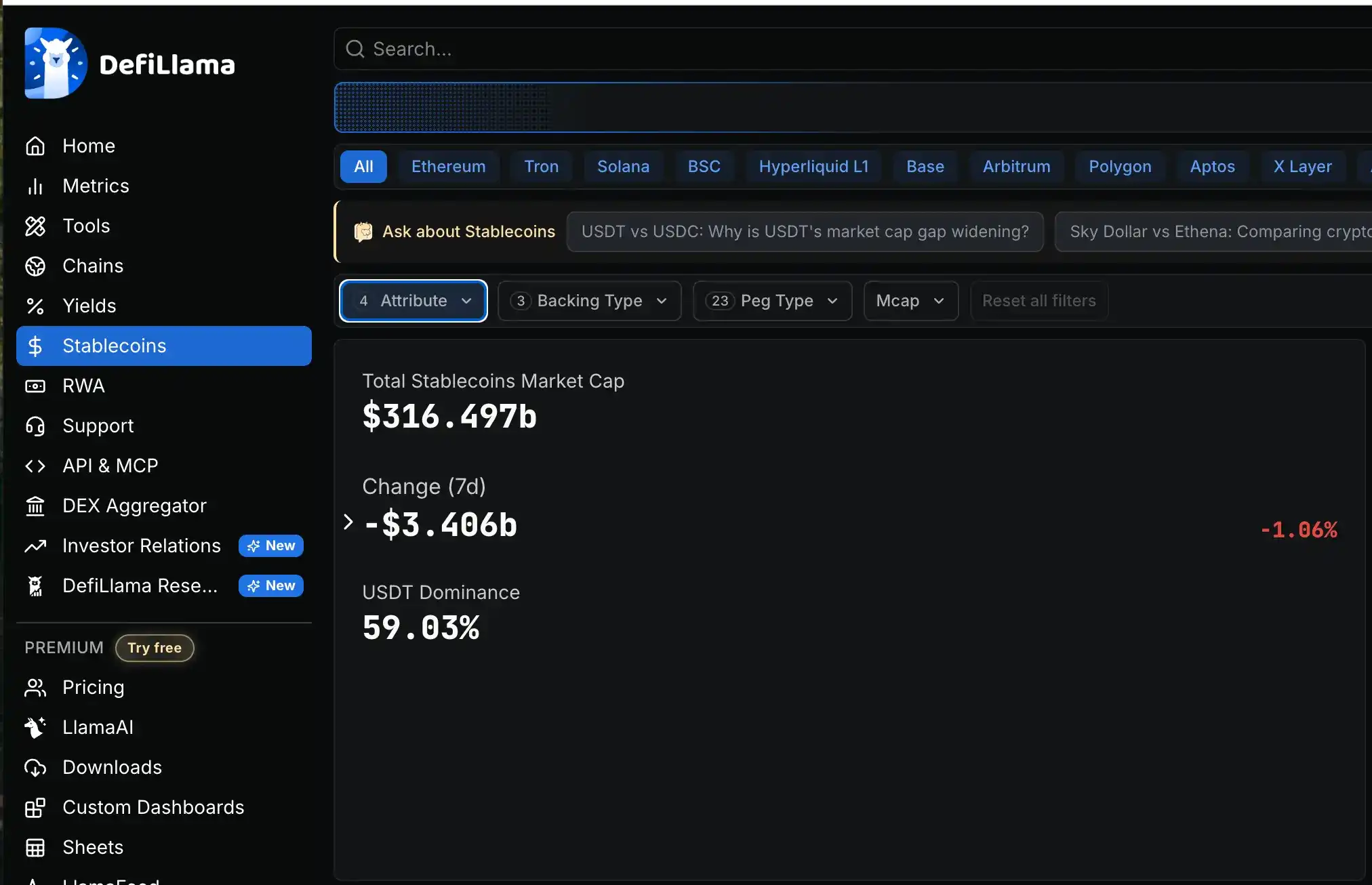
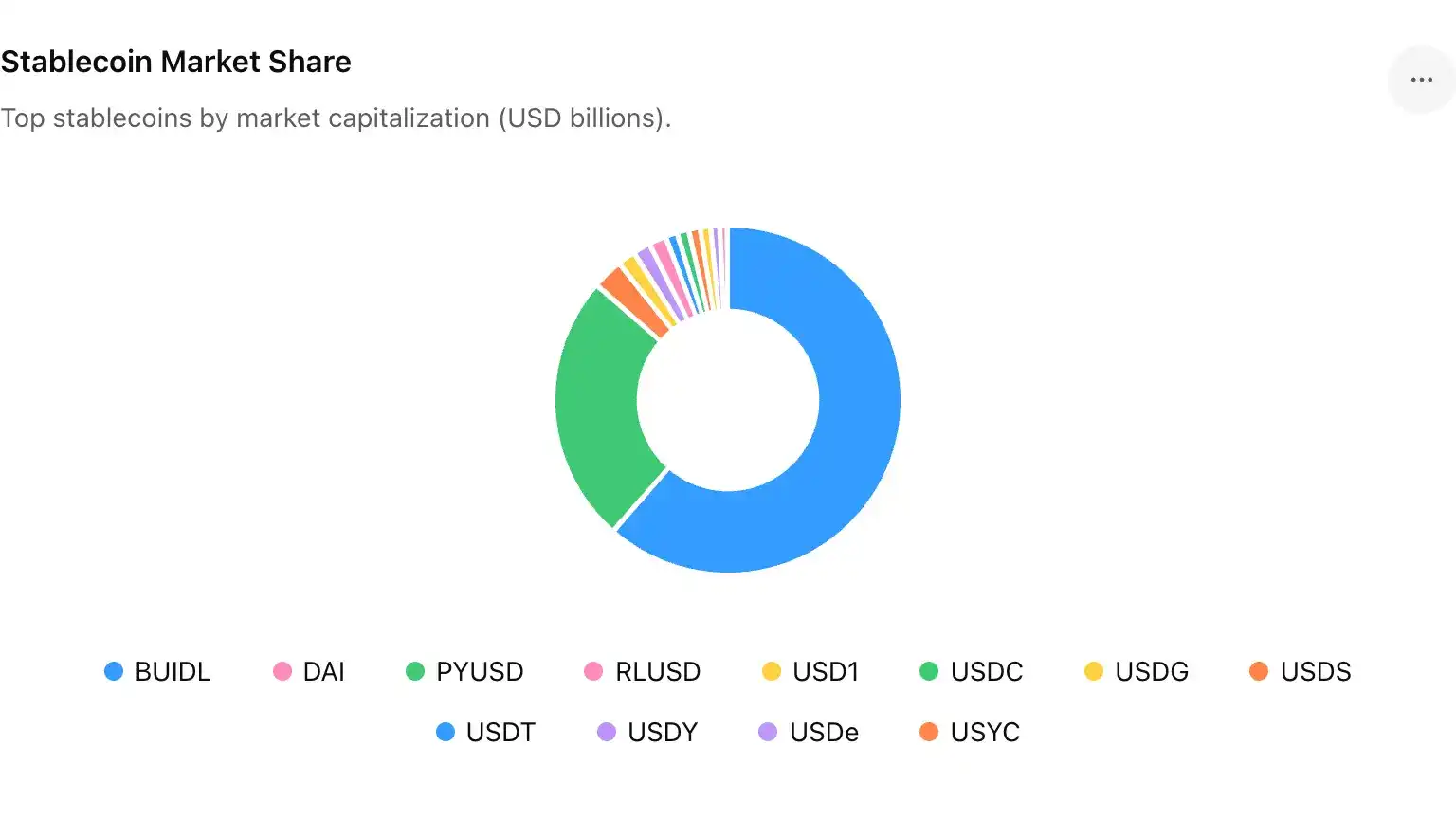
To understand this counterattack, one must first grasp what traditional finance is guarding against: stablecoins. According to DeFiLlama data, in June 2026, the total market capitalization of global stablecoins was approximately $3.16 trillion. USDT alone accounted for about 62%, with a market cap of around $1.86 trillion, while USDC stood at about $750 billion; together, they dominate roughly 80% of the market.
According to Bitrue, stablecoins processed approximately $46 trillion in transaction volume in 2025, over 20 times that of PayPal and approaching three times that of Visa. By Q1 2026, stablecoins accounted for about 75% of total crypto transaction volume. The stablecoin arena has long ceased to be merely a speculative tool; it has become a global payment and settlement pipeline active daily.

For traditional bankers, this pipeline strikes at their core business: deposits. The amount a bank can lend is fundamentally based on the deposits it holds. Once customers get accustomed to moving money from bank accounts into stablecoins in crypto wallets, the foundation for bank lending is hollowed out. Mark Monaco, Global Head of Payments at Bank of America, stated that this system is being prepared in advance for when demand truly takes off.

What is truly compelling banks to act proactively is regulatory easing. The US GENIUS Act has been enacted into law, requiring stablecoins to be fully backed 1:1 with reserves and undergo regular audits, with detailed implementation rules set to take effect on July 18, 2026. The impact of this law lies not in restricting stablecoins but in legitimizing them. When stablecoins transition from a gray area to licensed, audited, and bank-custodied legal instruments, their substitutability for traditional deposits is no longer hypothetical.

Banks have not suddenly fallen in love with blockchain; someone has already laid tracks to their doorstep, forcing them to lay their own.

Bridge or Chain? What Is This Network Exactly?

Returning to that unnamed chain. Its technical designation is a Regulated Settlement Network (RSN). The approach involves converting bank deposits into tokens recorded on a blockchain, enabling round-the-clock, 24/7 real-time settlement, without waiting for the next business day.

"Tokenized deposits" are not a new type of digital asset but the same deposit represented with a different method of record-keeping. They carry the same credit risk, are subject to the same regulations, and remain within the bank system protected by deposit insurance. This is their most fundamental difference from stablecoins: stablecoins move money outside the banking system, while tokenized deposits keep money within the system yet endow it with cryptocurrency-like speed and programmability.

David Watson, CEO of The Clearing House, noted that this is a major move for banks, describing on-chain payments as leading to a completely different future. Max Neukirchen, Co-Head of Global Payments at JPMorgan Chase, offered a more pragmatic perspective, stating that to maintain a stable and resilient payment ecosystem, a regulated market infrastructure is needed to clear these tokenized deposits.

As of the news release, the specific blockchain for this network has not been finalized. The technology is undecided, and its name oscillates between "bridge" and "chain." Yet, over a dozen of America's largest banks have already agreed to put their names on the same press release. At this stage, what has been agreed upon ahead of the technology is governance: who operates it, who can join, and who sets the rules. The answers to these three questions constitute the very essence of what "consortium blockchain" meant in the past.

Revisiting the Last Failure of Consortium Blockchains

From 2016 to 2022, there was a first wave of enterprise blockchain enthusiasm. JPMorgan Chase experimented on Ethereum as early as 2016 and later developed its own private blockchain, Quorum. Hyperledger Fabric by IBM and the Linux Foundation, and Corda led by R3, all saw initial hype followed by a collective fizzle-out.

The reasons, simply put, boiled down to two things. First, there was no compelling pressure for genuine cooperation; each bank built its own closed-off chain, which remained unconnected, resulting in isolated islands. Second, a permissioned ledger in many use cases was essentially just an encrypted database; the technology came first, and problems were sought retroactively. By 2020, as the market narrative shifted entirely toward public chains, DeFi, and liquidity mining, consortium blockchains were labeled as "on-chain, but in the wrong place" and gradually faded from mainstream conversation.

Reflecting on this history provides a contrasting backdrop for today. Consortium blockchains did not fail due to technology; they failed because no one genuinely needed them. What brings them back into view in 2026 precisely fills that critical missing piece: real, urgent, and regulatorily-endorsed demand. Where technology once forced-fit use cases, this time use cases are driving the search for technology.

Data Perspective: Institutional-Grade Consortium Chains Are Already Quietly Operating

The tokenized deposit network is not an isolated event. Over the past eighteen months, multiple institution-led purpose-built chains have accumulated quantifiable scale, with Canton Network having the most comprehensive data.

Developed by Digital Asset, Canton is a public permissioned blockchain, utilizing Daml for smart contracts. Its design goal is to enable competing financial institutions to share a single settlement infrastructure while preserving privacy. Its super validators include Visa, Nasdaq, and BNP Paribas.

In terms of usage, by the end of 2025, over 700 institutions were connected to Canton. The largest application on the network, the Broadridge Distributed Ledger Repo (DLR) platform, processes approximately $4 trillion in monthly tokenized US Treasury repo volume, equating to about $280 billion daily. This figure doubled from $2 trillion per month during 2025.

In December 2025, the US Depository Trust & Clearing Corporation (DTCC) announced a partnership with Digital Asset to tokenize US Treasuries it holds on Canton, with plans to scale up in the second half of 2026. As the core clearing and settlement entity for US equities and fixed income, DTCC's involvement signifies that institutional-grade chains have penetrated the foundational infrastructure of the US market.

Data at the single-bank level is equally concrete. JPMorgan's blockchain unit, Kinexys, has been using JPM Coin on its private blockchain to process institutional payments since 2020, currently handling over $5 billion daily. Citi's Token Services is live, supporting real-time cross-border transfers between New York, London, and Hong Kong. BNY Mellon also launched an institutional tokenized deposit service in January 2026.

Collectively, this data positions the tokenized deposit network as an interoperability layer connecting existing bank projects, rather than another entirely new chain. The driving force is not technology vendors but banks with accumulated real transaction volumes, now seeking a common standard to interconnect.

The Boundary Between Public and Consortium Chains Is Being Blurred by Insiders

A closer look at JPMorgan's strategy reveals it is simultaneously deepening its private blockchain Kinexys, having moved its JPM Coin deposit token (JPMD) onto Coinbase's public chain Base in June 2025. Shortly after, in January 2026, it natively deployed JPMD onto Canton, making it the second chain (after Base) to host this institutional digital cash.

The same bank is betting on three fronts: private chain, public permissioned chain, and public chain.

Earlier, DBS Bank of Singapore and Kinexys agreed in November 2025 to co-develop an interoperability framework enabling tokenized deposits to move between their respective chain ecosystems. What the industry truly cares about is no longer the binary choice of "consortium chain or public chain," but how "permissioned issuance" can interface with "cross-chain settlement."

For banks, public chains are channels to access capital and users, while consortium chains are the settlement backend meeting privacy and compliance needs. The two are not adversaries but sequential segments of the same value chain. What is "reviving" is not the closed, siloed consortium chain of 2018, but its governance soul: purpose-built, institution-led, rules-first. The difference is that this soul now inhabits a new body capable of interfacing with public chains.

Conclusion: The Real Competition Is Over Whose Name the Infrastructure Bears

The dominant narrative of the past few years has been "decentralization will eventually replace traditional finance." However, 2026 is scripting a different version: traditional finance is not being replaced; it is merely extracting blockchain technology from the context of public chains, token issuance, and DeFi, and reconnecting it to its familiar track: a logic of regulation, licensing, and institutional dominance.

This logic differs from the old consortium blockchain approach in that this time it carries the real demand validated by stablecoins, the regulatory runway paved by the GENIUS Act, and the actual transaction volumes demonstrated by Canton and Kinexys. It is no longer just a technological proposition but a functioning reality.

Whether public chains or consortium chains "win" was never the point. When tokenized deposits and stablecoins become functionally indistinguishable, the endgame of competition shifts from products to which infrastructure becomes the default option. Whose name the financial infrastructure of the next decade bears is the real stake on this card table.


Domande pertinenti

QWhat is the core reason driving major US banks to collaborate on building a regulated settlement network for tokenized deposits?

AThe core reason is to defend against the threat of stablecoins eroding traditional bank deposits. Stablecoins, especially after receiving regulatory clarity from the GENIUS Act, offer a fast, borderless payment alternative. By building their own tokenized deposit network, banks aim to keep money within the regulated banking system while providing the speed and programmability similar to cryptocurrencies.

QWhat key problem is the new 'bridge' or 'chain' network designed to solve?

AThe network, technically called a Regulated Settlement Network (RSN), is designed to enable real-time, 24/7 settlement of tokenized deposits. This solves the problem of traditional payment systems that operate only on business days and have slower settlement times. It allows money to move instantly within a regulated framework, improving speed and efficiency for cross-bank transactions.

QAccording to the article, what was the primary cause for the failure of the first wave of consortium/enterprise blockchains (e.g., Quorum, Hyperledger) around 2016-2022?

AThe primary cause was the lack of a genuine, urgent need for the technology. The early efforts created isolated, closed chains that didn't interoperate. They were often technology solutions searching for a problem rather than responding to a compelling demand. This contrasted with the 2026 scenario, where a real threat (stablecoins) and proven demand are driving the adoption of shared infrastructure.

QWhat example does the article give to show that institutional-grade consortium chains are already operating at a significant scale?

AThe article cites Canton Network, developed by Digital Asset. As of the end of 2025, it had over 700 connected institutions. Its flagship application, the Broadridge Distributed Ledger Repo (DLR) platform, processes around $4 trillion in tokenized US Treasury repo transactions monthly. Furthermore, DTCC (Depository Trust & Clearing Corporation) announced plans to tokenize US Treasuries on Canton, indicating deep integration into core US financial infrastructure.

QHow does the article describe the relationship between public blockchains and consortium chains in the context of banks' current strategies?

AThe article argues they are not opponents but complementary parts of the same ecosystem. Banks are adopting a multi-chain strategy: using public chains (like Base) to reach users and liquidity, and consortium/permissioned chains (like Canton) for private, compliant settlement. The 'soul' of the new consortium chains—purpose-built, institution-led, rules-first governance—is now being combined with a new 'body' capable of interoperability with public chains.

Letture associate

STAR 50 Soars 10.73%, Why Did A-Shares Stage a "V-Shaped Reversal"?

After a prolonged decline, the Chinese A-share market staged a strong rally on July 21. The STAR 50 index surged 10.73%, its largest single-day gain in nearly a year, leading a broad-based "V-shaped" reversal. The Shanghai Composite Index rose 1.79%, the Shenzhen Component Index gained 4.81%, and the ChiNext Index jumped 7.05%. Total market turnover reached 2.97 trillion yuan, an increase of 256.1 billion yuan from the previous session, with over 3,100 stocks advancing. The semiconductor sector spearheaded the rebound, with related ETFs posting significant gains. Analysts attribute the surge to three converging factors. First, coordinated capital inflows from "national team" institutions, insurance funds, listed company buybacks, and fund house self-purchases have bolstered market liquidity and confidence. Second, supportive policy signals, including commitments from regulators to ensure stable market operations, provided a favorable backdrop. Third, a stabilization and recovery in overseas markets, notably South Korea, created a positive external environment. Institutions suggest the most severe panic selling phase for the tech sector has likely passed, following a significant digestion of crowded positions and leveraged funds. While short-term volatility may persist, the medium to long-term outlook remains underpinned by enduring trends like AI computing demand expansion and semiconductor localization. The market's focus now shifts to the sustainability of supportive fund flows, earnings reports, and upcoming catalysts from the global AI industry chain.

marsbit18 min fa

STAR 50 Soars 10.73%, Why Did A-Shares Stage a "V-Shaped Reversal"?

marsbit18 min fa

U.S. Tech Momentum Stocks Post Largest Single-Day Gain Ever, But Is the Plunge Over?

US tech momentum stocks staged a sharp rebound on Tuesday (July 21st). Morgan Stanley's TMT Momentum Factor surged over 12%, marking its largest single-day gain on record, exceeding even peaks from the 2000 dot-com bubble. Key momentum indices from Goldman Sachs also posted their strongest daily performances in years. The rally was led by semiconductors, with the Philadelphia Semiconductor Index jumping 4.6%. This rebound followed three consecutive down days and a cumulative 33% plunge in momentum stocks, one of the steepest drawdowns since the dot-com era. Analysts attribute the surge largely to a short squeeze. Heavy selling had pushed high-beta momentum stocks into deeply oversold territory, forcing many short sellers, particularly in Asia, to cover their positions, creating a self-reinforcing buying spiral. However, the rebound's internals appear weak. Trading volume was notably low, and advancing stocks still lagged decliners on the S&P 500, indicating a narrow, concentrated rally rather than broad market participation. Diverging views emerge on the outlook. BTIG warns the bounce has hit key resistance and recommends selling into strength, citing extreme volatility and historical parallels to past market tops. Conversely, Goldman Sachs and UBS believe the momentum unwind is nearing its end, suggesting it may be time to gradually add exposure, as positioning has been significantly reduced. They caution, however, that high volatility warrants a measured approach, potentially using defined-risk strategies. The upcoming earnings season, particularly reports from major tech firms like Alphabet, is seen as a critical test for the rally's sustainability. Simultaneously, bond markets flashed a warning, with yields rising partly due to spiking oil prices. Analysts note that if long-term Treasury yields break decisively higher, it could pose a significant headwind for equities, especially growth stocks.

marsbit26 min fa

U.S. Tech Momentum Stocks Post Largest Single-Day Gain Ever, But Is the Plunge Over?

marsbit26 min fa

U.S. Tech Momentum Stocks Record Largest Single-Day Gain Ever, but Has the Rout Ended?

U.S. tech momentum stocks staged a dramatic rebound on Tuesday, July 21st. Key momentum indices like the Morgan Stanley TMT Momentum Factor and Goldman Sachs' High Beta Momentum Long Index posted historic or near-historic single-day gains, fueled largely by semiconductor stocks. This sharp rally followed a severe three-day sell-off that saw momentum stocks plunge 33%, marking one of the steepest pullbacks since the dot-com bubble. Analysts attribute the bounce primarily to a short squeeze, as forced covering from over-leveraged traders, particularly in Asia, created a buying spiral. However, the rally's health is questioned due to weak market breadth—overall trading volume was low, and decliners outnumbered advancers in the S&P 500 despite the index's gain—suggesting a narrow, concentrated surge rather than broad recovery. Opinions on the sustainability diverge. BTIG strategists warn the rebound has hit key resistance levels, citing extreme volatility and historic stock dispersion as signs of an ongoing broader correction, and recommend selling into strength. Conversely, Goldman Sachs and UBS view the aggressive momentum unwinding as nearing its end, noting reduced positioning and a lack of new fundamental catalysts. They suggest the sell-off presents a selective opportunity to add exposure, albeit cautiously and gradually using defined-risk strategies. The immediate trajectory hinges on the ongoing earnings season, with market focus on Alphabet's capital expenditure guidance for AI investment clarity. Meanwhile, bond markets present a risk, with rising Treasury yields—potentially heading toward 5.5%—and widening credit spreads for mega-cap tech companies posing a threat to equity valuations. The combination of technical factors, earnings results, and macro conditions leaves the durability of the rebound in doubt.

链捕手28 min fa

U.S. Tech Momentum Stocks Record Largest Single-Day Gain Ever, but Has the Rout Ended?

链捕手28 min fa

Long-Divided Must Unite, Long-United Must Divide: When L1 Becomes Its Own Rollup, What Is Ethereum's Endgame?

"The Inevitable Cycle: When L1 Becomes Its Own Rollup – What is Ethereum's Endgame?" For years, the Ethereum community grappled with concerns that L2s were fragmenting the ecosystem and eroding L1's value. While L2s provided cheaper execution, they also splintered liquidity and the unified user experience of a single chain. This has prompted a fundamental reassessment of the relationship between L1 and L2. Ethereum's roadmap is evolving. The "Scale" initiative merges L1 and L2 expansion into a holistic framework. L1 itself is advancing with higher gas limits, statelessness, and zkEVM verification, no longer content to be just a low-throughput settlement layer. Consequently, the primary value proposition of L2s is shifting from merely providing cheap blockspace to offering L1 cannot easily provide: application-specific optimizations, privacy features, and flexible governance models. L2s are becoming a spectrum of execution environments with varying degrees of security inheritance from Ethereum. A critical challenge in this multi-chain future is interoperability. The vision is to make Ethereum "feel like one chain again." This relies on advancements in native account abstraction (like EIP-7702) and intent-based architectures (Open Intents Framework), where users declare desired outcomes, and solvers handle the complex cross-chain execution. Furthermore, shortening Ethereum's finality time from minutes to seconds is crucial, as it underpins trust between chains for bridges, stablecoins, and cross-chain applications. Perhaps the most provocative idea is that Ethereum L1 itself could become a form of "its own Rollup." As zkEVM and proof systems mature, high-performance nodes could execute transactions and generate validity proofs. Regular validators would then verify these proofs instead of re-executing all transactions. This blurs the traditional L1/L2 hierarchy, making "Rollup" more of a general execution-verification architecture. Native Rollup aims to integrate L2 validation more directly into the Ethereum protocol, allowing L2s to inherit L1's security more fully and move away from reliance on security councils. In the end, L2s are not destined to replace L1 or be made obsolete by it. The likely future is a unified system where diverse execution environments—each optimized for specific use cases like DeFi, gaming, or privacy—coexist. They will share a common foundation of security, liquidity, and verifiable state, seamlessly connected to restore a cohesive user experience. The next phase for Ethereum is not just about scaling through separation, but about intelligently reintegrating what was separated back into a coherent whole.

链捕手44 min fa

Long-Divided Must Unite, Long-United Must Divide: When L1 Becomes Its Own Rollup, What Is Ethereum's Endgame?

链捕手44 min fa

Trading

Spot
活动图片




