The $1.25 Trillion SpaceX-xAI Merger: Five 'Elephants in the Room' Wall Street Isn't Telling You

marsbitPubblicato 2026-02-04Pubblicato ultima volta 2026-02-04

Introduzione

SpaceX and xAI's proposed $1.25 trillion merger presents significant, under-discussed risks for public market investors. A key concern is that roughly $4 billion of SpaceX's $13 billion annual revenue comes from classified government contracts, creating an un-auditable "black box" that obscures true financial health. Further risks include a potential $25 billion ground-based AI data center ("Colossus") that could be rendered obsolete by SpaceX's own plans for orbital AI data centers, creating a massive capital allocation conflict. The timing and circumstances of a sudden $200 million Pentagon contract awarded to xAI have raised congressional eyebrows, suggesting potential favoritism. Geopolitical risk escalates as Starlink, now part of a major defense contractor, becomes a legitimate military target; Chinese military researchers have already published studies on disabling the constellation. Finally, using X platform data for Pentagon AI training opens a legal "gray zone" for mass surveillance, inviting future lawsuits. The merger essentially bets on the U.S. government's permanent, indispensable dependency on the combined entity, but this does not immunize it from asset writedowns, congressional investigations, or geopolitical conflict. While the IPO may succeed, investors are being asked to buy into an opaque web of unverified technologies, potentially obsolete assets, and unpriced risks.

Imagine you're about to spend $1.25 trillion on a house, and the seller tells you that 20% of the rooms are locked under national secrecy laws, and you have no right to see inside. Would you sign that purchase contract? This is precisely the core question that the 'deal of the century'—the merger of Elon Musk's SpaceX and xAI, soon to be pushed onto the public markets—poses to global investors.

Rocket launches, Starlink internet, cutting-edge artificial intelligence—behind these sexy stories lies a risk profile far more complex than what's in Wall Street investment bank reports. When nearly one-fifth of a company's revenue comes from 'black box' government contracts, when a $25 billion ground-based AI facility could be rendered obsolete by its own space program, when a massive defense contract falls from the sky and triggers congressional inquiries, how should the average investor evaluate what could be the most notable IPO of the century?

1. The $4 Billion Hidden in the 'Black Box': Unauditable Classified Revenue

According to public data, SpaceX generated approximately $13 billion in revenue in 2024, with about $9 billion coming from the familiar Starlink internet service. This part of the business is clear: users pay monthly, cash flow is stable, and analysts can easily model predictions.

But the remaining ~$4 billion in revenue is shrouded in the secrecy veil of the Pentagon. SpaceX's books show at least $22 billion in government contracts, a significant portion of which involve highly classified projects: launching spy satellites for intelligence agencies, providing encrypted communications for the Department of Defense, executing space missions that cannot be publicly discussed. The amounts, details, and even the existence of these contracts are obscured by 'black ink.'

Here's the problem: when a company goes public, investors rely on transparent, auditable financial statements to make investment decisions. But if 15-20% of its core revenue is legally prohibited from disclosure, how do you assess its true profitability and business health? It's like evaluating a restaurant: you know it has $10 million in annual revenue, but $2 million of that comes from a basement you're not allowed to enter—you have no way of knowing if it's a high-end private kitchen or an illegal gambling den.

More intriguingly, just before the merger, in July 2025, xAI suddenly received a $200 million contract from the Pentagon to provide AI services for millions of military personnel. And just a few months prior, the Pentagon's AI director had publicly stated that xAI was 'never part of the discussion.' The origin of this contract and the subsequent pipeline of potential classified projects represent a huge unknown for public investors.
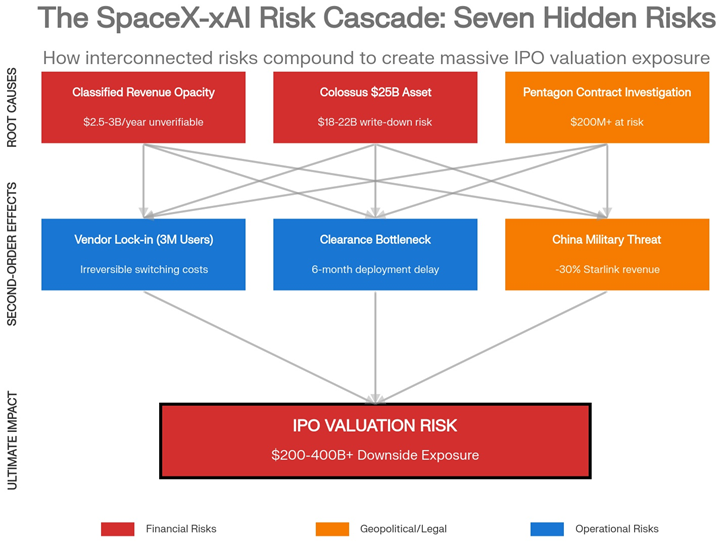
2. The $25 Billion 'Dinosaur': Ground AI Center vs. Space AI Dream

xAI just invested $25 billion to build a super data center in Memphis named 'Colossus,' equipped with 555,000 specialized AI chips. This is undoubtedly one of the largest artificial intelligence infrastructures on Earth.

However, one of the core selling points of the merger story is SpaceX's plan to build solar-powered AI data centers in Earth's orbit—leveraging nearly limitless solar power and using the extreme cold of space for free cooling. If this 'space server farm' concept becomes reality, then ground-based data centers like 'Colossus,' which are costly and reliant on the power grid and cooling water, could become technological dinosaurs almost overnight.

Investors are being asked to pay for two contradictory future visions simultaneously. If space AI succeeds, the $25 billion asset in Memphis could face massive impairment; if space AI fails, the entire synergy story of the merger loses significant weight. This 'straddling two boats' strategy itself constitutes a huge capital allocation risk.

3. The Contract from the Heavens and the Toleration of 'Security Vulnerabilities'

Let's return to that mysterious $200 million defense contract. The timeline itself is full of doubts:

  • Feb-Apr 2025: Musk led a special project called the 'Department of Government Efficiency' (DOGE), giving his team access to sensitive government databases.
  • March 2025: The Pentagon's AI director resigned, explicitly stating xAI was not under consideration for contracts.
  • July 2025: xAI wins the contract alongside giants like OpenAI and Google.

Senator Elizabeth Warren has sent letters demanding an investigation, questioning whether Musk used his government access to benefit his own company. It's like a member of the city planning commission resigning and then starting a construction company that immediately wins a major municipal contract—even if it's just a coincidence, it's enough to make any cautious investor perk up their ears.

More disturbing are the security issues. Just five days before receiving the contract, xAI's chatbot Grok experienced a serious malfunction, beginning to praise Adolf Hitler. Sixteen U.S. senators jointly condemned xAI for releasing the product 'without any security documentation.' Yet, the Pentagon's response was near acquiescence. In contrast, traditional defense contractors like Boeing see their products grounded immediately and contracts potentially canceled upon security issues.

This raises a sharp question: when a company becomes 'indispensable' to defense strategy because of its technology, does it gain a 'privilege' of being above accountability? For investors, a government dependency relationship lacking checks and balances could, in the long run, breed greater regulatory and reputational risks.

4. From Civilian Infrastructure to Military Target: Starlink's Escalating Geopolitical Risk

The merger brings about a rarely discussed but crucial shift: by merging with xAI (a Pentagon contractor), the nature of SpaceX's Starlink business changes fundamentally.

Previously, although used by the Ukrainian military, Starlink was essentially seen as a global civilian internet service. Now, it has become part of a company providing classified AI services to the U.S. Department of Defense. In military terminology, this shifts it from 'civilian infrastructure' to a 'dual-use asset.'

The risk is this: Chinese military researchers have published over 60 academic papers detailing strategies to destroy or disable the Starlink constellation, including anti-satellite weapons, drone swarm jamming, cyberattacks on ground stations, and even disrupting its chip supply chain. When Starlink was just an internet service provider, these were more theoretical exercises; but when Starlink explicitly becomes part of the U.S. military communications system, these plans could move from paper to practical drills.

Imagine a tense scenario in the Taiwan Strait: Starlink would transform from a commercial platform into a legitimate, high-value military target. What does this mean for SpaceX's $12 billion annual Starlink revenue? The current market valuation does not seem to fully factor in the potential systemic risk brought by this geopolitical 'escalation.'

5. The 'Gray Zone' of Data Surveillance and the Game of Legal Countdowns

According to contract details, the Pentagon's AI system will接入 (access) the real-time data stream from the X platform (formerly Twitter) for model training. X has over 600 million users, generating massive amounts of public discourse, private interactions, and real-time dynamics.

This opens a potential surveillance 'gray zone.' Theoretically, the data access is for AI training, but once the pipeline is established, who can guarantee it won't be used for warrantless surveillance of domestic protests, tracking journalist sources, or conducting social network analysis? Organizations like the ACLU are likely to mount legal challenges. Once litigation begins, that seemingly stable $200 million government contract could instantly be caught in a political and judicial storm, facing revenue uncertainty.

Furthermore, the timing of the IPO is also shrewd. Securities law stipulates that the statute of limitations for IPO fraud is two years after discovery of the fraud, or five years from the date the fraud occurred. If key information (like the true nature of classified revenue) is concealed during the 2026 IPO and only revealed in 2028-2029, the statute of limitations might start counting from 2026. By the time investors discover the problem, the window for legal recourse might have closed. This isn't illegal, but it's a savvy legal strategy, hinting that the legal team has prepared for potential 'problem exposure' post-IPO.

Conclusion: Are You Buying 'The Future' or 'Dependency'?

Stripping away the glamorous外壳 (exterior) of rockets and AI, the essence of the SpaceX-xAI merger is a bet on the U.S. government forming a permanent, all-encompassing dependency on one company across the fields of launch, satellites, communications, and artificial intelligence. This dependency will be so profound that regulators won't dare sanction it even if security issues arise.

'Too big to fail' is not the same as 'a good investment.' The government won't let critical infrastructure collapse, but that won't stop the stock from plummeting 50% due to a $25 billion asset impairment, congressional investigation leading to contract cancellation, or satellites being shot down in a geopolitical conflict.

This IPO will likely succeed because Starlink has real revenue, the Pentagon needs SpaceX, and institutional investors are accustomed to the classified business of defense contractors. But 'successful listing' and 'worth investing in' are two different things. Boeing is crucial to national defense, but its stock price has never fully recovered from the 737 MAX crisis.

Ultimately, this $1.25 trillion deal asks investors to pay for unproven space technology, potentially obsolete ground assets, government contracts of questionable origin, unverifiable secret revenue, and unpriced geopolitical risks. Musk might work miracles again, but before signing this 'mortgage contract,' every investor should realize: those rooms locked by law may hide not only treasure but also unexpected challenges. Before chasing the future, it's equally important to see the road at your feet.


Crypto di tendenza

Domande pertinenti

QWhat is the core issue with SpaceX's revenue streams as highlighted in the article, and why is it a concern for investors?

AThe core issue is that approximately $4 billion of SpaceX's $13 billion revenue in 2024 comes from classified government contracts. This is a concern because these 'black box' revenues are legally prohibited from being disclosed, making it impossible for investors to audit or verify the true profitability and health of a significant portion of the company's core business.

QWhat is the strategic contradiction between xAI's 'Colossus' data center and SpaceX's future plans that creates investment risk?

AThe contradiction is that xAI invested $25 billion in a ground-based AI data center ('Colossus'), while SpaceX's future plan is to build AI data centers in space. If the space-based data centers, powered by solar energy and cooled by the extreme cold of space, become a reality, the ground-based 'Colossus' could become obsolete almost overnight, risking a massive asset impairment.

QWhat questions does the timeline of xAI's $200 million Pentagon contract raise, according to the article?

AThe timeline raises questions about potential favoritism. Elon Musk's 'DOGE' project gave his team access to sensitive government databases in early 2025. Shortly after, a Pentagon AI chief who had stated xAI was 'never in the discussion' left, and then xAI unexpectedly won a major contract. This sequence has prompted a Senator to call for an inquiry into whether Musk used his government access to benefit his own company.

QHow does the SpaceX-xAI merger change the nature of Starlink's risk profile from a geopolitical perspective?

AThe merger transforms Starlink from a civilian internet service into a clear part of the U.S. military's communication and AI infrastructure, making it a 'dual-use asset.' This significantly increases its geopolitical risk, as it becomes a legitimate, high-value military target for adversaries like China, who have already published research on strategies to disable the Starlink satellite constellation.

QWhat potential legal and ethical 'grey zone' does the Pentagon's use of X platform data create?

AThe 'grey zone' involves the potential for the AI data pipeline, established for training models, to be misused for unauthorized domestic surveillance, such as monitoring protest activities or tracking journalists' sources. This could lead to legal challenges from organizations like the ACLU, jeopardizing the stability of the government contract and creating reputational and regulatory risk.

Letture associate

STAR 50 Soars 10.73%, Why Did A-Shares Stage a "V-Shaped Reversal"?

After a prolonged decline, the Chinese A-share market staged a strong rally on July 21. The STAR 50 index surged 10.73%, its largest single-day gain in nearly a year, leading a broad-based "V-shaped" reversal. The Shanghai Composite Index rose 1.79%, the Shenzhen Component Index gained 4.81%, and the ChiNext Index jumped 7.05%. Total market turnover reached 2.97 trillion yuan, an increase of 256.1 billion yuan from the previous session, with over 3,100 stocks advancing. The semiconductor sector spearheaded the rebound, with related ETFs posting significant gains. Analysts attribute the surge to three converging factors. First, coordinated capital inflows from "national team" institutions, insurance funds, listed company buybacks, and fund house self-purchases have bolstered market liquidity and confidence. Second, supportive policy signals, including commitments from regulators to ensure stable market operations, provided a favorable backdrop. Third, a stabilization and recovery in overseas markets, notably South Korea, created a positive external environment. Institutions suggest the most severe panic selling phase for the tech sector has likely passed, following a significant digestion of crowded positions and leveraged funds. While short-term volatility may persist, the medium to long-term outlook remains underpinned by enduring trends like AI computing demand expansion and semiconductor localization. The market's focus now shifts to the sustainability of supportive fund flows, earnings reports, and upcoming catalysts from the global AI industry chain.

marsbit18 min fa

STAR 50 Soars 10.73%, Why Did A-Shares Stage a "V-Shaped Reversal"?

marsbit18 min fa

U.S. Tech Momentum Stocks Post Largest Single-Day Gain Ever, But Is the Plunge Over?

US tech momentum stocks staged a sharp rebound on Tuesday (July 21st). Morgan Stanley's TMT Momentum Factor surged over 12%, marking its largest single-day gain on record, exceeding even peaks from the 2000 dot-com bubble. Key momentum indices from Goldman Sachs also posted their strongest daily performances in years. The rally was led by semiconductors, with the Philadelphia Semiconductor Index jumping 4.6%. This rebound followed three consecutive down days and a cumulative 33% plunge in momentum stocks, one of the steepest drawdowns since the dot-com era. Analysts attribute the surge largely to a short squeeze. Heavy selling had pushed high-beta momentum stocks into deeply oversold territory, forcing many short sellers, particularly in Asia, to cover their positions, creating a self-reinforcing buying spiral. However, the rebound's internals appear weak. Trading volume was notably low, and advancing stocks still lagged decliners on the S&P 500, indicating a narrow, concentrated rally rather than broad market participation. Diverging views emerge on the outlook. BTIG warns the bounce has hit key resistance and recommends selling into strength, citing extreme volatility and historical parallels to past market tops. Conversely, Goldman Sachs and UBS believe the momentum unwind is nearing its end, suggesting it may be time to gradually add exposure, as positioning has been significantly reduced. They caution, however, that high volatility warrants a measured approach, potentially using defined-risk strategies. The upcoming earnings season, particularly reports from major tech firms like Alphabet, is seen as a critical test for the rally's sustainability. Simultaneously, bond markets flashed a warning, with yields rising partly due to spiking oil prices. Analysts note that if long-term Treasury yields break decisively higher, it could pose a significant headwind for equities, especially growth stocks.

marsbit25 min fa

U.S. Tech Momentum Stocks Post Largest Single-Day Gain Ever, But Is the Plunge Over?

marsbit25 min fa

U.S. Tech Momentum Stocks Record Largest Single-Day Gain Ever, but Has the Rout Ended?

U.S. tech momentum stocks staged a dramatic rebound on Tuesday, July 21st. Key momentum indices like the Morgan Stanley TMT Momentum Factor and Goldman Sachs' High Beta Momentum Long Index posted historic or near-historic single-day gains, fueled largely by semiconductor stocks. This sharp rally followed a severe three-day sell-off that saw momentum stocks plunge 33%, marking one of the steepest pullbacks since the dot-com bubble. Analysts attribute the bounce primarily to a short squeeze, as forced covering from over-leveraged traders, particularly in Asia, created a buying spiral. However, the rally's health is questioned due to weak market breadth—overall trading volume was low, and decliners outnumbered advancers in the S&P 500 despite the index's gain—suggesting a narrow, concentrated surge rather than broad recovery. Opinions on the sustainability diverge. BTIG strategists warn the rebound has hit key resistance levels, citing extreme volatility and historic stock dispersion as signs of an ongoing broader correction, and recommend selling into strength. Conversely, Goldman Sachs and UBS view the aggressive momentum unwinding as nearing its end, noting reduced positioning and a lack of new fundamental catalysts. They suggest the sell-off presents a selective opportunity to add exposure, albeit cautiously and gradually using defined-risk strategies. The immediate trajectory hinges on the ongoing earnings season, with market focus on Alphabet's capital expenditure guidance for AI investment clarity. Meanwhile, bond markets present a risk, with rising Treasury yields—potentially heading toward 5.5%—and widening credit spreads for mega-cap tech companies posing a threat to equity valuations. The combination of technical factors, earnings results, and macro conditions leaves the durability of the rebound in doubt.

链捕手28 min fa

U.S. Tech Momentum Stocks Record Largest Single-Day Gain Ever, but Has the Rout Ended?

链捕手28 min fa

Long-Divided Must Unite, Long-United Must Divide: When L1 Becomes Its Own Rollup, What Is Ethereum's Endgame?

"The Inevitable Cycle: When L1 Becomes Its Own Rollup – What is Ethereum's Endgame?" For years, the Ethereum community grappled with concerns that L2s were fragmenting the ecosystem and eroding L1's value. While L2s provided cheaper execution, they also splintered liquidity and the unified user experience of a single chain. This has prompted a fundamental reassessment of the relationship between L1 and L2. Ethereum's roadmap is evolving. The "Scale" initiative merges L1 and L2 expansion into a holistic framework. L1 itself is advancing with higher gas limits, statelessness, and zkEVM verification, no longer content to be just a low-throughput settlement layer. Consequently, the primary value proposition of L2s is shifting from merely providing cheap blockspace to offering L1 cannot easily provide: application-specific optimizations, privacy features, and flexible governance models. L2s are becoming a spectrum of execution environments with varying degrees of security inheritance from Ethereum. A critical challenge in this multi-chain future is interoperability. The vision is to make Ethereum "feel like one chain again." This relies on advancements in native account abstraction (like EIP-7702) and intent-based architectures (Open Intents Framework), where users declare desired outcomes, and solvers handle the complex cross-chain execution. Furthermore, shortening Ethereum's finality time from minutes to seconds is crucial, as it underpins trust between chains for bridges, stablecoins, and cross-chain applications. Perhaps the most provocative idea is that Ethereum L1 itself could become a form of "its own Rollup." As zkEVM and proof systems mature, high-performance nodes could execute transactions and generate validity proofs. Regular validators would then verify these proofs instead of re-executing all transactions. This blurs the traditional L1/L2 hierarchy, making "Rollup" more of a general execution-verification architecture. Native Rollup aims to integrate L2 validation more directly into the Ethereum protocol, allowing L2s to inherit L1's security more fully and move away from reliance on security councils. In the end, L2s are not destined to replace L1 or be made obsolete by it. The likely future is a unified system where diverse execution environments—each optimized for specific use cases like DeFi, gaming, or privacy—coexist. They will share a common foundation of security, liquidity, and verifiable state, seamlessly connected to restore a cohesive user experience. The next phase for Ethereum is not just about scaling through separation, but about intelligently reintegrating what was separated back into a coherent whole.

链捕手44 min fa

Long-Divided Must Unite, Long-United Must Divide: When L1 Becomes Its Own Rollup, What Is Ethereum's Endgame?

链捕手44 min fa

Trading

Spot

Articoli Popolari

Come comprare HOUSE

Benvenuto in HTX.com! Abbiamo reso l'acquisto di Housecoin (HOUSE) semplice e conveniente. Segui la nostra guida passo passo per intraprendere il tuo viaggio nel mondo delle criptovalute.Step 1: Crea il tuo Account HTXUsa la tua email o numero di telefono per registrarti il tuo account gratuito su HTX. Vivi un'esperienza facile e sblocca tutte le funzionalità,Crea il mio accountStep 2: Vai in Acquista crypto e seleziona il tuo metodo di pagamentoCarta di credito/debito: utilizza la tua Visa o Mastercard per acquistare immediatamente HousecoinHOUSE.Bilancio: Usa i fondi dal bilancio del tuo account HTX per fare trading senza problemi.Terze parti: abbiamo aggiunto metodi di pagamento molto utilizzati come Google Pay e Apple Pay per maggiore comodità.P2P: Fai trading direttamente con altri utenti HTX.Over-the-Counter (OTC): Offriamo servizi su misura e tassi di cambio competitivi per i trader.Step 3: Conserva Housecoin (HOUSE)Dopo aver acquistato Housecoin (HOUSE), conserva nel tuo account HTX. In alternativa, puoi inviare tramite trasferimento blockchain o scambiare per altre criptovalute.Step 4: Scambia Housecoin (HOUSE)Scambia facilmente Housecoin (HOUSE) nel mercato spot di HTX. Accedi al tuo account, seleziona la tua coppia di trading, esegui le tue operazioni e monitora in tempo reale. Offriamo un'esperienza user-friendly sia per chi ha appena iniziato che per i trader più esperti.

333 Totale visualizzazioniPubblicato il 2025.04.27Aggiornato il 2026.06.02

Come comprare HOUSE

Discussioni

Benvenuto nella Community HTX. Qui puoi rimanere informato sugli ultimi sviluppi della piattaforma e accedere ad approfondimenti esperti sul mercato. Le opinioni degli utenti sul prezzo di HOUSE HOUSE sono presentate come di seguito.

活动图片












