Texas Poker Bluffing Battle | The Key to Victory in WPT Global High-Stakes Cash Game: AK vs 99

bitcoinistPubblicato 2025-12-24Pubblicato ultima volta 2025-12-24

Introduzione

An analysis of a high-stakes cash game hand on WPT Global between Alan Keating (A♠K♥) and Nik Airball (9♠9♦). The hand demonstrates how player image and credibility are often more critical than raw hand strength in deep-stack play. Keating, known for a loose and aggressive style with a wide range, 3-bet pre-flop. Airball, a skilled player adept at reading opponents, responded with a 4-bet. Keating then made a large 5-bet, a polarized move representing either a very strong hand or a pure bluff. Airball called, taking position to the flop (J♠4♦6♠). With his A-K missing the flop, Keating moved all-in with a massive overbet, attempting to maximize fold equity by representing a very strong range. However, Airball instantly called. His decision was a strategic read based on Keating's image; he calculated that Keating’s line was more likely a bluff with overcards. The board ran out twice with no A or K, and Airball's pocket nines held. The hand underscores a key high-stakes concept: betting power is determined not just by the cards, but by how opponents perceive your image and credibility. Keating’s aggressive play lost its effectiveness against an opponent who correctly adjusted his calling frequency to exploit it.

Learning from real battles, stealing skills from the masters. This hand between Keating and Airball with AK versus 99 at the WPT Global high-stakes cash table is a classic example. On the surface, it's a common high card versus medium pocket pair scenario, but in reality, it's an extreme confrontation under deep stack conditions, pushing image, credibility, and range reading to the limit.

To understand the direction of this hand, we must first understand the table personas of the two players, because at this level, hand strength is just the entry point; the core of decision-making is how much your opponent believes you.

Table Personas: One Relies on Chaotic Pressure, the Other on Reading Hands to Counter

Alan Keating is one of the most popular and difficult types to face at high-stakes tables. His VPIP is extremely high, his entering range is so wide it's almost distorted—he plays strong hands, marginal hands, and even garbage hands, daring to use massive sizing to apply pressure and bluff. His bankroll depth and risk preference give him a natural advantage in many confrontations, making it hard for opponents to pin down his hole cards using traditional signals, as his raises could be AA or 72 offsuit.

This near-crazy image can yield significant fold equity in the long run, but it also erodes his credibility. Once opponents categorize him as "polarized with a high bluff frequency," his big moves are easily counter-interpreted, ultimately becoming the starting point of a tragedy.

Nik Airball is the other extreme. A regular on shows like Hustler Casino Live, he is known for his incessant speech play and strong aggression. Public opinion on him is divided, but his technical foundation should not be underestimated. He is quite solid in range reading and tempo adjustment, especially skilled at making exploitative calls against specific opponents.

Facing an overly aggressive opponent like Keating, he knows when to increase his calling frequency and when to use calls to let the opponent bluff all the way. In other words, he isn't competing with Keating to see who is more aggressive, but rather who is better at turning the opponent's image into harvestable EV.

Pre-flop Raising War: Not AK vs 99, but the Pricing of Credibility

The hand starts with Airball opening with 9♠9♦. Keating's 3bet with A♠K♥ is a standard strong hand line, aiming to isolate the opponent and establish initiative. Airball then chooses to 4bet. This move is crucial in a deep stack scenario. 99 is an awkward medium pocket pair in most frameworks—it doesn't just seek set value like small pocket pairs, nor is it as comfortable under pressure as QQ or better. Airball's 4bet is both a test and a counter, betting that Keating's 3bet range is wide enough for him to still extract value and maintain initiative in the confrontation.

The real turning point occurs when Keating makes a 5bet, raising to 165,000. For most players, a 5bet is often seen as a signal for AA or KK, but in Keating's image framework, his 5bet is closer to a polarized move—either the nuts or using deep stacks and table credibility to force a fold. The question at this moment becomes: does Airball believe Keating's "represented range"? Airball doesn't shove all-in, nor does he fold. Instead, he chooses to call, taking the decision to the flop, using position and information advantage to delay the decision—a common high-level approach in high-stakes games, preserving room to observe Keating's post-flop line.

Flop: J♠4♦6♠, The Purpose and Cost of Keating's Overbet Shove

The flop doesn't bring an A or K; AK misses. Keating still chooses an overbet All-in shove. The core of this line is not hand strength, but maximizing Fold Equity. He hopes to use an extreme size to represent high-weight combinations like AA, KK, JJ, or strong flush draws, forcing a medium pocket pair like 99 to fold under immense pressure. Because if he checks or makes a small bet, AK can easily be passively led to a showdown disadvantage.

From a pure strategy perspective, this is a decision that settles the outcome in one go—success means taking the pot directly, failure means risking almost the entire buy-in.

The problem is, an overbet shove极度依赖信用度 (relies extremely on credibility). If the opponent believes you, it's a highly efficient pressure tool. If the opponent doesn't believe you, it becomes a move that locks the opponent's calling range into the "specifically designed to catch your bluff" zone, providing the opponent with the best incentive to call with your maximum size.
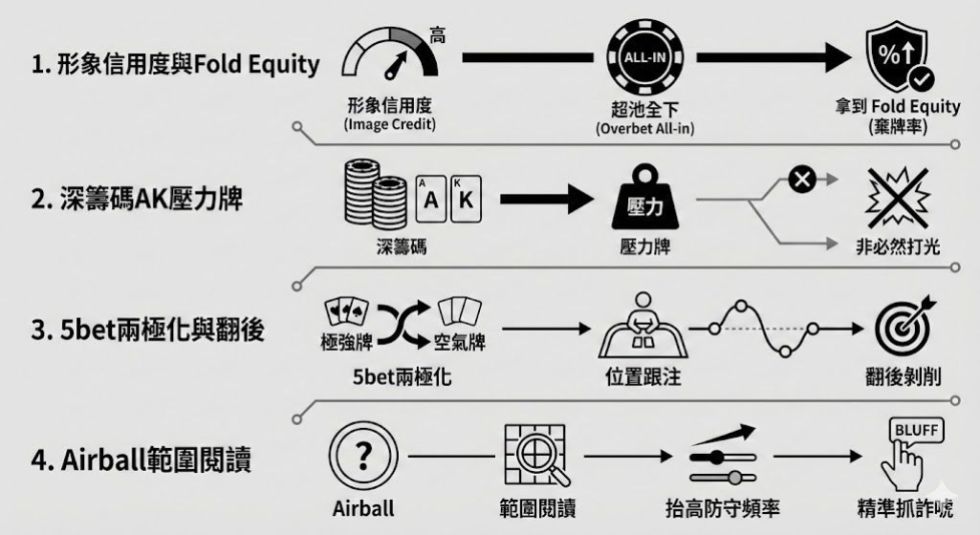
Airball's Instant Call: Calling with 99, Catching the Crack in Keating's Image

Airball's instant call looks like a hand strength decision, but it's actually a model decision. He calculates Keating's entire line within the framework of his opponent's persona: Keating has a wide pre-flop range, his 5bet has polarized characteristics, and when he misses the flop, he is more likely to push all the way with his two high-card air using a large size, trying to win the pot in one go.

Under this assumption, the relative strength of 99 on J♠4♦6♠ increases significantly. The call isn't about toughing it out; it's about exploiting the structural flaw of an opponent who applies excessive pressure and lacks credibility. They run it twice; neither runout produces an A or K. 99 holds its lead and busts Keating. The ending is sealed by the deal, but the logic of victory was actually determined the moment the instant call was made.

CoinPoker Gambling – The Overall Best Bitcoin Poker Gambling Site

CoinPoker has long been regarded as the most comprehensive Bitcoin gambling platform in the crypto space, establishing high competitiveness with its smooth interface, diverse gameplay, and strong bonus structure. The platform offers a 150% welcome bonus, with the first deposit going up to $2,000, making it an extremely attractive starting condition for both beginners and advanced players, and successfully solidifying its position as a mainstream BTC gambling site.

In terms of gameplay, CoinPoker offers over 15 betting markets, covering live sports, esports, virtual events, and more. It also supports deposits in multiple mainstream cryptocurrencies. Withdrawals are known for instant processing, zero fees, and anonymous settlement, ensuring players can withdraw their winnings quickly and safely. Beyond sports betting, the platform also features a mature casino system, including high-quality live dealer games, presented in HD stream from Blackjack to Roulette, allowing players to enjoy an immersion close to a physical casino on their mobile or desktop.

For poker players, CoinPoker's appeal is even more evident. The platform offers stable, active poker tables and diverse tournament formats. A 33% online poker rakeback is offered every Monday, providing substantial value for long-term players. Coupled with the platform's transparent operation and continuously promoted events, it creates a highly rated professional poker environment for global players.

CoinPoker combines Bitcoin gambling, live dealer casino, and a professional poker ecosystem, offering fast settlement,完善的奖金制度 (完善的 bonus system), and high anonymity, making it an ideal choice for crypto players seeking security, speed, and entertainment.

Enter CoinPoker to Play

Conclusion: The True Hand Strength in High-Stakes Games is How Your Opponent Sees You

The value of this hand lies in how clearly it illustrates the most essential reality of high-stakes games: the power of your bet is not only determined by the board but also by how your opponent prices your image. Keating's chaotic style can force excessive folds against many opponents, earning him a lot of non-showdown EV in the long run. But once he encounters an opponent who can calculate his bluff frequency into the equation, his 5bet and flop shove lose their intimidation power, even反过来 becoming the most comfortable calling point for the opponent. Airball wins by daring to increase his calling frequency and accurately choosing the most suitable structure to withstand the pressure.

A more realistic statement is: in a deep stack environment, AK is no longer a no-brainer all-in weapon. It's more like a pressure hand that requires credibility加成 (credibility bonus). When you are perceived as loose-aggressive, you must accept that opponents will call more boldly; your value lines need to be more direct, and your bluff lines need to be more selective. The reason this hand becomes a classic is not because 99 beat AK, but because it demonstrates the ultimate rule of high-stakes games: when your opponent sees through who you are, the cards in your hand get repriced.


Domande pertinenti

QWhat was the key factor that determined the outcome of the AK vs. 99 hand between Keating and Airball on the WPT Global high-stakes cash game?

AThe key factor was the players' table image and perceived credibility, not just the raw hand strength. Keating's hyper-aggressive and wide-ranging style had eroded his credibility, allowing Airball to accurately read his large bet on the flop as a likely bluff and make a profitable call with his pocket nines.

QHow did Nik Airball's playing style differ from Alan Keating's in this hand?

ANik Airball's style was based on solid range reading and making exploitative adjustments against specific opponents. He was adept at knowing when to increase his defense frequency and when to call down aggression. In contrast, Alan Keating employed a chaotic, high-VPIP style with a very wide range, using large bet sizes to apply pressure and bluff frequently.

QWhy did Alan Keating choose to make a 5-bet pre-flop and then an overbet all-in on the flop with A♠K♥?

AKeating's 5-bet pre-flop was a polarized move, representing either a very strong hand or a bluff designed to exploit his deep stack and force a fold. His overbet all-in on the J♠4♦6♠ flop was an attempt to maximize fold equity by representing a very strong hand (like an overpair or a strong draw) since his A-K had missed the board, hoping to win the pot without a showdown.

QWhat does the article suggest is the 'ultimate rule' of high-stakes poker, as demonstrated by this hand?

AThe 'ultimate rule' is that the power of a bet is not just determined by the cards, but by how an opponent prices your table image. When an opponent sees through your playing style and understands your tendencies, the value of the cards you hold is re-priced accordingly.

QAccording to the article, what makes A-K a different type of hand in a deep-stack environment against a skilled opponent?

AIn a deep-stack environment against a skilled opponent, A-K is no longer a hand to automatically commit all chips with. It becomes a pressure hand that requires credibility to be effective. If a player is perceived as loose and aggressive, opponents will be more willing to call, meaning value bets need to be more straightforward and bluffs need to be more carefully selected.

Letture associate

STAR 50 Soars 10.73%, Why Did A-Shares Stage a "V-Shaped Reversal"?

After a prolonged decline, the Chinese A-share market staged a strong rally on July 21. The STAR 50 index surged 10.73%, its largest single-day gain in nearly a year, leading a broad-based "V-shaped" reversal. The Shanghai Composite Index rose 1.79%, the Shenzhen Component Index gained 4.81%, and the ChiNext Index jumped 7.05%. Total market turnover reached 2.97 trillion yuan, an increase of 256.1 billion yuan from the previous session, with over 3,100 stocks advancing. The semiconductor sector spearheaded the rebound, with related ETFs posting significant gains. Analysts attribute the surge to three converging factors. First, coordinated capital inflows from "national team" institutions, insurance funds, listed company buybacks, and fund house self-purchases have bolstered market liquidity and confidence. Second, supportive policy signals, including commitments from regulators to ensure stable market operations, provided a favorable backdrop. Third, a stabilization and recovery in overseas markets, notably South Korea, created a positive external environment. Institutions suggest the most severe panic selling phase for the tech sector has likely passed, following a significant digestion of crowded positions and leveraged funds. While short-term volatility may persist, the medium to long-term outlook remains underpinned by enduring trends like AI computing demand expansion and semiconductor localization. The market's focus now shifts to the sustainability of supportive fund flows, earnings reports, and upcoming catalysts from the global AI industry chain.

marsbit1 min fa

STAR 50 Soars 10.73%, Why Did A-Shares Stage a "V-Shaped Reversal"?

marsbit1 min fa

U.S. Tech Momentum Stocks Post Largest Single-Day Gain Ever, But Is the Plunge Over?

US tech momentum stocks staged a sharp rebound on Tuesday (July 21st). Morgan Stanley's TMT Momentum Factor surged over 12%, marking its largest single-day gain on record, exceeding even peaks from the 2000 dot-com bubble. Key momentum indices from Goldman Sachs also posted their strongest daily performances in years. The rally was led by semiconductors, with the Philadelphia Semiconductor Index jumping 4.6%. This rebound followed three consecutive down days and a cumulative 33% plunge in momentum stocks, one of the steepest drawdowns since the dot-com era. Analysts attribute the surge largely to a short squeeze. Heavy selling had pushed high-beta momentum stocks into deeply oversold territory, forcing many short sellers, particularly in Asia, to cover their positions, creating a self-reinforcing buying spiral. However, the rebound's internals appear weak. Trading volume was notably low, and advancing stocks still lagged decliners on the S&P 500, indicating a narrow, concentrated rally rather than broad market participation. Diverging views emerge on the outlook. BTIG warns the bounce has hit key resistance and recommends selling into strength, citing extreme volatility and historical parallels to past market tops. Conversely, Goldman Sachs and UBS believe the momentum unwind is nearing its end, suggesting it may be time to gradually add exposure, as positioning has been significantly reduced. They caution, however, that high volatility warrants a measured approach, potentially using defined-risk strategies. The upcoming earnings season, particularly reports from major tech firms like Alphabet, is seen as a critical test for the rally's sustainability. Simultaneously, bond markets flashed a warning, with yields rising partly due to spiking oil prices. Analysts note that if long-term Treasury yields break decisively higher, it could pose a significant headwind for equities, especially growth stocks.

marsbit8 min fa

U.S. Tech Momentum Stocks Post Largest Single-Day Gain Ever, But Is the Plunge Over?

marsbit8 min fa

U.S. Tech Momentum Stocks Record Largest Single-Day Gain Ever, but Has the Rout Ended?

U.S. tech momentum stocks staged a dramatic rebound on Tuesday, July 21st. Key momentum indices like the Morgan Stanley TMT Momentum Factor and Goldman Sachs' High Beta Momentum Long Index posted historic or near-historic single-day gains, fueled largely by semiconductor stocks. This sharp rally followed a severe three-day sell-off that saw momentum stocks plunge 33%, marking one of the steepest pullbacks since the dot-com bubble. Analysts attribute the bounce primarily to a short squeeze, as forced covering from over-leveraged traders, particularly in Asia, created a buying spiral. However, the rally's health is questioned due to weak market breadth—overall trading volume was low, and decliners outnumbered advancers in the S&P 500 despite the index's gain—suggesting a narrow, concentrated surge rather than broad recovery. Opinions on the sustainability diverge. BTIG strategists warn the rebound has hit key resistance levels, citing extreme volatility and historic stock dispersion as signs of an ongoing broader correction, and recommend selling into strength. Conversely, Goldman Sachs and UBS view the aggressive momentum unwinding as nearing its end, noting reduced positioning and a lack of new fundamental catalysts. They suggest the sell-off presents a selective opportunity to add exposure, albeit cautiously and gradually using defined-risk strategies. The immediate trajectory hinges on the ongoing earnings season, with market focus on Alphabet's capital expenditure guidance for AI investment clarity. Meanwhile, bond markets present a risk, with rising Treasury yields—potentially heading toward 5.5%—and widening credit spreads for mega-cap tech companies posing a threat to equity valuations. The combination of technical factors, earnings results, and macro conditions leaves the durability of the rebound in doubt.

链捕手11 min fa

U.S. Tech Momentum Stocks Record Largest Single-Day Gain Ever, but Has the Rout Ended?

链捕手11 min fa

Long-Divided Must Unite, Long-United Must Divide: When L1 Becomes Its Own Rollup, What Is Ethereum's Endgame?

"The Inevitable Cycle: When L1 Becomes Its Own Rollup – What is Ethereum's Endgame?" For years, the Ethereum community grappled with concerns that L2s were fragmenting the ecosystem and eroding L1's value. While L2s provided cheaper execution, they also splintered liquidity and the unified user experience of a single chain. This has prompted a fundamental reassessment of the relationship between L1 and L2. Ethereum's roadmap is evolving. The "Scale" initiative merges L1 and L2 expansion into a holistic framework. L1 itself is advancing with higher gas limits, statelessness, and zkEVM verification, no longer content to be just a low-throughput settlement layer. Consequently, the primary value proposition of L2s is shifting from merely providing cheap blockspace to offering L1 cannot easily provide: application-specific optimizations, privacy features, and flexible governance models. L2s are becoming a spectrum of execution environments with varying degrees of security inheritance from Ethereum. A critical challenge in this multi-chain future is interoperability. The vision is to make Ethereum "feel like one chain again." This relies on advancements in native account abstraction (like EIP-7702) and intent-based architectures (Open Intents Framework), where users declare desired outcomes, and solvers handle the complex cross-chain execution. Furthermore, shortening Ethereum's finality time from minutes to seconds is crucial, as it underpins trust between chains for bridges, stablecoins, and cross-chain applications. Perhaps the most provocative idea is that Ethereum L1 itself could become a form of "its own Rollup." As zkEVM and proof systems mature, high-performance nodes could execute transactions and generate validity proofs. Regular validators would then verify these proofs instead of re-executing all transactions. This blurs the traditional L1/L2 hierarchy, making "Rollup" more of a general execution-verification architecture. Native Rollup aims to integrate L2 validation more directly into the Ethereum protocol, allowing L2s to inherit L1's security more fully and move away from reliance on security councils. In the end, L2s are not destined to replace L1 or be made obsolete by it. The likely future is a unified system where diverse execution environments—each optimized for specific use cases like DeFi, gaming, or privacy—coexist. They will share a common foundation of security, liquidity, and verifiable state, seamlessly connected to restore a cohesive user experience. The next phase for Ethereum is not just about scaling through separation, but about intelligently reintegrating what was separated back into a coherent whole.

链捕手27 min fa

Long-Divided Must Unite, Long-United Must Divide: When L1 Becomes Its Own Rollup, What Is Ethereum's Endgame?

链捕手27 min fa

Trading

Spot
活动图片




