# Testing Articoli collegati

Il Centro Notizie HTX fornisce gli articoli più recenti e le analisi più approfondite su "Testing", coprendo tendenze di mercato, aggiornamenti sui progetti, sviluppi tecnologici e politiche normative nel settore crypto.

How to Automate Any Workflow with Claude Skills (Complete Tutorial)

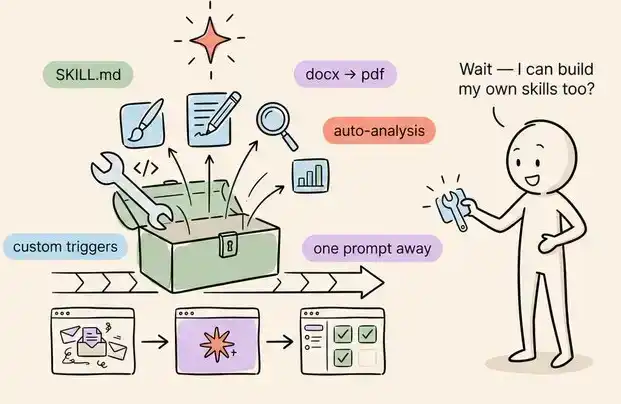
This is a comprehensive guide to mastering Claude Skills, a feature for creating permanent, reusable instruction sets that automate specific workflows. Unlike simple saved prompts, Skills function like trained employees, delivering consistent, high-quality outputs by defining the entire task process, standards, error handling, and output format. The guide is structured in four phases: **Phase 1: Installation (5 minutes).** Skills are folders containing a `SKILL.md` file. The user is instructed to find a relevant Skill online, install it, test it on a real task, and compare its performance to one-off prompts. **Phase 2: Building Your First Custom Skill.** Start by rigorously defining the Skill's purpose, trigger phrases, and providing a concrete example of perfect output. The `SKILL.md` file has two parts: a YAML frontmatter with a specific name/description/triggers, and a detailed, step-by-step workflow written in natural language with examples and quality standards. **Phase 3: Testing & Optimization for Production.** Test the Skill in three scenarios: 1) a standard, common task; 2) edge cases with missing or conflicting data; and 3) a pressure test with maximum complexity. Any failure indicates a needed instruction. Implement a weekly optimization cycle to continuously refine the Skill based on real usage. **Phase 4: Building a Complete Skill Library.** The goal is to create a team of Skills for all repetitive tasks. Examples are given for industries like real estate, marketing, finance, consulting, and e-commerce. The user should list their tasks, prioritize them, and build one new Skill per week, maintaining a master document to track their library. The conclusion emphasizes the compounding time savings: ten Skills saving 30 minutes each per week reclaims over 260 hours (6.5 work weeks) per year, fundamentally transforming one's work system.

marsbit05/12 09:45

How to Automate Any Workflow with Claude Skills (Complete Tutorial)

marsbit05/12 09:45

Morgan Stanley 2026 Semiconductor Report: Buy Packaging, Buy Testing, Buy China Chips, Avoid Traditional Tracks

Morgan Stanley 2026 Semiconductor Report: Buy Packaging, Buy Testing, Buy Chinese Chips; Avoid Traditional Segments. The core theme is the shift in AI compute supply from NVIDIA dominance to a three-track system of GPU + ASIC + China-local chips. The key opportunity is capturing share in this expansion, while non-AI semiconductors face marginalization due to resource reallocation to AI. Key investment conclusions, in order of priority: 1. **Advanced Packaging (CoWoS/SoIC) - Highest Conviction**: TSMC is the primary beneficiary of explosive demand, driven by massive cloud capex. Its pricing power and AI revenue share are rising significantly. 2. **Test Equipment - Undervalued & High-Growth Certainty**: Chip complexity is causing test times to double generationally, structurally driving handler/socket/probe card demand. Companies like Hon Hai Precision (Foxconn), WinWay, and MPI offer compelling value. 3. **China AI Chips (GPU/ASIC) - Long-Term Irreversible Trend**: Export controls are accelerating domestic substitution. Companies like Cambricon, with firm customer orders and SMIC's 7nm capacity support, are positioned to benefit from lower TCO (30-60% vs NVIDIA) and growing local cloud demand. 4. **Avoid Non-AI Semiconductors (Consumer/Auto/Industrial)**: These segments face a weak, structurally hindered recovery due to AI's resource "crowding-out" effect on capacity and supply chains. 5. **Memory - Severe Internal Divergence**: Strongly favor HBM (Hynix primary beneficiary) and NOR Flash (Macronix). Be cautious on interpreting price rises in DDR4/NAND as true demand recovery. The report emphasizes a 2026-2027 time window, stating the AI capital expenditure cycle is far from over. Key macro variables include persistent export controls and AI's systemic "crowding-out" effect on traditional semiconductor supply chains.

marsbit05/12 01:30

Morgan Stanley 2026 Semiconductor Report: Buy Packaging, Buy Testing, Buy China Chips, Avoid Traditional Tracks

marsbit05/12 01:30

AI Models Are Evolving Rapidly, How Can Workers Overcome 'AI Anxiety'?

AI models and tools are evolving rapidly, creating a sense of anxiety among professionals who feel pressured to keep up. The root of this "AI anxiety" isn't the pace of change itself, but the lack of a filter to distinguish what truly matters for one's work. Three key forces drive this anxiety: the AI content ecosystem thrives on urgency and hype, loss aversion makes people fear missing out, and too many options lead to decision paralysis. The solution is not to consume more information, but to build a personalized filtering system. "Keeping up" doesn't mean testing every new tool on day one; it means having a system to automatically answer: "Is this important for *my* work?" Three practical strategies are proposed: 1. **Build a "Weekly AI Digest" Agent:** Use automation (e.g., n8n) to gather news from trusted sources, then use an AI to filter it based on your specific job role and tasks. This delivers a concise weekly report of only the relevant updates. 2. **Test with *Your* Prompts:** When a new tool seems relevant, test it using your actual work prompts, not the vendor's perfect demos. Compare the results side-by-side with your current tools to see if it's truly better for your workflow. 3. **Distinguish "Benchmark" vs. "Business" Releases:** Most announcements are "benchmark releases" (improvements on standardized tests) that have little real-world impact. Focus only on "business releases" that offer new capabilities you can use immediately. Combining these strategies transforms AI updates from a source of stress into a manageable advantage. The real competitive edge lies not in accessing every new model, but in knowing what to ignore and what to test deeply for your specific work. The key is to stop trying to follow everything and start filtering for what truly matters.

marsbit02/09 12:19

AI Models Are Evolving Rapidly, How Can Workers Overcome 'AI Anxiety'?

marsbit02/09 12:19

活动图片