# Gas Articoli collegati

Il Centro Notizie HTX fornisce gli articoli più recenti e le analisi più approfondite su "Gas", coprendo tendenze di mercato, aggiornamenti sui progetti, sviluppi tecnologici e politiche normative nel settore crypto.

One Article to Understand $UORE: The V4 Hook Project That Packs Mining, Lottery, and NFT Into a Single Transaction

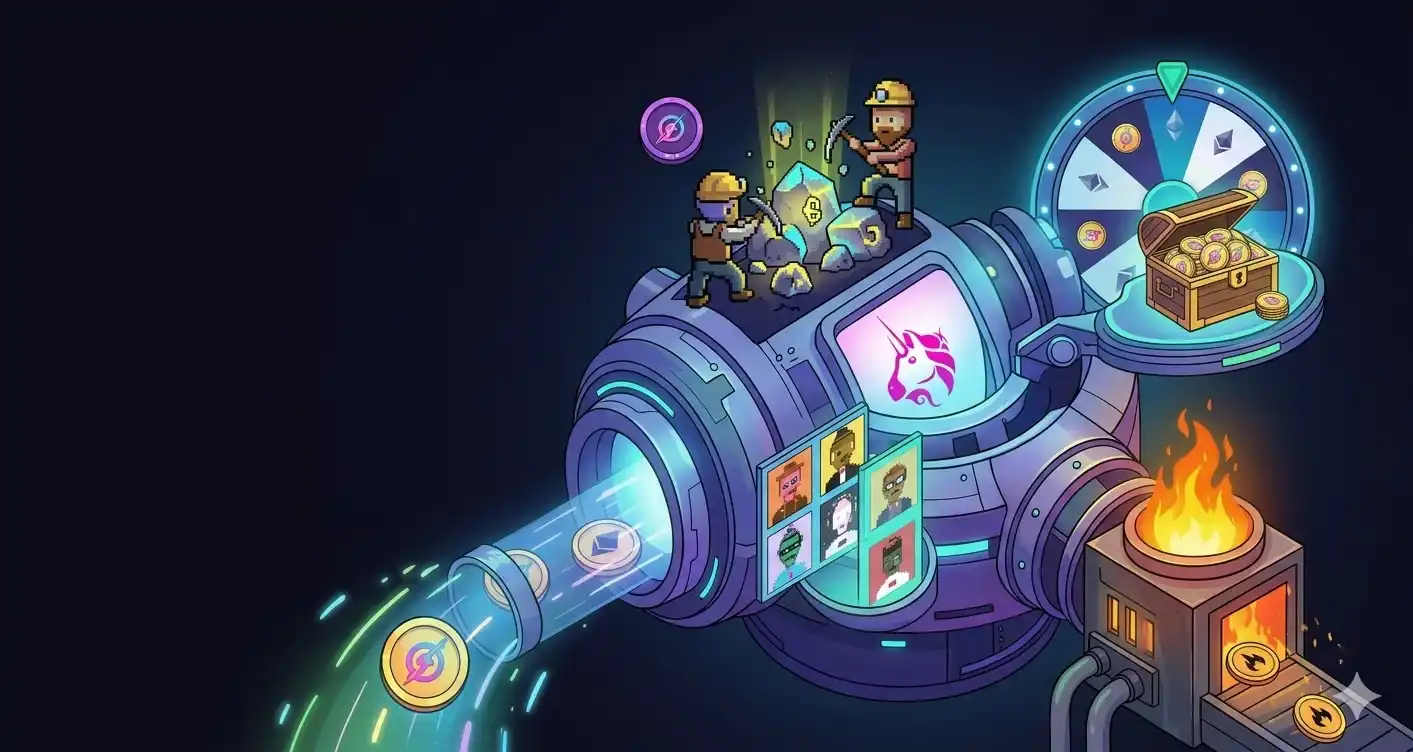
An In-Depth Look at $UORE: The V4 Hook Project Packing Mining, Lotteries, and NFTs into a Single Transaction $UORE is the latest project leveraging the Uniswap V4 Hook mechanism, following in the footsteps of projects like SATO, uPEG, and Slonks. It distinguishes itself by integrating multiple functions—on-chain mining, a buy-to-enter lottery, auto-generated pixel NFTs (Orelings), and a deflationary burn mechanism—all within a single Uniswap V4 liquidity pool transaction. This complexity results in transaction gas fees that are 2-3 times higher than a standard swap. The project's tokenomics are intricate. Each whole $UORE token held automatically mints a corresponding Oreling NFT, a 32x32 pixel miner character with random traits determined by the next block's hash. Each Oreling has a Class (rarity) and Hash value, which combine to form its Mining Power for staking rewards. Rewards are distributed daily from an emission that decays by 1% daily, with an 80/20 split between stakers and a Motherlode lottery pool. A "refined-ore boost" mechanism taxes early reward claims, redistributing 10% to remaining stakers. The Motherlode lottery awards tickets for buys of ≥0.1 ETH, with winning chances scaling up to 1% for 1 ETH purchases. Wins split the pool 50% to the buyer and 50% to a random staker. A 1% buy tax is burned, and a 1% sell tax funds an automatic buyback-and-burn mechanism triggered at 0.1 ETH. The project's code is a fork of uPEG, with claimed fixes for NFT duplication and flash loan attacks. Its creator, Noah, describes it as a fusion of Solana's ORE mining concept with uPEG's V4 Hook framework. Key challenges noted include high gas costs, the narrowing attention window for V4 Hook narratives as it's the fourth such project, and significant complexity that creates a high barrier to understanding for users. The project's whitepaper notably advises users to "Read the contracts and understand the mechanics before deploying capital," underscoring its complex and fast-moving nature within a trend where the "alpha" lifespan for new projects appears to be shrinking rapidly.

marsbit05/09 02:23
One Article to Understand $UORE: The V4 Hook Project That Packs Mining, Lottery, and NFT Into a Single Transaction

marsbit05/09 02:23

Wall Street Shorts ETH: Vitalik Knows and Is Front-Running, Tom Lee Remains Deluded

Wall Street short-selling firm Culper Research has disclosed a significant short position against ETH and related securities, including Bitmine (BMNR). The firm argues that Ethereum’s token economic model was broken following the Fusaka upgrade in December 2025. According to the report, Vitalik Buterin is aware of the issue and has been selling ETH, while prominent bull Tom Lee continues to invest despite what the report describes as clear signs of decline. Culper claims that the surge in on-chain activity post-Fusaka—cited by Lee as evidence of adoption—is largely driven by address poisoning and dust attacks, not genuine usage. Their analysis indicates that 95% of new wallet growth comes from dust addresses, poisoning attacks have tripled, and such transactions now account for 22.5% of all Ethereum activity. The upgrade increased the gas limit from 45M to 60M, aiming to expand capacity, but gas fees fell by ~90% instead of the projected 10–30%. Culper attributes this to a miscalculation in Layer-1 demand elasticity by Vitalik and developers, using outdated models. The report also notes declining validator earnings and a shift of developers and institutional activity to Solana, which it says is outperforming Ethereum in key metrics. The firm draws a parallel to past tech giants like Netscape and Nokia, suggesting Ethereum may face a similar decline absent structural changes.

marsbit03/06 04:45

Wall Street Shorts ETH: Vitalik Knows and Is Front-Running, Tom Lee Remains Deluded

marsbit03/06 04:45

Wall Street Shorts ETH: Vitalik Knew and Front-Ran, Tom Lee Still Deluded

Wall Street short-selling firm Culper Research has initiated a short position on ETH and related securities, including Bitmine (BMNR). The firm argues that Ethereum’s token economic model was fundamentally broken following the Fusaka upgrade in December 2025, which increased the gas limit from 45M to 60M. Contrary to initial expectations of a 10–30% drop, gas fees fell by approximately 90%, leading to a surge in low-value on-chain activity such as address poisoning and dust attacks. These activities now account for a significant portion of transaction growth and new wallet creation, distorting metrics often cited as signs of organic adoption. Culper alleges that Vitalik Buterin and core developers severely miscalculated Layer 1 demand elasticity using outdated models, overestimating real demand by 3–9 times. The report claims Vitalik is aware of these issues and has been selling ETH, exceeding previously announced sales targets. Meanwhile, Tom Lee of Bitmine continues to defend ETH based on misleading on-chain activity growth. Additionally, validators are earning 40–50% less in tips per unit of gas, reducing staking yields and potentially weakening institutional interest. Ethereum is also losing developer and market share to Solana, which has attracted major institutional DeFi adoption. Culper concludes that Ethereum’s tokenomics are irreparably damaged and expects further price declines.

Odaily星球日报03/06 04:44

Wall Street Shorts ETH: Vitalik Knew and Front-Ran, Tom Lee Still Deluded

Odaily星球日报03/06 04:44

What Are the Highlights of Ethereum's Most Important Glamsterdam Upgrade This Year?

Ethereum's upcoming Glamsterdam upgrade, a major mid-year update, focuses on execution-layer improvements, building upon the data-layer enhancements of the previous Fusaka upgrade. The core features include ePBS (enshrined Proposer-Builder Separation) and BAL (Block Access List). ePBS (EIP-7732) formally bakes the separation of block building and validation roles into the protocol, moving away from reliance on third-party relays. This aims to reduce trust assumptions, prevent centralization at the validator level, and improve network efficiency. BAL allows block builders to pre-declare which accounts and storage locations a block's transactions will access, enabling validators to prepare data and verify transactions in parallel, significantly boosting throughput. Additional changes include gas fee re-pricing and multi-dimensional gas, which are expected to lower costs for average users while increasing overall network capacity (though potentially raising costs for some developers). For stakers, the upgrade promises a clearer income model and greater block selection power, smoothing out MEV rewards. However, the full potential of ePBS is dependent on a future upgrade (Hegotá) to implement FOCIL (Fork Choice-Enforced Inclusion Lists), which would give validators a final tool to combat transaction censorship. Potential challenges include the upgrade's high complexity, the risk of new forms of validator centralization, and the fact that toxic MEV (e.g., front-running) may persist, merely shifting elsewhere. Ultimately, Glamsterdam represents a significant step in Ethereum's commitment to decentralization, potentially increasing its trust and adoption.

marsbit03/06 01:12

What Are the Highlights of Ethereum's Most Important Glamsterdam Upgrade This Year?

marsbit03/06 01:12

活动图片