# Financial Infrastructure Articoli collegati

Il Centro Notizie HTX fornisce gli articoli più recenti e le analisi più approfondite su "Financial Infrastructure", coprendo tendenze di mercato, aggiornamenti sui progetti, sviluppi tecnologici e politiche normative nel settore crypto.

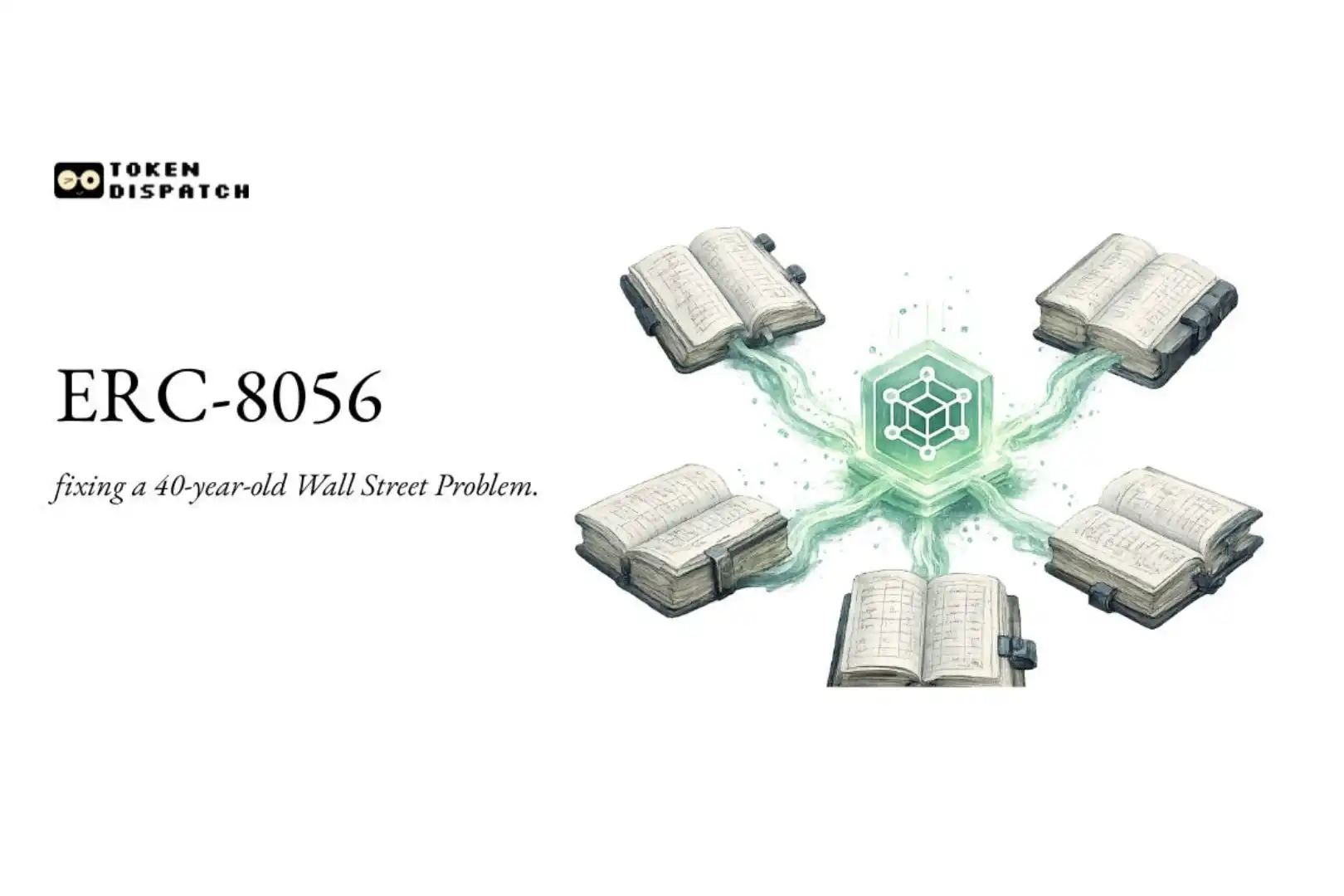
A 40-Year-Old Securities Reconciliation Dilemma: Could ERC-8056 Be the Final Answer?

For four decades, the global securities industry has grappled with an inefficient and costly process for handling corporate actions like dividends and stock splits, with an annual cost estimated at $58 billion. The core problem stems from a fragmented system involving multiple intermediaries—transfer agents, the Depository Trust Company (DTC), custodian banks, and brokerages—each maintaining separate, non-interoperable databases. This requires repetitive manual calculations and costly post-hoc reconciliation for every event. The inefficiency persists due to non-machine-readable data formats (like PDFs), a lack of incentive for issuers to change, and the dominance of data vendors who profit from manual processing. While technological solutions like XBRL exist, industry inertia has prevented widespread adoption. A potential solution is emerging through blockchain technology and a new token standard, ERC-8056. Unlike "mirrored" tokenized assets that add another layer to the old system, ERC-8056 enables native on-chain issuance, where the blockchain itself becomes the authoritative shareholder ledger. This standard can automate corporate actions through smart contracts—for example, adjusting displayed balances for a stock split without minting new tokens or distributing dividends directly and instantly to all holders—eliminating the need for multi-layered reconciliation. Companies like Superstate, which is a registered transfer agent, are pioneering this model. This approach aligns with the concept of triple-entry bookkeeping, creating a single, shared source of truth. Recent regulatory developments, including actions by the DTCC and Nasdaq, signal growing acceptance. The transformation may not require a crisis to drive change; instead, by building new, efficient systems for native on-chain securities, the industry can render the costly legacy reconciliation processes obsolete. The pace of adoption now hinges on regulatory clarity and issuer willingness to embrace this new paradigm.

marsbitIeri 09:11

A 40-Year-Old Securities Reconciliation Dilemma: Could ERC-8056 Be the Final Answer?

marsbitIeri 09:11

Wall Street Rushes into Ethereum, but Has It Become a Castoff for Investors?

Wall Street Embraces Ethereum, But Investors Remain Wary Ethereum is gaining significant institutional adoption from major financial firms like JPMorgan Chase, Robinhood, and Morgan Stanley, which are launching products and building on the network. A new non-profit, Ethereum Institutional, has also been formed to accelerate enterprise use. Technically, Ethereum co-founder Vitalik Buterin has unveiled a major multi-year upgrade plan called "Lean Ethereum," aiming to enhance privacy, security, and quantum resistance. Despite these positive fundamentals, the market reaction has been negative. ETH's price remains around $1,900, down over 60% from its all-time high. Analysts cite weak investor demand and persistent outflows from spot Ethereum ETFs. Citi has downgraded its 12-month price target to $2,240. A key challenge is the decoupling of network activity from ETH's value accrual. While Layer 2 scaling solutions have successfully reduced costs and increased throughput, most transactions now occur off the mainchain. This reduces the fee revenue and ETH burn on Ethereum itself, benefiting users but creating uncertainty for ETH holders. Price predictions are highly divergent, ranging from Citi's conservative $2,000+ outlook to StanChart's $4,000 by 2026 and even a long-term $25,000 forecast from Tom Lee. The consensus is that while Ethereum is increasingly likely to become core financial infrastructure, the extent to which ETH token holders will benefit remains unclear.

marsbit07/31 07:25

Wall Street Rushes into Ethereum, but Has It Become a Castoff for Investors?

marsbit07/31 07:25

Re-evaluating Founder-Market Fit Amidst the Crypto Bear Market

In the current crypto bear market, the concept of founder-market fit emerges as the most enduring investment signal. While markets, regulations, and products constantly change, the alignment between a specific founder and a specific market remains the constant, compounding factor, especially when prices stall. The blockchain space is now attracting a higher caliber of founders than ever before. Talent has converged on solving serious problems in two key verticals: AI and fintech. The most compelling challenge has become building institutional-grade financial infrastructure, drawing serious operators from firms like Citadel, Stripe, Block, Nvidia, and Goldman Sachs. This shift is supported by maturing on-chain data: stablecoin settlement now surpasses Visa and Mastercard combined, institutional adoption is rising, and tokenized real-world assets are growing rapidly. When evaluating founders, four key traits are sought: deep domain expertise, high agency, an unfair advantage in networks, and obsession. Examples like Offchain Labs (Arbitrum), Ondo Finance, Morpho, Circle (USDC), and Alchemy demonstrate that projects possessing all four traits can define categories and endure through cycles. For founders already building, bear markets strip away momentum and reveal true conviction. This period offers the quiet, uncrowded space to build foundational products that will define the next cycle when capital returns. Capital is still available, and lower valuations present an opportunity. The advice is to extend runway, focus on genuine product-market fit, and recruit strategically. For talented individuals still within traditional finance giants, the moment to act is now. The hard problems in crypto now align with their skills in institutional infrastructure—settlement, credit, custody, compliance. The bear market is not a risk but a testing ground, clearing out noise and creating the ideal conditions for builders with the right fit to establish themselves. The defining founders of the next cycle are not waiting; they are building in the quiet of the winter, anchored by a deep belief in their market that price action cannot shake. The ultimate question is not if the market will return, but who will be standing, stronger, in the market they were inherently meant to win.

Foresight News07/27 13:03
Re-evaluating Founder-Market Fit Amidst the Crypto Bear Market

Foresight News07/27 13:03

Airwallex Invests in Metal: How Stablecoins Reconnect with the Real Financial System?

Airwallex Invests in Metal: How Stablecoins Connect Back to the Real Financial System? Airwallex, a global financial platform for businesses, has completed a $3.2 billion Series H funding round at an $11 billion valuation. Concurrently, it co-led the seed round for Metal, a "tokenized financial products infrastructure" project, becoming its first design partner. This move signals Airwallex's strategic shift beyond traditional cross-border payments. It aims to leverage its decade of experience in licenses, local payment networks, and API infrastructure to address a new challenge: facilitating the entry of stablecoins, tokenized assets, and AI agents into enterprise financial systems. This involves handling critical functions like authorization, compliance, currency exchange, fiat on/off-ramps, and final settlement. Metal positions itself not merely as another stablecoin payment solution but as a compliant settlement layer (Layer 1 blockchain) designed for regulated financial institutions. It targets a broader scope of tokenized financial products, including stablecoins, tokenized deposits, and securities. The core challenge it addresses is connecting efficient on-chain assets with the complex realities of corporate finance, such as multi-currency bank accounts, securities, compliance checks, and local regulations. Airwallex's investment, alongside its founder-backed fund Capital49, provides Metal with crucial real-world infrastructure: access to local payment networks covering 200+ countries and 90+ currencies. This partnership aims to bridge the gap between on-chain efficiency and off-chain, institution-ready settlement. The announcement aligns with Airwallex's broader product direction, which includes an AI-native financial platform (T:0) and a wallet infrastructure for AI agent commerce (Airi). The combined vision is an integrated infrastructure that can handle the speed and cost benefits of on-chain assets while seamlessly managing compliance, authorization, and fiat connectivity required for global business operations and the emerging AI agent economy.

Foresight News07/03 08:32

Airwallex Invests in Metal: How Stablecoins Reconnect with the Real Financial System?

Foresight News07/03 08:32

Crypto Payment Cards with $1.5 Billion Monthly Transaction Volume, Stuck in the 1990s

Monthly crypto payment card transaction volume has reached $15 billion, but the industry's development stage is comparable to debit cards in the 1990s, before they became a mainstream financial staple. A key limitation is the lack of established daily financial relationships, such as direct salary deposits and recurring bill payments, with crypto wallets. Despite annualized transaction volumes of approximately $18 billion, the market is concentrated and immature. The leading provider, RedotPay, commands over half the market share. User adoption is heavily skewed towards emerging markets like Bangladesh, India, and Nigeria, where access to USD and stable financial services is limited, rather than developed economies. The sector features four primary business models: 1) Card-issuing infrastructure providers, 2) Exchange-affiliated cards for user retention, 3) Decentralized wallet/DeFi cards with self-custody but high complexity, and 4) Stablecoin-focused digital banks, which dominate transaction volume by offering integrated financial services. The article argues that a pure payment functionality is insufficient for long-term success, mirroring the historical trajectory of traditional debit cards. Future winners will need to: 1) Control the upstream flow of funds, 2) Secure defensible niches in underserved markets, and 3) Most crucially, build core account relationships that integrate into users' daily financial lives. Without this evolution, crypto cards risk remaining niche prepaid tools rather than becoming universal financial infrastructure.

Foresight News07/01 08:32

Crypto Payment Cards with $1.5 Billion Monthly Transaction Volume, Stuck in the 1990s

Foresight News07/01 08:32

The Rise of Stablecoins in Latin America Is Not, in Essence, a 'Victory for Crypto Technology'

The Rise of Stablecoins in Latin America: Not a Victory for Crypto, But for Remittance Infrastructure Stablecoin adoption in Latin America isn't primarily driven by belief in crypto technology. It's a pragmatic solution to a centuries-old problem: getting money home. The article draws parallels to the traditional "silver letters" (银信) system used by Chinese diaspora, where trust and execution relied on tight-knit community networks. The core pain point is remittances—the lifeblood for millions of families. Existing systems are often slow, expensive, and opaque. Stablecoins like USDT and USDC are not seen as speculative crypto assets but as "digital dollars in your phone." They address critical local needs: Argentinians use them as a hedge against hyperinflation, Venezuelans as a lifeline for essential goods, while in Brazil and Mexico, they facilitate cross-border payments and freelance payouts. The real challenge isn't the blockchain transfer itself, but the "on-ramps" and "off-ramps"—how to convert local currency into stablecoins and, crucially, how recipients can access the funds as spendable local currency via systems like Pix (Brazil) or SPEI (Mexico). The battlefield is building the infrastructure that seamlessly connects these ends. Regulators are less focused on "crypto adoption" and more on controlling what becomes a parallel foreign exchange system, concerned with AML, consumer protection, and capital flows. The future lies in stablecoins becoming an invisible, efficient middle layer in a new remittance stack, where the user only cares about one thing: the money arrived.

marsbit06/26 11:56

The Rise of Stablecoins in Latin America Is Not, in Essence, a 'Victory for Crypto Technology'

marsbit06/26 11:56

Ethereum Is Retracing the Path of the Internet and Linux: No One Yields, and the Neutral Party Ultimately Prevails

This article argues that Ethereum is following the historical path of open, neutral systems like the Internet and Linux, which eventually triumphed over proprietary, centrally-controlled alternatives. Major financial institutions like JPMorgan, Stripe, and Circle are building their own proprietary blockchains or networks (e.g., Tempo, Arc), but will never agree to build on a competitor's controlled infrastructure. This creates the perfect opportunity for Ethereum as the only neutral, credibly neutral settlement layer that no single entity controls. The piece draws parallels to the 1990s, when experts like Bill Gates predicted proprietary networks (from Microsoft, Oracle) would win over the open Internet, and when Sun Microsystems' Unix lost to the open-source "bazaar" development model of Linux. This model, described in Eric Raymond's "The Cathedral and the Bazaar," thrives on permissionless innovation where countless contributors improve the system, outpacing any centralized competitor. Ethereum embodies this through its decentralized development, broad validator distribution, and credible neutrality—rules that are transparent, equally applied, hard to change, and open to all. This has attracted over a million developers and major institutions like Coinbase, BlackRock, and JPMorgan, who choose Ethereum for its security, ecosystem, and sovereignty (the inability of any single party to change the rules). While proprietary chains offer initial speed and control, they inherit the downsides of both centralization and decentralization without the long-term innovation benefits. The article concludes that, just as open systems historically win, Ethereum is poised to become the foundational, neutral settlement layer for global finance.

marsbit06/22 02:51

Ethereum Is Retracing the Path of the Internet and Linux: No One Yields, and the Neutral Party Ultimately Prevails

marsbit06/22 02:51

2029 Finale Prediction: When Cryptocurrency Completely "Vanishes", Who Can Remain in This Financial Upheaval?

By 2029, the crypto industry will have transformed into a largely invisible but foundational layer for traditional finance. This timeline outlines the key shifts from now until then. By mid-2026, the most sought-after assets on-chain will not be traditional tokens, but synthetic perpetual contracts for private, high-growth companies (like SpaceX, OpenAI). These become primary price discovery tools, highlighting the market's craving for real-world asset value. Most altcoins enter a sustained bear market as their fundamental lack of asset-backed value is exposed. In late 2026, the "AI + Crypto" narrative largely fades as AI giants prove they don't need crypto infrastructure, except for prediction markets betting on model performance. Simultaneously, a quiet but significant wave of tokenization for institutional assets (money market funds, private credit) begins. The industry splits into a noisy speculative economy and a silent institutional one. Throughout 2027, major public blockchain foundations pivot decisively to serve institutional clients, building compliance toolkits and sales teams. However, key sectors hit growth ceilings: private perpetual contracts are legally restricted from public promotion, stable币 growth is capped by looming political uncertainty, and tokenization projects remain cautious. In 2028, following a U.S. election assumed to maintain a regulatory (not prohibitive) stance, a pivotal change occurs. After a major liquidation crisis exposes the flaws of synthetic contracts lacking a real-asset anchor, new regulations allow the *public solicitation* of private security sales (secondary market shares) to accredited investors. This creates a legitimate, direct on-ramp for retail capital into previously illiquid private equity. By 2029, the resulting bull market is driven by trading in real, innovative company shares (biotech, robotics, AI labs), not speculative tokens. "Crypto" as a distinct asset class recedes; it becomes the mundane, unseen plumbing for this new global private markets infrastructure. Tokens that survive are those capturing real cash flows from this infrastructure. Speculation persists but is marginalized. The core questions posed at the start are answered: token value is tied to legally enforceable claims on real assets, frontier tech adoption happens via private market channels, and crypto's absorption into traditional finance is marked by its becoming boring and invisible. The key validation for this entire thesis is whether, by late 2028, a legal pathway exists for ordinary accredited investors to access private assets directly.

marsbit06/16 06:50

2029 Finale Prediction: When Cryptocurrency Completely "Vanishes", Who Can Remain in This Financial Upheaval?

marsbit06/16 06:50

活动图片