A 40-Year-Old Securities Reconciliation Dilemma: Could ERC-8056 Be the Final Answer?

marsbitPubblicato 2026-08-03Pubblicato ultima volta 2026-08-03

Introduzione

For four decades, the global securities industry has grappled with an inefficient and costly process for handling corporate actions like dividends and stock splits, with an annual cost estimated at $58 billion. The core problem stems from a fragmented system involving multiple intermediaries—transfer agents, the Depository Trust Company (DTC), custodian banks, and brokerages—each maintaining separate, non-interoperable databases. This requires repetitive manual calculations and costly post-hoc reconciliation for every event. The inefficiency persists due to non-machine-readable data formats (like PDFs), a lack of incentive for issuers to change, and the dominance of data vendors who profit from manual processing. While technological solutions like XBRL exist, industry inertia has prevented widespread adoption. A potential solution is emerging through blockchain technology and a new token standard, ERC-8056. Unlike "mirrored" tokenized assets that add another layer to the old system, ERC-8056 enables native on-chain issuance, where the blockchain itself becomes the authoritative shareholder ledger. This standard can automate corporate actions through smart contracts—for example, adjusting displayed balances for a stock split without minting new tokens or distributing dividends directly and instantly to all holders—eliminating the need for multi-layered reconciliation. Companies like Superstate, which is a registered transfer agent, are pioneering this model. This approach a...

Original Author: Vaidik Mandloi

Original Compilation: Chopper, Foresight News

Nowadays, buying stocks can be settled instantly, but subsequent corporate actions such as dividends and stock splits remain chaotic and cumbersome.

When Netflix or Apple announces a dividend, the funds don't go directly to investors' accounts. They go through a fragmented process: intermediaries like the Depository Trust Company (DTC), brokers, and others rely on their own internal ledgers to calculate dividends, and only later cross-reference and synchronize the data.

These types of operations are collectively known as corporate actions. The entire financial industry spends up to $58 billion annually on handling these processes, with the vast majority of costs consumed in the multi-party data reconciliation required to ensure synchronized information across independent ledgers. This is an industry pain point that has persisted for 40 years and has never been fully automated. Now, a new on-chain token standard has the potential to eradicate this problem at its root.

Why Has the Traditional System Been Unable to Cure This Pain Point?

As I mentioned in a previous article, in 1968, the processing of physical stock certificates on Wall Street became completely overloaded, forcing exchanges to close every Wednesday. Subsequently, the Depository Trust Company (DTC) established a centralized depository system, converting physical stocks into book-entry registration, perfectly solving the problem of securities clearing and settlement.

However, there is a fundamental difference between corporate actions and settlement: settlement is a one-to-one transaction, involving only a buyer and a seller; whereas corporate actions like dividends and stock splits are one-to-many operations, where a single announcement simultaneously affects all shareholders.

Because share registration is dispersed across the entire intermediary chain—from transfer agents to underlying brokers—each party must calculate entitlements based on their own independent databases and subsequently reconcile repeatedly, leading to conflicts.

Let's dissect the existing process with a complete example. Suppose Apple announces a dividend of $0.25 per share. The dividend funds do not go directly to retail investors; the full amount is first allocated to the transfer agent (such as Computershare, the official custodian of the shareholder register).
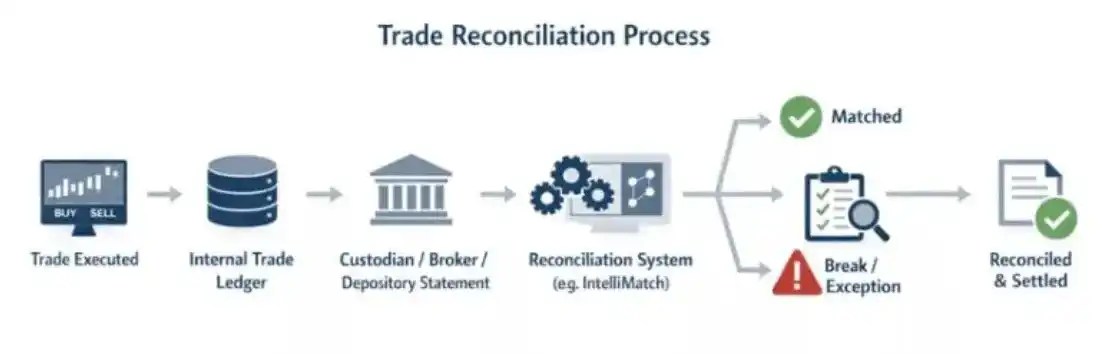
However, the names of ordinary investors do not appear on the official register; all shares are uniformly registered in the name of Cede & Co., the nominee of DTC. Therefore, the transfer agent only pays the dividend to DTC. DTC then splits the corresponding amount based on its own ledger and allocates it to its custodian banks (such as Bank of New York Mellon); the custodian banks further split the funds and distribute them to their partner brokers; finally, your broker (such as Fidelity) separately pulls its own customer data, calculates the dividend each person is entitled to, and credits their account.

This entire process involves five independent institutions, each repeating the same dividend calculation based on non-interoperable databases.

Even more unreasonable is that the data updates in the various ledgers are not synchronized. Asset managers execute corporate actions on the ex-dividend date, but custodians typically wait until the payment date weeks later to actually distribute. During this period, the broker's ledger will falsely show that you hold the corresponding stock, and traders can even sell shares they haven't actually received.

Globally, there are about one million corporate action events each year, each one must go through this fragmented chain, generating a staggering $58 billion in processing costs. The high costs, in turn, create industry inertia, with little motivation for any single party to drive optimization.

The root cause of this system's ailment lies in data formats and the distribution of interests. After Apple announces a dividend, it only files documents with the SEC and issues a press release. The announcements are in unstructured SWIFT text, which cannot be automatically parsed and integrated into systems for automated processing.

Even today in 2026, while trillions of dollars in daily stock trading can be cleared in seconds, dividend and stock split announcements still circulate as non-machine-readable PDFs or copy-pasted text.

The industry is not without machine-readable data standards; XBRL (eXtensible Business Reporting Language) has been around for over a decade. However, the business of filtering through messy announcements and extracting standardized, valid data has long been monopolized by Bloomberg and S&P. These institutions employ hundreds of analysts to manually interpret ambiguous statements in announcements and organize standardized data for downstream institutions. S&P Global alone manually verifies 1.4 million corporate action announcements covering 170 countries each year. If listed companies uniformly issued machine-readable, standardized announcements, the core business of these data service providers would be significantly eroded. They, who are most capable of promoting source data standardization reform, have instead become the biggest obstacle.

On the other hand, issuing companies like Apple bear no processing costs; they merely complete the filing and bear no further responsibility, with all costs borne by downstream intermediaries. Industry associations have proposed that issuers adopt standardized messaging, but companies have explicitly stated they need corresponding incentives to cooperate.

Financial infrastructure iteration is rarely driven by a 'efficiency improvement' logic. Only a major industry crisis can break the inertia of the existing system and drive change. Unfortunately, corporate action operations have never faced a systemic risk severe enough to force an industry-wide overhaul. The total cost is enormous, but when distributed among each institution, the amount is limited, and no single entity has the motivation to lead a unified reform.

ERC-8056: A New On-Chain Token Standard

Since the traditional system cannot solve the problem internally, can blockchain be used to completely bypass the existing old-fashioned chain? The ERC-8056 token standard provides a solution.

ERC-8056, introduced by Robinhood's Chris Ridmann in collaboration with Superstate, is a balance multiplier display standard compatible with ERC-20 tokens. The traditional model for stock splits requires minting a large number of new tokens; this standard only adjusts the displayed multiplier on the ledger without minting new tokens. Example: You hold 100 tokens, and a 4-for-1 stock split occurs. Your wallet will automatically update the displayed quantity of your holdings; the contract itself does not mint any new tokens. The original holdings and transaction history are completely preserved, requiring no transfer or reconciliation processing.

With just one smart contract rule, it can replace the entire process of separate calculation and repeated reconciliation by five institutions in the traditional system.

This programmable logic can be reused for all corporate actions difficult to automate in the traditional system. Dividends only need to invoke the contract once to uniformly distribute funds to all on-chain shareholders, no longer requiring cascading distribution and multi-ledger updates on staggered schedules; operations like rights offerings and proxy voting can also be encoded as on-chain rules, automatically executed based on a single authoritative share register.

For forty years, corporate actions have relied on manual processing, with the core root cause being five independent databases performing redundant calculations and post-facto reconciliation. ERC-8056 simplifies the entire value chain into one programmable layer.

Here, it's necessary to distinguish between two types of tokenized stock models to avoid misconceptions. Some tokenized products are merely digital mirrors of traditional stocks. For example, Robinhood issues tokenized stocks for Apple and Tesla, where the underlying real stocks are held in traditional brokerage accounts. The tokens are just a sixth layer of ledger superimposed on the original five-layer intermediary system, not solving the root reconciliation problem.

xStocks on the Solana blockchain uses a similar architecture, with even more glaring product design flaws. It holds the majority of the tokenized stock market share on Solana, but user dividends are forcibly reinvested and cannot be withdrawn as cash; the contract has built-in permanent authorization functions, allowing the issuer to unilaterally transfer tokens from user wallets at will. These so-called 'decentralized' equity products grant the issuer far greater control over assets than traditional brokers.

Only the native on-chain issuance model can solve the problem at its root, making the blockchain itself the official shareholder register. Superstate is a representative company in this field. It has registered a legitimate transfer agent with the U.S. SEC, no longer maintaining an independent database to periodically reconcile with DTC; share ownership is directly recorded on-chain.

Galaxy Digital recently announced plans to leverage Superstate's native issuance solution to tokenize all its equity on Solana. Once implemented, all shareholder information for Galaxy Digital will be natively on-chain. Dividends will no longer need to flow through multiple layers of intermediaries; the entire intermediate chain disappears.

Ian Grigg proposed the theory of triple-entry bookkeeping in the early 2000s, perfectly aligning with the value of native on-chain issuance. He suggested that when two parties complete a transaction, they generate a cryptographic record that both can verify and that is not controlled by either party alone—the third bookkeeping entry.

Since Luca Pacioli established double-entry bookkeeping in 1494, it has remained the foundation of global financial accounting. Triple-entry bookkeeping is the first major upgrade to this system since its inception, relying on a single authoritative shared ledger to completely eliminate the need for bilateral reconciliation.

The logic of the existing system is 'first process the business, then reconcile afterwards,' with costs and risks concentrated in the reconciliation step. Achieving instant settlement via a shared ledger means the reconciliation step disappears entirely—it's not just about reducing costs, but eliminating the very step that generates them.

The good news is that global regulation is rapidly adapting to this new model. In December 2025, the Depository Trust & Clearing Corporation (DTCC) issued a no-action letter, removing obstacles for tokenized securities to connect to the existing clearing system; Nasdaq has also received approval to conduct tokenized securities business, and traditional exchanges have incorporated native on-chain equity issuance into their long-term plans.

As mentioned at the beginning of the article, corporate actions have been stagnant for 40 years, largely because financial infrastructure reforms have historically required major crises to drive them. But this time, the industry might not need to wait for a crisis. Companies can issue equity natively on-chain, with the blockchain serving as the official transfer agent register, avoiding the arduous task of fixing the outdated system of five database layers.

The industry will directly build a new alternative, rendering the traditional processes that generate high reconciliation costs obsolete. The speed of this transformation depends on the progress of regulatory frameworks in various countries and how many issuing companies are willing to make the change.


Domande pertinenti

QWhat is the core problem with the traditional system of handling corporate actions like dividends and stock splits?

AThe core problem is the reliance on five or more separate, siloed databases maintained by different intermediaries (like transfer agents, DTC, custodial banks, and brokers). Each party must independently calculate and reconcile data for the same corporate action event, leading to massive inefficiencies, delays, and an estimated $58 billion in annual processing costs.

QHow does the ERC-8056 token standard propose to solve the corporate action reconciliation problem?

AERC-8056 is a multiplier standard for ERC-20 tokens. It allows corporate actions like stock splits to be executed by simply adjusting a multiplier on the token contract, instantly updating all holder balances without minting new tokens or requiring any transfers. This programmable logic replaces the entire multi-layered, manual reconciliation process with a single, automated action on a shared ledger.

QWhat is the key difference between a tokenized 'digital mirror' of a stock and a natively issued on-chain security?

AA 'digital mirror' token (like some tokenized stocks from Robinhood or xStocks) is a sixth layer of record-keeping on top of the existing five-layer traditional intermediary system. It does not solve the underlying reconciliation problem. A natively issued on-chain security, as proposed by Superstate, uses the blockchain itself as the primary and official shareholder register, eliminating the legacy intermediaries and their separate databases entirely.

QAccording to the article, what has been the main obstacle to automating corporate action announcements for decades?

AThe main obstacle is the non-machine-readable format (like unstructured SWIFT messages, PDFs, or copied text) of corporate action announcements issued by companies. While a machine-readable standard (XBRL) exists, data vendors like Bloomberg and S&P have a monopoly on manually interpreting and standardizing this data. They lack incentive to push for source-level reform, and issuers like Apple have no direct cost incentive to change their reporting format.

QHow does the concept of 'triple-entry accounting' relate to the proposed blockchain solution?

ATriple-entry accounting, as conceptualized by Ian Grigg, involves a cryptographically sealed, shared record (the third entry) for every transaction that is not controlled by either party alone. This aligns perfectly with a native on-chain security system, where the blockchain serves as a single, authoritative, and shared ledger. It enables immediate settlement and eliminates the very need for the costly and risky post-facto reconciliation process inherent in the traditional double-entry system.

Letture associate

CATL Invests in a 00s Graduate from Harbin Institute of Technology

Contemporary Amperex Technology Co., Limited (CATL) has exclusively invested in the Pre-A round of RoboParty, a company founded by 22-year-old Huang Yi. A former student at Harbin Institute of Technology, Huang built a bipedal humanoid robot in his dorm room and later dropped out to launch RoboParty in Shanghai. The company focuses on developing a fully open-source platform for humanoid robots, combining self-developed hardware, operating systems (Party OS), and foundational models. RoboParty's strategy emphasizes open-source collaboration to accelerate development and build a developer ecosystem, positioning itself as foundational infrastructure for embodied AI. Since its 2025 founding, the team—composed largely of top-tier university graduates—has secured six funding rounds in eight months, with investors including Matrix Partners, Xiaomi, and now CATL. This investment by CATL's corporate venture arm signals strong industry confidence in RoboParty's potential for real-world manufacturing and complex scenarios. Huang Yi prioritizes technological excellence and developer community growth over rapid commercialization. The company has already garnered significant interest from developers and research institutions globally. With a focus on continuous, rapid iteration and open innovation, RoboParty aims to prove the versatility of humanoid robots and drive the field toward an open-source future.

marsbit3 min fa

CATL Invests in a 00s Graduate from Harbin Institute of Technology

marsbit3 min fa

Will SpaceX's First Quarterly Report Rescue Its Stock Price Under the Pressure of 1.2 Billion Shares Unlocking?

SpaceX is set to release its first quarterly earnings report since going public, a key test for its stock which has declined 20% from its IPO price. Approximately 9.12 billion shares are set to unlock on August 6, with an additional 3.19 billion following a week later, creating potential selling pressure from early investors. A strong report may be the only catalyst to reverse the downtrend. The report will cover three segments: Space, Connectivity (Starlink), and AI. The AI business, centered on the merged xAI, is the biggest uncertainty. While it generated $818 million in revenue last quarter, it also reported a $2.5 billion operating loss and $7.7 billion in capital expenditures. New data center rental agreements with Anthropic and Google, particularly the substantial $1.25 billion monthly deal with Anthropic, add significant revenue variability this quarter. Investors await guidance on AI's future outlook and the timeline for launching AI computing satellites via Starship. Starlink remains the stable profit driver, ending last quarter with 10.3 million subscribers. Key metrics will be user growth, average revenue per user (ARPU), and enterprise/government contract backlogs. The Space segment, which posted a $657 million operating loss last quarter, will be scrutinized for updates on Starship development following its 13th test flight and the pace of Falcon 9 launches, many of which support internal Starlink deployment. Wall Street expects Q2 revenue of around $6.9 billion and EBITDA of $2.1 billion. However, as this is the first earnings report, analyst forecasts lack a historical baseline and could see significant variance. With a current market cap of ~$1.4 trillion and a high valuation, the market's reaction post-earnings will hinge on the report's strength, the magnitude of post-lockup selling, and ongoing investor concerns.

marsbit3 min fa

Will SpaceX's First Quarterly Report Rescue Its Stock Price Under the Pressure of 1.2 Billion Shares Unlocking?

marsbit3 min fa

Soaring 20% Then Dropping 5%: When Will the Bottom of the Korean Stock Market Be?

"South Korean stocks face a turbulent period as the KOSPI index, after a 20% surge, fell 5% to 6257 points. The market is grappling with severe issues: over 500,000 leveraged retail accounts have been liquidated, and more than 24 trillion won has flowed from stocks into bank deposits for safety. This reflects a significant loss of market liquidity and shaken investor confidence. In response, Korean financial regulators are taking action. They have tripled the minimum保证金 (margin) requirement for single-stock leveraged ETF trades to 30 million won and are considering granting themselves "emergency intervention" powers. These could include capping leverage ratios and setting investment limits on these ETFs, seen by many as amplifying market volatility. Initial results show a 75% drop in these products' trading volume post-regulation. The market downturn has political repercussions, pushing President Yoon Suk-yeol's approval rating to a new low. Meanwhile, foreign investors made a record net purchase of 7.18 trillion won during a recent rebound, while domestic retail investors sold off massively. Morgan Stanley has upgraded South Korean stocks to "overweight," citing the ongoing "leverage unwinding" and potential for a 36% upside, with giants like Samsung Electronics and SK Hynix providing valuation support. However, analysts caution that the market's structure remains vulnerable to foreign capital flows, and the current low may not be the bottom."

marsbit18 min fa

Soaring 20% Then Dropping 5%: When Will the Bottom of the Korean Stock Market Be?

marsbit18 min fa

Goldman Sachs Stakes a Clear Position: This Is the Largest Capital Demand Cycle in Human History, and the Fed Is Just an Observer

Goldman Sachs argues that the world is entering the most capital-intensive investment cycle in history, driven by concurrent massive demands from AI infrastructure, reindustrialization, defense reinvestment, power grid rebuilding, supply chain realignment, and sovereign debt financing. This structural competition for capital is pushing its cost higher, fundamentally altering investment paradigms. Goldman's Mark Wilson states that the Federal Reserve is merely a "passenger, not the driver" in this shift, with rising yields rooted in these real economy demands rather than just monetary policy. While major indices appeared calm in July, underlying market movements were historic, featuring extreme stock dispersion and a severe momentum factor crash, leading to significant de-risking by fund managers. Wilson cautions against expecting a quick reversal in August, citing ongoing digestion of higher rates, disrupted risk models, and typically muted market performance ahead of US midterm elections. Corporate fundamentals remain robust with strong earnings, though growth rates are peaking in the US while accelerating in Europe. Notably, hyperscale cloud companies like Amazon and Microsoft are announcing staggering capital expenditure projections for 2027-2028, justified by explosive AI-related revenue growth and high returns. Amazon revealed its AI revenue run-rate exceeds $25 billion, growing triple-digits annually, and expressed confidence that AWS could become a trillion-dollar revenue business. The report concludes that a transitional period is underway, marked by a growing tension between aggressively investing private tech giants and increasingly capital-constrained sovereign governments. The AI super-cycle continues, with August likely being a consolidation phase.

marsbit23 min fa

Goldman Sachs Stakes a Clear Position: This Is the Largest Capital Demand Cycle in Human History, and the Fed Is Just an Observer

marsbit23 min fa

Trading

Spot
活动图片