# Custody Articoli collegati

Il Centro Notizie HTX fornisce gli articoli più recenti e le analisi più approfondite su "Custody", coprendo tendenze di mercato, aggiornamenti sui progetti, sviluppi tecnologici e politiche normative nel settore crypto.

BitGo Buys NYDIG's Trading Unit as Institutions Consolidate Crypto Services

On August 27, 2026, BitGo, a major regulated crypto custodian, announced the acquisition of NYDIG's institutional trading division. This move expands BitGo's service offerings to include derivatives, structured products, and lending services, allowing it to provide institutions with a more comprehensive, single-provider solution for custody, trading, and settlement. The deal adds approximately 30 NYDIG employees and their trading network to BitGo. The acquisition reflects a broader institutional trend towards consolidating digital asset services with fewer, regulated partners. A Fireblocks report from April 2026 indicated strong institutional budget allocation for such infrastructure, with 53% of surveyed firms spending at least $1 million. BitGo, which went public in January 2026, reported significant revenue and client growth alongside platform assets of $65.2 billion. Its regulatory standing, including a federal trust license, is a key factor for risk-conscious institutions. The deal also provides BitGo access to the crypto lending market, despite a recent quarterly decline reported by Galaxy Research, and aligns with growing activity on regulated derivatives venues like CME Group. However, this integration of multiple services attracts closer regulatory scrutiny. The Bank for International Settlements has warned that such crypto conglomerates could concentrate financial risks. For NYDIG, the sale marks a strategic shift to focus on its vertically integrated bitcoin mining and high-performance computing data center business.

cryptonews.ru2 giorni fa 05:31

BitGo Buys NYDIG's Trading Unit as Institutions Consolidate Crypto Services

cryptonews.ru2 giorni fa 05:31

The Battle for Control of the Tracks Enters the Second Half: Banks vs. Crypto, Who Will Have the Last Laugh?

The competition for control over the tokenization infrastructure, or the "rails," is intensifying, moving beyond initial asset listing to dominance over settlement, custody, and regulatory layers. Recent developments signal a shift in power towards traditional finance. Key evidence includes: the formation of the BankChain Alliance by 39 U.S. state banking associations to launch a banking-owned blockchain network; moves by market infrastructure giants like DTCC, ICE, and Citadel Securities to establish their own institutional-grade on-chain systems; the struggle of crypto-native custodians like ZeroHash (re-applying for a bank charter) and Copper (facing a severe valuation drop), highlighting that regulatory "license moats" are now more critical than technical advantages; and the launch of stablecoin USD1 by licensed trust bank BitGo on the permissioned Canton network, showing convergence of stablecoin issuance towards regulated entities. The analysis concludes this is not a simple "banks vs. crypto" battle but a redefinition of the foundational infrastructure. A clear division of labor is emerging: open public chains for DeFi and innovation, while bank-led consortium chains and licensed entities capture institutional settlement, tokenized deposits, and regulated custody. The defining question is no longer *if* an asset is tokenized, but *on which rails* it runs and *who controls* those rails, with regulation and牌照 providing the ultimate backstop.

marsbit08/27 10:16

The Battle for Control of the Tracks Enters the Second Half: Banks vs. Crypto, Who Will Have the Last Laugh?

marsbit08/27 10:16

SEC Submits Proposal to White House for Revising Crypto Asset Custody Rules

The U.S. Securities and Exchange Commission (SEC) has submitted a proposal to the White House for revising rules governing the custody of crypto-assets by investment advisers and funds. Dated August 25, 2026, the proposal—known as Amendments to the Custody Rules (RIN 3235-AN46)—has entered review by the Office of Information and Regulatory Affairs (OIRA). The SEC aims to clarify the regulatory framework for crypto-asset custody and modernize certain requirements it deems outdated in light of market and technological evolution. The proposal, classified as economically significant and deregulatory under Executive Order 14192, seeks to alleviate industry burdens by removing redundant rules rather than imposing new ones. This initiative emerges amid Congressional delays in passing the comprehensive Digital Asset Market Clarity Act (CLARITY). SEC Chair Paul Atkins previously indicated the agency would proceed with its own rules if CLARITY stalled. The SEC plans to publish a Notice of Proposed Rulemaking (NPRM) in October 2026, followed by a standard public comment period. The move marks a shift from the post-2008 Madoff scandal era, which spurred stricter custody rules, toward a more flexible approach for crypto markets. However, unresolved technical questions, such as the regulatory treatment of private key custody, remain. The proposal balances industry adaptability against potential risks, as reduced oversight could delay the detection of custody issues.

cryptonews.ru08/27 10:04

SEC Submits Proposal to White House for Revising Crypto Asset Custody Rules

cryptonews.ru08/27 10:04

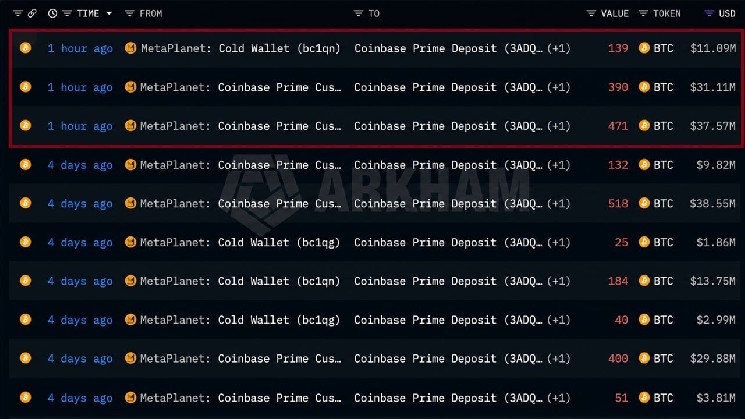
Metaplanet Transfers 1,000 BTC to Coinbase Prime Custody

Japanese bitcoin custody giant Metaplanet transferred another 1,000 BTC, worth approximately $79.77 million, to Coinbase Prime on August 25. This follows the company's recent disclosure of holdings totaling 43,000 BTC, and the transfer suggests these are existing coins, not a new market purchase. According to Lookonchain, the average purchase price for Metaplanet's BTC holdings is $96,191 per coin, valuing its total portfolio at roughly $4.09 billion. The company's accumulation has accelerated rapidly over the past two years, growing from 1,761 BTC at the end of Q4 2024 to over 40,000 BTC recently. A recent purchase of 2,823 BTC solidified its position as Asia's largest publicly traded bitcoin holder. Funding has primarily come through equity issuance and structured products linked to its stock price, with an ambitious goal to hold 210,000 BTC by the end of 2027. The transfer to the exchange's custody service may not indicate an immediate sale but could be for regulated custody, facilitating over-the-counter trades, or enabling corporate transactions. For instance, Metaplanet recently agreed to contribute 2,100 BTC to Nasdaq-listed Super League Enterprise to form a new US treasury platform. With bitcoin's price still below Metaplanet's average cost basis, market participants are closely watching how these custody moves will support the company's long-term accumulation strategy.

cryptonews.ru08/25 20:59

Metaplanet Transfers 1,000 BTC to Coinbase Prime Custody

cryptonews.ru08/25 20:59

Zcash ETF Moves One Step Closer: Wall Street to Pack Privacy Coin into Securities Accounts for the First Time

The Grayscale Zcash Trust has filed its fifth amended registration statement with the SEC, aiming to convert into the first U.S. spot ETF directly holding a privacy coin (ticker ZCSH). Key terms include a 2.5% annual fee, Bank of NY Mellon as administrator, and Coinbase for custody and brokerage. The trust held ~388,700 ZEC (~$155M) as of June 30; its AUM surged to ~$260M by August 21, driven by ZEC's price rally from $250 to over $800. The ETF represents a major identity shift for Zcash, a coin previously delisted by many exchanges and flagged by regulators for its anonymity. However, the ETF strips away Zcash's core privacy feature. To ensure compliance, all trust-held ZEC will be stored in transparent addresses, making transactions auditable and traceable. Zcash's optional privacy—unlike Monero's mandatory privacy—is the key compromise enabling this Wall Street entry. Market pricing reflects aggressive optimism for institutional access, but challenges remain. Only ~22% of circulating ZEC is in shielded pools; if ETF demand siphons transparent coins, Zcash's privacy narrative weakens. Competition from programmable privacy on Ethereum L2s could also dilute its value proposition. With prices already up over 200% in four months, the rally may have prematurely priced in the ETF approval, leaving limited safety margin. Grayscale's move highlights traditional finance's capacity to repackage regulatory-edge assets into compliant products, raising questions about the future boundaries of crypto ETF adoption.

marsbit08/24 00:11

Zcash ETF Moves One Step Closer: Wall Street to Pack Privacy Coin into Securities Accounts for the First Time

marsbit08/24 00:11

活动图片