# Carry Trade Articoli collegati

Il Centro Notizie HTX fornisce gli articoli più recenti e le analisi più approfondite su "Carry Trade", coprendo tendenze di mercato, aggiornamenti sui progetti, sviluppi tecnologici e politiche normative nel settore crypto.

Yen Hits 40-Year Low, What Will Japan Use to Price in Shorts?

The Japanese yen is hovering near a 40-year low against the U.S. dollar, with the USD/JPY pair approaching 164 in July. Japanese Finance Minister Shunichi Suzuki has issued stern warnings of potential "bold" action to counter disorderly market movements, placing the 163-165 range in focus as a key policy test zone for authorities. The yen's weakness extends beyond dollar strength, as evidenced by its low trade-weighted index, which pressures import costs and inflation—particularly with elevated oil prices. This dynamic increases the likelihood of further Bank of Japan (BoJ) rate hikes. The Ministry of Finance is first aiming to raise the cost for yen short-sellers through verbal intervention and the threat of action, rather than immediately altering fundamentals. While direct FX intervention remains a high-barrier option, slower-moving factors like potential BoJ rate hikes and asset rebalancing by Japan's Government Pension Investment Fund (GPIF) could provide more sustained support for the yen. The core risk for carry trades—which involve borrowing low-yielding yen to invest in higher-yielding assets—is not an imminent unwind but a sudden spike in yen volatility. As policymakers deploy a mix of warnings, rate hike expectations, and potential fund flows, the cost and risk of shorting the yen are increasing. The 163-165 zone is becoming an area where policy responses could trigger a broader repricing, making the yen a more critical variable for global risk asset leverage.

marsbit07/24 08:17

Yen Hits 40-Year Low, What Will Japan Use to Price in Shorts?

marsbit07/24 08:17

STRC Severely Unpegged, What Risks Is the Market Pricing In?

The article analyzes the recent significant de-pegging of Strategy's perpetual preferred stock, STRC, whose price fell to approximately $89, far below its $100 face value. This discount has pushed its simple yield to around 12.9%, creating a paradox. The stock was designed as a high-yield instrument trading near par, and Strategy maintains an 11.5% annual dividend, even recently switching to semi-monthly payments to support the price. The author explores several reasons why the high yield hasn't attracted enough buying pressure to restore the par value. A key factor is potential reverse deleveraging from carry trades, where leveraged investors may be forced to sell due to margin calls as the price falls, creating a self-reinforcing downward spiral. Additionally, the tokenization and integration of STRC into DeFi protocols (like Apyx, Saturn, Pendle) have introduced faster, more transparent, and potentially more volatile price adjustment mechanisms through leverage and yield-splitting products. The emergence of a competing product, Strive's SATA, offering a 13% yield with daily dividends, has also changed the yield benchmark, challenging STRC's unique high-yield narrative. Furthermore, the market is questioning the distinction between Strategy's substantial Bitcoin reserves, which provide long-term balance sheet coverage, and the certainty of stable near-term cash flow for dividends. Ultimately, the price dip represents a stress test for this type of BTC-backed, high-yield financing tool. The future path of STRC depends on whether Strategy acts to reinforce the $100 peg (e.g., by adjusting dividends), whether DeFi-related leverage unwinds further, and how investors ultimately price the risks of leverage, competition, and cash flow uncertainty against the offered yield.

marsbit06/18 06:51

STRC Severely Unpegged, What Risks Is the Market Pricing In?

marsbit06/18 06:51

Alarm Bells Ringing: BOJ's Imminent 25bp Rate Hike, a Repeat of the 2024-Style Flash Crash for US Stocks and Crypto?

The Bank of Japan (BoJ) is highly expected to raise its short-term policy rate by 25 basis points to 1.0% at its June 15-16 meeting, marking the highest level since 1995. This imminent hike, driven by energy-induced inflation and a persistently weak yen, risks triggering a global market correction by forcing the unwinding of an estimated $500 billion in yen carry trades. As investors borrow cheap yen to fund investments in higher-yielding assets like U.S. stocks and cryptocurrencies, a BoJ rate hike would increase funding costs and potentially strengthen the yen. This could force a rapid deleveraging cycle: investors would sell overseas assets, buy back yen to repay loans, and amplify selling pressure. A similar scenario in August 2024 caused a global flash crash, with Bitcoin plunging nearly $20,000 in a single day. High-valuation assets are particularly vulnerable. AI-driven tech stocks, sensitive to liquidity and financing costs, face pressure from rising energy expenses and potential regulatory shifts. For cryptocurrencies, already competing with AI for market liquidity, the tightening of global leverage poses a significant near-term risk. Analysts warn this liquidity shock could lead to sharp corrections in both equities and crypto, urging investors to exercise caution regarding leverage amid heightened volatility.

Odaily星球日报06/11 01:33

Alarm Bells Ringing: BOJ's Imminent 25bp Rate Hike, a Repeat of the 2024-Style Flash Crash for US Stocks and Crypto?

Odaily星球日报06/11 01:33

New Wall Street Play: Yen Shorts Still Adding, But Japan Stocks Don't Rely on Carry Trade Unwinding

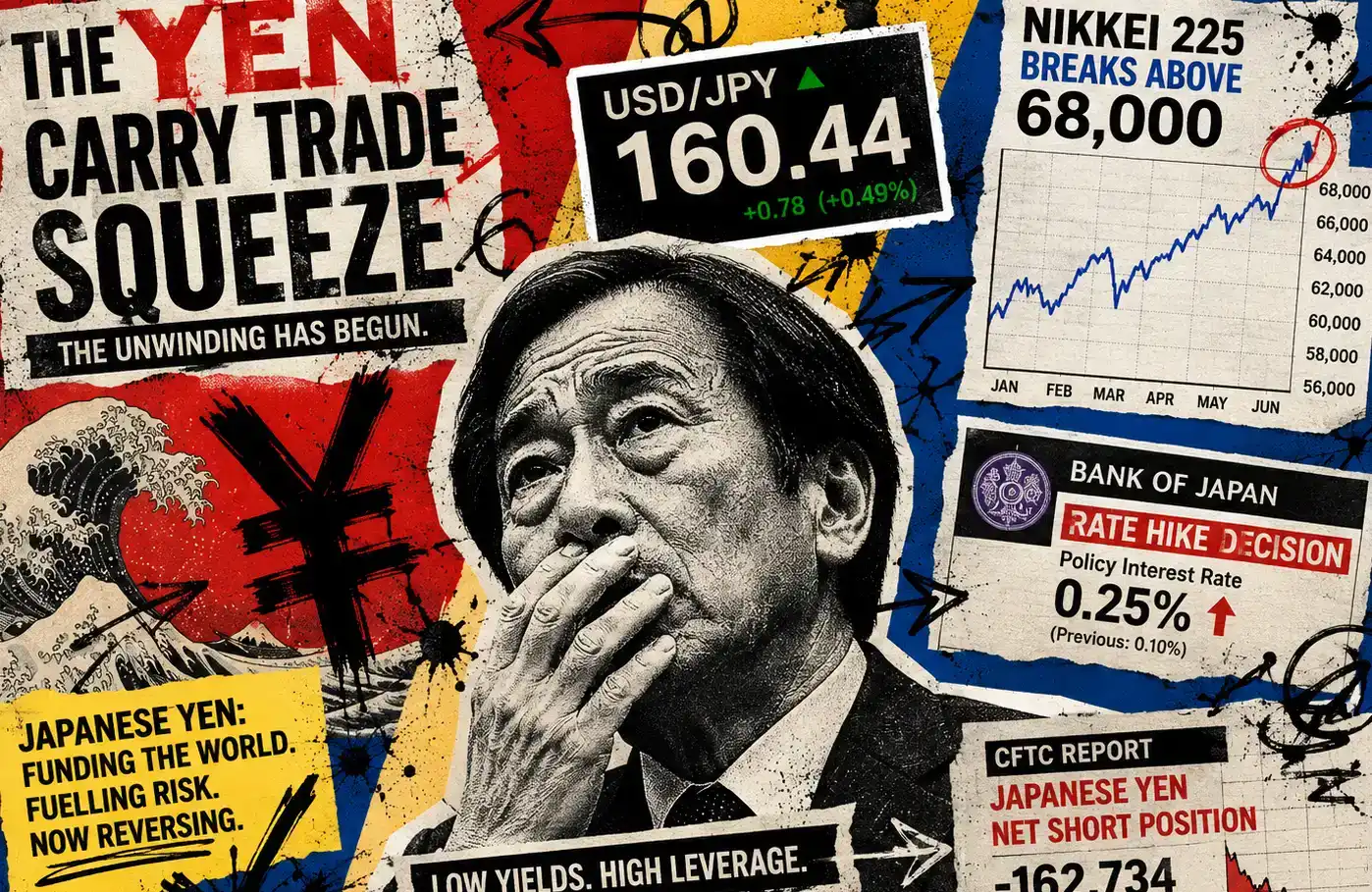
On June 3rd, USD/JPY hit 160.44, its highest level since July 2024, while the Nikkei 225 surged past 68,000 points. Contrary to popular narratives of an imminent "carry trade unwind" akin to August 2024, data reveals a more complex picture. Speculative net short positions in yen futures have actually increased, reaching -114,667 contracts by late May, suggesting traders are doubling down rather than retreating. Meanwhile, Japan's Finance Ministry conducted its largest-ever single-round FX intervention (11.73 trillion yen) in April-May but failed to hold the 160 yen line. The Nikkei's rally is not driven by carry trade dynamics. Foreign investors are aggressively buying Japanese stocks, with net purchases in 2026 running nearly 16 times higher than 2025 levels. This inflow is concentrated in AI and semiconductor-related stocks like SoftBank and Socionext, fueled by positive sector outlooks, rather than being a flight from unwinding yen shorts. Furthermore, the Nikkei has continued climbing despite the Bank of Japan's (BOJ) rate hikes to 0.75%. This disconnect exists because the current equity boom is fueled by AI-driven foreign investment, not reliant on cheap yen funding. However, this relationship remains fragile. Should the BOJ hike rates further (e.g., to 1.0%) while dollar weakness increases carry trade costs, the trajectories of the yen and Japanese stocks could reconverge, potentially triggering volatility.

marsbit06/04 04:47

New Wall Street Play: Yen Shorts Still Adding, But Japan Stocks Don't Rely on Carry Trade Unwinding

marsbit06/04 04:47

Under the squeeze between giants Tether and Circle, how can foreign exchange stablecoins break through?

In the face of dominance by Tether (USDT) and Circle (USDC), new entrants in the stablecoin space face significant challenges competing directly, especially in the foreign exchange (FX) market. A more viable and efficient path forward is the adoption of synthetic foreign exchange (Forex) built atop existing USD stablecoin rails. The rise of stablecoin neo-banks represents the next major growth area for mass crypto adoption, with FX becoming a core component. However, replicating the vast liquidity, distribution channels, and network effects of USDT/USDC is extremely difficult for new FX stablecoin issuers. The total market cap of all FX stablecoins is a fraction (roughly 1/700th) of USD stablecoins, leading to issues like poor liquidity, peg instability, limited acceptance, and complex compliance hurdles. Instead of issuing spot FX stablecoins, the article advocates for a model inspired by traditional finance's non-deliverable forwards (NDFs). Users would continue to hold underlying USDT/USDC, while their account balances are displayed and economically settled in their preferred local currency through MtM (Mark-to-Market) NDF structures. This approach leverages the deep liquidity and infrastructure of USD stablecoins while providing synthetic forex exposure. Key advantages include strong peg stability via oracles, retained access to USD stablecoin yields and liquidity, high capital efficiency, and easy scalability to new currencies. Primary use cases for this on-chain NDF forex include: 1. Neo-banks, custodians, and wallets offering multi-currency accounts to attract international users and increase deposits. 2. Forex carry trade strategies, potentially offering more stable and scalable yields compared to crypto-native products like Ethena. 3. Global corporate payments, allowing businesses to receive payments in local currencies while hedging forex risk on-chain, similar to services offered by Stripe in traditional finance. This synthetic forex model presents a pragmatic solution to overcome the network effects of incumbents and unlock the next wave of stablecoin utility for global consumers and businesses.

marsbit05/24 00:30

Under the squeeze between giants Tether and Circle, how can foreign exchange stablecoins break through?

marsbit05/24 00:30

活动图片