Someone Predicts South Korean Stock Market with Hyperliquid, Achieving 74% Accuracy?

Foresight NewsPubblicato 2026-06-10Pubblicato ultima volta 2026-06-10

Introduzione

A study analyzed whether weekend price movements of four Korean stock perpetual futures contracts (Samsung Electronics, SK Hynix, Hyundai Motor, and EWY) on Hyperliquid could predict their Monday opening directions on their respective primary exchanges (KRX, NYSE). Over 62 weekend observations across the four assets, Hyperliquid correctly predicted the Monday opening direction 45 times (73.8% accuracy). However, performance varied significantly. Samsung Electronics showed the strongest and statistically significant signal, with Hyperliquid's weekend close correctly predicting its KRX Monday open in 15 out of 16 cases (94% accuracy, p-value < 0.001). This signal remained strong (75% accuracy) even when using Saturday's close instead of Sunday's, suggesting genuine price discovery beyond last-minute convergence. Hyundai Motor also showed high accuracy (81%, 13/16 correct), but this was not statistically significant after accounting for a baseline downward bias in its Monday opens. SK Hynix performed marginally better than a coin flip (63%, 10/16). EWY performed the worst (54%, 7/13), underperforming a simple strategy of always predicting a Monday rise. The stark difference between Samsung and EWY is largely attributed to market timing. KRX opens shortly after Hyperliquid's Sunday close, while NYSE opens ~14 hours later, allowing new information to flow in. The results suggest that for assets like Samsung Electronics, where weekend trading on Hyperliquid precedes the primary...


Written by: Ponyo(@ponyo_fp), Four Pillars Researcher & Hyperliquid Core Contributor

Compiled by: AididiaoJP, Foresight News


In February, TradeXYZ launched perpetual futures contracts for Samsung Electronics, SK Hynix, Hyundai Motor, and EWY on Hyperliquid, allowing investors to gain exposure to South Korean stocks on weekends for the first time.


I reviewed the weekend price movements of these stock contracts since their launch, covering a total of 62 observation samples across the 4 assets. I compared each contract's movement from Friday close to Sunday close with the direction of the underlying asset's Monday opening auction. For South Korean stocks, I used the KRX opening price at 9:00 AM (KST); for EWY, I used the NYSE opening price at 9:30 AM (ET).


Hyperliquid correctly predicted the opening direction in 45 out of the 62 cases, an accuracy rate of 73.8%. This number sounds good, but the aggregate data masks highly uneven performance across different assets.
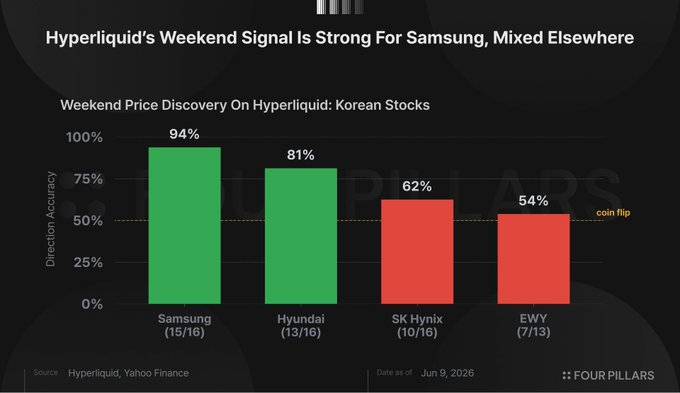


Samsung Electronics shows a clear outlier. Hyperliquid correctly predicted the direction 15 out of 16 weekends. Since Samsung's Monday openings were evenly distributed between up and down, there's no inherent directional bias inflating the hit rate. The binomial test (against a 50% benchmark) yields a p-value of 0.0003, meaning the probability of such a strong result occurring by random chance is only 0.03%. Although the sample size is still small, a result of 15 correct out of 16 is hard to ignore.


Hyundai Motor also performed well, with 13 correct predictions out of 16, an 81% accuracy rate. However, after accounting for the stock's slight downward bias on Mondays, this result did not reach statistical significance. During the sample period, Hyundai Motor opened lower on Mondays 62% of the time, meaning a simple strategy of always predicting "down" would have had a high baseline win rate.


SK Hynix is less convincing. It was correct only 10 out of 16 times, barely better than a coin flip. Some misses were significant. On the weekend of June 5-7, the Hyperliquid contract closed up 0.11%, while SK Hynix gapped down 10.34% at the Monday KRX open.


EWY had the worst results. It was correct only 7 out of 13 weekends, even underperforming the benchmark. Out of those 13 Mondays, EWY opened higher 10 times, accounting for 77%. A simple weekly prediction of "up" would have outperformed Hyperliquid's signal. Meanwhile, the Hyperliquid weekend contract closed down in 9 out of the 13 cases, repeatedly pointing traders in the wrong direction.


The discrepancy between Samsung Electronics and EWY can largely be explained by market time differences. The KRX opens at 9:00 KST, which is 00:00 UTC, almost exactly coinciding with Hyperliquid's daily candle reset time. Therefore, the time gap between Hyperliquid's last weekend trade and the KRX opening auction is only a few minutes.


In contrast, EWY trading on the NYSE doesn't start until 9:30 AM ET, about 14 hours after Hyperliquid's Sunday candle close. By then, the entire Monday trading session on the KRX is complete, European markets are open, and US pre-market trading has incorporated a new round of information. The information set determining EWY's Monday open simply didn't exist when Hyperliquid's weekend candle closed.


A reasonable critique is that even Samsung's results might reflect last-moment convergence rather than genuine price discovery. Informed traders might adjust positions on Hyperliquid just before the KRX opens, making this "prediction" almost tautological.


To test this, I repeated the analysis using Saturday's close instead of Sunday's, creating a lead time of about 24 hours instead of just minutes. The results show that the Saturday signal still predicted Samsung's Monday opening direction with 75% accuracy (against a 50% benchmark). Sunday trading improved the result but didn't create the signal from scratch.


In comparison, Samsung's own Friday price movement predicted Monday's direction with only 62% accuracy. This suggests Hyperliquid's weekend market provides information beyond a simple continuation of the previous KRX trading session.


Among the four assets tested, only Samsung Electronics produced a statistically significant directional signal. The sample size remains small, and the results have not been validated out-of-sample. Nevertheless, this might still be valuable information for anyone trading Samsung Electronics or the broader KOSPI market.


Despite an average weekend trading volume of only about $12,000, Hyperliquid correctly predicted the Monday opening direction for a company with a market cap of roughly $300 billion with 94% accuracy and a p-value below 0.001. For anyone trading Samsung Electronics on the KRX, checking Hyperliquid's weekend closing price before Monday's opening auction appears to be a very worthwhile practice.


Domande pertinenti

QWhat is the main finding of the analysis regarding Hyperliquid's weekend contracts for predicting Korean stock market opens?

AThe analysis found that Hyperliquid's weekend contracts, specifically for Samsung Electronics, predicted the direction of Monday's KRX opening auction with 94% accuracy (15 out of 16 times), a result highly unlikely to be due to random chance (p-value < 0.001).

QWhy was the performance of the EWY contract on Hyperliquid significantly worse than for Samsung Electronics?

AThe EWY contract performed poorly because NYSE opens approximately 14 hours after Hyperliquid's Sunday close. By that time, new information from a full day of KRX trading, European markets, and US pre-market activity becomes available, which was not reflected in the Hyperliquid weekend price.

QWhat was the author's method to test if the Samsung result was due to last-minute convergence or genuine price discovery?

ATo test this, the author repeated the analysis using Saturday's closing price on Hyperliquid instead of Sunday's, creating a 24-hour lead time. The result showed a 75% accuracy rate, indicating the signal existed beyond just last-minute convergence before KRX open.

QHow did the author account for potential bias from a stock's inherent Monday opening direction when evaluating the results?

AThe author noted that for stocks like Hyundai Motor, which had a 62% probability of opening down on Mondays, a high accuracy rate needed to be considered against this baseline. They also mentioned that Samsung's Monday openings were evenly distributed, so a high accuracy was not due to a directional bias.

QWhat is a key limitation of the study's findings mentioned by the author?

AA key limitation is the small sample size (only 16 weekends for Samsung Electronics) and the fact that the results have not yet been validated out-of-sample.

Letture associate

The More It Rises, the More Dangerous? The Systemic Risks Behind SpaceX's Soaring Valuation

Summary: The article raises concerns about the systemic risks posed by SpaceX's skyrocketing valuation, arguing that modern market mechanics, rather than fundamentals, are driving its price discovery. Following SpaceX's market capitalization surpassing $3 trillion in after-hours trading, the author contends that the market is no longer functioning properly. The core issue is not SpaceX's business prospects but the unhealthy market structure surrounding it. With limited float and the imminent launch of options trading, the stage is set for a potential "gamma squeeze"—a feedback loop where market makers hedging call options are forced to buy shares, pushing the price higher and attracting more speculative momentum traders. This mechanism, seen previously with Tesla and meme stocks, can decouple valuation from financial reality. The danger escalates as extreme valuations force passive funds, ETFs, pensions, and major indices to hold the stock. If SpaceX grows large enough—hypothetically reaching $5 or even $10 trillion—its performance would increasingly dictate broader market indices, embedding systemic risk. The author warns that when price appreciation itself becomes the primary bullish thesis, the market transforms from a capital allocation mechanism into a self-reinforcing speculative machine, endangering the retirement savings of ordinary investors tied to passive strategies. The piece questions whether such a system can still perform its fundamental role of price discovery.

marsbit3 min fa

The More It Rises, the More Dangerous? The Systemic Risks Behind SpaceX's Soaring Valuation

marsbit3 min fa

How Much of the Subscription Fee You Pay to Claude Can Optical Module Companies Get?

How much of your $20 Claude Pro subscription actually goes to AI model companies like Anthropic? A viral breakdown image highlights the fundamental valuation challenge for AI applications versus traditional SaaS. Unlike SaaS with high software margins, AI subscriptions face variable "inference costs": every user query consumes GPU time, power, and cloud resources. This creates a tension between fixed subscription fees and usage-driven expenses. While the specific dollar splits are illustrative, the core question is whether AI revenue can achieve SaaS-like margins as usage scales. Currently, infrastructure providers (cloud platforms, GPU makers like Nvidia, HBM suppliers, power/data centers) capture more certain revenue from growing AI usage. Their financials reflect pricing power and faster earnings validation. The bullish case hinges on efficiency improvements: model optimization, caching, smaller models, and custom chips could lower per-token costs over time. The key debate is whether cost declines can outpace increases in user workload complexity and volume. Ultimately, for AI companies to command high SaaS-like valuations, they must demonstrate not just user growth but also improving gross margins after accounting for inference costs. Investors will scrutinize not just subscriber numbers, but usage patterns, enterprise pricing tiers, and real efficiency gains.

marsbit13 min fa

How Much of the Subscription Fee You Pay to Claude Can Optical Module Companies Get?

marsbit13 min fa

OpenAI's Hyperliquid Pre-IPO Pricing Venture: Why Did It Last Only Half a Year?

The article discusses the rise and fall of Pre-IPO pricing markets on the Hyperliquid blockchain. Trade.xyz, an anonymous team, successfully built the largest pre-market for SpaceX (SPCX) by launching a contract with a clear anchor: the eventual Nasdaq listing price. This provided inherent price stability and validation. In contrast, Ventuals, a team backed by Paradigm, failed despite holding exclusive contracts for highly sought-after companies like OpenAI and Anthropic. Its key mistake was its pricing mechanism. For companies with no near-term IPO date, Ventuals' oracle relied partly on opaque private market transactions and, critically, partly on its own contract's moving average price. This created a self-referential feedback loop where prices were artificially propped up and detached from genuine supply and demand, leading to illiquid markets. Ventuals shut down after nine months, settling positions at final prices of $1,341.80 for OpenAI and $1,618.90 for Anthropic. Ironically, some employees and late-stage investors of these very companies reportedly used these flawed Ventuals prices for valuation reference, highlighting the acute demand for any price signal in illiquid private markets. The article concludes that while demand for pre-IPO trading is real and growing, with players like Coinbase now entering the space, the fundamental challenge remains: without a public listing to provide a definitive price anchor, these markets struggle to establish truly accurate and liquid pricing. The need for a transparent, self-correcting market is the critical lesson from Ventuals' failure.

marsbit29 min fa

OpenAI's Hyperliquid Pre-IPO Pricing Venture: Why Did It Last Only Half a Year?

marsbit29 min fa

With Daily Active Users Reaching 3-4 Times That of the Industry's Second Place, Which Crack in the Office Agent Market Has Tencent's WorkBuddy Torn Open?

Tencent's AI office assistant, WorkBuddy, has achieved daily active users (DAU) 3-4 times that of the industry's second-place product, primarily driven by non-technical users like HR, operations, and administrative staff. Its rapid growth, starting with a public beta in March 2026, highlights a key strategic divergence from competitors like OpenAI's Codex and Anthropic's Claude Code. Unlike those tools, which originated as developer-focused assistants (in command lines or IDEs) and are now expanding towards office scenarios, WorkBuddy was built from the ground up for non-technical office workers. Its development was user-driven, initiated after腾讯云's team observed non-technical employees using their CodeBuddy coding tool for general tasks. WorkBuddy's design is defined by three core decisions aimed at lowering barriers: 1) Using natural language instead of technical concepts, so users describe their goal without needing to understand prompts or agents. 2) Providing pre-packaged "Skill" templates for common office tasks like data processing, content creation, and research. 3) Natively integrating into existing腾讯 ecosystems like腾讯 Docs and WeChat, making the agent a seamless part of the user's workflow rather than a separate tool. This "scenario encapsulation" approach, prioritizing the shortest path for users to get work done, contrasts with the "underlying capability" focus of Codex and Claude, which offer more flexibility but require more technical setup. Analysts confirm WorkBuddy's leading market position in China by mid-2026, with massive user and request growth following its launch. Recognizing the same trend of surging non-technical adoption, OpenAI and Anthropic are now pivoting their products with features like role-based plugins (Codex) and a simplified desktop interface (Claude Cowork). However, adapting tools built for developers requires significant changes to interaction models and integrations. WorkBuddy currently holds an estimated six-month lead in delivering a complete solution for non-technical office users. Its recently launched enterprise version aims to solidify this advantage. The competition underscores two valid paths: embedding agent capabilities directly into familiar work environments versus building powerful, general-purpose agents that users must learn to access. WorkBuddy's early success demonstrates the effectiveness of the former strategy for mainstream office adoption.

marsbit37 min fa

With Daily Active Users Reaching 3-4 Times That of the Industry's Second Place, Which Crack in the Office Agent Market Has Tencent's WorkBuddy Torn Open?

marsbit37 min fa

Trading

Spot
Futures
活动图片