According to data from Blockworks, Solana processed a record 169.9 million transactions on August 13. This is a record number of transactions for a single day in the network's history. Non-vote transactions filter out messages validators send to each other to agree on blocks, so this number reflects actual user and application activity, not consensus overhead.
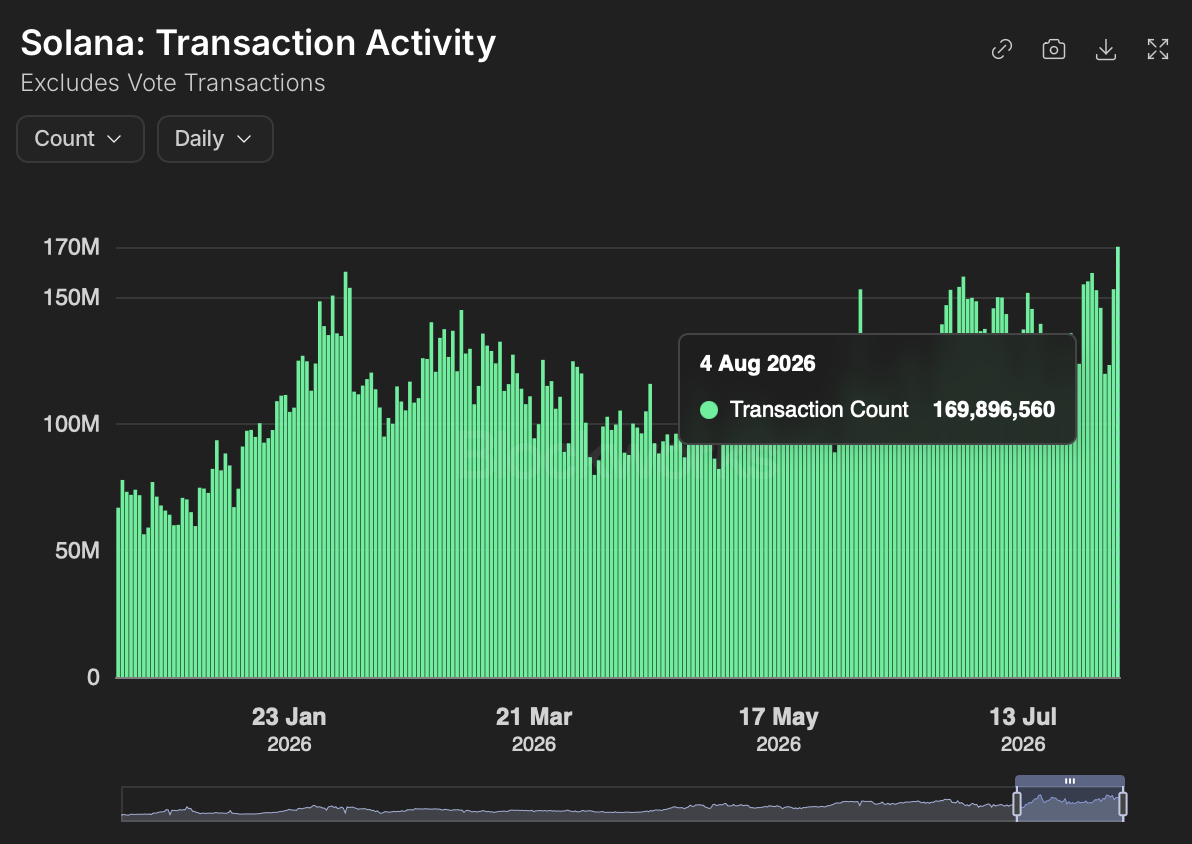
Source: Blockworks
On a weekly basis, the transaction count surpassed the highs set in early February and is up about 55% from this year's lows in April.
Capacity Increased by 66%, Filled in Six Days
On July 29, Solana activated the SIMD-0286 network upgrade at the beginning of a new epoch—the roughly two-day cycle Solana uses to rotate validator duties. The update increased the maximum compute resource limit per block from 60 million to 100 million compute units, representing a 66% increase. Compute units essentially measure the amount of work processed, so a higher limit can accommodate more transactions in a block.
This upgrade, developed by Jito Labs engineer Lukas Bruder, is the most significant throughput increase for Solana since its launch. The block creation time remained at 400 milliseconds, with no impact on speed. This was only possible after XDP kernel-bypass networking technology, which allows validators to transmit data faster by bypassing parts of the operating system, processed 70% of staked SOL.
The 60 Million Limit Was Tested Under Real Traffic
Data from the Solana Foundation shows that 11.2% of blocks reached 56 million compute units or higher, approaching the previous 60 million limit. The limit was stress-tested during periods of volatility, precisely when traders need their orders executed. In this sense, block space wasn't sitting idle waiting for users. Demand was pushing against the limit.
Most New Flow Comes From Trading Mechanisms
Market makers, using their own automated market makers (AMMs), constantly update their quotes on the blockchain, and according to Blockworks Research estimates, this flow could account for roughly 20% of all Solana transactions by the end of 2025. On top of this are arbitrage and order book maintenance. This kind of traffic expands to fill available block space, as this is how providing liquidity works on a platform with 400ms blocks and sub-cent fees. This traffic also keeps spreads low for everyone else.
The payment aspect emerged on the same day. Western Union's Stablecard launched on August 4 on the Solana platform via Rain, covering 37 markets and running on the USDPT stablecoin. The circulation volume is still around 7.4 million tokens, which is not yet impacting transaction counts. But the reason Western Union chose Solana is the same reason the record was set, and there is now potential to scale this flow.
UrgentKIN: Western Union Stablecard is live. Instant payments anywhere Visa works, across 175 million merchant locations in 37 markets at launch. The card runs on USDPT, a native stablecoin on Solana and backed by @WesternUnion, issued on-chain by @raincards . https://t.co/A0ycTQP68X pic.twitter.com/01NajGWGPe
— Solana (@solana) August 4, 2026
Record Throughput, Lowest Fees Since 2023
The issue lies in revenue metrics. Network usage fees in Q2 were $51 million, making it the weakest quarter for Solana since Q3 2023, while decentralized exchange (DEX) trading volumes are at their lowest since September 2024. Transaction counts are breaking records while associated monetary volumes are shrinking.
The mix has changed. Memecoin speculation generated good revenue per transaction. Market maker quote updates and stablecoin payments do not. This is healthier for infrastructure and less costly for business, and it's a real trade-off, not a side effect.
Next up are Alpenglow and 200-millisecond slots. Solana is building towards throughput it has yet to fully realize.