Crypto wrench attacks steal more than $30M so far in 2026: Chainalysis

cointelegraphPubblicato 2026-08-06Pubblicato ultima volta 2026-08-06

Introduzione

Criminals stole over $30 million through physical "wrench attacks" on cryptocurrency holders in the first half of 2026, putting the year on track to exceed the record $58 million stolen in 2025. Blockchain analytics firm Chainalysis reported 46 such violent incidents globally by late June, including kidnappings and home invasions, up from 40 in the same period last year. While the attackers' success rate dropped to 26% from 49% in 2025, the report warns the true scale is likely understated due to unreported cases. France remains a major hotspot, with 30 publicly known incidents by mid-2026—a significant increase from 19 in all of 2025. French authorities have counted over 70 cases, with data breaches, including the alleged misuse of tax records and a leak at a crypto tax firm, cited as key drivers. Attack methods vary in sophistication, from directly cashing out stolen funds on exchanges to using complex laundering services, with some cases linked to broader criminal networks.

Criminals stole more than $30 million through physical attacks on crypto holders in the first half of this year, putting the year on pace to surpass the record $58 million stolen in 2025.

In a Chainalysis report released Thursday, the blockchain analytics firm said that 46 violent crypto-related incidents had been documented globally through late June, up from 40 during the same period in 2025. The incidents include kidnappings, home invasions and hostage situations, collectively known as “wrench attacks.”

The findings suggest wrench attacks are increasing, expanding the risks facing crypto holders beyond custody and asset management to their physical safety, homes and families.

According to the report, only 12 of the 46 attempts resulted in payment, giving attackers a 26% success rate, down from 49% in 2025. However, the report acknowledged that known cases likely understate the scale of the problem, as many attacks go unreported.

Chainalysis said the “tradecraft tends to be amateur at the point of violence, but professional at both ends,” with victims often selected through data leaks, social media or insider information before low-skilled crews carry out the attacks.
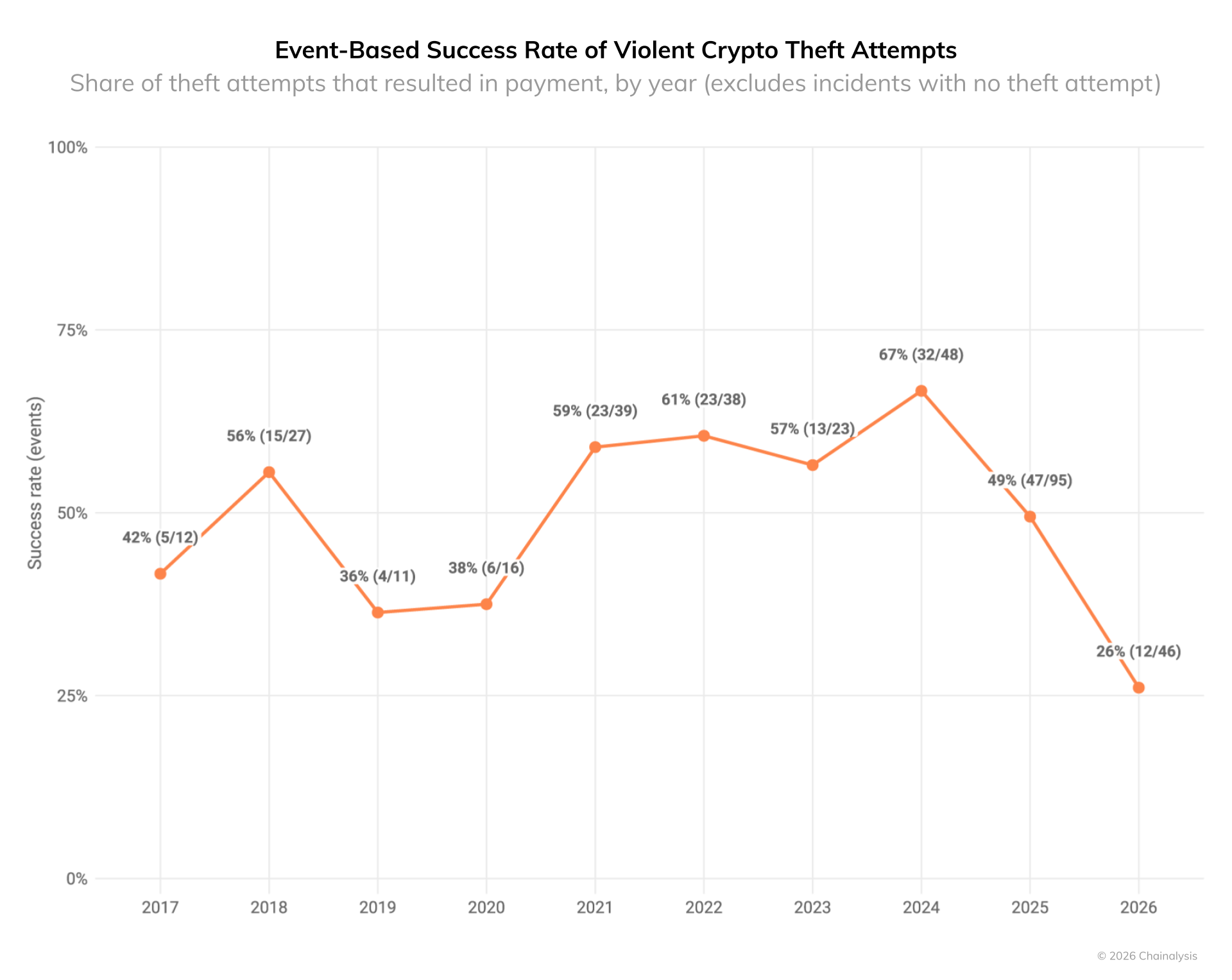
Success rate of crypto wrench attacks by year. Source: Chainalysis

France remains wrench attack hotspot

According to Chainalysis, France recorded 30 publicly known incidents by midyear, compared with 19 throughout 2025. The report noted that French authorities have counted more than 70 incidents, indicating the actual total may be substantially higher.

Related: Spain arrests suspect in 2025 kidnapping of Ledger co-founder

In July, Interior Minister Laurent Nuñez put the first-half count at 77 kidnappings, extortions or attempted extortions, up from 45 in all of 2025. In response, the government has introduced a rapid-alert and protection system and promised greater intelligence-sharing and coordination with the crypto industry.

Chainalysis said in the Thursday report that the alleged misuse of French tax records was the likeliest driver of the surge. A French tax official allegedly accessed and sold information about crypto investors to criminals, while a separate breach at crypto tax-reporting company Waltio reportedly exposed data belonging to about 50,000 users.

Onchain activity also showed varying levels of sophistication. Some attackers sent stolen funds directly to centralized exchanges, while others used bridges, decentralized exchanges and laundering services. Chainalysis said the most advanced cases showed links to broader criminal networks.

Magazine: Do the Coldcard attacks mean all hardware wallets are now insecure?

Domande pertinenti

QAccording to the Chainalysis report, what is the estimated total value stolen through 'wrench attacks' in the first half of 2026, and how does this pace compare to 2025?

ACriminals stole more than $30 million through 'wrench attacks' in the first half of 2026. This pace puts the year on track to surpass the record $58 million stolen in the entirety of 2025.

QWhat does the term 'wrench attack' refer to in the context of cryptocurrency crime, and what is the reported success rate for these attacks in the first half of 2026?

AIn cryptocurrency crime, a 'wrench attack' refers to a physical, violent attack on a crypto holder, such as a kidnapping, home invasion, or hostage situation, aimed at coercing them to surrender their crypto assets. According to the report, only 12 of the 46 documented attempts resulted in payment, giving a success rate of 26% for the first half of 2026.

QWhich country is identified as the primary hotspot for crypto wrench attacks, and what is cited as a key factor driving the surge in incidents there?

AFrance is identified as the primary hotspot for crypto wrench attacks. The report cites the alleged misuse of French tax records as the likeliest driver of the surge, where a tax official reportedly sold information on crypto investors to criminals. A separate data breach at the crypto tax firm Waltio also reportedly exposed user data.

QBeyond the direct violence, how does Chainalysis describe the 'tradecraft' or methods used by attackers in these incidents?

AChainalysis describes the tradecraft as 'amateur at the point of violence, but professional at both ends.' Victims are often identified professionally through data leaks, social media, or insider information. However, the physical attacks themselves are frequently carried out by low-skilled crews. Onchain analysis of the stolen funds also shows varying levels of sophistication in moving and laundering the assets.

QWhat measures have French authorities reportedly taken in response to the increase in wrench attacks?

AIn response to the increase, the French government has introduced a rapid-alert and protection system. They have also promised greater intelligence-sharing and coordination with the cryptocurrency industry to combat these crimes.

Letture associate

Shareholders' Accurate Reduction of 1.4 Billion Shares, Under Heavy Performance Pressure, Meish Technology Makes an Emergency Cross-Border Move into Indium Phosphide

Domestic distributed audio-visual and AI vision solutions provider Meish Technology (001229.SZ), despite its AI concept, has shown signs of fatigue shortly after listing, with consecutive declines in revenue and net profit. Amid this pressure, the company is making an urgent foray into the hot "indium phosphide" semiconductor concept. The company moved swiftly, establishing a wholly-owned subsidiary in July and holding an extraordinary shareholders' meeting in August to authorize management to advance the project. This rapid capital operation is seen as a move to tap into the AI computing power industry chain. However, behind this "cross-border self-rescue" lies deep pressure on fundamental performance, precise high-level减持 by a major shareholder who cashed out approximately 142 million yuan just before the stock price peaked, and the new business remaining at a very preliminary "blueprint" stage with no substantive impact on performance yet. Meish Tech's core business of "distributed audio-video control systems" faces intense competition. While maintaining high gross margins, its revenue growth and profit growth have seriously diverged. Although its AI business revenue surged in 2025, it failed to halt the overall profit decline. Since its 2022 IPO, the company's performance has declined, with 2026 first-quarter results even showing a loss. The half-year 2026 forecast predicts a profit plunge of over 70% year-on-year. In this context, the跨界 into the high-tech barrier, capital-intensive indium phosphide field appears more like a gamble driven by market valuation concerns than a strategy based on deep technical积累.

marsbit8 min fa

Shareholders' Accurate Reduction of 1.4 Billion Shares, Under Heavy Performance Pressure, Meish Technology Makes an Emergency Cross-Border Move into Indium Phosphide

marsbit8 min fa

Just 3.5 Months After Its Founding, It Started Making External Investments: The Embodied AI Sector Is Collectively 'Investing While Fundraising'

A counterintuitive trend is emerging in China's embodied AI sector: numerous startups that are still actively raising capital themselves are now making strategic investments in other companies. An analysis of 29 such enterprises reveals a pattern of "fundraising while investing," where companies, often still in early funding rounds, rapidly deploy capital into the ecosystem. These 29 investment entities, primarily based in the Pearl River Delta and Yangtze River Delta regions, have executed over 125 investment deals. Notably, 17 of them (59%) are humanoid robot manufacturers, making them the most active investors. The trend shows that newer companies are investing faster; firms founded after 2023 made their first external investment in an average of just 22.8 months, with one company, Poke Robotics, doing so within 3.8 months of its founding. Zhiyuan Robot (智元机器人) stands out as the most active corporate venture capital (CVC) player, completing 37 investments in 23 months. A more complex, networked investment structure is also forming, where companies like Lingchu Intelligent (灵初智能) and Lingxin Qiaoshou (灵心巧手), which received investments from larger players, have themselves become active investors, extending the strategic reach of capital down the supply chain. This collective shift from a few large players to widespread participation signals a strategic move to use capital as a lever to accelerate industry consolidation. Companies are seeking to quickly integrate critical supply chain elements—such as dexterous hands, joint motors, and AI data platforms—into their ecosystems to gain a competitive edge in a rapidly evolving, highly contested market window. The strategy aims to compress the decade-long process of traditional supply chain integration into just a few years, though it carries risks related to technology bets and ongoing capital burn. As the sector's IPO pipeline grows, this "fundraise and invest" model may soon become a standard industry practice.

marsbit12 min fa

Just 3.5 Months After Its Founding, It Started Making External Investments: The Embodied AI Sector Is Collectively 'Investing While Fundraising'

marsbit12 min fa

Trading

Spot
活动图片