SOL Set for a Comeback? Whales Hoard 200K Coins, Shorts Liquidated, $145 Becomes the Make-or-Break Line

金色财经Pubblicato 2025-12-11Pubblicato ultima volta 2025-12-11

Introduzione

Solana (SOL) is showing multiple bullish signals, indicating a possible major price movement. Large investors, or "whales," have been aggressively accumulating SOL, with one new wallet withdrawing 200,000 SOL from Binance, reducing market supply by approximately $28 million and tightening exchange liquidity. Technically, SOL has formed a bullish MACD crossover, and its price is consolidating with higher lows within a $126-$145 range. A decisive break above the key $145 resistance level could trigger a rally toward $168 and beyond. On-chain data reveals a surge in organic demand, with DEX volume reaching $3.798 billion in 24 hours and $24.6 billion over the past week, a 12.7% increase. Furthermore, short sellers are being squeezed, with $293,000 in short liquidations—more than double the long liquidations—particularly on Binance around the $138.64 level. Futures market data shows persistent buying pressure, with the Cumulative Volume Delta (CVD) favoring buyers, indicating the accumulation of long-term positions rather than short-term speculation. This aligns with whale accumulation, suggesting coordinated capital deployment ahead of a potential upward move. In summary, SOL exhibits strong reversal signals from whale activity, technical indicators, on-chain momentum, and futures market dynamics. A sustained break above $145 is the critical level needed to confirm a shift from accumulation to a full bullish trend.

Solana (SOL) has been making subtle moves lately, with whales, technical indicators, and on-chain data all sending signals—is it gearing up for something big?

Whales on a Buying Spree, Drying Up Exchange Liquidity

SOL whales have been insatiable lately! A new wallet directly withdrew 200,000 SOL from Binance, reducing market supply by nearly $28 million in one go—this aggressive accumulation clearly signals bullish sentiment for future price action. Free group + QQ:3260353596

When whales make their move, SOL on centralized exchanges becomes scarcer. Tightened supply naturally fuels bullish sentiment. SOL is currently stuck at the upper end of the $126-$145 consolidation range, with big funds waiting to add more—all it needs is a breakout catalyst.

Technical Signals Unavoidable: MACD Golden Cross, Higher Lows

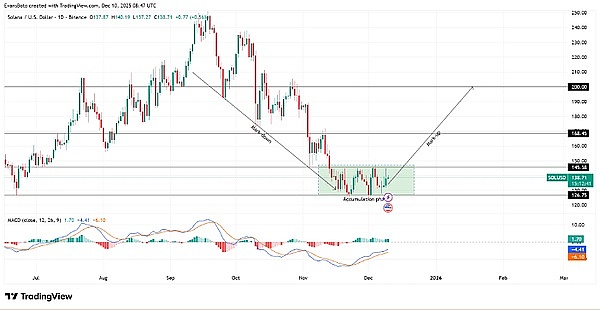
It's not just the whales; technicals are quietly improving too! The MACD line has risen above the signal line, forming a bullish golden cross—a clear sign of strengthening short-term momentum. Moreover, the price is consolidating near the midpoint of the range, with successively higher lows, erasing any trace of the previous downtrend.

Now, all eyes are on breaking the key resistance at $145! If it can hold above this level, the next target is $168, and if momentum remains strong, further upside potential awaits.
DEX Trading Volume Surges, Shorts Get Crushed

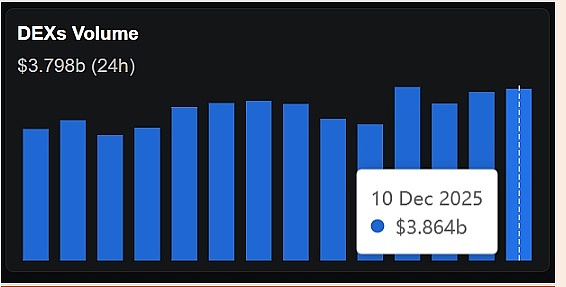
On-chain ecosystem news is also positive: SOL's DEX 24-hour trading volume surged to $3.798 billion, with a seven-day volume skyrocketing to $24.6 billion, up 12.7% week-over-week! This indicates increased willingness to trade on-chain, not just leverage speculation, signaling growing organic demand.
Even more satisfying for bulls—shorts are getting squeezed! Recently, SOL shorts were liquidations totaled $293,000, more than double the long liquidations, especially on Binance, where shorts kept betting on a drop below $138.64 but were repeatedly stopped by buyers. The more shorts lose, the weaker the downward momentum, paving the way for upward moves.
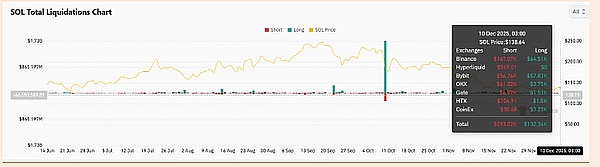
Futures Market Buyers Hold Firm, Long-Term Capital Accumulating

The futures market also tells a story: the buying CVD indicator has been skewed toward buyers, with purchases absorbing sell-offs even when sellers dump. This suggests participants aren't just speculating short-term but are quietly building long-term positions, growing increasingly confident in SOL. Free group + QQ:3260353596
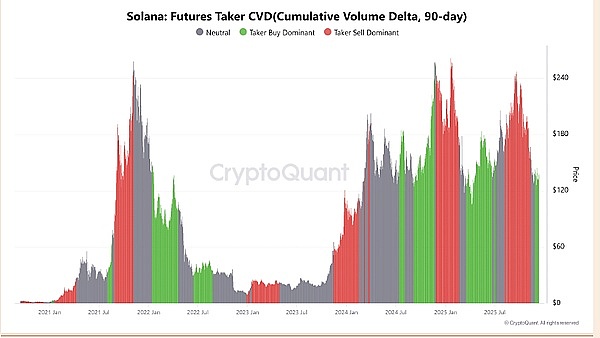
Moreover, whale accumulation aligns perfectly with futures buyers stepping in—no coincidence here. Capital is positioning early, awaiting the rally.

Summary: Break $145 and Take Off!

SOL's reversal signals are now evident: whale accumulation, strengthening technicals, active DEXs, and short liquidations. The key is whether it can break through $145 smoothly. If it holds above this level, SOL will transition from consolidation to uptrend mode, charging toward $168 and beyond. Free group + QQ:3260353596


Domande pertinenti

QWhat key price level is identified as the critical resistance point for SOL's potential bullish breakout?

AThe critical resistance point for SOL's potential bullish breakout is $145.

QHow many SOL tokens did a new whale wallet withdraw from Binance according to the article?

AA new whale wallet withdrew 200,000 SOL tokens from Binance.

QWhat technical indicator is mentioned as having formed a bullish crossover (golden cross)?

AThe MACD line rising above the signal line to form a bullish golden cross is mentioned.

QWhat was the 24-hour DEX trading volume for Solana, and what does this high volume suggest?

AThe 24-hour DEX trading volume for Solana was $3.798 billion, suggesting strong organic demand and increased on-chain activity rather than leveraged speculation.

QHow much was liquidated from SOL short positions recently, and how did it compare to long liquidations?

A$293,000 was liquidated from SOL short positions recently, which was more than double the amount liquidated from long positions.

Letture associate

Wintermute Market Weekly: Iran War Ends, Inflation Meets Expectations, BTC Rebounds to Lower 60ks But Don’t Rush to Buy the Dip

**Wintermute Market Weekly: BTC Rebounds to $60K Lows, But Caution Advised** This week saw a broad market rebound, primarily driven by two converging factors: a US CPI inflation reading that met expectations (4.2% YoY) and former President Trump's announcement of a deal to end the Iran conflict. The latter triggered a sharp drop in oil prices, reducing geopolitical risk premiums and easing inflation fears. Consequently, risk assets like equities and cryptocurrencies rallied, with Bitcoin recovering from lows around $60,000 to close the week up 1.9%, while altcoins gained 3.1%. Despite the price bounce, the underlying liquidity picture for crypto remains weak. Key funding channels—stablecoin flows, ETF inflows, and Digital Asset Treasury (DAT) activity—show no signs of structural improvement. ETF outflows recently hit a record streak, and DAT assets have declined significantly. The rally from $60K to $83K earlier is now viewed as a bear-market rally that has failed. The current environment is characterized by low directional conviction and choppy, range-bound trading, likely persisting into summer. The report advises caution against aggressively buying the dip. While the $60K area offers attractive long-term risk/reward, a sustained bull run requires a visible turnaround in capital inflows, which hasn't materialized. The upcoming FOMC meeting and Powell's commentary, alongside the formal Iran deal signing, are noted as near-term catalysts. The core takeaway is to watch fund flows rather than price action and avoid being whipsawed by volatility before clear signs of institutional or retail capital returning emerge.

marsbit14 min fa

Wintermute Market Weekly: Iran War Ends, Inflation Meets Expectations, BTC Rebounds to Lower 60ks But Don’t Rush to Buy the Dip

marsbit14 min fa

Cursor, Why Boarded Musk's Starship?

SpaceX announced its acquisition of AI programming startup Cursor's parent company, Anysphere, for $60 billion in an all-stock deal, just days after its record-breaking IPO. The move sent SpaceX's stock soaring, briefly making it the most valuable U.S. company. Cursor, founded in 2022 by MIT graduate Michael Truell and his classmates, is a popular AI coding assistant that allows developers to switch between models from OpenAI, Anthropic, and others. It saw explosive revenue growth, reaching a $4 billion annualized run rate in early 2026. However, its market share was eroded by the launch of competitor Claude Code from its key AI supplier, Anthropic. This dependence prompted Cursor to develop its own AI model, Composer, in early 2026. To scale Composer, Cursor needed immense computing power. In April 2026, it struck a deal with SpaceX, granting the latter an option to acquire it post-IPO. SpaceX exercised this option, offering Cursor access to its Colossus supercomputer, powered by hundreds of thousands of top-tier Nvidia AI chips. For SpaceX, the acquisition is a strategic move to bolster its AI capabilities, particularly for its xAI division, and advance its broader ambition of building orbital, solar-powered data centers. While the deal surprised some employees and investors given Truell's earlier stance on independence, it represents a high-stakes partnership. SpaceX CEO Elon Musk has projected the company could reach $1 trillion in revenue by 2030. For Truell, joining forces with SpaceX is a monumental gamble on an unprecedented scale in the race for AI dominance.

链捕手16 min fa

Cursor, Why Boarded Musk's Starship?

链捕手16 min fa

The More It Rises, the More Dangerous? The Systemic Risks Behind SpaceX's Soaring Valuation

Summary: The article raises concerns about the systemic risks posed by SpaceX's skyrocketing valuation, arguing that modern market mechanics, rather than fundamentals, are driving its price discovery. Following SpaceX's market capitalization surpassing $3 trillion in after-hours trading, the author contends that the market is no longer functioning properly. The core issue is not SpaceX's business prospects but the unhealthy market structure surrounding it. With limited float and the imminent launch of options trading, the stage is set for a potential "gamma squeeze"—a feedback loop where market makers hedging call options are forced to buy shares, pushing the price higher and attracting more speculative momentum traders. This mechanism, seen previously with Tesla and meme stocks, can decouple valuation from financial reality. The danger escalates as extreme valuations force passive funds, ETFs, pensions, and major indices to hold the stock. If SpaceX grows large enough—hypothetically reaching $5 or even $10 trillion—its performance would increasingly dictate broader market indices, embedding systemic risk. The author warns that when price appreciation itself becomes the primary bullish thesis, the market transforms from a capital allocation mechanism into a self-reinforcing speculative machine, endangering the retirement savings of ordinary investors tied to passive strategies. The piece questions whether such a system can still perform its fundamental role of price discovery.

marsbit21 min fa

The More It Rises, the More Dangerous? The Systemic Risks Behind SpaceX's Soaring Valuation

marsbit21 min fa

How Much of the Subscription Fee You Pay to Claude Can Optical Module Companies Get?

How much of your $20 Claude Pro subscription actually goes to AI model companies like Anthropic? A viral breakdown image highlights the fundamental valuation challenge for AI applications versus traditional SaaS. Unlike SaaS with high software margins, AI subscriptions face variable "inference costs": every user query consumes GPU time, power, and cloud resources. This creates a tension between fixed subscription fees and usage-driven expenses. While the specific dollar splits are illustrative, the core question is whether AI revenue can achieve SaaS-like margins as usage scales. Currently, infrastructure providers (cloud platforms, GPU makers like Nvidia, HBM suppliers, power/data centers) capture more certain revenue from growing AI usage. Their financials reflect pricing power and faster earnings validation. The bullish case hinges on efficiency improvements: model optimization, caching, smaller models, and custom chips could lower per-token costs over time. The key debate is whether cost declines can outpace increases in user workload complexity and volume. Ultimately, for AI companies to command high SaaS-like valuations, they must demonstrate not just user growth but also improving gross margins after accounting for inference costs. Investors will scrutinize not just subscriber numbers, but usage patterns, enterprise pricing tiers, and real efficiency gains.

marsbit31 min fa

How Much of the Subscription Fee You Pay to Claude Can Optical Module Companies Get?

marsbit31 min fa

Trading

Spot
Futures

Articoli Popolari

Cosa è ATWO

I. Introduzione al ProgettoArena Two è una piattaforma interattiva decentralizzata che consente ai fan di svolgere un ruolo attivo e tokenizzato nei risultati degli eventi in tempo reale. A differenza dei modelli di trasmissione tradizionali che riducono i fan a spettatori passivi, Arena Two sfrutta la tecnologia blockchain per consentire ai fan di votare direttamente in tempo reale e influenzare i risultati sul campo.II. Informazioni sul TokenNome del token: ATWO(Arena Two)III. Link CorrelatiSito web:https://arenatwo.com/Esploratori:https://basescan.org/token/0x499D35eBE6cEe9B2Ac35Fd003fcBbeeB9CFc7B32Twitter:https://x.com/arenatwoXNota: L'introduzione al progetto proviene dai materiali pubblicati o forniti dal team ufficiale del progetto, che è solo a scopo di riferimento e non costituisce consulenza sugli investimenti. HTX non si assume responsabilità per eventuali perdite dirette o indirette derivanti.

216 Totale visualizzazioniPubblicato il 2026.05.18Aggiornato il 2026.06.02

Cosa è ATWO

Come comprare ATWO

Benvenuto in HTX.com! Abbiamo reso l'acquisto di Arena Two (ATWO) semplice e conveniente. Segui la nostra guida passo passo per intraprendere il tuo viaggio nel mondo delle criptovalute.Step 1: Crea il tuo Account HTXUsa la tua email o numero di telefono per registrarti il tuo account gratuito su HTX. Vivi un'esperienza facile e sblocca tutte le funzionalità,Crea il mio accountStep 2: Vai in Acquista crypto e seleziona il tuo metodo di pagamentoCarta di credito/debito: utilizza la tua Visa o Mastercard per acquistare immediatamente Arena TwoATWO.Bilancio: Usa i fondi dal bilancio del tuo account HTX per fare trading senza problemi.Terze parti: abbiamo aggiunto metodi di pagamento molto utilizzati come Google Pay e Apple Pay per maggiore comodità.P2P: Fai trading direttamente con altri utenti HTX.Over-the-Counter (OTC): Offriamo servizi su misura e tassi di cambio competitivi per i trader.Step 3: Conserva Arena Two (ATWO)Dopo aver acquistato Arena Two (ATWO), conserva nel tuo account HTX. In alternativa, puoi inviare tramite trasferimento blockchain o scambiare per altre criptovalute.Step 4: Scambia Arena Two (ATWO)Scambia facilmente Arena Two (ATWO) nel mercato spot di HTX. Accedi al tuo account, seleziona la tua coppia di trading, esegui le tue operazioni e monitora in tempo reale. Offriamo un'esperienza user-friendly sia per chi ha appena iniziato che per i trader più esperti.

122 Totale visualizzazioniPubblicato il 2026.05.18Aggiornato il 2026.06.02

Come comprare ATWO

Cosa è ZEST

I. Introduzione al Progetto1. Cos'è Zest Protocol?Zest Protocol è un protocollo di prestito nativo di Bitcoin costruito su Stacks Layer 2 che consente agli utenti di guadagnare rendimento con BTC o di prendere in prestito asset collaterizzando BTC. I contratti intelligenti del protocollo sono scritti nel linguaggio Clarity, operano interamente on-chain e sono open-source, con un design ispirato a Aave v3. Zest è attualmente il più grande protocollo DeFi su Stacks, con oltre 800 BTC depositati e un TVL massimo che supera i 100 milioni di dollari. Nel maggio 2026, il protocollo ha ulteriormente introdotto i Bitcoin Collateral Vaults, estendendo le capacità di prestito da Stacks alla rete principale di Bitcoin. Questo consente agli utenti di prendere in prestito stablecoin senza spostare BTC dalla rete Bitcoin, abilitando prestiti in custodia autonoma.2. Come Funziona Zest Protocol?Zest Protocol è composto da due mercati. Il mercato di Stacks è costruito su Aave v3, consentendo agli utenti di depositare asset come sBTC, STX e USDC per guadagnare rendimento o prendere prestiti sovra-collaterizzati. Il LTV massimo predefinito è del 50% (70% per sBTC). Il mercato di Bitcoin opera attraverso i recentemente lanciati Bitcoin Collateral Vaults. Gli utenti prendono in prestito stablecoin bloccando BTC in vaults di custodia autonoma sulla catena di Bitcoin. Il collaterale rimane sulla rete principale di Bitcoin durante l'intero processo, e gli utenti mantengono la custodia a meno che la posizione non venga liquidata.3. Chi Ha Fondato Zest Protocol?Tycho Onnasch (Co-Fondatore): Laureato all'Università di Oxford. Coinvolto nella ricerca e nei finanziamenti per la Stacks Open Internet Foundation. Ex Manager presso Trust Machines e Fondatore di Deedmob. Profilo LinkedIn: https://www.linkedin.com/in/tychokoonnasch/.Fernando Foy (Co-Fondatore): Ha precedentemente lavorato nella consulenza IT presso Objectif Emploi. Profilo LinkedIn: https://www.linkedin.com/in/fernando-foy/.Emil E. (Co-Fondatore): Ha un Master in Fisica dall'Università di Warwick. Ex Partner Ingegneristico presso Trust Machines, Sviluppatore Full-Stack per progetti Web3 e Data Scientist presso HSBC. Profilo LinkedIn: https://www.linkedin.com/in/emil-e-49771a145/.Dettagli sul Finanziamento: Nel maggio 2024, Zest Protocol ha annunciato il completamento di un round di finanziamento seed da 3,5 milioni di dollari guidato da Tim Draper, con la partecipazione di Binance Labs, Flow Traders, Trust Machines e altri.4. Tokenomics di $ZEST$ZEST è il token nativo di Zest Protocol con un'offerta totale fissa di 1 miliardo di token e senza meccanismo inflazionistico.Comunità (27,83%): Utilizzato per airdrop e incentivi per gli utenti;Sviluppo dell'Ecosistema (24,82%): Utilizzato per liquidità, partnership, marketing, listing su exchange, ecc.;Investitori (22,35%): Sostegno alle parti investitrici che hanno supportato lo sviluppo iniziale di Zest Protocol;Team (25%): Allocato per i contributori principali.Piano di Vesting: I token del Team e degli Investitori sono soggetti a un periodo di lock-up di 1 anno seguito da 3 anni di sblocco lineare.5. Cronologia delle Pietre Miliari Chiave2022: Zest Protocol è ufficialmente fondato.Marzo 2024: Completato l'audit di sicurezza e lanciato il mercato di prestiti di Stacks sulla mainnet.Nel febbraio 2026, viene lanciato il Mercato Stacks V2, introducendo i Gruppi di Rischio.Nel maggio 2026, sono stati introdotti i Bitcoin Collateral Vaults e un prototipo operativo della mainnet è ora disponibile. Questo consente agli utenti di utilizzare BTC in custodia autonoma sulla L1 di Bitcoin come collaterale per prendere in prestito stablecoin su catene EVM, ponendo fine a bridging, wrapping e custodia di terze parti. Questo rollout è diviso in due fasi. Fase 1: Utilizza transazioni pre-firmate per limitare il movimento di BTC; Fase 2: Utilizza BitVM per la verifica. II. Informazioni sul TokenNome del token: ZEST (Zest Protocol)III. Link CorrelatiSito web: https://www.zestprotocol.com/Esploratori: https://bscscan.com/token/0x5506599c722389a60580b5213ea1da60d64754a1Twitter: https://twitter.com/ZestProtocolNota: L'introduzione del progetto proviene dai materiali pubblicati o forniti dal team ufficiale del progetto, che è solo a scopo di riferimento e non costituisce consulenza per gli investimenti. HTX non si assume responsabilità per eventuali perdite dirette o indirette risultanti.

117 Totale visualizzazioniPubblicato il 2026.05.19Aggiornato il 2026.06.02

Cosa è ZEST

Discussioni

Benvenuto nella Community HTX. Qui puoi rimanere informato sugli ultimi sviluppi della piattaforma e accedere ad approfondimenti esperti sul mercato. Le opinioni degli utenti sul prezzo di A A sono presentate come di seguito.

活动图片