Probability of Shutdown Plummets: Why Was the U.S. Government Shutdown Crisis Suddenly 'Resolved'?

比推Pubblicato 2026-01-29Pubblicato ultima volta 2026-01-29

Introduzione

The risk of a U.S. government shutdown at the end of January has significantly decreased, with prediction markets showing the probability dropping from 80% to 42%. The potential shutdown stemmed from a partisan dispute over funding for the Department of Homeland Security (DHS), particularly related to the Immigration and Customs Enforcement (ICE) agency. Democrats sought to limit funding after a controversial ICE operation in Minnesota resulted in fatalities, while Republicans defended ICE's role in immigration enforcement. The shift in shutdown probability reflects a likely political compromise, as both parties recognize that a shutdown could harm their prospects in the upcoming midterm elections. Control of Congress is at stake, and neither side wants to be blamed for economic and operational disruptions. Democrats have proposed separating the DHS funding bill from other appropriations to avoid a full shutdown, and reports indicate negotiations are underway between the White House and Senate leaders to reach a short-term funding extension. The focus is on avoiding a repeat of the 43-day shutdown from late last year.

Author: Golem

Original Title: U.S. Government Shutdown Is Difficult Because Both Parties Have Already Calculated the Cost


A major macroeconomic event this month is whether the U.S. government will shut down at the end of January. Last October, the U.S. government shut down for 43 days, and it has been operating since then only after the passage of a temporary funding bill. January 30 is the expiration date of the temporary funding bill. If Congress fails to pass a formal funding bill or if there is no new temporary bill to extend it, the U.S. government will shut down again.

This time, the dispute between the two U.S. parties is mainly over funding for the Department of Homeland Security (DHS). Democrats believe that ICE (Immigration and Customs Enforcement) has problems with law enforcement in Minnesota, resulting in two deaths, and they want to strictly restrict funding and related operations. However, Republicans disagree, arguing that ICE is a key force in combating illegal immigration and welfare fraud. As a result, the two sides are at a stalemate. (For details on the dispute between the two U.S. parties, please read: "U.S. Government Shutdown Storm Is Brewing Again, Will the Crypto Circle Repeat the Crash Script?")

It is this confrontational state and the approaching expiration date of the temporary funding bill that caused the probability of a U.S. government shutdown at the end of January to rise sharply on prediction markets. However, this morning, Polymarket data showed that the probability of the U.S. government shutting down at the end of January has continued to decline and currently stands at 42%, down from a previous high of 80%.
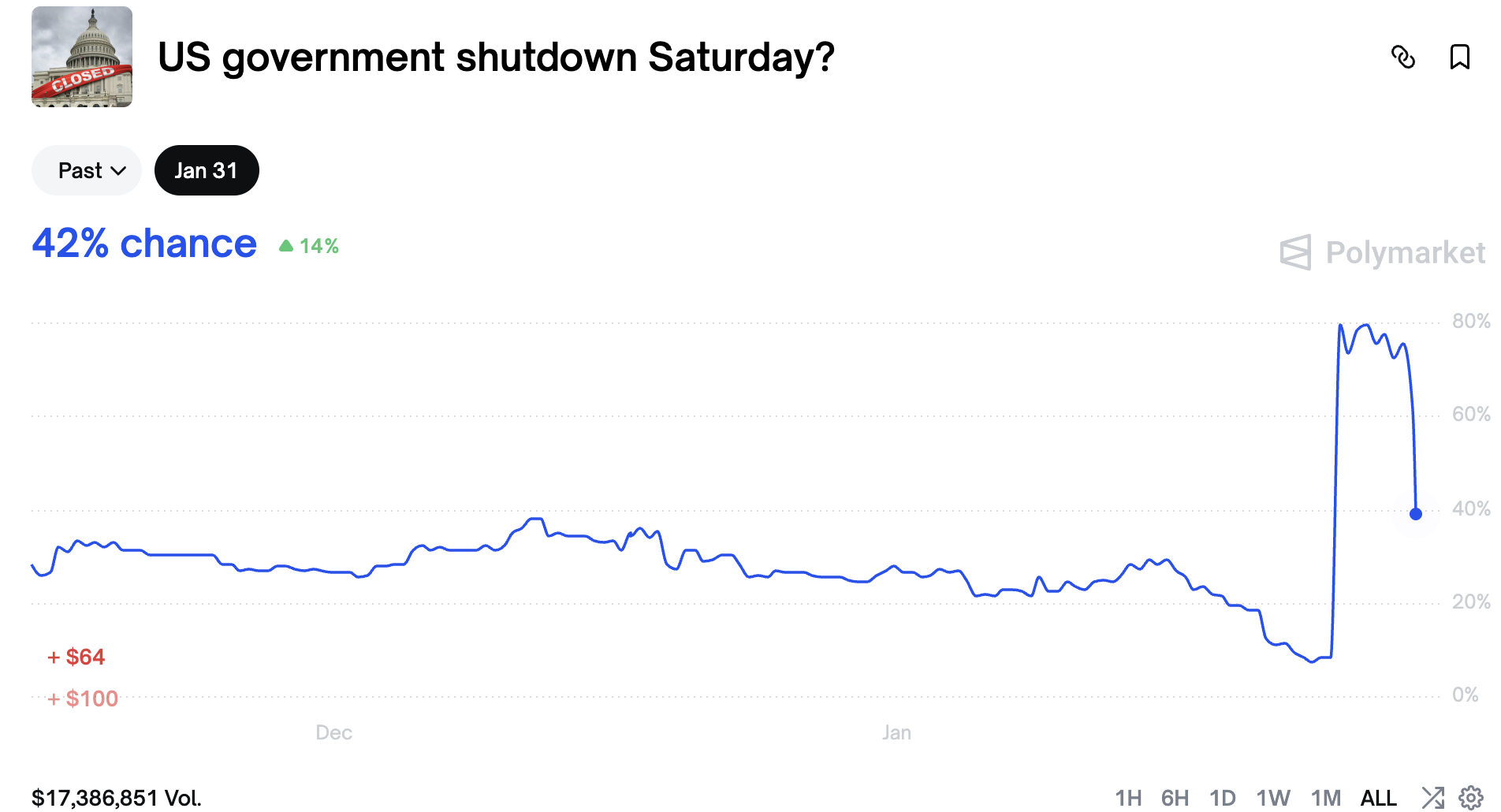
Price changes in prediction markets reflect the results of collective wisdom and博弈. The rising probability that the U.S. government will not shut down at the end of January indicates that people believe the high certainty of a government shutdown suggested by the prediction market probability no longer exists under the current U.S. political situation.

Midterm Elections Are the Key Focus for Both U.S. Parties

On January 28, regarding the risk of another possible U.S. government shutdown, U.S. Treasury Secretary Besant said the situation is still unclear but emphasized that President Trump has urged the Democratic side to avoid this outcome.

This government shutdown crisis is essentially because the Republicans were caught by the Democrats with a political counterattack handle. The shooting death of a U.S. citizen by ICE law enforcement officers in Minnesota on January 24 was essentially a result of the Trump administration's increased immigration enforcement efforts, which also led to large-scale public protests expressing dissatisfaction with the Trump administration. The Democrats reasonably seized this opportunity and used it as an excuse to block the passage of the funding bill in the Senate. Because it reflects the demands of voters, the Democrats' counterattack has taken the political initiative.

The Republicans have thus been put in a passive position. If the U.S. government does shut down as a result, the Democrats could blame all subsequent economic and livelihood problems caused by the shutdown (delayed release of economic data, large-scale flight delays at airports, etc.) on the incompetence of the Republican government.

And this series of possible chain reactions will also affect the issue that both U.S. parties truly care about this year: the U.S. midterm elections.

The U.S. "midterm elections" are held in the second year of a presidential term. All 435 seats in the House of Representatives will be re-elected, and approximately one-third of the seats in the Senate are usually re-elected. Currently, the Republicans hold a majority in both the House (218 seats) and the Senate (53 seats). For the Republicans to maintain their seat advantage after the midterm elections at the end of the year and reduce governance difficulties, they cannot accumulate too many "stains" politically this year.

At the same time, although the midterm elections do not involve the U.S. presidential election, they are also regarded as a "midterm referendum" on the incumbent president, which will affect the president's policy orientation in the latter two years and also reshape the intra-party power structure and the candidate landscape for the next presidential election. Therefore, it is extremely important for Trump as well.

From the above analysis, it can be seen that this government shutdown is no longer a simple funding issue but a political battlefield set up in advance by both U.S. parties for the midterm elections at the end of the year. The Republicans, who are in a passive position, are highly likely to compromise to resolve the crisis and矛盾.

For the Democrats, if the Republicans compromise, it would also be a political victory.

Compromise Is Already Underway

This U.S. government shutdown crisis will not be a "full shutdown" like last October (when all 12 funding bills expired). The scale of the shutdown may be much smaller. Funding for the Commerce Department (responsible for releasing GDP and other data) and the Agriculture Department (responsible for food benefits) has already been secured, but about 78% of federal government functions—involving the remaining 6 funding bills—may face funding cuts.

The Democrats have actually already given the Republicans a way out. Senate Minority Leader Chuck Schumer (D-N.Y.) said on January 28 that Senate Democrats are "prepared to quickly advance five funding bills by the January 30 deadline, separate from the Department of Homeland Security funding bill," which could be a way to avoid a large-scale government shutdown. However, Senate Republicans have not yet agreed to separate the DHS bill from the overall funding package.

On the other hand, it is unrealistic to demand changes to the DHS funding before January 30, as any changes to the remaining six funding bills must be submitted to the House of Representatives for approval, and the House will not reconvene until February 2.

For the Democrats, forcing the U.S. government into a shutdown state by being too rigid about amending the funding bill would not be of much benefit, and the "offensive and defensive态势" with the Republicans could even reverse. Therefore, the current consensus between the two U.S. parties may be to pass a temporary funding bill to first solve the potential government shutdown problem and postpone the矛盾 between the two parties.

And just as Odaily was writing this article speculating that the two parties might compromise to avoid a government shutdown, The New York Times also reported that Trump is reaching a possible agreement with Chuck Schumer to avoid a U.S. government shutdown.

According to two informed officials, under the plan being developed, the Senate would separate one bill from the six spending bills, which is intended to fund the Department of Homeland Security to maintain funding for the military, medical programs, and other federal agencies for the remainder of the fiscal year. The Senate will pass these bills by the Friday midnight deadline, and Congress will also consider a short-term extension of homeland security operations to prevent service disruptions at the TSA, Coast Guard, and Federal Emergency Management Agency.

It is still unclear how this potential agreement will affect this week's funding bill vote, but it at least indicates that the White House and the Senate are working towards resolving the crisis.


Twitter:https://twitter.com/BitpushNewsCN

Bitpush TG Discussion Group:https://t.me/BitPushCommunity

Bitpush TG Subscription: https://t.me/bitpush

Original link:https://www.bitpush.news/articles/7607037

Domande pertinenti

QWhy did the probability of a US government shutdown at the end of January drop significantly?

AThe probability dropped because both political parties recognized that a shutdown could negatively impact the midterm elections. The Republican party, in particular, was in a politically vulnerable position and was likely to compromise to avoid the economic and public backlash associated with a shutdown.

QWhat was the main point of contention between Democrats and Republicans that threatened a government shutdown?

AThe main contention was over funding for the Department of Homeland Security (DHS), specifically related to the Immigration and Customs Enforcement (ICE) agency. Democrats wanted to restrict funding and actions for ICE following a fatal incident in Minnesota, while Republicans defended ICE's role in combating illegal immigration.

QHow are the upcoming US midterm elections connected to the government shutdown crisis?

AThe midterm elections are the key political priority for both parties. A government shutdown would create economic and logistical problems that could be used as political ammunition. Republicans, who control both chambers of Congress, want to avoid any 'stains' on their record to maintain their majority, making them more willing to compromise.

QWhat specific compromise was proposed by Democrats to avoid a full government shutdown?

ASenate Democratic Leader Chuck Schumer proposed separating the Homeland Security funding bill from the other five remaining appropriations bills. This would allow the non-controversial bills to pass quickly before the deadline, avoiding a full shutdown, while negotiations on DHS funding continued.

QWhat was reported that indicated a deal was being made to prevent the shutdown?

AThe New York Times reported that President Trump and Senator Chuck Schumer were working on a potential deal. The plan involved separating the Homeland Security appropriations bill from the others and passing a short-term extension for DHS to prevent service disruptions while a longer-term solution was negotiated.

Letture associate

STAR 50 Soars 10.73%, Why Did A-Shares Stage a "V-Shaped Reversal"?

After a prolonged decline, the Chinese A-share market staged a strong rally on July 21. The STAR 50 index surged 10.73%, its largest single-day gain in nearly a year, leading a broad-based "V-shaped" reversal. The Shanghai Composite Index rose 1.79%, the Shenzhen Component Index gained 4.81%, and the ChiNext Index jumped 7.05%. Total market turnover reached 2.97 trillion yuan, an increase of 256.1 billion yuan from the previous session, with over 3,100 stocks advancing. The semiconductor sector spearheaded the rebound, with related ETFs posting significant gains. Analysts attribute the surge to three converging factors. First, coordinated capital inflows from "national team" institutions, insurance funds, listed company buybacks, and fund house self-purchases have bolstered market liquidity and confidence. Second, supportive policy signals, including commitments from regulators to ensure stable market operations, provided a favorable backdrop. Third, a stabilization and recovery in overseas markets, notably South Korea, created a positive external environment. Institutions suggest the most severe panic selling phase for the tech sector has likely passed, following a significant digestion of crowded positions and leveraged funds. While short-term volatility may persist, the medium to long-term outlook remains underpinned by enduring trends like AI computing demand expansion and semiconductor localization. The market's focus now shifts to the sustainability of supportive fund flows, earnings reports, and upcoming catalysts from the global AI industry chain.

marsbit25 min fa

STAR 50 Soars 10.73%, Why Did A-Shares Stage a "V-Shaped Reversal"?

marsbit25 min fa

U.S. Tech Momentum Stocks Post Largest Single-Day Gain Ever, But Is the Plunge Over?

US tech momentum stocks staged a sharp rebound on Tuesday (July 21st). Morgan Stanley's TMT Momentum Factor surged over 12%, marking its largest single-day gain on record, exceeding even peaks from the 2000 dot-com bubble. Key momentum indices from Goldman Sachs also posted their strongest daily performances in years. The rally was led by semiconductors, with the Philadelphia Semiconductor Index jumping 4.6%. This rebound followed three consecutive down days and a cumulative 33% plunge in momentum stocks, one of the steepest drawdowns since the dot-com era. Analysts attribute the surge largely to a short squeeze. Heavy selling had pushed high-beta momentum stocks into deeply oversold territory, forcing many short sellers, particularly in Asia, to cover their positions, creating a self-reinforcing buying spiral. However, the rebound's internals appear weak. Trading volume was notably low, and advancing stocks still lagged decliners on the S&P 500, indicating a narrow, concentrated rally rather than broad market participation. Diverging views emerge on the outlook. BTIG warns the bounce has hit key resistance and recommends selling into strength, citing extreme volatility and historical parallels to past market tops. Conversely, Goldman Sachs and UBS believe the momentum unwind is nearing its end, suggesting it may be time to gradually add exposure, as positioning has been significantly reduced. They caution, however, that high volatility warrants a measured approach, potentially using defined-risk strategies. The upcoming earnings season, particularly reports from major tech firms like Alphabet, is seen as a critical test for the rally's sustainability. Simultaneously, bond markets flashed a warning, with yields rising partly due to spiking oil prices. Analysts note that if long-term Treasury yields break decisively higher, it could pose a significant headwind for equities, especially growth stocks.

marsbit32 min fa

U.S. Tech Momentum Stocks Post Largest Single-Day Gain Ever, But Is the Plunge Over?

marsbit32 min fa

U.S. Tech Momentum Stocks Record Largest Single-Day Gain Ever, but Has the Rout Ended?

U.S. tech momentum stocks staged a dramatic rebound on Tuesday, July 21st. Key momentum indices like the Morgan Stanley TMT Momentum Factor and Goldman Sachs' High Beta Momentum Long Index posted historic or near-historic single-day gains, fueled largely by semiconductor stocks. This sharp rally followed a severe three-day sell-off that saw momentum stocks plunge 33%, marking one of the steepest pullbacks since the dot-com bubble. Analysts attribute the bounce primarily to a short squeeze, as forced covering from over-leveraged traders, particularly in Asia, created a buying spiral. However, the rally's health is questioned due to weak market breadth—overall trading volume was low, and decliners outnumbered advancers in the S&P 500 despite the index's gain—suggesting a narrow, concentrated surge rather than broad recovery. Opinions on the sustainability diverge. BTIG strategists warn the rebound has hit key resistance levels, citing extreme volatility and historic stock dispersion as signs of an ongoing broader correction, and recommend selling into strength. Conversely, Goldman Sachs and UBS view the aggressive momentum unwinding as nearing its end, noting reduced positioning and a lack of new fundamental catalysts. They suggest the sell-off presents a selective opportunity to add exposure, albeit cautiously and gradually using defined-risk strategies. The immediate trajectory hinges on the ongoing earnings season, with market focus on Alphabet's capital expenditure guidance for AI investment clarity. Meanwhile, bond markets present a risk, with rising Treasury yields—potentially heading toward 5.5%—and widening credit spreads for mega-cap tech companies posing a threat to equity valuations. The combination of technical factors, earnings results, and macro conditions leaves the durability of the rebound in doubt.

链捕手34 min fa

U.S. Tech Momentum Stocks Record Largest Single-Day Gain Ever, but Has the Rout Ended?

链捕手34 min fa

Long-Divided Must Unite, Long-United Must Divide: When L1 Becomes Its Own Rollup, What Is Ethereum's Endgame?

"The Inevitable Cycle: When L1 Becomes Its Own Rollup – What is Ethereum's Endgame?" For years, the Ethereum community grappled with concerns that L2s were fragmenting the ecosystem and eroding L1's value. While L2s provided cheaper execution, they also splintered liquidity and the unified user experience of a single chain. This has prompted a fundamental reassessment of the relationship between L1 and L2. Ethereum's roadmap is evolving. The "Scale" initiative merges L1 and L2 expansion into a holistic framework. L1 itself is advancing with higher gas limits, statelessness, and zkEVM verification, no longer content to be just a low-throughput settlement layer. Consequently, the primary value proposition of L2s is shifting from merely providing cheap blockspace to offering L1 cannot easily provide: application-specific optimizations, privacy features, and flexible governance models. L2s are becoming a spectrum of execution environments with varying degrees of security inheritance from Ethereum. A critical challenge in this multi-chain future is interoperability. The vision is to make Ethereum "feel like one chain again." This relies on advancements in native account abstraction (like EIP-7702) and intent-based architectures (Open Intents Framework), where users declare desired outcomes, and solvers handle the complex cross-chain execution. Furthermore, shortening Ethereum's finality time from minutes to seconds is crucial, as it underpins trust between chains for bridges, stablecoins, and cross-chain applications. Perhaps the most provocative idea is that Ethereum L1 itself could become a form of "its own Rollup." As zkEVM and proof systems mature, high-performance nodes could execute transactions and generate validity proofs. Regular validators would then verify these proofs instead of re-executing all transactions. This blurs the traditional L1/L2 hierarchy, making "Rollup" more of a general execution-verification architecture. Native Rollup aims to integrate L2 validation more directly into the Ethereum protocol, allowing L2s to inherit L1's security more fully and move away from reliance on security councils. In the end, L2s are not destined to replace L1 or be made obsolete by it. The likely future is a unified system where diverse execution environments—each optimized for specific use cases like DeFi, gaming, or privacy—coexist. They will share a common foundation of security, liquidity, and verifiable state, seamlessly connected to restore a cohesive user experience. The next phase for Ethereum is not just about scaling through separation, but about intelligently reintegrating what was separated back into a coherent whole.

链捕手50 min fa

Long-Divided Must Unite, Long-United Must Divide: When L1 Becomes Its Own Rollup, What Is Ethereum's Endgame?

链捕手50 min fa

Trading

Spot
活动图片