New Crypto Market Structure Bill Draft Could Be Ready By Week’s End, Senator Scott Says

bitcoinistPubblicato 2026-03-19Pubblicato ultima volta 2026-03-19

Introduzione

Senator Tim Scott announced that a new draft of the crypto market structure bill (CLARITY Act) could be ready by the end of this week. Speaking at the DC Blockchain Summit 2026, Scott highlighted progress made over the past month, crediting White House involvement for breaking a two-month deadlock. Key issues include controversial policies around DeFi restrictions and stablecoin yield payments, which have caused tension between the banking and crypto industries. The bill previously stalled due to opposition to prohibiting interest payments to passive token holders. Scott expressed optimism, stating that bipartisan efforts are addressing remaining challenges, including DeFi, ethics, and AML regulations. He emphasized the importance of clear legislation and artificial deadlines to maintain momentum.

Senator Tim Scott discussed the impact of digital asset legislation and the progress on the highly anticipated crypto market structure bill on Tuesday, revealing that a fresh draft could be ready by the end of the week.

Crypto Market Structure Bill Sees Progress

Speaking at the DC Blockchain Summit 2026, Senate Banking Committee Chairman Tim Scott highlighted the “powerful impact for good” that the landmark stablecoin legislation, the GENIUS Act, has already had in the market.

Scott emphasized the importance of clear legislation, noting that politicians and bureaucrats often act arbitrarily without any rules of the road. “The market structure gives us the rules of the road for what I believe is going to be the most powerful force for good for kids like me growing up in poverty in a single-parent household,” he stated.

When asked about the status of the crypto market structure bill, known as the CLARITY Act, he humorously said, “Let us pray,” before revealing that significant progress has been made over the past month, largely due to the White House’s involvement.

For context, the crypto market structure bill has been stalled for two months since the Senate Banking Committee published its draft in mid-January. The text included several controversial policies, including significant restrictions for DeFi and the payment of interest on stablecoins.

The latter has become a major point of contention between the banking and crypto industries. As reported by Bitcoinist, the banking side has criticized the GENIUS Act for loopholes that could put the financial system at risk, arguing that allowing interest payments on stablecoins could distort market dynamics.

To address this issue, banks urged lawmakers to include language in the CLARITY Act to ban yield on stablecoins from crypto exchanges, brokers, and related entities, rather than only issuers.

The Senate Banking Committee’s draft proposed that issuers offer rewards for specific actions, such as account openings and cashback. However, it also prohibited interest payments to passive token holders, which ultimately delayed the bill’s January markup session due to backlash.

After weeks of negotiation, the US President’s Council of Advisors on Digital Assets stepped in, holding multiple meetings to negotiate key issues that have stalled the crypto market structure bill.

“I tell you, we have made a lot of progress over the last 30 days. Thank God for the White House getting involved. Patrick Witt has been incredibly helpful,” he told the DC Blockchain Summit.

Following the recent negotiations, Scott explained, lawmakers now have a bipartisan coalition working on “the more important issues that remain undone,” but added that they are making progress “on all the other parts that we don’t hear about,” including issues related to DeFi, ethics, and Anti-Money Laundering (AML).

CLARITY Could Come Soon

Speaking about the proposed deadlines that have not been met throughout the past two months, Scott shared that he had “some artificial deadlines (...) put in place to kind of force the conversation because it had been languishing for too long.”

“We missed lots of my artificial deadlines, but I put them in place so that we would actually have the conversation and create a sense of urgency because I do believe that at some point, politics takes over everything,” he affirmed.

The senator called the stablecoin yield compromise the “largest publicly celebrated challenge” lawmakers and crypto legislation have faced, but affirmed that “big Mo’ momentum is finally on our side, and we are heading in the right direction,” with a new, amended draft for the crypto bill potentially being completed this week.

“I believe that this week we will have the first proposal in my hands to take a look at. And if that actually happens before the end of this week, and I think that it will, we’ll at least know that the sketch looks like the person. And if that’s the case, I think we’re going to be in much better shape”, he concluded.
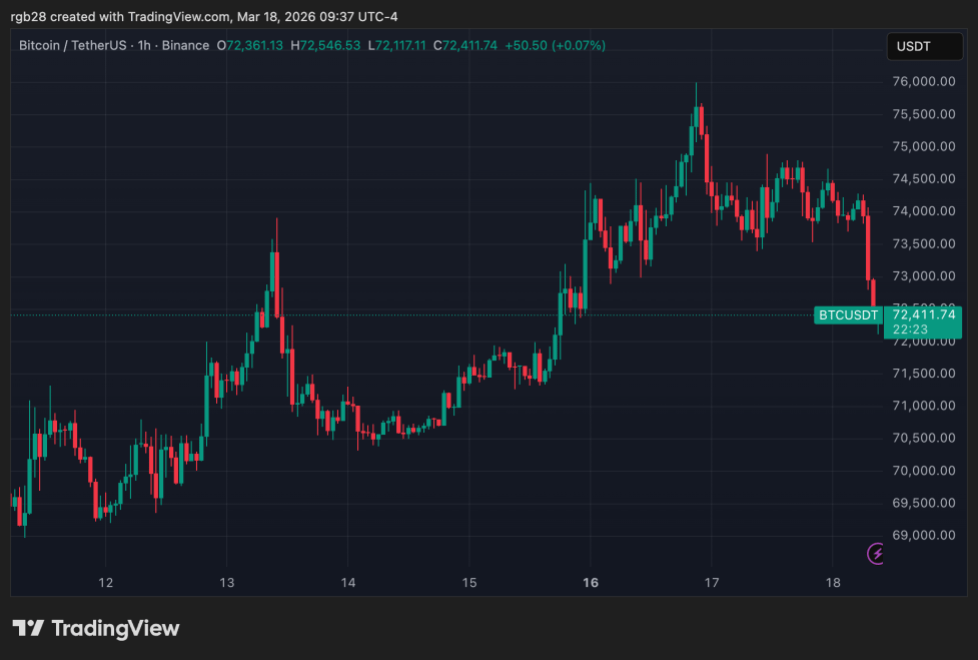
Bitcoin (BTC) trades at $72,411 in the one-week chart. Source: BTCUSDT on TradingView


Domande pertinenti

QWhat is the expected timeline for the new draft of the crypto market structure bill according to Senator Tim Scott?

ASenator Tim Scott stated that a fresh draft of the crypto market structure bill could be ready by the end of the week.

QWhat is the name of the stablecoin legislation mentioned in the article and what impact has it had?

AThe stablecoin legislation mentioned is the GENIUS Act, which has had a 'powerful impact for good' in the market according to Senator Scott.

QWhat was a major point of contention between the banking and crypto industries regarding the CLARITY Act?

AA major point of contention was the payment of interest on stablecoins. The banking industry criticized the GENIUS Act for loopholes and urged lawmakers to ban yield on stablecoins from crypto exchanges, brokers, and related entities, not just issuers.

QWhich key entity stepped in to help negotiate the stalled issues in the crypto market structure bill?

AThe US President’s Council of Advisors on Digital Assets stepped in, holding multiple meetings to negotiate key issues that had stalled the bill.

QWhat did Senator Scott call the 'largest publicly celebrated challenge' for lawmakers and crypto legislation?

ASenator Scott called the stablecoin yield compromise the 'largest publicly celebrated challenge' they have faced.

Letture associate

Hyperliquid, Wall Street's All-Day Trading Convenience Store

**Hyperliquid: Wall Street's 24/7 Trading Convenience Store** Written by Vicky Ge Huang, Wall Street Journal. Hyperliquid, a decentralized crypto trading platform, has become a go-to venue for Wall Street traders, especially during weekends when traditional U.S. markets are closed. Operating 24/7, it allows traders to pre-position or close trades ahead of market opens, capitalizing on events like geopolitical news. The platform, founded by former Hudson River Trading quant Jeff Yan, offers perpetual contracts on a wide range of assets, including Bitcoin, the S&P 500, oil, and even pre-IPO companies like SpaceX. Its growth exemplifies the merging of traditional finance and crypto markets, attracting significant volume from professional traders seeking leverage and constant access. A key differentiator, according to Yan, is user self-custody of assets—a necessity highlighted by the FTX collapse. Despite U.S. regulatory restrictions, some American users reportedly access the platform via VPN, drawn by its ease of use, lack of stringent KYC, and strong community culture on platforms like Discord and X. The platform is not without risks. Perpetual contracts are complex and highly leveraged, leading to massive liquidations during market volatility. Hyperliquid itself saw $10 billion in liquidations during a market crash in October last year. Regulatory warnings emphasize insufficient risk disclosure for retail investors. With about 11 employees, Hyperliquid and its associated blockchain reportedly generated around $800 million in revenue last year. Its native token, HYPE, has surged over 100% since late 2024. The platform plans to expand into prediction markets and options trading, aiming to become a hub for all financial activity.

foresightnews_api3 min fa

Hyperliquid, Wall Street's All-Day Trading Convenience Store

foresightnews_api3 min fa

Former Bankless Member Lucas: Why I Still Bullish on Ethereum

Former Bankless member Lucas explains why he remains bullish on Ethereum despite widespread pessimism. He acknowledges ETH's poor price performance over the past five years compared to Bitcoin and traditional markets, but draws parallels to historical multi-year consolidations seen in tech giants like Amazon and NVIDIA before major breakouts. Fundamentally, Ethereum is stronger than ever: record-high daily transactions (2.27 million in May 2026), significantly lower average gas fees ($0.27), over 400 million total addresses, and more than 32% of ETH staked, securing the network. Lucas's core thesis remains unchanged: all valuable assets will eventually be tokenized, Ethereum will become the primary settlement layer for these assets, and ETH will capture the resulting value. This transition is already underway. Stablecoins, the first proven tokenized real-world asset (RWA), have a $300+ billion market cap, with 54% settled on Ethereum. The broader RWA sector has surpassed $30 billion, with over 53% deployed on Ethereum. He compares the current RWA adoption phase to early DeFi in 2019-20, suggesting immense growth potential. Key catalysts like the potential passage of the U.S. CLARITY Act in 2026 could accelerate institutional adoption. While other blockchains will share the market, Lucas argues that traditional finance prioritizes Ethereum's security, stability, and established ecosystem for trillion-dollar asset tokenization. He concludes that as global assets migrate on-chain, the market will reprice ETH accordingly.

foresightnews_api7 min fa

Former Bankless Member Lucas: Why I Still Bullish on Ethereum

foresightnews_api7 min fa

Trump's 'Bitcoin Retirement Plan' Hits Roadblock: Democrats Claim It Endangers American Workers' Pensions?

Democratic Senators Bernie Sanders (I-VT) and Elizabeth Warren (D-MA), along with Rep. Bobby Scott (D-VA), are urging the Labor Department to repeal a proposed rule that would open U.S. retirement savings accounts, like 401(k) plans, to investments in Bitcoin and other cryptocurrencies. In a letter to Acting Labor Secretary Keith Sonderling, they argue the rule would endanger workers' financial futures and contradicts long-standing legal precedents under the Employee Retirement Income Security Act (ERISA). The rule, stemming from a Trump executive order, would shift the legal standard for plan fiduciaries. Instead of requiring them to prove they conducted due diligence on volatile assets, it would presume prudence if they followed a specified process. The lawmakers warn this exposes the $14.2 trillion in 401(k) savings to highly volatile and less-regulated assets, citing FINRA warnings on crypto's risks and FBI data on massive crypto scam losses. The letter also alleges a conflict of interest, noting that President Trump's adult children manage the family's crypto business, which has raised billions. They claim the rule could allow the Trump family to profit at the expense of workers and retirees. Consumer advocates echo concerns that it could turn retirement savings into a lifeline for a risky industry. The Trump administration defends the rule as expanding worker choice, with officials stating it ends the department "picking winners and losers" and requires fiduciaries to follow a prudent process.

foresightnews_api10 min fa

Trump's 'Bitcoin Retirement Plan' Hits Roadblock: Democrats Claim It Endangers American Workers' Pensions?

foresightnews_api10 min fa

Rules Change Mid-Game, Polymarket’s Billion-Dollar Bitcoin Prediction Market Mired in Settlement Controversy

A nearly $150 million prediction market contract on Polymarket is in turmoil after the platform refused to settle in favor of traders who correctly predicted that MicroStrategy (now Strategy) would sell Bitcoin. The core dispute revolves around a sale of 32 BTC, which occurred between May 26-31 but was officially disclosed in an SEC 8-K filing on June 1. The original contract stated it would resolve to "Yes" if Strategy sold any Bitcoin before May 31, 11:59 PM ET, using public disclosures and on-chain data as proof. After the filing on June 1, traders who saw the disclosure rushed to buy "Yes" contracts, believing it was conclusive evidence. However, Polymarket's operators later added a rule that the disclosure itself must occur by the deadline, not just the transaction, invalidating the filing as proof. This retroactive rule change has sparked accusations of market manipulation, leaving traders like "willo2," who invested $527,000, facing total losses. The controversy highlights a deeper structural flaw in Polymarket's decentralized settlement system, which relies on UMA's optimistic oracle. Disputed resolutions are ultimately decided by a vote among UMA token holders, a mechanism critics say is vulnerable to manipulation by large holders ("whales") who can vote in their own financial interest rather than on objective facts. Data suggests a high concentration of voting power and significant overlap between voters and Polymarket traders. The dispute emerges as prediction markets like Polymarket and Kalshi are experiencing massive growth and seeking mainstream financial legitimacy, having recently secured regulatory approval from the U.S. CFTC. However, the incident underscores the unresolved tension between decentralized, token-vote-based settlement and the need for transparent, rules-based outcomes in high-stakes financial contracts.

foresightnews_api13 min fa

Rules Change Mid-Game, Polymarket’s Billion-Dollar Bitcoin Prediction Market Mired in Settlement Controversy

foresightnews_api13 min fa

Trading

Spot
Futures
活动图片