Kyle Criticizes Hyperliquid Four Days After Leaving, Arthur Hayes Responds with a $100,000 Bet

marsbitPubblicato 2026-02-09Pubblicato ultima volta 2026-02-09

Introduzione

In the midst of a market downturn, Hyperliquid ($HYPE) has nearly doubled in value since January, drawing both praise and criticism. Kyle Samani, the recently departed co-founder of Multicoin Capital, publicly criticized the project, calling it representative of crypto's classic problems: founders "fleeing their home country," facilitating crime, being closed-source, and permissioned. Arthur Hayes, BitMEX co-founder, responded not by addressing the criticisms but by proposing a $100,000 bet: that HYPE would outperform any large-cap crypto of Kyle’s choosing from February 10th to July 31st. Kyle did not accept the wager, aligning with his earlier, since-deleted tweet expressing that crypto is "not as interesting as many thought." The article dissects Kyle's critiques, noting that Hyperliquid's operational structure (offshore entity, U.S. user ban) is standard industry practice. It suggests his harsh tone may stem from a personal desire to distance himself from the industry post-departure, contrasting with his former firm, Multicoin, which was revealed to have built a significant $46 million position in HYPE around the time of his exit. The exchange highlights a classic crypto divide: those who have left the "table" often critique from an ethical standpoint ("should"), while those still invested argue primarily with price action ("will it pump"). The discussion quickly devolved into personal attacks about wealth and portfolio performance, underscoring how deeply entrenched f...

Author: David, Shenchao TechFlow

There aren't many projects worth mentioning in this downturn, but Hyperliquid is one of them.

$HYPE has nearly doubled from its January low. No matter how you view this project, the market is voting. But Kyle Samani, the former co-founder of Multicoin, voted against it.

On February 8th, Blockworks Research published a report stating that Hyperliquid's silver contracts have begun competing head-to-head with traditional futures exchanges like CME in terms of spreads and execution.

Many in the circle shared it, seeing it as a sign that on-chain finance is finally starting to bite into traditional finance's turf.

But Kyle poured cold water on it.
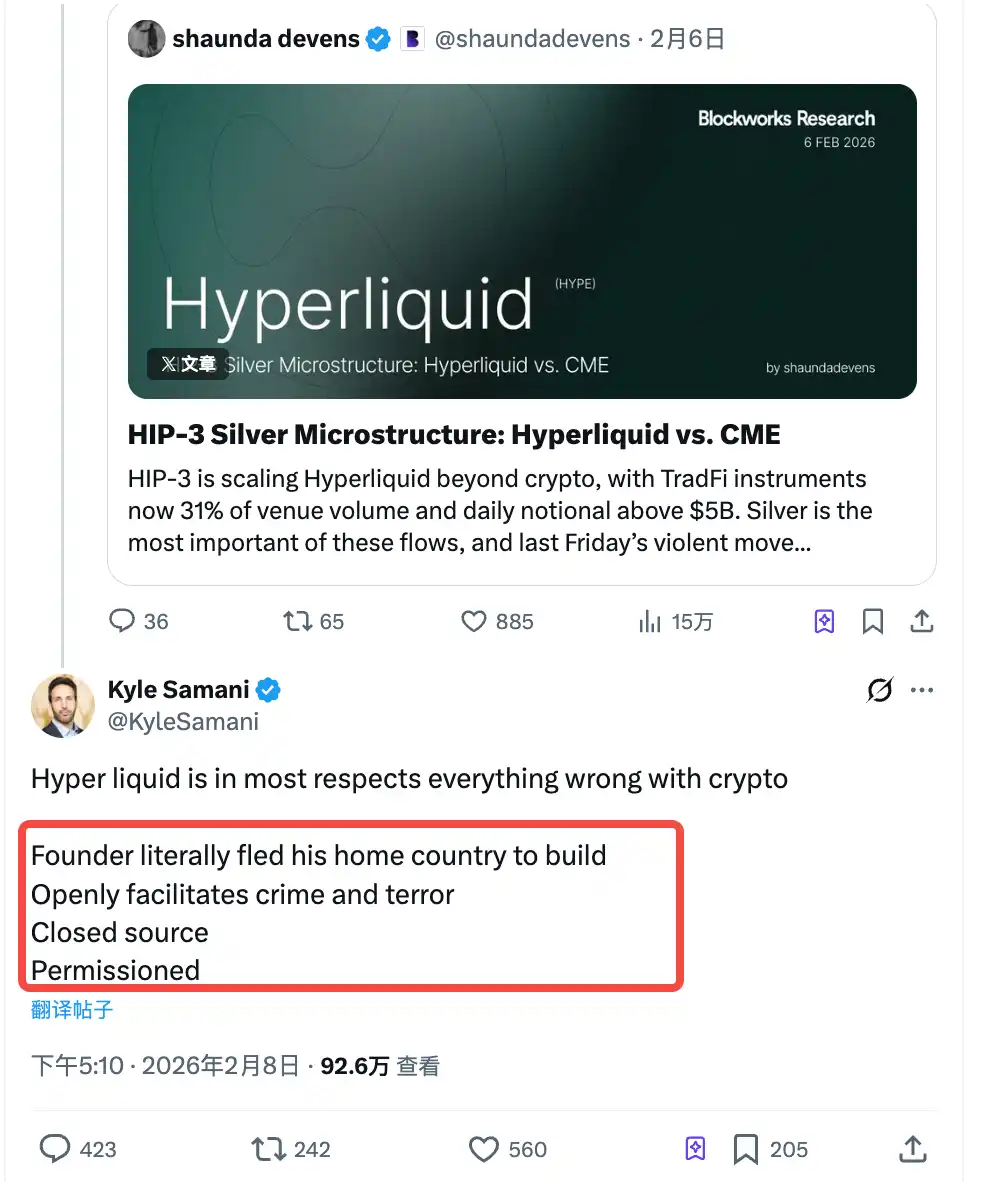
He believes that Hyperliquid represents almost all the classic problems of the crypto industry:

  • The founders fled their home country to build this project
  • The platform openly facilitates crime and terrorist activities
  • The code is closed-source
  • The product operates with permissions, not fully open

In the past, this kind of statement would have been a common project attack on Crypto Twitter.

But don't forget, just four days ago, Kyle announced his departure from Multicoin Capital (Reference reading: Kyle Left the Crypto Industry, I'm a Bit Sad), and before the departure announcement, he posted a since-deleted tweet:

"Crypto isn't as fun as many people (including myself) once thought."

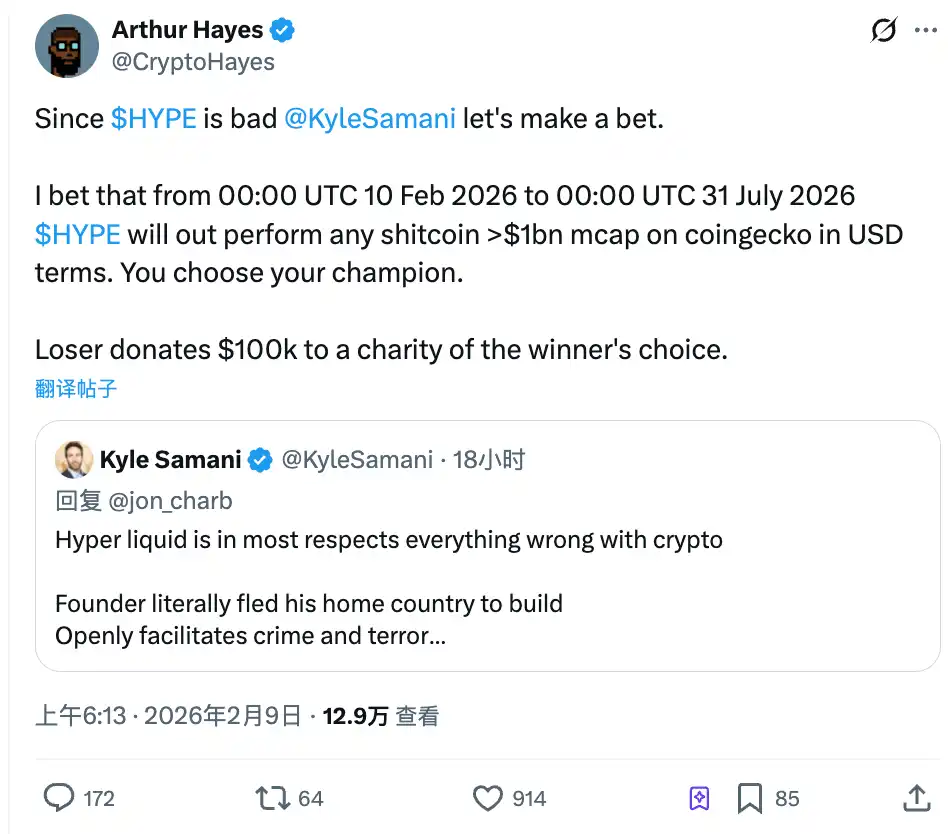
Old acquaintance Arthur Hayes clearly disagreed with this assessment, and he directly expressed his confidence in HYPE after Kyle's comments:

"Since you think HYPE is so bad, let's make a bet. From February 10th to July 31st, HYPE outperforms any coin with a market cap over $1 billion that you choose. The loser donates $100,000 to the winner's chosen charity. You pick the coin, I'm only betting HYPE wins."
Criticism, Leaving the Table

As of publication, Kyle has not accepted Arthur's bet and likely won't.

Someone who just said "crypto isn't as fun anymore" is unlikely to sit back down at the table to compare whose coin pumps more.

But Kyle's accusations against Hyperliquid are worth discussing.

For example, "the founders fled their home country." Hyperliquid founder Jeff Yan grew up in Palo Alto, California, graduated from Harvard, and previously worked as a quant at the high-frequency trading firm Hudson River Trading.

The team is based in Singapore, the company is registered in the Cayman Islands, and the platform blocks US users.

This structure is used by everyone from Binance to dYdX. Having been in this industry for nearly a decade, Kyle must know this is standard practice for offshore compliance.

Calling it "fleeing his homeland" seems a bit deliberate for someone who grew up in Palo Alto.

The points about being closed-source, permissioned, and facilitating crime aren't without merit, but in the past, Kyle might not have publicly stated such criticism. When he was at Multicoin, his job was to find, invest in, and promote projects; these gray areas were an unspoken cost everyone in the industry understood.

The change is that Kyle is no longer in that position.

What one sees after leaving the table is different from what one sees while sitting at it.

Pumping, No Need for Words

On the other hand, note that Arthur Hayes did not refute any of Kyle's accusations. He didn't defend Hyperliquid's closed-source nature, nor did he explain why Jeff Yan moved to Singapore.

His response was simply a price bet.

This is familiar crypto logic: pumping equals a good product. Choosing to respond with price is because, for those still working in this industry full-time, price is the only language that matters.

You say Hyperliquid has moral flaws, he says HYPE will outperform any large-cap altcoin in five months.

These two statements seem to be about the same thing but are actually on completely different planes.

Kyle is talking about "should or shouldn't," Hayes is talking about "will it pump or not."

This kind of talking past each other happens every cycle in the crypto space. Every time the market reaches its mid-to-late stages or a bear market, a group of people stands up and says the industry has problems, and those still at the table always respond with the same phrase:

Then look at the price.

Token price is the most convenient weapon for players still in the game because, as long as it's rising, all criticism can be temporarily set aside.

The problem is, Kyle might not be entirely an insider anymore. For a fund's co-founder to publicly express disillusionment with the entire industry just before formally resigning isn't quite appropriate in any circle.

The post was deleted, but the sentiment remains.

His current criticism of Hyperliquid, with its tone of leaving no room for doubt, seems less like criticizing a project and more like cutting ties with certain aspects of his past eight years.

However, while he personally can cut ties, Multicoin itself is still in the game.
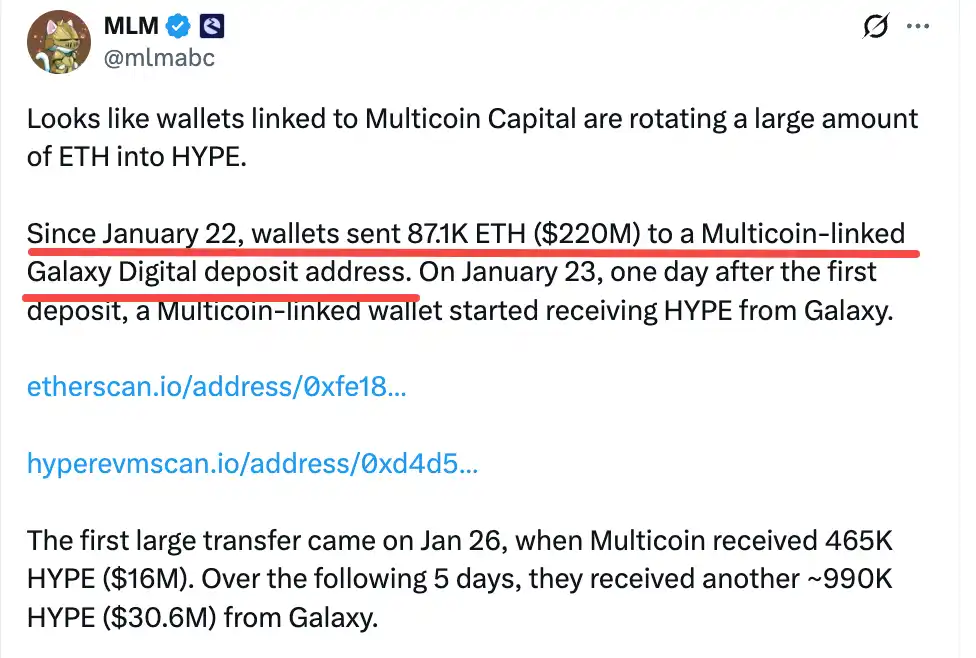
Starting November 22nd of this year, on-chain analysts discovered that a wallet疑似 associated with Multicoin deposited approximately 87,000 ETH to Galaxy Digital, and began buying HYPE in 17 transactions the next day, totaling about $46 million.

This means that around the time Kyle was leaving Multicoin, his former fund was making large investments in the project he just harshly criticized.

17 separate purchase transactions most likely mean someone within Multicoin made a judgment call and took action.

Kyle thinks Hyperliquid represents all the problems of the crypto industry, but at least someone at Multicoin thinks it's worth voting for with real money. Holding it is an attitude in itself.

Kyle left, but his old employer's money might have sat down. And it sat down at the very table Kyle despises the most.

Beyond the Arthur and Kyle showdown, the reactions in the comments are also interesting.

A Hyperliquid community user named Max dug up an old post he made in September 2024. The background of that post was that people were questioning Multicoin's operations in the circle. Max criticized Kyle back then, roughly saying:

"You're always trying to use LPs' money to chase the beta returns of your heavily invested assets, while also helping to pump your own investment portfolio."

A year and a half later, with Kyle now criticizing Hyperliquid, Max believes the套路 hasn't really changed:

Kyle is still the same Kyle, always criticizing others through the lens of his own portfolio. Defending Solana back then, sour on Hyperliquid now—the root lies in Multicoin's ecosystem interests and competitive anxiety.

Kyle couldn't help himself and directly replied with a characteristically crypto "wealth flex":The money I've directly invested in crypto is at least 10 times the total sum of your entire life.
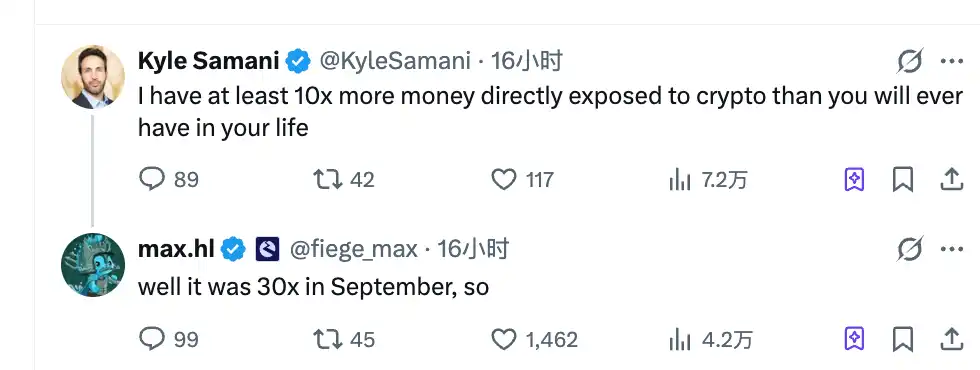
And Max's follow-up jab hit the mark perfectly,In September last year, your assets might have been 30 times mine...

From September 2025 to February 2026, the market experienced several fluctuations. Multicoin, which Kyle previously represented, clearly saw its crypto assets shrink significantly; meanwhile, Hyperliquid has remained relatively resilient.

Position never exists separately from portfolio.

When a project begins to threaten the traffic and valuation of an existing ecosystem, criticism is quickly labeled as "conflict of interest"; conversely, defenders retaliate with "you're just jealous."

In this wave, Kyle wanted to attack Hyperliquid from the high ground of morality and decentralization purity, but was easily pulled back into the jungle law of "whoever makes money is right" by his opponent.

In the end, rational discussion is drowned out by tribal狂欢, leaving only screenshots and memes.

Every cycle is like this. Some people sit down, some people stand up. Those sitting down talk about price, those standing up talk about morality.

But whether one sees the problems first and then becomes disillusioned with the industry, or becomes disillusioned first and then sees the problems, the order is actually unclear.

Regardless of whether HYPE rises or falls five months from now, Kyle probably won't care. He's already looking at other things.


Domande pertinenti

QWhat were Kyle Samani's main criticisms of Hyperliquid?

AKyle Samani criticized Hyperliquid on several fronts: its founders 'fled their home country' to build the project, the platform publicly facilitates crime and terrorist activities, its code is closed-source, and the product operates with permissions and is not fully open.

QHow did Arthur Hayes respond to Kyle Samani's criticism of Hyperliquid?

AArthur Hayes did not address the specific criticisms. Instead, he proposed a $100,000 bet, wagering that the HYPE token would outperform any cryptocurrency with a market cap over $1 billion that Kyle chose from February 10th to July 31st, with the loser donating to the winner's chosen charity.

QWhat was the context of Kyle Samani's comments, given his recent professional move?

AKyle Samani had just announced his departure from Multicoin Capital four days prior. Before the official announcement, he posted (and then deleted) a tweet stating, 'Crypto is not as interesting as many people (including myself) once thought it was,' indicating a sense of disillusionment with the industry.

QWhat does the article suggest is the fundamental difference in perspective between Kyle Samani and those still 'at the table' like Arthur Hayes?

AThe article suggests Kyle is arguing from a perspective of 'should' or 'should not'—focusing on moral and ideological flaws in the project and industry. In contrast, those like Hayes are arguing from a perspective of 'will it go up'—where price performance is the only meaningful metric, and all criticisms can be sidelined if the asset appreciates.

QWhat ironic detail does the article reveal about Multicoin Capital's actions regarding Hyperliquid?

ADespite Kyle's public criticism, the article reveals that around November 22nd of the previous year, a wallet linked to Multicoin Capital deposited a large amount of ETH and then made 17 separate purchases of HYPE tokens totaling approximately $46 million, indicating his former firm had taken a significant bullish position in the project he was attacking.

Letture associate

STAR 50 Soars 10.73%, Why Did A-Shares Stage a "V-Shaped Reversal"?

After a prolonged decline, the Chinese A-share market staged a strong rally on July 21. The STAR 50 index surged 10.73%, its largest single-day gain in nearly a year, leading a broad-based "V-shaped" reversal. The Shanghai Composite Index rose 1.79%, the Shenzhen Component Index gained 4.81%, and the ChiNext Index jumped 7.05%. Total market turnover reached 2.97 trillion yuan, an increase of 256.1 billion yuan from the previous session, with over 3,100 stocks advancing. The semiconductor sector spearheaded the rebound, with related ETFs posting significant gains. Analysts attribute the surge to three converging factors. First, coordinated capital inflows from "national team" institutions, insurance funds, listed company buybacks, and fund house self-purchases have bolstered market liquidity and confidence. Second, supportive policy signals, including commitments from regulators to ensure stable market operations, provided a favorable backdrop. Third, a stabilization and recovery in overseas markets, notably South Korea, created a positive external environment. Institutions suggest the most severe panic selling phase for the tech sector has likely passed, following a significant digestion of crowded positions and leveraged funds. While short-term volatility may persist, the medium to long-term outlook remains underpinned by enduring trends like AI computing demand expansion and semiconductor localization. The market's focus now shifts to the sustainability of supportive fund flows, earnings reports, and upcoming catalysts from the global AI industry chain.

marsbit25 min fa

STAR 50 Soars 10.73%, Why Did A-Shares Stage a "V-Shaped Reversal"?

marsbit25 min fa

U.S. Tech Momentum Stocks Post Largest Single-Day Gain Ever, But Is the Plunge Over?

US tech momentum stocks staged a sharp rebound on Tuesday (July 21st). Morgan Stanley's TMT Momentum Factor surged over 12%, marking its largest single-day gain on record, exceeding even peaks from the 2000 dot-com bubble. Key momentum indices from Goldman Sachs also posted their strongest daily performances in years. The rally was led by semiconductors, with the Philadelphia Semiconductor Index jumping 4.6%. This rebound followed three consecutive down days and a cumulative 33% plunge in momentum stocks, one of the steepest drawdowns since the dot-com era. Analysts attribute the surge largely to a short squeeze. Heavy selling had pushed high-beta momentum stocks into deeply oversold territory, forcing many short sellers, particularly in Asia, to cover their positions, creating a self-reinforcing buying spiral. However, the rebound's internals appear weak. Trading volume was notably low, and advancing stocks still lagged decliners on the S&P 500, indicating a narrow, concentrated rally rather than broad market participation. Diverging views emerge on the outlook. BTIG warns the bounce has hit key resistance and recommends selling into strength, citing extreme volatility and historical parallels to past market tops. Conversely, Goldman Sachs and UBS believe the momentum unwind is nearing its end, suggesting it may be time to gradually add exposure, as positioning has been significantly reduced. They caution, however, that high volatility warrants a measured approach, potentially using defined-risk strategies. The upcoming earnings season, particularly reports from major tech firms like Alphabet, is seen as a critical test for the rally's sustainability. Simultaneously, bond markets flashed a warning, with yields rising partly due to spiking oil prices. Analysts note that if long-term Treasury yields break decisively higher, it could pose a significant headwind for equities, especially growth stocks.

marsbit32 min fa

U.S. Tech Momentum Stocks Post Largest Single-Day Gain Ever, But Is the Plunge Over?

marsbit32 min fa

U.S. Tech Momentum Stocks Record Largest Single-Day Gain Ever, but Has the Rout Ended?

U.S. tech momentum stocks staged a dramatic rebound on Tuesday, July 21st. Key momentum indices like the Morgan Stanley TMT Momentum Factor and Goldman Sachs' High Beta Momentum Long Index posted historic or near-historic single-day gains, fueled largely by semiconductor stocks. This sharp rally followed a severe three-day sell-off that saw momentum stocks plunge 33%, marking one of the steepest pullbacks since the dot-com bubble. Analysts attribute the bounce primarily to a short squeeze, as forced covering from over-leveraged traders, particularly in Asia, created a buying spiral. However, the rally's health is questioned due to weak market breadth—overall trading volume was low, and decliners outnumbered advancers in the S&P 500 despite the index's gain—suggesting a narrow, concentrated surge rather than broad recovery. Opinions on the sustainability diverge. BTIG strategists warn the rebound has hit key resistance levels, citing extreme volatility and historic stock dispersion as signs of an ongoing broader correction, and recommend selling into strength. Conversely, Goldman Sachs and UBS view the aggressive momentum unwinding as nearing its end, noting reduced positioning and a lack of new fundamental catalysts. They suggest the sell-off presents a selective opportunity to add exposure, albeit cautiously and gradually using defined-risk strategies. The immediate trajectory hinges on the ongoing earnings season, with market focus on Alphabet's capital expenditure guidance for AI investment clarity. Meanwhile, bond markets present a risk, with rising Treasury yields—potentially heading toward 5.5%—and widening credit spreads for mega-cap tech companies posing a threat to equity valuations. The combination of technical factors, earnings results, and macro conditions leaves the durability of the rebound in doubt.

链捕手34 min fa

U.S. Tech Momentum Stocks Record Largest Single-Day Gain Ever, but Has the Rout Ended?

链捕手34 min fa

Long-Divided Must Unite, Long-United Must Divide: When L1 Becomes Its Own Rollup, What Is Ethereum's Endgame?

"The Inevitable Cycle: When L1 Becomes Its Own Rollup – What is Ethereum's Endgame?" For years, the Ethereum community grappled with concerns that L2s were fragmenting the ecosystem and eroding L1's value. While L2s provided cheaper execution, they also splintered liquidity and the unified user experience of a single chain. This has prompted a fundamental reassessment of the relationship between L1 and L2. Ethereum's roadmap is evolving. The "Scale" initiative merges L1 and L2 expansion into a holistic framework. L1 itself is advancing with higher gas limits, statelessness, and zkEVM verification, no longer content to be just a low-throughput settlement layer. Consequently, the primary value proposition of L2s is shifting from merely providing cheap blockspace to offering L1 cannot easily provide: application-specific optimizations, privacy features, and flexible governance models. L2s are becoming a spectrum of execution environments with varying degrees of security inheritance from Ethereum. A critical challenge in this multi-chain future is interoperability. The vision is to make Ethereum "feel like one chain again." This relies on advancements in native account abstraction (like EIP-7702) and intent-based architectures (Open Intents Framework), where users declare desired outcomes, and solvers handle the complex cross-chain execution. Furthermore, shortening Ethereum's finality time from minutes to seconds is crucial, as it underpins trust between chains for bridges, stablecoins, and cross-chain applications. Perhaps the most provocative idea is that Ethereum L1 itself could become a form of "its own Rollup." As zkEVM and proof systems mature, high-performance nodes could execute transactions and generate validity proofs. Regular validators would then verify these proofs instead of re-executing all transactions. This blurs the traditional L1/L2 hierarchy, making "Rollup" more of a general execution-verification architecture. Native Rollup aims to integrate L2 validation more directly into the Ethereum protocol, allowing L2s to inherit L1's security more fully and move away from reliance on security councils. In the end, L2s are not destined to replace L1 or be made obsolete by it. The likely future is a unified system where diverse execution environments—each optimized for specific use cases like DeFi, gaming, or privacy—coexist. They will share a common foundation of security, liquidity, and verifiable state, seamlessly connected to restore a cohesive user experience. The next phase for Ethereum is not just about scaling through separation, but about intelligently reintegrating what was separated back into a coherent whole.

链捕手51 min fa

Long-Divided Must Unite, Long-United Must Divide: When L1 Becomes Its Own Rollup, What Is Ethereum's Endgame?

链捕手51 min fa

Trading

Spot
活动图片




