Hoskinson Warns Cardano Could Lose Its ‘Science Coin’ Edge

bitcoinistPubblicato 2026-05-21Pubblicato ultima volta 2026-05-21

Introduzione

Charles Hoskinson warns that Cardano risks losing its identity as the "science coin" if DReps fail to approve a key research funding proposal. He explains the ecosystem is in "treasury season" with a tougher funding environment, requesting $52 million this year versus $98 million last year, leading to cuts and layoffs. Hoskinson argues Cardano's research program is its "spine and backbone," responsible for its differentiation through work on proof-of-stake, extended UTXO, Plutus, and academic collaborations. He rejects calls to selectively fund parts of the research group, warning that treating researchers as commodities could lead to an irreplaceable talent drain to better-funded rivals. Hoskinson ties research funding to Cardano's long-term investment case, stating that without it, the project would lose a core value proposition. He ends with a direct appeal to DReps to vote for the proposal, calling it a necessary foundation for Cardano's future.

Charles Hoskinson has urged Cardano DReps to back a research funding proposal, warning that a failure to do so could damage one of the network’s core value propositions: its identity as a research-led blockchain.

Speaking in a May 21 livestream from England, Hoskinson said Cardano is in “treasury season” and facing a tougher funding environment than last year. According to him, the ecosystem is asking for about $52 million in funding this year, down from roughly $98 million last year, after cuts that have already affected engineers and community teams.

“Many people have had to make profound sacrifices,” Hoskinson said. “Good people have had to go. Engineers have been let go. Community teams liquidating familiar faces and new faces alike.”

But the proposal that drew his strongest concern was research. Hoskinson said he had seen a “disturbing trend” of some DReps voting against funding Cardano’s research group, despite what he described as its foundational role in the network’s development.

Hoskinson Defends Cardano’s Research Core

Hoskinson framed the debate as larger than a budget dispute. In his view, Cardano’s long-running research program is the “spine and backbone” of the ecosystem and a key reason the project has differentiated itself from other major blockchains.

“The spine and backbone of what makes Cardano Cardano has always been and will always be the fact that we’re the science coin,” he said. “We’re the research coin. Over the last 10 years, hundreds of millions of dollars has been spent, and countless hundreds of researchers have been involved in the production of the largest research group in the world for cryptocurrencies.”

He pointed to Cardano’s work on proof-of-stake research, extended UTXO, Plutus, sidechains and Bitcoin-related DeFi research as examples of the group’s output. He also argued that the network’s academic ties, spanning institutions such as Stanford, the University of Edinburgh, the University of Wyoming and others, are not easily replaceable.

Hoskinson said critics of the proposal have argued that research funding should be broken apart, allowing the ecosystem to “pick and choose” which areas or people to keep. He rejected that framing, saying it would force the ecosystem into decisions it is not equipped to make without damaging the research operation as a whole.

“So then I asked the DReps, which scientists would you like me to fire?” he said, before naming several researchers associated with Cardano’s technical development. “And if not people, perhaps institutions. Which institutions would you like to shut down? And because you’re so qualified, which research agendas do you so feel are unnecessary?”

Warning Over Talent Flight

A major part of Hoskinson’s argument was that Cardano’s researchers could be recruited by better-funded rival ecosystems if the project signals that their work is no longer valued. He said other blockchains with large treasuries would likely be interested in the same cryptographers, programming language experts and distributed systems researchers.

“If you treat these people like commodities, they will leave,” Hoskinson said. “They’ll leave to other ecosystems that have a lot more money and are willing to pay a lot more with better stability and certainty.”

He warned that the loss would not be easily reversible. Academic and technical talent, he argued, depends on long-term stability, and once researchers move on to other ecosystems, Cardano may not be able to bring them back. “We can’t recover this. It’s a one-way door. If you lose your best and brightest, we won’t get them back. We don’t get to say we’re sorry.”

Hoskinson also tied the issue to market perception. He asked what Cardano’s investment case would look like over the next three to five years if the ecosystem signaled it was no longer willing to support research. Without that layer, he suggested, Cardano would have to lean more heavily on metrics such as monthly active users, TVL or transaction volume.

The livestream ended as a direct appeal to DReps who have not yet voted and to those who have voted against the proposal. Hoskinson asked them to reconsider, saying research funding is not a discretionary line item but part of Cardano’s long-term competitive position.

“You can’t walk without a spine,” he said. “Please vote for science. Please vote for the research proposal for IOG. It’s a necessary foundational proposal, and we can’t afford to lose it.”

At press time, ADA traded at $0.2499.
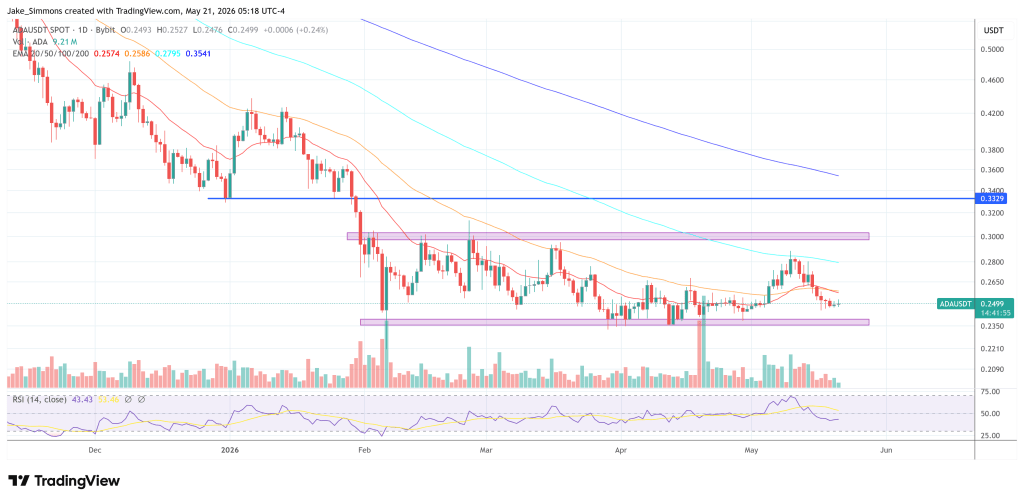
ADA remains in sideways trend, 1-day chart | Source: ADAUSDT on TradingView.com

Domande pertinenti

QAccording to Hoskinson, what is the core identity of Cardano that is at risk?

AAccording to Hoskinson, Cardano's core identity at risk is being the 'science coin' or the research-led blockchain, which he describes as the 'spine and backbone' of the ecosystem.

QWhat is the potential consequence if Cardano's DReps vote against the research funding proposal, as warned by Hoskinson?

AHoskinson warns that voting against the research funding could lead to a talent flight, where Cardano's researchers would leave for better-funded rival ecosystems. This loss would be irreversible and would damage Cardano's long-term competitive position and investment case.

QHow much funding is the Cardano ecosystem asking for this year, and how does it compare to last year?

AThe Cardano ecosystem is asking for about $52 million in funding this year, which is down from roughly $98 million last year.

QWhat examples does Hoskinson give to demonstrate the output of Cardano's research group?

AHoskinson points to Cardano's work on proof-of-stake research, extended UTXO, Plutus, sidechains, and Bitcoin-related DeFi research as examples of the research group's output.

QWhat does Hoskinson say critics of the research funding proposal have argued, and how does he respond?

AHoskinson says critics argue that research funding should be broken apart, allowing the ecosystem to 'pick and choose' which areas or people to fund. He rejects this, stating it would force the ecosystem into decisions it is not equipped to make and would damage the research operation as a whole, challenging critics to name which specific scientists or institutions they would cut.

Letture associate

Detained for 37 Days: The First Wave of People Who Got Rich from 'AI Gateways' Are Starting to Go to Jail

A prominent AI proxy service operator was reportedly detained for 37 days and is now on bail pending trial, highlighting the legal risks in China's booming but unregulated AI intermediary market. These services act as "AI scalpers," providing domestic users with access to restricted overseas models (like OpenAI, Claude) by bundling APIs, handling payments, and bypassing network blocks, all for a fee. Their controversial profitability stems from practices like bulk-registering accounts to resell free credits, exploiting refund policies, overcharging for tokens, substituting cheaper models, and illegally selling user conversation data. Major figures, including cryptocurrency entrepreneurs, are now entering this space. Legally, these operations face severe risks. Their core model often involves unauthorized API access and operating without required telecom licenses, potentially constituting illegal business operations. They fail to meet data security obligations for the vast amounts of user data they process, risking charges for failing to fulfill network security duties. Crucially, the unauthorized collection and sale of user data, which can include personal and commercial secrets, easily meets the threshold for the crime of infringing on personal information. The case underscores a critical juncture for the AI industry. While proxies lower access barriers, they expose user data to unsecured middlemen and undermine the business models of AI developers, forcing them to divert resources to security and distorting market value perceptions. The article argues that the industry's sustainable future depends on building trust, protecting data, and fostering compliant competition, moving away from its current "wild growth" phase.

marsbit2 h fa

Detained for 37 Days: The First Wave of People Who Got Rich from 'AI Gateways' Are Starting to Go to Jail

marsbit2 h fa

Putting Markets On-Chain: Canton Network Quietly Becomes the New Backbone of Institutional Finance

**Title: Letting the Market Itself Go On-Chain: Canton Network Quietly Becomes the New Backbone for Institutional Finance** **Summary:** The Canton Network, a blockchain platform designed for institutional finance, is gaining significant traction. A key sign of its maturity was Visa's recent entry as a super-validator, a proposal approved in just three days—highlighting prior, extensive collaboration between traditional finance and crypto. Unlike public chains like Ethereum that prioritize transparency and asset onboarding, Canton focuses on enabling confidential, compliant business operations for regulated institutions. Its core design features built-in **data visibility control**, meaning transaction details are only shared between direct counterparties. This privacy is fundamental, allowing competing institutions (like banks Goldman Sachs, JPMorgan, and BNP Paribas, all validators) to interact on the same network without exposing sensitive positions or strategies. Developed by Wall Street veterans at Digital Asset, Canton has taken a slow, deliberate approach to onboard real financial activity. It now handles over **$9 trillion monthly** in transaction volume, primarily from real-world institutional use cases like **tokenized repo agreements**, Treasury settlements, and collateral mobility. Major live applications include **JPM Coin** for institutional payments and **DTCC's tokenized U.S. Treasuries** project. Canton's native token, **CC**, is framed as a "network utility asset" with zero pre-mine or VC allocations. Its value is intended to be driven by the volume of real financial activity on the network. Looking ahead, Canton aims to become the invisible foundational layer for global finance—enabling atomic settlement (where payment and asset delivery occur simultaneously), 24/7 capital flows, and the native issuance and settlement of various asset classes, from corporate bonds to potentially equities. The main challenges are no longer technical but involve navigating fragmented global regulations and integrating with legacy financial systems.

marsbit2 h fa

Putting Markets On-Chain: Canton Network Quietly Becomes the New Backbone of Institutional Finance

marsbit2 h fa

Trading

Spot
Futures

Articoli Popolari

Come comprare EDGE

Benvenuto in HTX.com! Abbiamo reso l'acquisto di edgeX (EDGE) semplice e conveniente. Segui la nostra guida passo passo per intraprendere il tuo viaggio nel mondo delle criptovalute.Step 1: Crea il tuo Account HTXUsa la tua email o numero di telefono per registrarti il tuo account gratuito su HTX. Vivi un'esperienza facile e sblocca tutte le funzionalità,Crea il mio accountStep 2: Vai in Acquista crypto e seleziona il tuo metodo di pagamentoCarta di credito/debito: utilizza la tua Visa o Mastercard per acquistare immediatamente edgeXEDGE.Bilancio: Usa i fondi dal bilancio del tuo account HTX per fare trading senza problemi.Terze parti: abbiamo aggiunto metodi di pagamento molto utilizzati come Google Pay e Apple Pay per maggiore comodità.P2P: Fai trading direttamente con altri utenti HTX.Over-the-Counter (OTC): Offriamo servizi su misura e tassi di cambio competitivi per i trader.Step 3: Conserva edgeX (EDGE)Dopo aver acquistato edgeX (EDGE), conserva nel tuo account HTX. In alternativa, puoi inviare tramite trasferimento blockchain o scambiare per altre criptovalute.Step 4: Scambia edgeX (EDGE)Scambia facilmente edgeX (EDGE) nel mercato spot di HTX. Accedi al tuo account, seleziona la tua coppia di trading, esegui le tue operazioni e monitora in tempo reale. Offriamo un'esperienza user-friendly sia per chi ha appena iniziato che per i trader più esperti.

694 Totale visualizzazioniPubblicato il 2026.03.31Aggiornato il 2026.03.31

Come comprare EDGE

Discussioni

Benvenuto nella Community HTX. Qui puoi rimanere informato sugli ultimi sviluppi della piattaforma e accedere ad approfondimenti esperti sul mercato. Le opinioni degli utenti sul prezzo di EDGE EDGE sono presentate come di seguito.

活动图片