Hacker Attack Cuts Flow in Half, Rollback Plan Sparks Civil War Within Ecosystem

Odaily星球日报Pubblicato 2025-12-29Pubblicato ultima volta 2025-12-29

Introduzione

A severe hack targeting the Flow blockchain, developed by Dapper Labs, led to the theft of approximately $3.9 million due to an execution layer vulnerability. The incident caused the token FLOW to plummet by over 50%, dropping from $0.173 to $0.079, though it later partially recovered to around $0.107. Initially, the Flow Foundation proposed rolling back the network to a checkpoint before the attack to remove all transactions within a six-hour window, aiming to eliminate fraudulent activity. However, this plan faced strong opposition from cross-chain bridge partners and community members. Key partners, including deBridge and LayerZero, warned that a rollback could cause severe issues like double-spending and inconsistent asset states across chains, potentially harming legitimate users and bridge operators. Under significant criticism, Flow abandoned the rollback plan and instead adopted an "Isolation and Recovery" strategy. This new approach involves no chain reorganization, preserves all legitimate user transactions, and temporarily restricts accounts that received illicitly minted assets. The recovery is being executed in phases, with Cadence environment repairs prioritized first, followed by gradual reactivation of EVM functionality and cross-chain services. The incident sparked a broader debate about decentralization and chain integrity, with critics arguing that the initial rollback proposal revealed excessive centralization. The revised recovery plan has eased some t...

Original | Odaily Planet Daily (@OdailyChina)

Author | Asher (@Asher_ 0210)
Last Saturday afternoon, a sudden hacker attack threw the Flow network into chaos. This Layer 1 network, built by the Dapper Labs team and tailored for the next generation of applications, games, and digital assets, watched helplessly as assets worth $3.9 million were transferred off-chain due to an exploited execution layer vulnerability. Following the attack, its token FLOW was temporarily cut in half, plummeting from $0.173 to $0.079, and has since rebounded slightly to around $0.107.
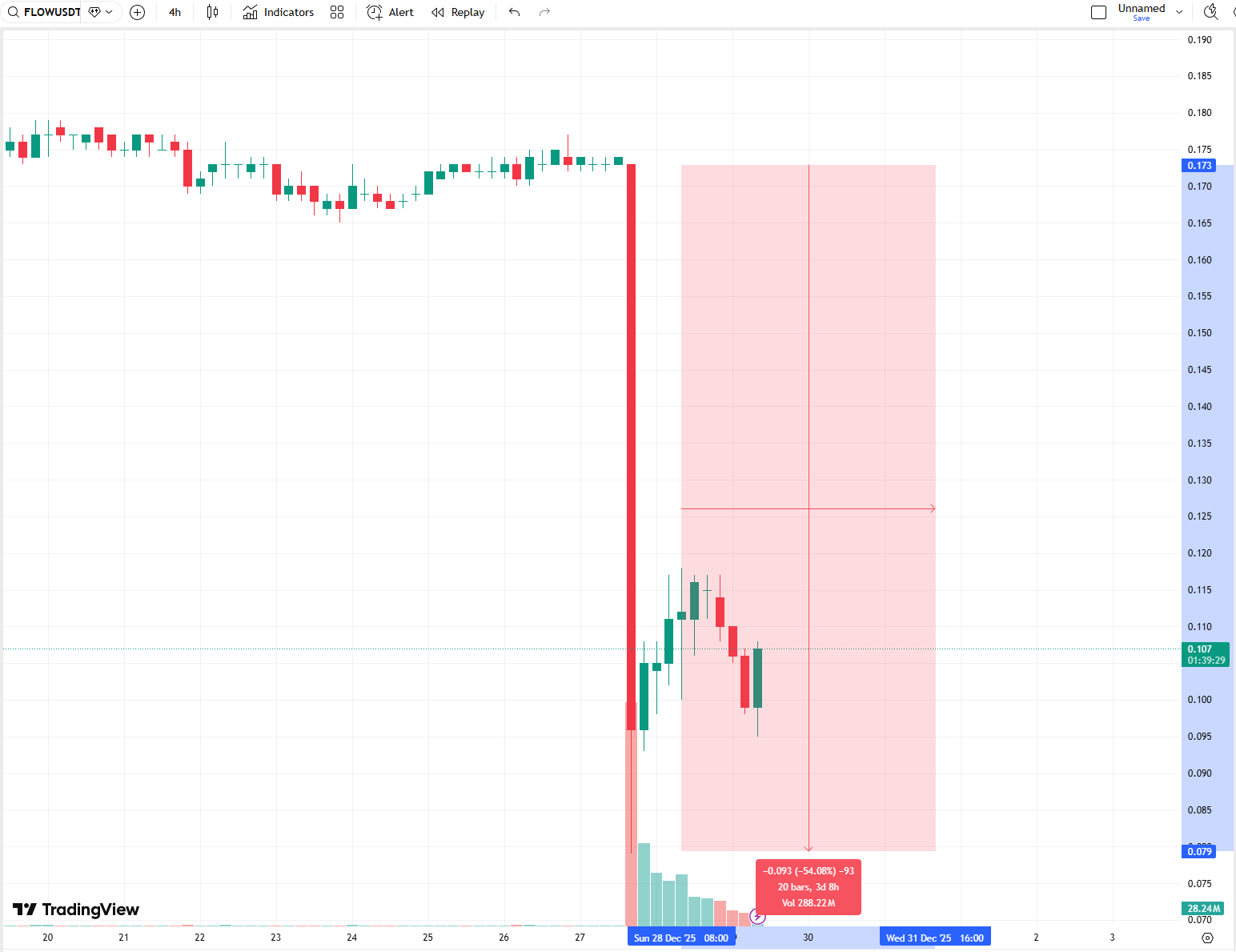
FLOW K-Line Chart

Below, Odaily Planet Daily breaks down this Flow theft incident, the official response, and why it has sparked strong质疑 (questioning/doubts) from Flow's partners and community.

Flow Official Emergency Response: Isolate Network, and Announce Rollback Plan

After the attack, the Flow Foundation quickly responded and confirmed the details of the incident. The attacker exploited an execution layer vulnerability to transfer approximately $3.9 million in assets; the incident did not affect users' existing balances, and user deposits remain safe. The relevant attack addresses have been marked, money laundering paths are being continuously tracked, and the Foundation has submitted asset freeze requests to Circle, Tether, and several major exchanges.

To clean up illegal on-chain transactions and repair the vulnerability, the Flow Foundation isolated the network and simultaneously published Mainnet 28, a patched version for the mainnet vulnerability. The Foundation's initial proposed solution was to roll back the network state to a checkpoint before the attack, specifically to Cadence block height 137363395, thereby deleting all transaction records generated within approximately a 6-hour window. Regardless of whether the transactions were legitimate, they would all be erased, and users would need to resubmit transactions after node restart. The Foundation believed this plan was the safest path to restore network integrity, repeatedly emphasized that user funds would not be affected throughout the process, and promised to provide external updates on progress every two hours.

This rollback decision, seemingly decisive, quickly ignited an ecosystem firestorm—because the hacker's funds had already been bridged off-chain, the rollback would not affect the attacker but would only impact honest users and partners.

Cross-Chain Bridge Partners, Community Users Strongly Oppose, Rollback Plan Heavily Criticized

After the rollback plan was announced, cross-chain bridge partners within the Flow ecosystem and community users quickly faced collective质疑 (questioning/doubts). Alex Smirnov, co-founder of deBridge, a major cross-chain bridge partner for Flow, publicly criticized the decision on platform X as too hasty and stated that no prior communication had been made with key bridge partners beforehand. As a crucial asset channel for the Flow ecosystem, deBridge did not receive any advance notice regarding the rollback.

Smirnov pointed out that the potential damage from a rollback could far exceed that of the initial hack itself. Since cross-chain assets had already circulated across multiple systems, a forced rollback would cause serious issues like asset duplication and inconsistent custodial states, ultimately harming the bridges, users, and counterparties who operated normally during the window. He disclosed that approximately $200,000 and $50,000 in deposits on deBridge fell within the rollback time window; once the rollback was executed, it could lead to funds disappearing on one side or the extreme case of assets being double-minted.

Based on these risks, Smirnov called on Flow validators to suspend block production and validation until compensation plans, partner coordination mechanisms, and plans for independent security team involvement were all clarified. Similar issues were not isolated cases. As the main cross-chain custodian for USDC on the Flow network, LayerZero also faced risks with approximately $220,000 and $180,000 in cross-chain transactions falling within the rollback window.

Beyond cross-chain bridge partners within the Flow ecosystem, users on platform X began集中 (concentratedly) expressing concerns about fund safety, developers questioned the network's reliability and governance mechanisms under extreme circumstances, investor sentiment turned cautious accordingly, and selling pressure intensified. A significant number of voices directly pointed out that the rollback itself exposed the reality of centralized control on the chain, rapidly turning a technical incident into a crisis of trust.

Some community views further targeted the core principles of blockchain. Some argued that the rollback directly shook transaction finality and immutability, making Flow resemble an alliance chain subject to administrative intervention at a critical moment. Others compared it to historical security incidents on other public chains, pointing out that similar situations are usually handled by isolating attacker addresses and freezing fund flows, rather than performing a global rollback of the entire network state.

Crypto KOL Wazz (@WazzCrypto) stated bluntly on platform X that Flow's rollback decision was one of the worst handling methods he had ever seen. In his view, the attacker had already transferred nearly $4 million in assets off-chain and would hardly be substantively affected by the rollback; the real cost would instead be borne by innocent users who used the network normally via cross-chain bridges.

Flow Official Changes Stance: Abandons Rollback, Adopts New Isolation Recovery Plan

Facing strong opposition from partners and the community, the Flow official team ultimately decided to abandon the network rollback and shift to an "Isolation Recovery Plan". This plan was developed through direct consultation with cross-chain bridges, exchanges, and infrastructure partners. Key points include:

  • No rollback/reorganization, preserving all legitimate user activity;
  • No need for partners to replay transactions;
  • Over 99.9% of accounts unaffected, normal operation upon restart;
  • Temporary restriction of accounts that received illegally minted tokens upon restart;

Furthermore, the network will be restored in phases:

  • Phase 1: Cadence environment goes online, EVM temporarily restricted;
  • Phase 2: Cadence repair (approx. 24 to 48 hours);
  • Phase 3: EVM repair and restart;
  • Phase 4: Cross-chain bridges/exchanges resume operation, specific recovery time determined by operators based on actual conditions after confirming stability.

Additionally, Dapper Labs, the team behind Flow, expressed support for this plan on platform X, stating it "preserves legitimate activity and provides a clear path to recovery".

This "abandon rollback" stance alleviated ecosystem tensions in the short term and avoided the systemic risk扩散 (spread/proliferation) a rollback might have caused. As of now, the network is still in a phased coordination and recovery process, with officials stating user funds remain safe.

In the highly uncertain environment of the crypto market, this crisis may become a significant watershed in Flow's development path. Its long-term impact remains to be tested by time.


Domande pertinenti

QWhat was the immediate impact of the hack on the Flow network's native token, FLOW?

AThe FLOW token experienced a sharp price drop, falling from $0.173 to $0.079, effectively halving its value in a short period. It later saw a small rebound to around $0.107.

QWhat was the initial recovery plan proposed by the Flow Foundation after the hack, and why was it controversial?

AThe initial plan was to roll back the network state to a checkpoint before the attack, which would have erased all transactions from a 6-hour window. This was controversial because it would have affected legitimate user transactions and cross-chain bridge operations, potentially causing more damage than the hack itself, while the hacker's funds were already off-chain and unaffected.

QWhich key cross-chain bridge partner publicly criticized the rollback plan, and what was their main concern?

AAlex Smirnov, the co-founder of deBridge, publicly criticized the plan. The main concern was that the rollback was decided without prior communication with key bridge partners and would create severe problems like double-spending and inconsistent custodial states for assets that had already been bridged to other chains during that window.

QWhat was the final recovery solution that Flow adopted instead of a network rollback?

AFlow abandoned the rollback and adopted an 'Isolation Recovery Plan.' This plan involved no rollback, preserved all legitimate user activity, did not require partners to replay transactions, and temporarily restricted accounts that received illegally minted tokens. The network was to be restored in phases.

QWhat broader principle of blockchain technology did the proposed rollback crisis call into question according to the community?

AThe community argued that the proposed rollback shook the core blockchain principles of transaction finality and immutability, making Flow appear more like a centrally controlled consortium chain that could be administratively interfered with, rather than a decentralized ledger.

Letture associate

Anthropic Starts Poaching Scientists? $27K Weekly Onsite Stipend to Fix Claude's Expert-Level Errors

Anthropic has launched a new STEM Fellow program, offering $3,800 per week for a three-month, in-person residency in San Francisco. The role targets experts from science, technology, engineering, and mathematics (STEM) fields—machine learning experience is helpful but not required. Instead, Anthropic values scientific judgment and a willingness to learn quickly. Fellows will work with Claude models and internal tools under the guidance of an Anthropic researcher. Example projects include a materials scientist identifying errors in Claude’s reasoning or a climate scientist integrating atmospheric modeling software with Claude. The goal is to have experts "tell Claude where it's wrong" and improve its scientific capabilities. This initiative is part of Anthropic’s broader strategy to strengthen its scientific ecosystem, following earlier programs like the AI Safety Fellows and AI for Science programs. The company acknowledges that current AI models, while powerful, still produce high-confidence errors and lack end-to-end research autonomy. The program aims to embed domain expertise directly into model development, turning scientists into "high-level reviewers" for AI. Anthropic CEO Dario Amodei has previously emphasized AI’s potential to accelerate scientific breakthroughs, particularly in biology and healthcare. The company believes that the next phase of AI competition will depend not on scaling parameters, but on integrating human expertise to refine model accuracy and reliability.

marsbit37 min fa

Anthropic Starts Poaching Scientists? $27K Weekly Onsite Stipend to Fix Claude's Expert-Level Errors

marsbit37 min fa

On the Eve of X Money's Launch, Musk Dismantles the Referee First

"X Money Launches After Dismantling Regulator: Musk's 9-Day Power Play" In February 2025, a team from the "Department of Government Efficiency" (DOGE), led by Elon Musk, entered the Consumer Financial Protection Bureau (CFPB) headquarters. Shortly after, the CFPB was effectively dismantled—its funding frozen, activities suspended, and nearly 90% of staff laid off. This move came just nine days after X announced a partnership with Visa and as X Money prepared to launch. The article contrasts this with the decade-long regulatory battles faced by companies like Coinbase and PayPal. Coinbase spent over $75 million in political contributions and endured a major SEC lawsuit to operate legally. PayPal complied with strict state and federal rules for its stablecoin PYUSD, including 100% reserve requirements and monthly audits. However, Musk’s approach was different. After the CFPB introduced a rule placing large digital payment apps under federal oversight, Musk tweeted "Delete CFPB." Within months, the rule was revoked by Congress. Meanwhile, DOGE operatives gained "god-tier" access to CFPB databases, potentially obtaining sensitive competitive information from rivals like Apple, Google, and PayPal. The article also highlights a "suspicious exemption clause" in the GENIUS Act, which allows private companies like X to issue stablecoins with fewer restrictions. Senator Elizabeth Warren questioned whether Musk, who was a senior presidential advisor during the Act’s drafting, influenced this clause. X Money offers a 6% APY on deposits, despite FDIC warnings that stablecoin users are not insured. As X Money launches to 600 million monthly users, the article questions the fairness of a system where Musk can bypass regulations that others spent years and millions to comply with. The dismantling of the CFPB and the alleged regulatory advantages raise concerns about the future of equitable rule-making in the U.S. financial system.

marsbit46 min fa

On the Eve of X Money's Launch, Musk Dismantles the Referee First

marsbit46 min fa

Trading

Spot
Futures

Articoli Popolari

Come comprare FLOW

Benvenuto in HTX.com! Abbiamo reso l'acquisto di Flow (FLOW) semplice e conveniente. Segui la nostra guida passo passo per intraprendere il tuo viaggio nel mondo delle criptovalute.Step 1: Crea il tuo Account HTXUsa la tua email o numero di telefono per registrarti il tuo account gratuito su HTX. Vivi un'esperienza facile e sblocca tutte le funzionalità,Crea il mio accountStep 2: Vai in Acquista crypto e seleziona il tuo metodo di pagamentoCarta di credito/debito: utilizza la tua Visa o Mastercard per acquistare immediatamente FlowFLOW.Bilancio: Usa i fondi dal bilancio del tuo account HTX per fare trading senza problemi.Terze parti: abbiamo aggiunto metodi di pagamento molto utilizzati come Google Pay e Apple Pay per maggiore comodità.P2P: Fai trading direttamente con altri utenti HTX.Over-the-Counter (OTC): Offriamo servizi su misura e tassi di cambio competitivi per i trader.Step 3: Conserva Flow (FLOW)Dopo aver acquistato Flow (FLOW), conserva nel tuo account HTX. In alternativa, puoi inviare tramite trasferimento blockchain o scambiare per altre criptovalute.Step 4: Scambia Flow (FLOW)Scambia facilmente Flow (FLOW) nel mercato spot di HTX. Accedi al tuo account, seleziona la tua coppia di trading, esegui le tue operazioni e monitora in tempo reale. Offriamo un'esperienza user-friendly sia per chi ha appena iniziato che per i trader più esperti.

161 Totale visualizzazioniPubblicato il 2024.12.10Aggiornato il 2025.03.21

Come comprare FLOW

Discussioni

Benvenuto nella Community HTX. Qui puoi rimanere informato sugli ultimi sviluppi della piattaforma e accedere ad approfondimenti esperti sul mercato. Le opinioni degli utenti sul prezzo di FLOW FLOW sono presentate come di seguito.

活动图片












