From Pump.fun to Collector Crypt: Has Solana's Revenue Throne Changed Hands?

链捕手Pubblicato 2026-07-02Pubblicato ultima volta 2026-07-02

Introduzione

From Pump.fun to Collector Crypt: Is Solana’s Revenue Throne Changing Hands? Solana’s on-chain narrative is expanding from meme coins to tokenized trading cards. Previously, Pump.fun dominated consumer revenue on Solana. However, starting in Q2 2026, Pump.fun's quarterly revenue growth slowed, while Collector Crypt shows a stronger recent growth trajectory. Data indicates Pump.fun's Q1 revenue was $108.3M, dropping 36.1% to $69.2M in Q2 so far. Conversely, Collector Crypt's revenue grew 108.8%, from $12.3M in Q1 to $25.8M in Q2 to date, with recent weekly revenue hitting $5.1M. While Pump.fun remains larger in scale, Collector Crypt demonstrates stronger short-term momentum. Collector Crypt's model involves custodying graded physical trading cards, minting corresponding NFTs on Solana, and selling randomized packs. Revenue comes from pack sales, secondary market fees, and royalties. Its profitability, estimated around 4-5%, stems from bulk card purchases at a discount and a buyback system for users. However, a full-scale reversal in rankings hasn't occurred. Year-to-date, Pump.fun's revenue is ~$177.5M (with its ecosystem at ~$466.5M), vastly exceeding Collector Crypt's ~$38.1M. The shift is more about narrative and recent growth dynamics than total historical volume. Pump.fun relies on speculative token launches, while Collector Crypt focuses on collectibility, scarcity, and real-world asset backing. This highlights a broadening of Solana's consumer revenue sources beyo...

Author: Chloe, ChainCatcher

The narrative on Solana is expanding from meme coins to tokenized trading cards. In the past, Pump.fun was almost the representative application for consumer-side revenue on Solana; but entering the second quarter of 2026, Pump.fun's quarterly revenue began to slow down, while Collector Crypt delivered a stronger recent growth curve.

DefiLlama data shows that Pump.fun's revenue in Q1 was $108.3 million, which has dropped to $69.2 million so far in Q2, a decrease of 36.1% compared to the previous quarter. During the same period, Collector Crypt's revenue curve has clearly trended upward.

Collector Crypt's revenue in Q1 was $12.3 million, rising to $25.8 million so far in Q2, a growth of 108.8%; its recent weekly revenue reached $5.1 million, accounting for about 38% of its 30-day total revenue of nearly $13.5 million. This set of data shows that Pump.fun still has a larger scale, but Collector Crypt is gaining stronger short-term growth momentum.
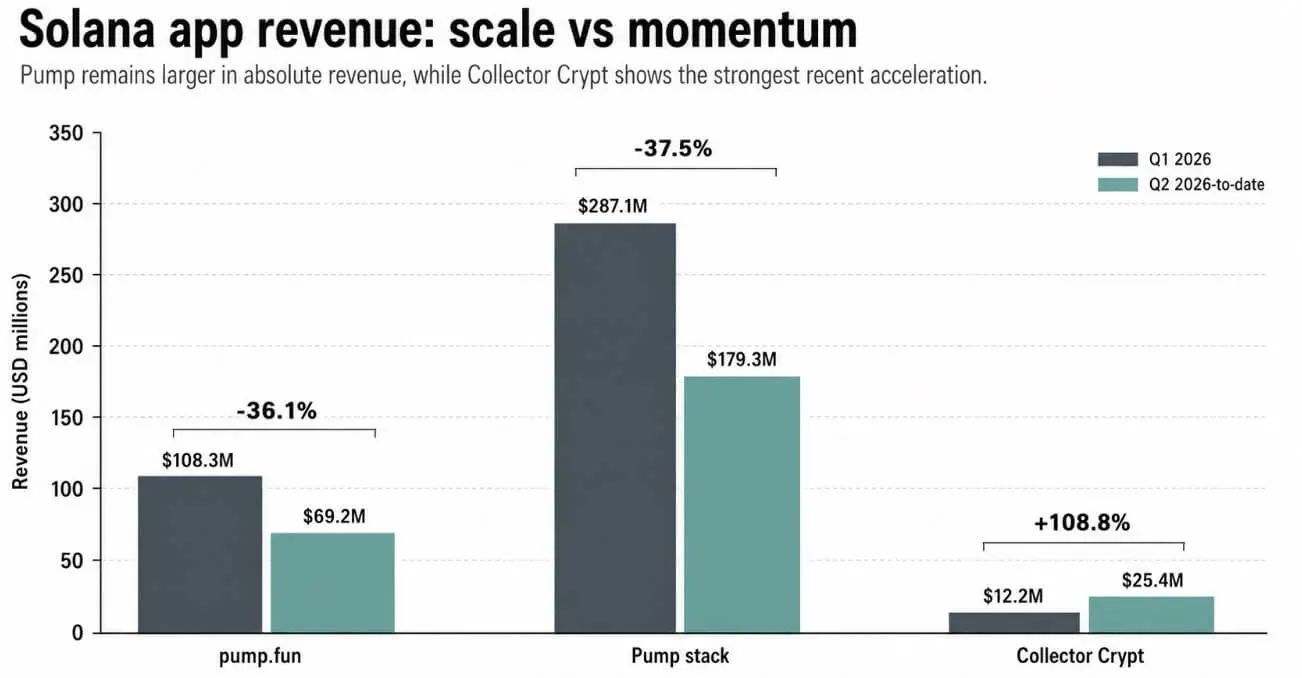
Summarizing the data, perhaps it's not that Pump.fun has lost scalable growth, but rather that the sources of consumer fees on Solana are beginning to diversify. The meme coin sector remains vast, but tokenized trading cards, random card packs, physical redemption, and on-chain secondary markets are becoming another consumer scenario capable of generating real fees, real transactions, and truly retaining users.

Are Collector Crypt's Profit Sources Stable?

The core operational model of Collector Crypt is to hold physical graded trading cards in custody and mint corresponding NFTs on Solana. Users who purchase random card packs receive digital cards linked to real physical cards; they can then choose to hold the NFT, sell it on-chain, sell it back to the platform, or redeem the physical card.

Collector Crypt's revenue mainly comes from random card pack sales, secondary market transaction fees, and royalties; when calculating revenue, it also deducts buyback costs incurred when users sell cards back to the platform. Furthermore, Collector Crypt purchases trading cards in bulk, acquiring inventory at discounts of about 5% to 15%; after users open packs, if they don't want to keep the cards, they can sell them back to the platform at a price roughly 7% to 15% below market value.

This allows Collector Crypt to retain an operating profit margin of about 4% to 5%. According to estimates, for a $1,000 card pack, Collector Crypt's comprehensive profit margin is about 5.14%; after deducting incentive costs such as user rewards, the net profit margin is about 4.44%.

This model has garnered attention because it's not just about selling on-chain pictures, but about connecting on-chain transactions with real-world collectibles. Collector Crypt surpassed $1 billion in cumulative trading volume in May 2026; the platform opened over 215,000 tokenized trading card packs in a single week, and more than 30% of users have redeemed physical cards.

Solana's Revenue Ranking Has Not Fully Reversed

However, Collector Crypt has not truly replaced Pump.fun in terms of total volume. So far in 2026, Pump.fun's revenue is about $177.5 million, and the overall Pump ecosystem revenue is about $466.5 million; in comparison, Collector Crypt's 2026 revenue is about $38.1 million. In cumulative revenue, Pump.fun exceeds $1 billion, the overall Pump ecosystem is about $1.18 billion, while Collector Crypt is about $58.4 million.
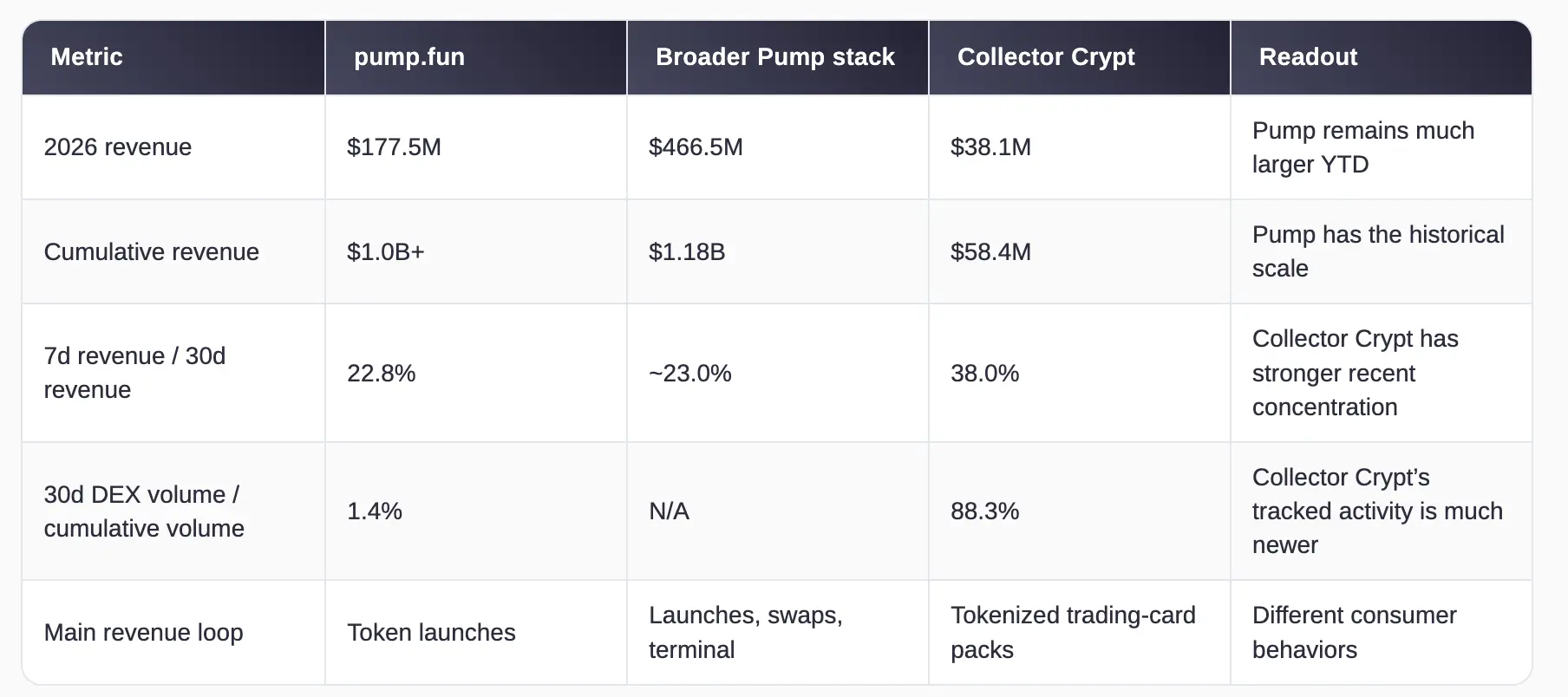
Therefore, the so-called "change of hands on the revenue throne" more accurately describes a narrative shift in recent revenue momentum and daily revenue rankings, rather than a complete reversal in historical cumulative scale.

Pump.fun's model relies on a speculative token-issuance cycle: users continuously issue new tokens, trade on early price curves, then some tokens enter public markets, generating fees at various stages. Collector Crypt's model is another type of consumer cycle: users buy random card packs, receive on-chain vouchers corresponding to physical collectibles, and then engage in on-chain trading, instant sell-back, or physical redemption. Both can generate fees, trading volume, and market attention, but they attract users for different reasons.

Pump.fun leans more towards attention, volatility, and early meme coin positions; Collector Crypt leans more towards collecting, scarcity, gamified experience, and real-world asset anchoring. This is also where the focus of the discussion about Solana's consumer applications is changing: revenue is no longer just from meme coin issuance, but can also come from collectible consumption closer to real-world assets.

Conclusion

Finally, the sustainability of Collector Crypt's revenue first depends on whether demand for random card packs can be maintained. If pack demand remains strong, Collector Crypt's 30-day revenue may continue to approach that of Pump.fun; if demand for random card packs cools, the recent high concentration of Collector Crypt's revenue could turn from a growth signal into a risk.

Additionally, the second growth variable for Collector Crypt is whether it can expand from Pokémon cards to sports cards and other collectibles. Data indicates that Pokémon cards currently dominate Collector Crypt's monthly trading volume; but at physical card shows, sports cards and Pokémon card sales are roughly split 50/50, while on-chain sports cards currently only account for 3% to 4% of Collector Crypt's $88 million monthly trading volume.

The third variable for Collector Crypt is regulatory pressure. If multiple jurisdictions begin to scrutinize the random card pack mechanism using a "loot box regulatory framework," it could slow Collector Crypt's growth.

Therefore, barring changes in the macro environment, Pump.fun will likely remain the larger revenue engine, while Collector Crypt will continue to appear at the top of Solana application revenue rankings. In this scenario, consumer application revenue on Solana will no longer rely solely on meme coin issuance but will gradually diffuse into more consumer scenarios.

The key change for Solana is not that Pump.fun has been completely replaced, but that the consumer revenue structure has broadened. Pump.fun proved that meme coin issuance can become a highly revenue-generating consumer application on Solana; Collector Crypt proves that tokenized physical collectibles can also form real revenue, real transactions, and real user behavior.


Crypto di tendenza

Domande pertinenti

QAccording to the article, what is the main difference between Pump.fun's and Collector Crypt's revenue models?

APump.fun's revenue model relies on a speculative cycle of new token issuance and early-stage trading on bonding curves, attracting users with attention, volatility, and early memecoin access. Collector Crypt's revenue model is based on a consumption cycle: users buy randomized card packs containing tokenized, real-world graded trading cards, and then engage in on-chain trading, instant buybacks, or physical redemption, focusing on collection, scarcity, gamification, and real-world asset backing.

QWhat specific reasons does the article give for Collector Crypt's recent stronger growth in revenue compared to Pump.fun?

AThe article attributes Collector Crypt's stronger recent revenue growth to its unique offering of randomized packs linked to real-world collectible trading cards, creating a 'real fee, real transaction, and real user retention' scenario. This has provided stronger short-term growth momentum, evidenced by a 108.8% increase in Q2 revenue year-over-year and recent weekly revenue accounting for 38% of its 30-day total.

QWhat are the three key variables or challenges mentioned that could affect the sustainability of Collector Crypt's growth?

AThe three key variables are: 1) Sustained demand for randomized card packs, 2) The ability to expand from Pokémon cards to other collectibles like sports cards, and 3) Potential regulatory pressure as jurisdictions may scrutinize the 'randomized pack' mechanism under 'blind box' regulatory frameworks.

QBased on the DefiLlama data cited, how do the cumulative revenues of Pump.fun and Collector Crypt compare historically?

AHistorically, Pump.fun holds a significantly larger cumulative revenue. The article states Pump.fun's cumulative revenue exceeds $1 billion, and the broader Pump ecosystem is around $1.18 billion. In contrast, Collector Crypt's cumulative revenue is approximately $58.4 million. Therefore, the shift in 'revenue throne' refers to recent momentum, not a total historical reversal.

QWhat is the article's final conclusion regarding the broader change in Solana's consumer application landscape, beyond just the competition between these two protocols?

AThe article concludes that the key change on Solana is not Pump.fun being replaced, but a broadening of the consumer application revenue structure. While Pump.fun proved memecoin issuance could generate high revenue, Collector Crypt demonstrates that tokenized physical collectibles can also create real revenue, transactions, and user engagement, indicating a diffusion of revenue sources into more diverse consumer scenarios.

Letture associate

On the Eve of Its U.S. Journey, SK Hynix Plummets Sharply

Just before its highly anticipated U.S. listing, SK Hynix saw its share price plummet dramatically, losing over 14% in a single day. The sell-off was triggered by market fears of a potential slowdown in AI capital expenditure. This followed a news report suggesting Meta might sell "excess AI compute," which was later amended to remove the word "excess." The initial phrasing sparked a chain reaction in investor sentiment, linking it to a potential peak in AI demand. Despite the sharp downturn, the article argues this is likely an overreaction driven by market sentiment and structural de-leveraging, rather than a fundamental reversal of the AI trend. The author points out that even if Meta proceeds, it could be an optimization of existing assets, not a systemic demand contraction. SK Hynix is in the final stages of its U.S. IPO via an ADR listing on Nasdaq, aiming to raise approximately $29.4 billion—one of the largest such offerings ever. The funds are earmarked for expanding domestic Korean production capacity for HBM (High Bandwidth Memory) and advanced packaging. A key motivation for the U.S. listing is to achieve a valuation re-rating, escaping the so-called "Korea discount" and tapping into the higher valuation multiples typically given to AI-related semiconductor stocks in the U.S. market. In conclusion, the article views the current price drop as a potential buying opportunity, suggesting the long-term industry fundamentals for SK Hynix—particularly its leading position in the crucial HBM market—remain strong. The significant capital raised from the IPO is also seen as a factor that could provide underlying support for the stock post-listing.

Odaily星球日报41 min fa

On the Eve of Its U.S. Journey, SK Hynix Plummets Sharply

Odaily星球日报41 min fa

Trading

Spot

Articoli Popolari

Cosa è MEME 2.0

Memecoin 2.0: L'Ascesa di $MEME 2.0 nel Mondo delle Criptovalute Introduzione Nel panorama in continua evoluzione delle criptovalute, è emerso un nuovo contendente. Memecoin 2.0, simboleggiato come $MEME 2.0, porta il concetto di meme coin a un livello emozionante. Come prodotto derivato dal Memecoin originale, questo progetto ha catturato l'attenzione della comunità crypto spostando il focus da incentivi finanziari tipici a un'esperienza coinvolgente e divertente. Operando sulla blockchain di Ethereum, Memecoin 2.0 ridefinisce audacemente l'impegno della comunità nella sfera crypto. Che cos'è Memecoin 2.0, $MEME 2.0? Alla base, Memecoin 2.0 è un progetto di criptovaluta che dà priorità allo spirito di comunità e al divertimento associato alla cultura meme. A differenza delle criptovalute convenzionali, che si concentrano su casi d'uso pratici e benefici tangibili, Memecoin 2.0 si distingue abbracciando il lato più leggero della moneta digitale. Il progetto esiste senza promesse di utilità, una roadmap strutturata o ritorni finanziari, concentrandosi invece sulla creazione di una comunità vibrante incentrata sui meme e sul divertimento condiviso. Facendo così, attinge alla crescente tendenza della cultura meme nello spazio online, rendendola un giocatore unico nel mondo degli asset digitali. Creatore di Memecoin 2.0, $MEME 2.0 Nonostante ricerche approfondite sulle origini di Memecoin 2.0, l'identità esplicita del suo creatore rimane sconosciuta. Questa anonimità non è rara nella comunità crypto, dove molti progetti sono guidati da individui o gruppi che preferiscono rimanere dietro le quinte. La mancanza di informazioni pubblicamente disponibili sul creatore potrebbe essere vista come una mossa strategica, mettendo in evidenza l'impegno della comunità piuttosto che la notorietà individuale all'interno dello spazio. Investitori di Memecoin 2.0, $MEME 2.0 Le informazioni riguardanti gli investitori o il supporto finanziario per Memecoin 2.0 sono scarse. Questa assenza di dettagli potrebbe suggerire che il progetto sia autofinanziato o che il suo focus sulla comunità piuttosto che sulle strutture d'investimento tradizionali abbia attratto un tipo diverso di sostenitore. Poiché il mondo delle meme coin coinvolge tipicamente un maggior coinvolgimento di base piuttosto che investimenti istituzionali, questo approccio si allinea con l'etica dei progetti guidati dalla comunità. Come funziona Memecoin 2.0, $MEME 2.0? Memecoin 2.0 opera interamente sulla blockchain di Ethereum, capitalizzando le sue robuste caratteristiche di sicurezza e scalabilità. Sfruttando i punti di forza di Ethereum, Memecoin 2.0 può offrire un ambiente sicuro per le interazioni degli utenti garantendo che le transazioni siano sia efficienti che convenienti. Uno degli attributi unici di Memecoin 2.0 risiede nella sua struttura guidata dalla comunità. Il valore e la popolarità del token $MEME 2.0 derivano dalla partecipazione attiva dei suoi utenti, piuttosto che dalla utilità intrinseca. Questo design rinforza il focus del progetto sull'aspetto dell'intrattenimento delle criptovalute, implicando che la risata e l'impegno della comunità siano le vere monete che guidano il suo successo. Inoltre, il progetto si inserisce all'interno dell'ecosistema più ampio delle meme coin, dove il valore di ciascuna meme coin oscilla in base alla cultura, alle tendenze e all'impegno della comunità piuttosto che ai principi economici tradizionali. Cronologia di Memecoin 2.0, $MEME 2.0 Per comprendere meglio l'evoluzione e le pietre miliari di Memecoin 2.0, ecco una cronologia che evidenzia eventi significativi nella sua storia: 2024: L'inizio di Memecoin 2.0 è riconosciuto come un ramo del Memecoin originale, affermandosi all'interno del contesto fiorente delle meme coin mentre opera sulla blockchain di Ethereum. 13 luglio 2024: Memecoin 2.0 si posiziona ufficialmente come una meme coin incentrata sulla comunità sulla rete Ethereum, enfatizzando il suo approccio centrato sull'intrattenimento che invita gli utenti a impegnarsi e partecipare alla sua crescita. Punti Chiave su Memecoin 2.0, $MEME 2.0 Diverse caratteristiche critiche definiscono Memecoin 2.0: Approccio Centrico alla Comunità: La missione principale di Memecoin 2.0 è creare un'esperienza comunitaria divertente e coinvolgente, capitalizzando il piacere collettivo derivante dalla cultura memetica. Costruita su Ethereum: Operare sulla blockchain di Ethereum fornisce al progetto un'infrastruttura essenziale che garantisce sicurezza e scalabilità. Mancanza di Utilità o Roadmap: In una marcata deviazione dalle criptovalute tradizionali, Memecoin 2.0 non promette alcuna caratteristica utilitaria o ritorni finanziari, riaffermando il suo impegno per il coinvolgimento della comunità e l'impegno sociale. Focus sulla Cultura Memetica: Abbracciando gli aspetti umoristici e culturali del fenomeno meme, Memecoin 2.0 offre una piattaforma per gli utenti per interagire con la crypto offline e online. Ulteriore Contesto: L'Importanza delle Meme Coin Le meme coin sono emerse come una classe distinta di criptovaluta, spesso guidata dall'umorismo e da un approccio spensierato al trading. Queste monete generalmente mancano di significative utilità o roadmap di sviluppo, attirando gli utenti con la promessa di divertimento, interazione comunitaria e rilevanza culturale. Nel panorama del più ampio ecosistema crypto, le meme coin rianimano l'importanza dell'impegno della comunità, opponendosi ad approcci esclusivamente orientati al profitto. Progetti come Memecoin 2.0 danno il via a un'era in cui l'intrattenimento può armonizzarsi con le aspirazioni finanziarie, trasformando la blockchain in un parco giochi per la creatività e l'interazione sociale. Conclusione Memecoin 2.0, o $MEME 2.0, incarna una nuova ondata di criptovaluta che dà priorità all'impegno della comunità rispetto a rigidi strutture finanziarie. Con un focus sull'umorismo e l'interazione sociale, capitalizza sulla fascinazione circondante la cultura meme. Operando sulla blockchain di Ethereum, Memecoin 2.0 sfrutta le capacità della tecnologia mantenendo fermo il suo impegno per il valore ricreativo della valuta digitale. Mentre lo spazio delle criptovalute continua a evolversi, Memecoin 2.0 serve come testimonianza della nozione che il futuro degli asset digitali potrebbe ben dipendere da esperienze condivise, risate e solidi legami comunitari. Nel mondo imprevedibile delle crypto, forse la gioia può essere altrettanto preziosa quanto il guadagno finanziario tradizionale.

104 Totale visualizzazioniPubblicato il 2024.04.04Aggiornato il 2024.12.03

Cosa è MEME 2.0

Come comprare MEME

Benvenuto in HTX.com! Abbiamo reso l'acquisto di Memeland (MEME) semplice e conveniente. Segui la nostra guida passo passo per intraprendere il tuo viaggio nel mondo delle criptovalute.Step 1: Crea il tuo Account HTXUsa la tua email o numero di telefono per registrarti il tuo account gratuito su HTX. Vivi un'esperienza facile e sblocca tutte le funzionalità,Crea il mio accountStep 2: Vai in Acquista crypto e seleziona il tuo metodo di pagamentoCarta di credito/debito: utilizza la tua Visa o Mastercard per acquistare immediatamente MemelandMEME.Bilancio: Usa i fondi dal bilancio del tuo account HTX per fare trading senza problemi.Terze parti: abbiamo aggiunto metodi di pagamento molto utilizzati come Google Pay e Apple Pay per maggiore comodità.P2P: Fai trading direttamente con altri utenti HTX.Over-the-Counter (OTC): Offriamo servizi su misura e tassi di cambio competitivi per i trader.Step 3: Conserva Memeland (MEME)Dopo aver acquistato Memeland (MEME), conserva nel tuo account HTX. In alternativa, puoi inviare tramite trasferimento blockchain o scambiare per altre criptovalute.Step 4: Scambia Memeland (MEME)Scambia facilmente Memeland (MEME) nel mercato spot di HTX. Accedi al tuo account, seleziona la tua coppia di trading, esegui le tue operazioni e monitora in tempo reale. Offriamo un'esperienza user-friendly sia per chi ha appena iniziato che per i trader più esperti.

307 Totale visualizzazioniPubblicato il 2024.12.12Aggiornato il 2026.06.02

Come comprare MEME

Discussioni

Benvenuto nella Community HTX. Qui puoi rimanere informato sugli ultimi sviluppi della piattaforma e accedere ad approfondimenti esperti sul mercato. Le opinioni degli utenti sul prezzo di MEME MEME sono presentate come di seguito.

活动图片












