Berkshire Hathaway's Q2 13F Portfolio Reshuffle: Increased Stakes in Google and Delta Air Lines, Consecutive Quarter of Cutting Bank of America

marsbitPubblicato 2026-08-16Pubblicato ultima volta 2026-08-16

Introduzione

Berkshire Hathaway's second-quarter 13F filing, released August 14th, reveals significant portfolio shifts under new leadership. The total portfolio value rose to approximately $299.3 billion. Key highlights include a major increase in Alphabet (Google) holdings. Berkshire's stake in Google-A surged 45.24% to $28.16 billion, while its Google-C holdings jumped 658% to $9.61 billion, making Alphabet the firm's third-largest combined holding after Apple and American Express. Conversely, Bank of America was the largest reduction, with shares cut by 5.89% for the second consecutive quarter, though it remains the fifth-largest holding. Berkshire also increased positions in Delta Air Lines (up 44%) and homebuilder Lennar, while initiating a small new position in D.R. Horton. The consumer sector saw Constellation Brands completely sold off. Overall, the portfolio reflects a continued move toward technology and specific cyclical sectors like housing and airlines, while trimming some financial and consumer stakes. Apple remains the top holding at 22% of the portfolio.

Author: Wall Street News

Following 'Oracle of Omaha' Warren Buffett's resignation as CEO, Berkshire Hathaway has released its second 13F filing.

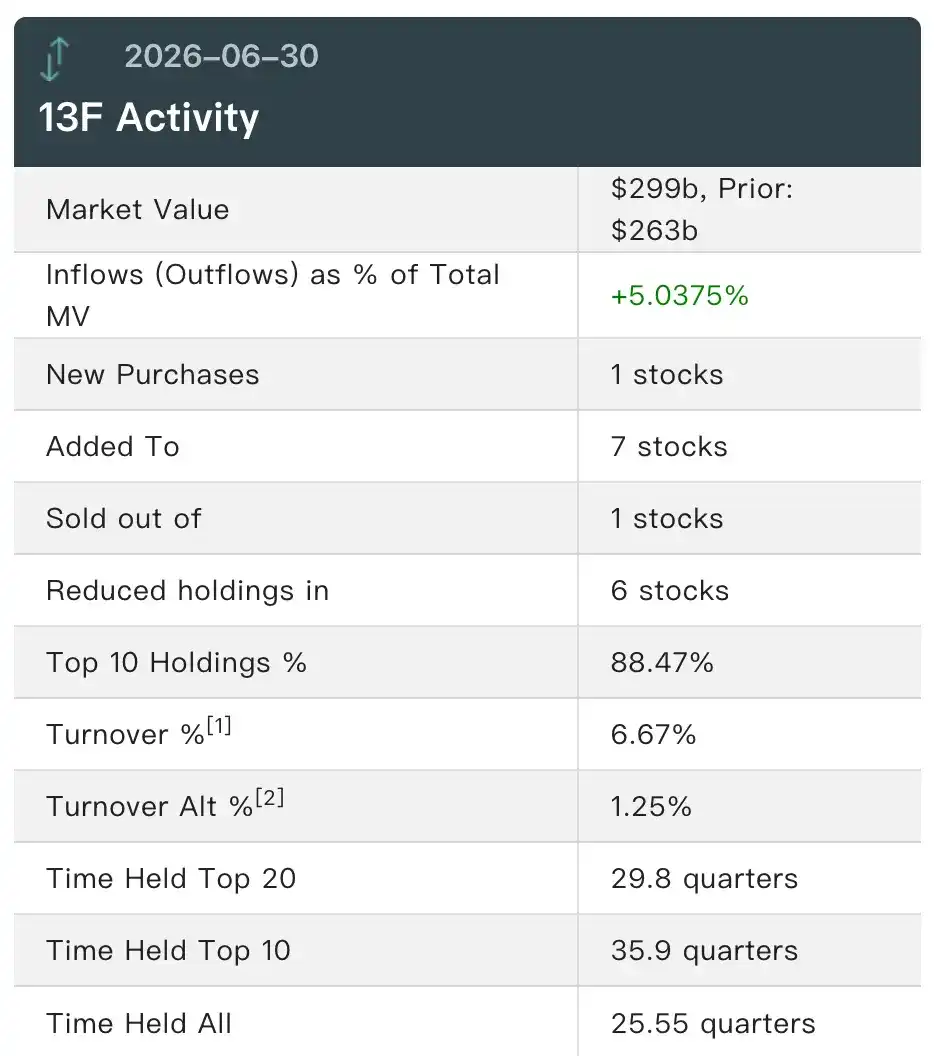
According to documents disclosed on August 14, Eastern Time, Berkshire's 13F equity portfolio value was approximately $299.3 billion at the end of the second quarter, an increase of 12.09% from approximately $263.1 billion at the end of the first quarter. Overall, Berkshire initiated a position in 1 new stock, added to 7 stocks, reduced holdings in 6 stocks, and completely exited 1 stock in the second quarter.

It is evident that under the leadership of Greg Abel, Berkshire has been continuously increasing its bets on Alphabet, housing, and airlines, while gradually trimming traditional financials and some consumer holdings.
When consolidating Alphabet's two share classes, Berkshire's current top ten holdings are Apple, American Express, Alphabet, Coca-Cola, Bank of America, Chevron, Occidental Petroleum, Chubb, Moody's, and Kraft Heinz.
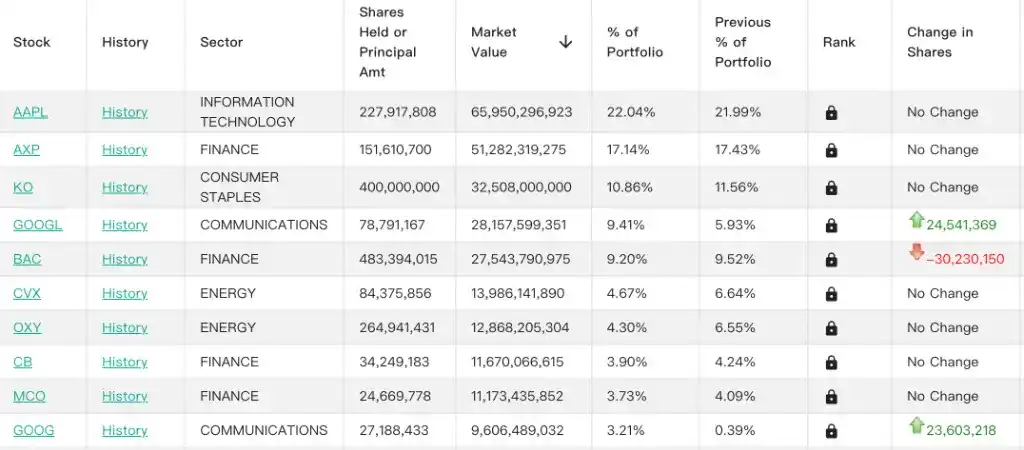
Apple remains Berkshire's largest holding, with a portfolio value of approximately $65.950 billion, accounting for about 22% of the 13F portfolio value. American Express ranks second with a value of approximately $51.282 billion, a 17.14% share. The combined Alphabet holds the third position. Coca-Cola and Bank of America rank fourth and fifth, respectively.

In the second quarter of this year, Berkshire continued to significantly increase its stake in Alphabet (Google's parent company). Berkshire added approximately 24.54 million shares of Alphabet-A, an increase of 45.24%, bringing the total holding to about 78.79 million shares valued at approximately $28.158 billion. It also added approximately 23.60 million shares of Alphabet-C, a staggering increase of 658.35%, bringing the total holding to about 27.19 million shares valued at approximately $9.606 billion.

This brings the combined value of Alphabet-A and Alphabet-C to approximately $37.764 billion at the end of Q2, representing about 12.62% of the 13F portfolio value, surpassing Coca-Cola to become Berkshire's third-largest holding after Apple and American Express on a consolidated basis.

Additionally, among the top ten holdings, the only stock that was reduced was Bank of America. In the quarter, Berkshire sold approximately 30.20 million shares (based on the period-end price, the reduction was about 30.23 million shares), a decrease of 5.89%, representing a reduction in value of approximately $1.72 billion. This made Bank of America the largest reduction for the quarter. At quarter-end, Berkshire still held 483 million shares of Bank of America valued at approximately $27.544 billion, accounting for 9.2% of the 13F portfolio value, making it the fifth-largest holding. Bank of America remains a significant investment for Berkshire but has now been reduced for two consecutive quarters.

Otherwise, Berkshire's holdings in the remaining top ten stocks remained unchanged in the second quarter.

Regarding other additions, in the second quarter of this year, Berkshire increased its stake in Delta Air Lines by approximately 17.51 million shares, an increase of about 44%, bringing the total holding to 57.32 million shares valued at approximately $5.369 billion. It added about 3.01 million shares of Lennar Corporation Class A, an increase of nearly 30%, and also added about 60,000 shares of Lennar Corporation Class B. Berkshire increased its stake in Macy's by approximately 4.31 million shares, a 141.82% increase. It slightly added about 550,000 shares of The New York Times Company.

The only new position initiated by Berkshire in the second quarter was D.R. Horton, with a small initiation of 3,564 shares worth approximately $580,000.

Regarding reductions, apart from Bank of America, Berkshire also reduced holdings in Ally Financial, Capital One Financial, kidney dialysis service provider DaVita, grocer Kroger, and steel manufacturer Nucor. The alcoholic beverage producer Constellation Brands, which was significantly reduced in the first quarter, was completely sold off by Berkshire in the second quarter.


Crypto di tendenza

Domande pertinenti

QAccording to the 13F filing, which company became Berkshire Hathaway's third largest holding when Google's Class A and C shares are combined?

AAlphabet (Google's parent company) became Berkshire Hathaway's third largest holding, with a combined value of approximately $37.764 billion, surpassing Coca-Cola.

QWhat were the main categories of stocks that saw increased investment from Berkshire Hathaway in Q2 under Greg Abel's leadership?

AUnder Greg Abel's leadership, Berkshire Hathaway increased investments in technology (Alphabet), housing (Lennar, Horton), and airlines (Delta Air Lines).

QWhich stock was the largest reduction for Berkshire Hathaway in Q2 2024, and was this part of a trend?

ABank of America was the largest reduction, with approximately 30.23 million shares sold (worth about $1.72 billion). This was part of a trend, as it was the second consecutive quarter of减持.

QWhat was the total market value of Berkshire Hathaway's 13F stock portfolio at the end of Q2 2024, and how did it change from the previous quarter?

AThe total market value was approximately $299.3 billion at the end of Q2 2024, representing an increase of 12.09% from the approximately $263.1 billion at the end of Q1.

QWhich company did Berkshire Hathaway completely exit (sell its entire position in) during the second quarter of 2024?

ABerkshire Hathaway completely exited its position in Constellation Brands during the second quarter of 2024.

Letture associate

Upbit is Anxious: A Hasty Counterattack Aimed at Regaining Stablecoin Market Share

Title: Upbit's Rushed Counterattack to Reclaim Stablecoin Market Share Facing a dramatic shift in South Korea's stablecoin market, leading exchange Upbit launched a promotional campaign from July 26 to August 9, waiving the 0.05% trading fee for stablecoins paired with the Korean Won (KRW) and rapidly listing new stablecoins like RLUSD and USDG. This move is a direct response to its plummeting market share in this sector. Historically a duopoly with Bithumb, the market has been reshaped since October 2025 when Coinone permanently removed fees for USDC trading. By June 2026, Coinone led with 34.8% of stablecoin volume, followed by Bithumb (31.1%) and Upbit (30.1%). This contrasts sharply with the overall crypto market, where Upbit commands 60%. The data shows stablecoin demand is highly sensitive to fees, as users primarily buy them to transfer capital overseas for derivatives trading or forex arbitrage. South Korean exchanges have seen a net outflow of stablecoins for 18 consecutive months, totaling approximately 14.9 trillion KRW, underscoring their role as a cross-border capital conduit. Upbit's limited-time promotion initially boosted its daily stablecoin volume by 162%, but the surge was almost entirely in USDT (98.1% of volume). The newly listed stablecoins saw negligible, fleeting interest. Furthermore, the promotional effect quickly waned in the second week, with volume dropping 33% on weekdays. A concurrent weakening of the KRW also contributed to the trading spike, independent of the fee waiver. The analysis suggests that once the promotion ends, Upbit is unlikely to retain its temporary gains unless it matches Coinone's permanent zero-fee policy, forcing a choice between market share and fee revenue. Upbit's strategic push may be less about immediate profit and more about preparing for future regulatory shifts. With South Korea's *Digital Asset Basic Act* on the horizon, which will regulate KRW-backed stablecoins, and following Dunamu's (Upbit's parent) integration into Naver Financial to build a payment ecosystem, securing a dominant position in the dollar stablecoin distribution channel holds long-term strategic value. However, potential regulatory conflicts could prevent Upbit from listing a future Naver-issued KRW stablecoin, making the current fight for dollar stablecoin flow even more critical.

marsbit12 min fa

Upbit is Anxious: A Hasty Counterattack Aimed at Regaining Stablecoin Market Share

marsbit12 min fa

Michael Saylor Compares Bitcoin and Gold!

Michael Saylor, founder of MicroStrategy, argues that Bitcoin fundamentally changes how wealth is stored and transferred by transforming digital scarcity into economic value. He describes Bitcoin as the first digital monetary network, combining computers, digital networks, and cryptography. It digitizes monetary assets, allowing their supply to be controlled by public protocols rather than institutions, thus converting economic value into information transmissible over global networks. Comparing Bitcoin to gold, Saylor states that while increasing Bitcoin's supply is harder, its integration with software and transfer is easier. He highlights Bitcoin's proof-of-work mechanism, which ties it to the physical world by consuming real energy to secure the ledger, making past transactions immutable. This creates a shared security system involving miners, energy companies, and investors. Saylor suggests "digital monetary energy" is a more accurate term than "digital gold." He emphasizes that the Bitcoin network is an adaptive ecosystem of miners, nodes, developers, and users. Its core design is intentionally simple, focused on maintaining a secure ledger for scarce digital assets, with complex functionalities built in higher-layer applications. This architecture allows Bitcoin to serve as a foundation for transmitting value and fostering innovation in payments and financial services. Saylor notes Bitcoin's deeper impact lies in creating digital sovereignty, where private keys give individuals permissionless control over their economic power, with ownership verified mathematically, not by institutions. He concludes that while gold's physical scarcity makes it money, Bitcoin's digital scarcity does the same, characterizing Bitcoin as the monetary energy of the digital age.

cryptonews.ru1 h fa

Michael Saylor Compares Bitcoin and Gold!

cryptonews.ru1 h fa

Trading

Spot

Articoli Popolari

Cosa è $BANK

Banca AI: Un Passo Rivoluzionario nel Futuro della Banca Introduzione In un'era caratterizzata da rapidi progressi tecnologici, Banca AI si trova all'incrocio tra intelligenza artificiale (AI) e servizi bancari. Questo progetto innovativo mira a ridefinire il panorama finanziario, migliorando l'efficienza operativa, le misure di sicurezza e le esperienze dei clienti attraverso il potere dell'AI. Mentre ci impegniamo in questa esplorazione di Banca AI, esamineremo cosa comporta il progetto, le sue dinamiche operative, il suo contesto storico e i traguardi significativi. Cos'è Banca AI? Alla sua essenza, Banca AI rappresenta un'iniziativa trasformativa volta a integrare l'intelligenza artificiale in varie operazioni bancarie. Questo progetto sfrutta le capacità dell'AI per automatizzare processi, migliorare i protocolli di gestione del rischio e potenziare l'interazione con i clienti attraverso servizi personalizzati. Gli obiettivi principali di Banca AI includono: Automazione delle Funzioni Bancarie: Sfruttando le tecnologie AI, Banca AI mira ad automatizzare compiti di routine, riducendo il carico sulle risorse umane e aumentando l'efficienza. Miglioramento della Gestione del Rischio: Il progetto utilizza algoritmi AI per prevedere e identificare i rischi, rafforzando così le misure di sicurezza contro le frodi e altre minacce. Personalizzazione dei Servizi Bancari: Banca AI si concentra sull'offrire prodotti e servizi finanziari su misura analizzando i dati e i comportamenti dei clienti. Miglioramento dell'Esperienza del Cliente: L'implementazione di soluzioni guidate dall'AI, come chatbot e assistenti virtuali, mira a fornire agli utenti interazioni più umane, rivoluzionando il modo in cui i clienti si relazionano con le banche. Con questi obiettivi, Banca AI si posiziona come un attore cruciale nel rendere la banca più efficiente, sicura e centrata sull'utente. Chi è il Creatore di Banca AI? I dettagli riguardanti il creatore di Banca AI rimangono sconosciuti. Pertanto, non è stata identificata alcuna persona o organizzazione specifica nelle informazioni disponibili. L'anonimato che circonda la nascita del progetto solleva domande, ma non sminuisce la sua ambiziosa visione e obiettivi. Chi sono gli Investitori di Banca AI? Simile al creatore del progetto, informazioni specifiche riguardo gli investitori o le organizzazioni di supporto di Banca AI non sono state divulgate. Senza queste informazioni, è difficile delineare il sostegno finanziario e istituzionale che potrebbe spingere il progetto in avanti. Tuttavia, l'importanza di avere una solida base di investimento è fondamentale per sostenere lo sviluppo in un campo così innovativo. Come Funziona Banca AI? Banca AI opera su più fronti innovativi, concentrandosi su fattori unici che la differenziano dai framework bancari tradizionali. Di seguito sono riportate le caratteristiche operative chiave: Automazione: Applicando algoritmi di machine learning, Banca AI automatizza vari processi manuali all'interno delle banche. Ciò si traduce in una riduzione dei costi operativi e consente ai lavoratori umani di reindirizzare i propri sforzi verso attività più strategiche. Gestione Avanzata del Rischio: L'integrazione dell'AI nelle pratiche di gestione del rischio fornisce alle banche strumenti per prevedere con precisione potenziali minacce come le frodi, garantendo che le informazioni e i beni dei clienti rimangano al sicuro. Raccomandazioni Finanziarie Personalizzate: Attraverso l'apprendimento continuo dalle interazioni con i clienti, i sistemi AI sviluppano una comprensione sfumata delle esigenze degli utenti, consentendo loro di offrire consigli su misura per le decisioni finanziarie. Interazioni Migliorate con i Clienti: Utilizzando chatbot e assistenti virtuali alimentati dall'AI, Banca AI consente un'esperienza cliente più coinvolgente, permettendo agli utenti di risolvere rapidamente le loro richieste, riducendo così i tempi di attesa e migliorando i livelli di soddisfazione. Tutte queste caratteristiche operative posizionano Banca AI come un pioniere nel settore bancario, stabilendo nuovi standard per la fornitura di servizi e l'eccellenza operativa. Timeline di Banca AI Comprendere la traiettoria di Banca AI richiede uno sguardo al suo contesto storico. Di seguito è riportata una timeline che evidenzia traguardi e sviluppi importanti: Inizio 2010: La concettualizzazione dell'integrazione dell'AI nei servizi bancari ha cominciato a guadagnare attenzione mentre le istituzioni bancarie riconoscevano i potenziali benefici. 2018: Si è verificato un aumento significativo nell'implementazione delle tecnologie AI quando le banche hanno iniziato a utilizzare strumenti AI come i chatbot per servizi clienti di base e sistemi di gestione del rischio per migliorare la sicurezza. 2023: La sofisticazione dell'AI ha continuato ad avanzare, con l'introduzione dell'AI generativa per compiti più complessi come l'elaborazione di documenti e l'analisi degli investimenti in tempo reale. Quest'anno ha segnato un significativo salto nelle capacità offerte alle banche dalla tecnologia AI. 2024-Stato Attuale: A partire da quest'anno, Banca AI è su una traiettoria ascendente, con ricerche e sviluppi in corso pronti a migliorare ulteriormente le capacità nelle operazioni bancarie. L'esplorazione continua delle applicazioni AI suggerisce sviluppi entusiasmanti in arrivo. Punti Chiave su Banca AI Integrazione dell'AI nella Banca: Banca AI si concentra sull'adozione dell'intelligenza artificiale per snellire i processi bancari e migliorare le esperienze degli utenti. Focus su Automazione e Gestione del Rischio: Il progetto enfatizza fortemente queste aree, mirando a spostare il carico di compiti di routine mentre migliora le strutture di sicurezza attraverso analisi predittive. Soluzioni Bancarie Personalizzate: Sfruttando i dati dei clienti, Banca AI consente servizi bancari su misura che si adattano alle esigenze individuali degli utenti. Impegno per lo Sviluppo: Banca AI rimane impegnata in sforzi di ricerca e sviluppo continuativi, garantendo la sua adattabilità e rilevanza continua man mano che la tecnologia continua a evolversi. Conclusione In sintesi, Banca AI rappresenta un passo cruciale in avanti nell'industria bancaria, sfruttando l'intelligenza artificiale per rimodellare i paradigmi operativi, migliorare la sicurezza e promuovere la soddisfazione del cliente. Nonostante le lacune nelle informazioni riguardo il creatore e gli investitori, gli obiettivi chiari e i meccanismi funzionali di Banca AI forniscono una solida base per la sua continua evoluzione. Mentre la tecnologia AI continua ad avanzare e fondersi con il settore bancario, Banca AI è ben posizionata per avere un impatto significativo sul futuro dei servizi finanziari, migliorando il modo in cui comprendiamo e interagiamo con la banca.

264 Totale visualizzazioniPubblicato il 2024.04.06Aggiornato il 2024.12.03

Cosa è $BANK

Come comprare BANK

Benvenuto in HTX.com! Abbiamo reso l'acquisto di Lorenzo Protocol (BANK) semplice e conveniente. Segui la nostra guida passo passo per intraprendere il tuo viaggio nel mondo delle criptovalute.Step 1: Crea il tuo Account HTXUsa la tua email o numero di telefono per registrarti il tuo account gratuito su HTX. Vivi un'esperienza facile e sblocca tutte le funzionalità,Crea il mio accountStep 2: Vai in Acquista crypto e seleziona il tuo metodo di pagamentoCarta di credito/debito: utilizza la tua Visa o Mastercard per acquistare immediatamente Lorenzo ProtocolBANK.Bilancio: Usa i fondi dal bilancio del tuo account HTX per fare trading senza problemi.Terze parti: abbiamo aggiunto metodi di pagamento molto utilizzati come Google Pay e Apple Pay per maggiore comodità.P2P: Fai trading direttamente con altri utenti HTX.Over-the-Counter (OTC): Offriamo servizi su misura e tassi di cambio competitivi per i trader.Step 3: Conserva Lorenzo Protocol (BANK)Dopo aver acquistato Lorenzo Protocol (BANK), conserva nel tuo account HTX. In alternativa, puoi inviare tramite trasferimento blockchain o scambiare per altre criptovalute.Step 4: Scambia Lorenzo Protocol (BANK)Scambia facilmente Lorenzo Protocol (BANK) nel mercato spot di HTX. Accedi al tuo account, seleziona la tua coppia di trading, esegui le tue operazioni e monitora in tempo reale. Offriamo un'esperienza user-friendly sia per chi ha appena iniziato che per i trader più esperti.

882 Totale visualizzazioniPubblicato il 2025.05.09Aggiornato il 2026.06.02

Come comprare BANK

Discussioni

Benvenuto nella Community HTX. Qui puoi rimanere informato sugli ultimi sviluppi della piattaforma e accedere ad approfondimenti esperti sul mercato. Le opinioni degli utenti sul prezzo di BANK BANK sono presentate come di seguito.

活动图片