From Frenzy to Chill: Solana Falls Below $80, Meme Narrative Recedes

比推Pubblicato 2026-02-13Pubblicato ultima volta 2026-02-13

Introduzione

Foresight News reports that Solana (SOL) has experienced a significant downturn, falling below $80 and hitting a low of $67 in early February—its lowest point since December 2023. The token has declined for five consecutive months, with a peak drop of over 71% from its October 2025 high. Key NFT projects like Mad Lads also saw major devaluations. During the bull market, SOL rose dramatically from $8 to $295, fueled largely by meme coin mania on platforms like Pump.fun. Meme activity, including tokens like Dogwifhat and Bonk, drove high engagement, further amplified by Donald Trump’s token launch on Solana. However, the meme trend has since cooled, with trading volume on Pump.fun dropping to one-sixth of its peak. Attention and capital have partially shifted to BNB Chain, where meme platforms gained traction in late 2025. Solana also faces growing competition from other blockchains. Ethereum’s upgrades have improved its scalability and reduced fees, narrowing Solana’s speed advantage. Base chain has also grown, attracting users with AI-related tokens. Additionally, real-world asset (RWA) tokenization remains dominated by Ethereum, limiting Solana’s expansion in that sector. Despite earlier support from corporate digital asset treasuries (DATs)—which bought SOL as treasury assets—the overall bear market and declining confidence have outweighed buy-side pressure. Both Bitcoin and Ethereum have also seen significant price drops recently. Solana’s co-founder has openly sought ...

Author: Ma He, Foresight News

Original Title: Meme Recedes, Narrative Cools: Falling Below $80, Solana's Cycle Dividend Ends


Even one of the most successful public blockchains, Solana, has entered a winter moment.

During the market crash on February 5th, Solana's token SOL once fell to $67, hitting a new low since December 2023. As of now, SOL's latest quoted price is $80, with a 24-hour drop of 3.57%. Looking at the monthly chart, SOL has been declining for 5 consecutive months since the high in October 2025, with a maximum drop of over 71% during this period. The floor price of its ecosystem's most famous NFT representative, Mad Lads, once fell to 22 SOL, approximately $1,760, while at its peak, this NFT was once worth over $40,000.

Looking back during this bull market, SOL rose from a low of $8 all the way to $295, performing quite impressively among public blockchains. Coupled with the explosion of the Meme track, even US President Trump chose to launch his token first on the Solana network, during which countless wealth stories emerged.

However, as the market turns bearish, coin prices fall, TVL is halved, on-chain transaction volume plummets, and the growth flywheel stalls, Solana also faces its own various problems.

Meme Craze Ends

This cycle, the Meme craze began on Solana. From late 2024 to early 2025, Solana launched the "Meme Summer" through the Pump.fun platform, with the number of new tokens issued daily once breaking ten thousand, and the transaction volume peak exceeding $6 billion. Meme coins like Dogwifhat and Bonk saw their market capitalization soar, pushing Solana's overall activity to its peak. This reached its zenith when Trump issued TRUMP, creating a historic high of $295. However, as various frauds emerged and the wealth effect dissipated, starting from mid-2025, the Meme craze began to cool, with many projects having a graduation rate of less than 2%, and capital began to outflow.
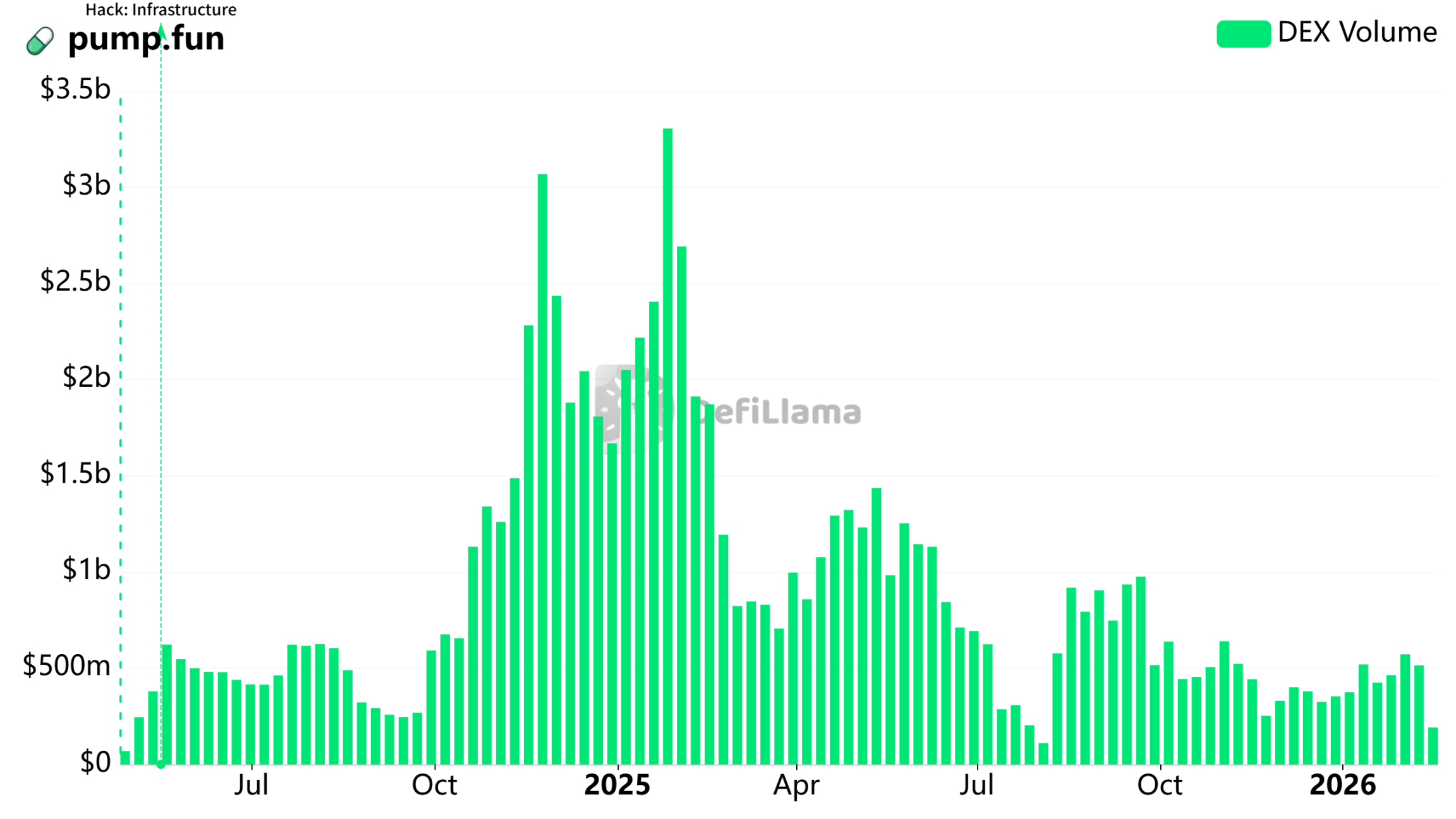
Defilama data shows that around the first few months of 2025, the transaction volume of the Meme platform pump.fun reached a historical high. The weekly transaction volume exceeded $3 billion twice, followed by a continuous decline. In early 2026, its transaction volume hovered around $500 million, one-sixth of its peak.

At the same time, some Meme traffic shifted to BNB Chain. BNB Chain rapidly rose through the Four.Meme platform. In the second half of 2025, Chinese-themed Memes like "Binance Life" and "I'm F*cking Coming" sparked FOMO sentiment. BNB Chain's Meme market capitalization grew from almost zero to hundreds of millions of dollars, with a 24-hour transaction volume reaching $460 million. In comparison, although Solana's Meme market capitalization still amounts to billions of dollars, growth has stagnated, with many projects falling over 95% from their peaks.

In October 2025, BNB Chain once replaced Solana on the trending Meme list, with obvious capital rotation: when BNB Chain Memes surged, Solana's capital contracted; after BNB Chain receded, capital partially flowed back, but the momentum had weakened. Furthermore, under the influence of influential figures CZ/He Yi, BNB Chain saw short-term growth stimulation, while Solana's Pump.fun, despite its first-mover advantage, weakened due to narrative exhaustion and a lack of incremental funds.

The end of the Meme wave means that the demand for its public chain token has also decreased simultaneously.

Public Chain Narrative Cools

Additionally, the overall cooling of the public chain narrative has further weakened Solana's ecosystem expansion plans. Between 2025-2026, the crypto market retreated from early high leverage and excessive narrative expansion. Many weak narratives, such as celebrity tokens and the Meme craze, quickly faded, shifting focus to areas with more practicality and institutional support. Solana's narrative as a "high-speed public chain" once attracted developers, but as the market entered the "deep water of value," investors tended to prefer mainstream assets like Bitcoin and Ethereum for their "digital gold" or "settlement layer" positioning, leading to a continued overall bear market and intensified capital outflow from Solana.

This narrative fatigue reflects that public chain competition has shifted from pure TPS competition to ecological maturity and regulatory adaptability. Solana's previous TPS and ecological advantages have been diluted. Whether in terms of Memes or airdrop incentives, Solana's appeal to new users has weakened.

Meanwhile, the significant speed improvement of the Ethereum mainnet has also weakened Solana's core advantage. Through the Fusaka upgrade in 2025, Ethereum increased data blob capacity from 3 to 6-9 and introduced the PeerDAS mechanism, significantly reducing transaction fees and increasing throughput. Transaction volume and active addresses subsequently rebounded.
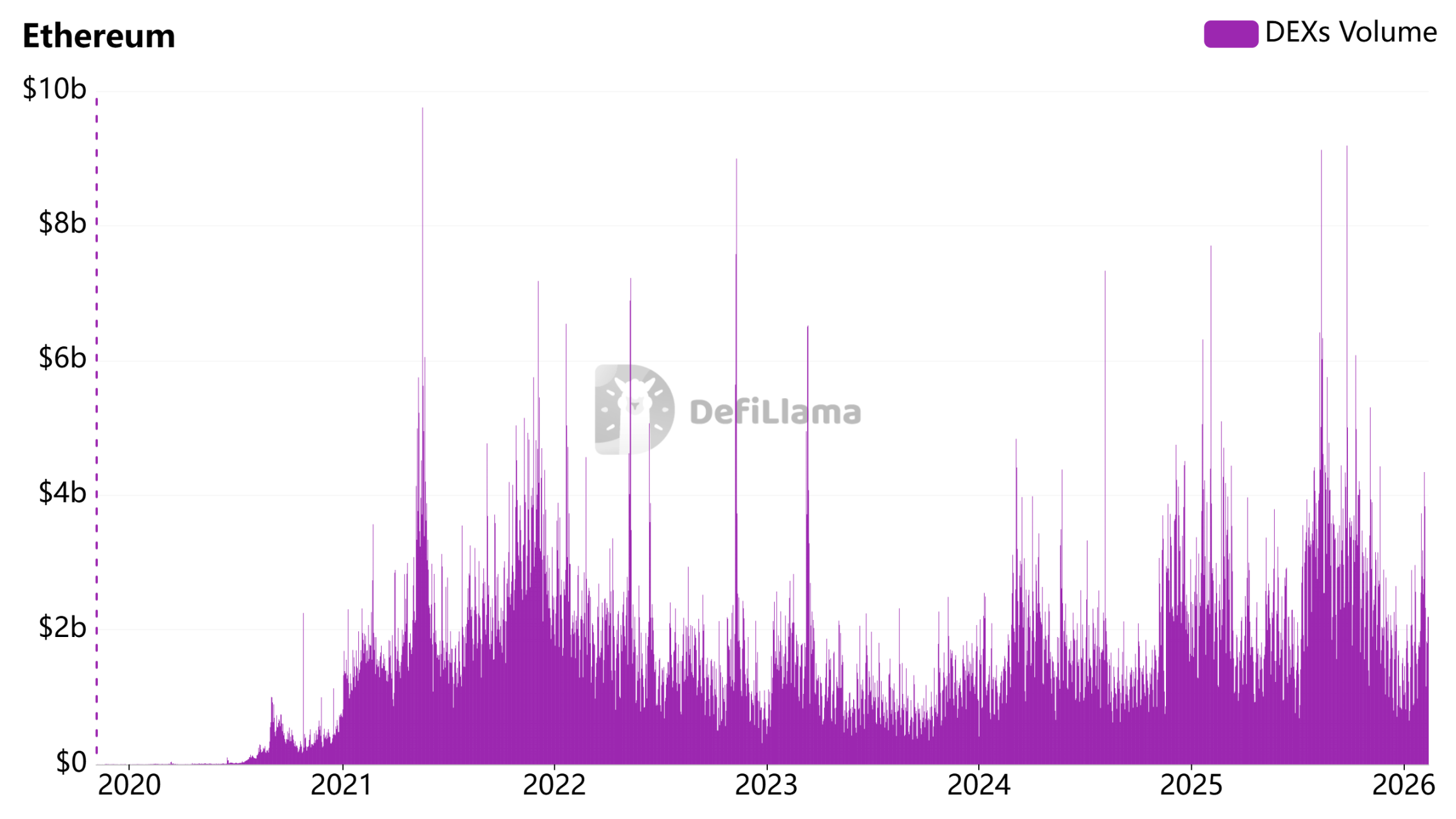
Data shows that DEX trading volume on Ethereum saw an overall upward trend in late 2025. Entering 2026, the Glamsterdam upgrade will achieve near-perfect parallel processing, further accelerating block verification and reducing fees, bringing the mainnet closer to an "operating system" level. These improvements bring Ethereum mainnet's TPS and cost close to Solana's levels, while retaining higher security and decentralization, reducing the necessity for users to switch to Solana.

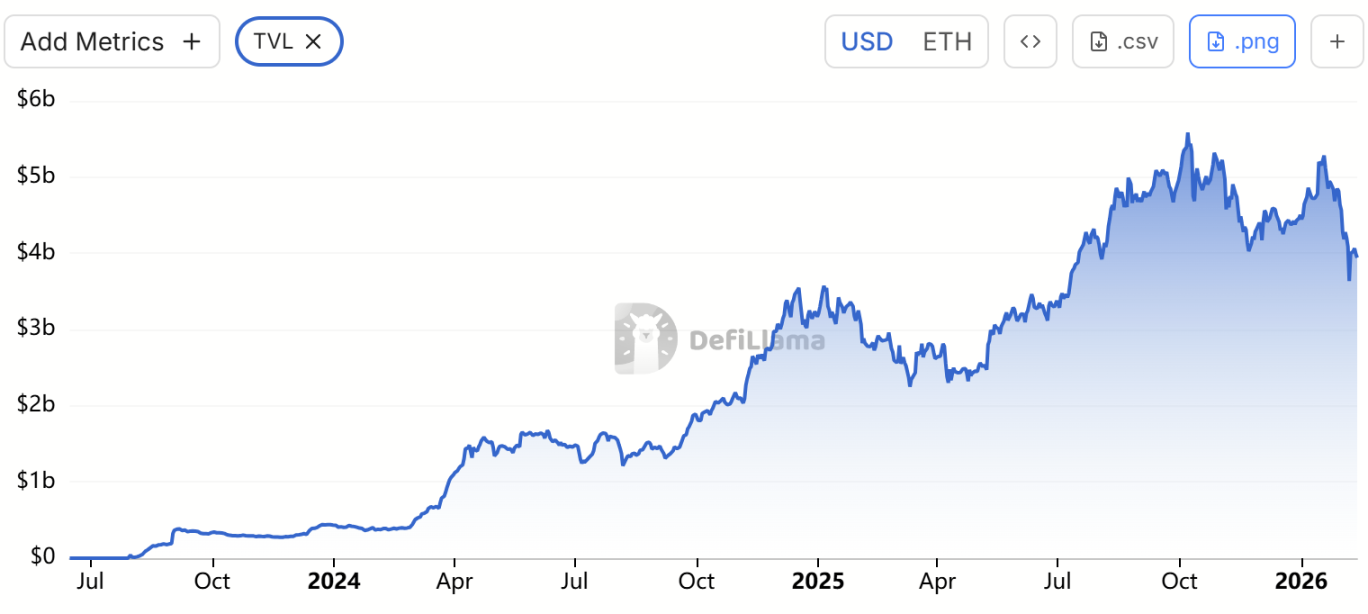
Another rising competitor, Base, is also growing rapidly, particularly with AI tokens attracting many users. According to DefiLlama data, its TVL is still maintained at a high level of $4 billion.
Under the tokenization boom, RWA occurs more on Ethereum, further marginalizing Solana's ecosystem. As of February 12, 2026, data from rwa.xyz shows that RWA assets on the Ethereum mainnet are $14.9 billion, while Solana is only $1.7 billion, still a significant gap. The tokenization trend of RWA emphasizes stability and compliance, with Ethereum's leading position making it difficult for Solana to get a share.

Digital Asset Treasury Buyers Fail to Offset Overall Bear Market Selling Pressure

From the perspective of Digital Asset Treasuries (DAT), in 2025, the DAT model was once all the rage. Many publicly traded companies such as Forward Industries, Upexi, and Sharps Technology purchased large amounts of SOL as treasury assets through private financing or debt issuance.
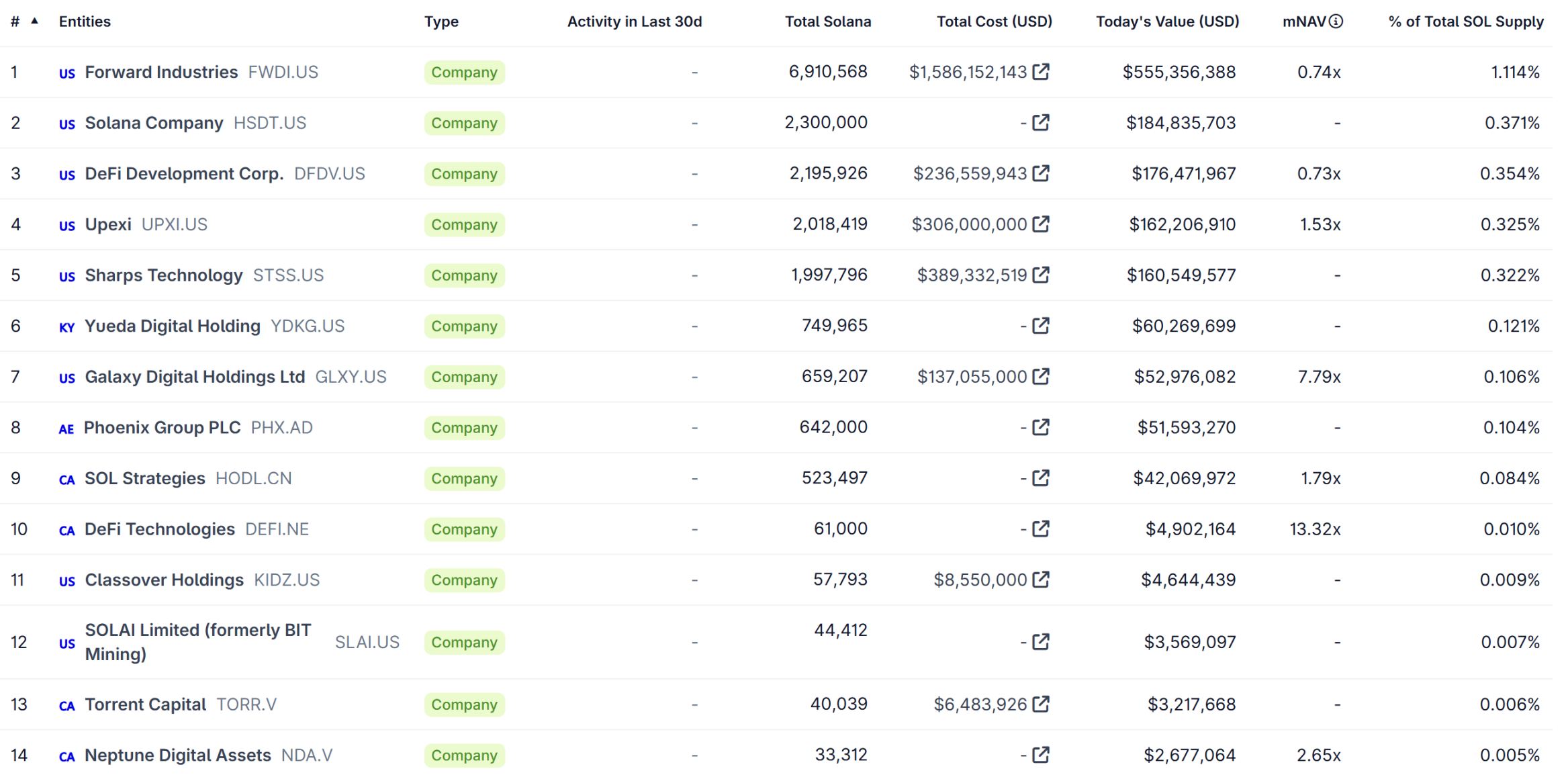
Entering 2026, as the SOL price fell from the 2025 peak of around $200 to about $80, the market capitalization of these DAT companies shrank significantly. For example, Forward Industries spent $1.58 billion to purchase SOL, now worth only $555 million, shaking some investors' confidence.

Furthermore, the DAT buying frenzy has weakened, with fewer new joiners. Although the early purchased locked SOL reduces circulating supply, it has failed to offset the overall market bearish pressure.

Bitcoin and Ethereum prices have also been hit hard in the bear market of recent months. BTC fell from $126,000 to the current $67,000, and ETH fell from $4,900 to the current $2,000.

In January 2026, Solana founder toly asked on X in Chinese: What do you think is Solana's biggest challenge now? The comments section received a variety of feedback and answers, including: no direct exchange, users have less perception of other product ecosystems besides Meme, etc.

Perhaps Solana will find its own solutions.


Twitter:https://twitter.com/BitpushNewsCN

Bitpush TG Discussion Group:https://t.me/BitPushCommunity

Bitpush TG Subscription: https://t.me/bitpush

Original link:https://www.bitpush.news/articles/7611730

Domande pertinenti

QWhat was the lowest price Solana (SOL) reached during the recent market crash, and what was its peak price during the bull run?

ADuring the market crash, Solana (SOL) fell to a low of $67, its lowest since December 2023. Its peak price during the bull run was $295.

QWhat was the primary driver of Solana's growth and activity during the recent bull cycle?

AThe primary driver was the Meme coin frenzy, which was largely facilitated by the Pump.fun platform on Solana, leading to massive daily token issuance and high trading volumes.

QWhich competing blockchain saw a rise in Meme coin activity, partially at the expense of Solana?

ABNB Chain saw a significant rise in Meme coin activity through its Four.Meme platform, attracting some of the Meme-related traffic and capital that was previously on Solana.

QHow did Ethereum's technical upgrades impact its competitive position against Solana?

AEthereum's Fusaka and upcoming Glamsterdam upgrades significantly increased its transaction throughput (TPS) and reduced fees, bringing its performance closer to Solana's while maintaining higher security and decentralization, thus reducing the incentive for users to switch to Solana.

QWhat is one major challenge for Solana's ecosystem mentioned in the article, beyond the decline of Meme coins?

AOne major challenge is the lack of user perception and engagement with products and ecosystems on Solana beyond Meme coins, as well as the overall cooling of the public chain narrative where investors are focusing more on established assets like Bitcoin and Ethereum.

Letture associate

Sequoia Dialogue with Jensen Huang: Computing Model Undergoes a 60-Year Transformation; You Won't Be Replaced by AI, But You Will Be Dimensionality-Reduced by 'Those Who Master AI'

NVIDIA founder and CEO Jensen Huang, in a conversation with Sequoia Capital's Konstantine Buhler, argues that we are witnessing the most significant computing shift in 60 years—from retrieval-based to generative computing. Instead of just storing and retrieving data, future systems will generate highly personalized content (text, images, video) on demand, powered by massive "AI factories." Huang envisions a global "intelligence network" that will envelop the planet, following the historical patterns of energy and communication grids. He outlines a five-layer investment framework: 1) Energy, 2) Chips/Computers, 3) Infrastructure (data centers), 4) AI Models, and 5) Applications. He predicts this ecosystem will reach a scale of $20 trillion annually. Crucially, Huang pushes back against fears of AI-driven job loss. He distinguishes between specific "tasks" (e.g., typing, analyzing images) and overall "jobs" (e.g., CEO, radiologist). While AI automates tasks, it increases efficiency and demand for the higher-value problem-solving aspects of professions, thus creating more jobs and "up-leveling" careers. The real risk, he asserts, is not being replaced by AI, but being outperformed by someone who effectively leverages it. He urges everyone to embrace AI as a tool for augmented capability and innovation.

marsbit4 min fa

Sequoia Dialogue with Jensen Huang: Computing Model Undergoes a 60-Year Transformation; You Won't Be Replaced by AI, But You Will Be Dimensionality-Reduced by 'Those Who Master AI'

marsbit4 min fa

"I Don't Need a Better Model Anymore": A Panorama of AI Users Under a Reddit Hot Post

Titled "I Don't Need a Better Model Anymore": AI User Reactions on Reddit Anthropic recently released Claude Fable 5, its first publicly available 'Mythos'-tier model, achieving 80.3% on the SWE-Bench Pro benchmark and significantly outperforming its predecessor and competitors. However, a viral Reddit post titled "Claude Fable made me realize I don't need better models anymore" highlighted a growing user sentiment of "good enough." Top comments expressed "model fatigue," with users stating that earlier models like Opus 4.5/4.8 already sufficed for their workflows. High cost was a key concern, as Fable 5's API is nearly twice the price of Opus 4.8, with users questioning the return on investment and suggesting the field has hit a plateau. The most frequent complaint targeted Fable 5's stringent safety filters. Designed to intercept high-risk requests (e.g., cybersecurity), the system was perceived as overly conservative. Users reported frequent rejections for routine security-related tasks, leading to automatic fallbacks to the older Opus model. Paying users were particularly frustrated, feeling they paid a premium for a less usable product. Dissenting voices came from users with heavy, complex tasks. For workloads like high-energy physics simulations with thousands of code lines, Fable 5's improved long-context understanding and error detection represented a significant, worthwhile leap—described as moving from a "college player to an NBA starter." The debate underscores a divergence between benchmark performance and practical utility. For most users, current models meet their needs, making further advances relevant only for extreme use-cases. The discussion also raised concerns about a potential "Public AI Freeze," where the most powerful models (like the restricted Mythos 5) remain exclusive to enterprises and governments, while public offerings stagnate. The launch presents two report cards: one of technical excellence and another of user skepticism. Fable 5's ultimate reception may depend on Anthropic's ability to refine its safety filters and justify its cost for specialized, high-demand users.

marsbit11 min fa

"I Don't Need a Better Model Anymore": A Panorama of AI Users Under a Reddit Hot Post

marsbit11 min fa

When AI Traffic Surpasses Humans, How Do You Prove You're Human?

With AI-generated web traffic surpassing human activity, websites face a crisis as AI agents bypass ads, avoid clicks, and scrape data without generating revenue. This disrupts the ad-based internet economy, diverting traffic and reducing site visits. In response, sites are blocking AI crawlers and deploying traps like Cloudflare's "honeypot" pages. Traditional CAPTCHAs are now ineffective against advanced AI. The focus has shifted to behavioral biometrics—analyzing unique human patterns such as cursor movement, typing rhythm, and keystroke dynamics. Companies like IBM and BioCatch use this data to distinguish humans from bots, even detecting fraud through behavioral inconsistencies. Two competing approaches aim to verify human identity centrally. Sam Altman’s World (formerly Worldcoin) uses iris scanning to create unique credentials, though it faces privacy concerns and regulatory bans. Alternatively, cryptographic zero-knowledge proofs offer anonymous verification without revealing personal data, championed by Vitalik Buterin to avoid centralized surveillance. However, both systems have flaws. Centralized solutions risk biometric data misuse, while decentralized models may be exploited through identity rental markets in economically unequal regions. Despite challenges, the author favors cryptographic methods for preserving privacy over pervasive behavioral monitoring that permanently captures and controls personal biometric data.

marsbit20 min fa

When AI Traffic Surpasses Humans, How Do You Prove You're Human?

marsbit20 min fa

2026 Landscape of Decentralized AI: Why is Blockchain the Inevitable "Antidote" for AI?

**The 2026 Landscape of Decentralized AI: Why Blockchain is the "Cure" AI Cannot Ignore** Decentralized AI addresses fundamental bottlenecks of centralized AI: scarce and expensive computational resources, excessive control concentration, unverifiable model outputs, and increasing difficulty in acquiring training data due to privacy and regulation. Blockchain offers a path to make intelligence open, verifiable, and economically accessible. The technical stack comprises three layers: 1. **Applications & Services**: The main crypto use cases are "Agentic Finance" (converting natural language into on-chain actions) and "Agentic Payments" for machine-to-machine commerce. Projects like Giza, Infinity Labs, Coinvest AI, and x402 (handling 173M+ transactions) are key players. 2. **Middleware**: This coordination layer enables agents to discover, identify, and transact. Notable projects include Gokite AI (specialized L1), Virtuals (an OS for the agent economy), and especially Bittensor—a network of specialized subnets forming competitive AI micro-economies. 3. **Infrastructure**: The capital-intensive layer providing raw resources. It includes decentralized compute (Akash, Render, Aethir), verifiable inference (Venice AI, OpenGradient), distributed training (Prime Intellect, Templar AI), decentralized storage (Filecoin, Walrus), and privacy/verification layers (Nillion, Arcium, Phala Network) using technologies like ZKPs, MPC, and TEEs. The outlook for 2026-2027 indicates AI demand outpacing infrastructure, with AI agents as a primary growth engine. Computation is becoming an asset class, with on-chain markets as its financial layer. Tokenomics is emerging as a structural advantage for coordinating capital, compute, and data in decentralized AI networks. While still early—with adoption uneven and revenue often trailing token incentives—projects like Bittensor, NEAR, and Virtuals demonstrate a shift from speculative narrative to a new model for coordinating intelligence.

marsbit23 min fa

2026 Landscape of Decentralized AI: Why is Blockchain the Inevitable "Antidote" for AI?

marsbit23 min fa

a16z Crypto Partner: Cash Flow is the Moat

Cash Flow as the Moat: A Playbook for Crypto Founders Historically, the most enduring businesses have been built by positioning themselves within the "flow of funds"—facilitating the creation and transfer of value in a network and extracting a portion of it. Cryptocurrency is the first modern technology natively built for this purpose. For startups, failing to architect products and businesses to leverage these principles means missing a major opportunity. Blockchains are inherently network businesses. Each transaction settles on a shared ledger, and every new participant strengthens the underlying network for all. Well-designed network tokens amplify this by aligning users, developers, and validators around growing the network, with value flowing back to contributors in a transparent feedback loop. This model is not new; companies from railroads and Standard Oil to Google, Meta, and AWS have thrived by inserting themselves into critical flows of value (goods, attention, compute). Financial markets make it even clearer: firms like Visa and major market makers generate immense revenue not by predicting markets but by being in the path of transactions. The combination of fund flow and network effects creates one of the most durable business structures. The high margins in traditional finance (payments, custody, lending, FX) represent prime targets. Crypto founders have the opportunity to build the next version—programmable, instant, global, and natively in the flow of funds. The frontier extends beyond finance to areas like computing/GPUs, AI training data, energy, robotics, and space—markets without entrenched intermediaries, ripe for building new, efficient value rails on programmable infrastructure. Founders should ask: Are you in the flow of funds today? Does your revenue scale 10x with the value of activity on your platform? Where in your target market are profit margins highest relative to value created? The opportunity is clear: embed your startup into the new flows of value and let the network effects accumulate.

marsbit25 min fa

a16z Crypto Partner: Cash Flow is the Moat

marsbit25 min fa

Trading

Spot
Futures

Articoli Popolari

Cosa è MEME 2.0

Memecoin 2.0: L'Ascesa di $MEME 2.0 nel Mondo delle Criptovalute Introduzione Nel panorama in continua evoluzione delle criptovalute, è emerso un nuovo contendente. Memecoin 2.0, simboleggiato come $MEME 2.0, porta il concetto di meme coin a un livello emozionante. Come prodotto derivato dal Memecoin originale, questo progetto ha catturato l'attenzione della comunità crypto spostando il focus da incentivi finanziari tipici a un'esperienza coinvolgente e divertente. Operando sulla blockchain di Ethereum, Memecoin 2.0 ridefinisce audacemente l'impegno della comunità nella sfera crypto. Che cos'è Memecoin 2.0, $MEME 2.0? Alla base, Memecoin 2.0 è un progetto di criptovaluta che dà priorità allo spirito di comunità e al divertimento associato alla cultura meme. A differenza delle criptovalute convenzionali, che si concentrano su casi d'uso pratici e benefici tangibili, Memecoin 2.0 si distingue abbracciando il lato più leggero della moneta digitale. Il progetto esiste senza promesse di utilità, una roadmap strutturata o ritorni finanziari, concentrandosi invece sulla creazione di una comunità vibrante incentrata sui meme e sul divertimento condiviso. Facendo così, attinge alla crescente tendenza della cultura meme nello spazio online, rendendola un giocatore unico nel mondo degli asset digitali. Creatore di Memecoin 2.0, $MEME 2.0 Nonostante ricerche approfondite sulle origini di Memecoin 2.0, l'identità esplicita del suo creatore rimane sconosciuta. Questa anonimità non è rara nella comunità crypto, dove molti progetti sono guidati da individui o gruppi che preferiscono rimanere dietro le quinte. La mancanza di informazioni pubblicamente disponibili sul creatore potrebbe essere vista come una mossa strategica, mettendo in evidenza l'impegno della comunità piuttosto che la notorietà individuale all'interno dello spazio. Investitori di Memecoin 2.0, $MEME 2.0 Le informazioni riguardanti gli investitori o il supporto finanziario per Memecoin 2.0 sono scarse. Questa assenza di dettagli potrebbe suggerire che il progetto sia autofinanziato o che il suo focus sulla comunità piuttosto che sulle strutture d'investimento tradizionali abbia attratto un tipo diverso di sostenitore. Poiché il mondo delle meme coin coinvolge tipicamente un maggior coinvolgimento di base piuttosto che investimenti istituzionali, questo approccio si allinea con l'etica dei progetti guidati dalla comunità. Come funziona Memecoin 2.0, $MEME 2.0? Memecoin 2.0 opera interamente sulla blockchain di Ethereum, capitalizzando le sue robuste caratteristiche di sicurezza e scalabilità. Sfruttando i punti di forza di Ethereum, Memecoin 2.0 può offrire un ambiente sicuro per le interazioni degli utenti garantendo che le transazioni siano sia efficienti che convenienti. Uno degli attributi unici di Memecoin 2.0 risiede nella sua struttura guidata dalla comunità. Il valore e la popolarità del token $MEME 2.0 derivano dalla partecipazione attiva dei suoi utenti, piuttosto che dalla utilità intrinseca. Questo design rinforza il focus del progetto sull'aspetto dell'intrattenimento delle criptovalute, implicando che la risata e l'impegno della comunità siano le vere monete che guidano il suo successo. Inoltre, il progetto si inserisce all'interno dell'ecosistema più ampio delle meme coin, dove il valore di ciascuna meme coin oscilla in base alla cultura, alle tendenze e all'impegno della comunità piuttosto che ai principi economici tradizionali. Cronologia di Memecoin 2.0, $MEME 2.0 Per comprendere meglio l'evoluzione e le pietre miliari di Memecoin 2.0, ecco una cronologia che evidenzia eventi significativi nella sua storia: 2024: L'inizio di Memecoin 2.0 è riconosciuto come un ramo del Memecoin originale, affermandosi all'interno del contesto fiorente delle meme coin mentre opera sulla blockchain di Ethereum. 13 luglio 2024: Memecoin 2.0 si posiziona ufficialmente come una meme coin incentrata sulla comunità sulla rete Ethereum, enfatizzando il suo approccio centrato sull'intrattenimento che invita gli utenti a impegnarsi e partecipare alla sua crescita. Punti Chiave su Memecoin 2.0, $MEME 2.0 Diverse caratteristiche critiche definiscono Memecoin 2.0: Approccio Centrico alla Comunità: La missione principale di Memecoin 2.0 è creare un'esperienza comunitaria divertente e coinvolgente, capitalizzando il piacere collettivo derivante dalla cultura memetica. Costruita su Ethereum: Operare sulla blockchain di Ethereum fornisce al progetto un'infrastruttura essenziale che garantisce sicurezza e scalabilità. Mancanza di Utilità o Roadmap: In una marcata deviazione dalle criptovalute tradizionali, Memecoin 2.0 non promette alcuna caratteristica utilitaria o ritorni finanziari, riaffermando il suo impegno per il coinvolgimento della comunità e l'impegno sociale. Focus sulla Cultura Memetica: Abbracciando gli aspetti umoristici e culturali del fenomeno meme, Memecoin 2.0 offre una piattaforma per gli utenti per interagire con la crypto offline e online. Ulteriore Contesto: L'Importanza delle Meme Coin Le meme coin sono emerse come una classe distinta di criptovaluta, spesso guidata dall'umorismo e da un approccio spensierato al trading. Queste monete generalmente mancano di significative utilità o roadmap di sviluppo, attirando gli utenti con la promessa di divertimento, interazione comunitaria e rilevanza culturale. Nel panorama del più ampio ecosistema crypto, le meme coin rianimano l'importanza dell'impegno della comunità, opponendosi ad approcci esclusivamente orientati al profitto. Progetti come Memecoin 2.0 danno il via a un'era in cui l'intrattenimento può armonizzarsi con le aspirazioni finanziarie, trasformando la blockchain in un parco giochi per la creatività e l'interazione sociale. Conclusione Memecoin 2.0, o $MEME 2.0, incarna una nuova ondata di criptovaluta che dà priorità all'impegno della comunità rispetto a rigidi strutture finanziarie. Con un focus sull'umorismo e l'interazione sociale, capitalizza sulla fascinazione circondante la cultura meme. Operando sulla blockchain di Ethereum, Memecoin 2.0 sfrutta le capacità della tecnologia mantenendo fermo il suo impegno per il valore ricreativo della valuta digitale. Mentre lo spazio delle criptovalute continua a evolversi, Memecoin 2.0 serve come testimonianza della nozione che il futuro degli asset digitali potrebbe ben dipendere da esperienze condivise, risate e solidi legami comunitari. Nel mondo imprevedibile delle crypto, forse la gioia può essere altrettanto preziosa quanto il guadagno finanziario tradizionale.

93 Totale visualizzazioniPubblicato il 2024.04.04Aggiornato il 2024.12.03

Cosa è MEME 2.0

Come comprare MEME

Benvenuto in HTX.com! Abbiamo reso l'acquisto di Memeland (MEME) semplice e conveniente. Segui la nostra guida passo passo per intraprendere il tuo viaggio nel mondo delle criptovalute.Step 1: Crea il tuo Account HTXUsa la tua email o numero di telefono per registrarti il tuo account gratuito su HTX. Vivi un'esperienza facile e sblocca tutte le funzionalità,Crea il mio accountStep 2: Vai in Acquista crypto e seleziona il tuo metodo di pagamentoCarta di credito/debito: utilizza la tua Visa o Mastercard per acquistare immediatamente MemelandMEME.Bilancio: Usa i fondi dal bilancio del tuo account HTX per fare trading senza problemi.Terze parti: abbiamo aggiunto metodi di pagamento molto utilizzati come Google Pay e Apple Pay per maggiore comodità.P2P: Fai trading direttamente con altri utenti HTX.Over-the-Counter (OTC): Offriamo servizi su misura e tassi di cambio competitivi per i trader.Step 3: Conserva Memeland (MEME)Dopo aver acquistato Memeland (MEME), conserva nel tuo account HTX. In alternativa, puoi inviare tramite trasferimento blockchain o scambiare per altre criptovalute.Step 4: Scambia Memeland (MEME)Scambia facilmente Memeland (MEME) nel mercato spot di HTX. Accedi al tuo account, seleziona la tua coppia di trading, esegui le tue operazioni e monitora in tempo reale. Offriamo un'esperienza user-friendly sia per chi ha appena iniziato che per i trader più esperti.

295 Totale visualizzazioniPubblicato il 2024.12.12Aggiornato il 2026.06.02

Come comprare MEME

Discussioni

Benvenuto nella Community HTX. Qui puoi rimanere informato sugli ultimi sviluppi della piattaforma e accedere ad approfondimenti esperti sul mercato. Le opinioni degli utenti sul prezzo di MEME MEME sono presentate come di seguito.

活动图片














