Ethereum Glamsterdam Upgrade: Largest-Scale Underlying Restructuring Yet, Mainnet Date Still Undecided

marsbitPubblicato 2026-08-14Pubblicato ultima volta 2026-08-14

Introduzione

The upcoming Ethereum "Glamsterdam" upgrade is viewed by core developers as the most significant protocol-level refactoring since The Merge, fundamentally altering how the network processes transactions and manages its state to advance L1 scaling. Its core goals are: accelerating processing via parallelization, increasing capacity, and enhancing sustainability through adjusted fees that better reflect long-term data storage costs. The upgrade features two headline proposals. First, **ePBS (EIP-7732)** on the consensus layer aims to formalize proposer-builder separation directly within the protocol, eliminating reliance on off-chain relayers. This built-in mechanism is designed to provide a more secure and efficient block production pipeline, extending the critical validation window to allow the network to handle more data, particularly for Layer2s. Second, **BALs (EIP-7928)** on the execution layer introduces block-level access lists. These lists specify the data each transaction will access beforehand, allowing the network to identify and safely execute non-conflicting transactions in parallel, rather than strictly sequentially. This also speeds up new node synchronization. Glamsterdam also includes配套 proposals to reprice storage costs (aiming for a predictable ~120 GiB annual state growth) and the cost of data-reading operations to better align with modern hardware costs and prevent spam. Regarding the timeline, the initial schedule targeting a mainnet activation on Sep...

Author | jk

The upcoming Glamsterdam upgrade for Ethereum is seen by core developers as the most extensive protocol-level restructuring since The Merge. The name is a combination of two parts: the execution layer upgrade continues the "Amsterdam" naming from previous Devconnect host cities, while the consensus layer upgrade is named "Gloas" after a star. Following the previous Fusaka upgrade, Glamsterdam advances L1 scaling by restructuring how the network processes transactions and manages its growing database, fundamentally updating how Ethereum creates and validates blocks.

This upgrade revolves around three core objectives:

  • Accelerated Processing (Parallelization): Reorganizes how the network records data dependencies, enabling it to safely process many transactions simultaneously rather than slowly one-by-one in sequence.
  • Scalability: Splits the heavy workload of block creation and validation, giving the network more time to propagate larger amounts of data without slowing down.
  • Sustainability: Adjusts network fees to accurately reflect the long-term hardware costs of storing new data, clearing the way for future gas limit increases while avoiding hardware performance degradation.

The upgrade's two headline proposals fall under the consensus and execution layers respectively:
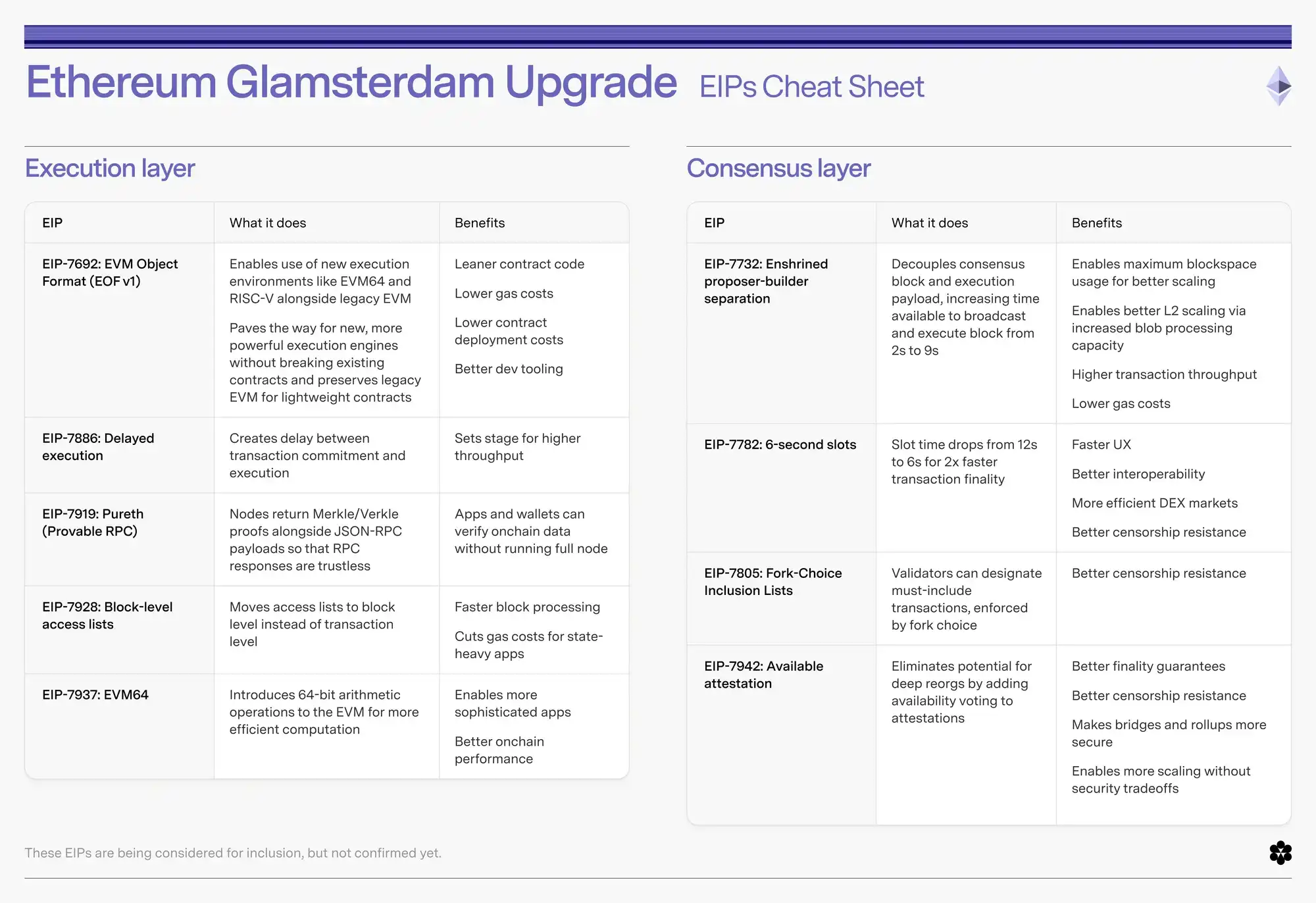
There are two headline proposals. Source: Ethereum

Headline Proposal One: ePBS, Turning "Outsourced Middlemen" into "Built-in Rules"

First, the consensus layer's headline proposal: enshrined Proposer-Builder Separation, abbreviated as ePBS (EIP-7732).

Each time Ethereum produces a block, it involves two steps: one person is responsible for "selecting which block" (the proposer), and another is responsible for "actually assembling the transactions within the block" (the builder). Currently, this division of labor is not mandated by the Ethereum protocol itself, but is instead facilitated by a batch of off-chain "intermediary companies" (jargon: relays). This off-chain relationship also creates a critical path during block validation, forcing validators to rush through transaction broadcasting and execution within a tight 2-second window, limiting the amount of data the network can handle. An analogy: it's like a restaurant's ordering and cooking process originally relying on an independent external coordinator to relay the orders; if this coordinator fails, the kitchen and the front-of-house might end up with mismatched accounts.

What ePBS does is codify this "order-cooking" division of labor into the restaurant's own operational manual, eliminating reliance on the external coordinator. This way, on-chain trusted block delivery and payment mechanisms are directly built into the protocol itself, thus no longer requiring dependence on third-party middleware. However, if the parties wish to use complex features not yet specified in the protocol, they can still choose to revert to using an external coordinator. Meanwhile, to prevent the "order relay" process from being a frantic rush, ePBS also establishes a dedicated "inspection team" to separately verify "who placed the order" and "whether the food was prepared and served on time." The original 2-second order relay window is consequently expanded to approximately 9 seconds, allowing the restaurant to handle more orders in one go—meaning Ethereum can carry more data destined for Layer2.

Headline Proposal Two: BALs, Making a "Shopping List" Before Heading Out

Next, the execution layer's headline proposal: Block-level Access Lists, abbreviated as BALs (EIP-7928).

The current way Ethereum processes transactions is akin to a person going grocery shopping blindfolded: they must touch an item first, confirm what it is, before deciding on the next step, so items must be handled one by one in a queue. Because it's not known in advance which data a transaction will use (e.g., which accounts it involves), the system must process transactions strictly in sequence, one after another. Otherwise, two transactions might unintentionally attempt to modify the same piece of data (like the balance of the same address) simultaneously, causing conflicts and errors.

BALs are equivalent to giving this person a "shopping list" written in advance, specifying "which shelves to go to and which items to pick up." With this list, the system can see ahead of time which transactions are completely unrelated and won't "fight" with each other. It can then group these unrelated transactions and process them concurrently in parallel, rather than having to queue them up one by one. This list has an additional benefit: when new nodes join the network, they can directly copy the final results recorded in this list, without needing to recompute all the complex historical transactions, significantly speeding up the node synchronization process. To facilitate the actual circulation of these lists within the network, Glamsterdam also bundles a supporting transport protocol upgrade that allows nodes to share these access lists. This transport protocol has now become a mandatory requirement for all execution layer clients.

Supporting Proposals: Recalculating Costs for "Space-Occupying" Operations

Besides these two headline proposals, Glamsterdam also bundles two repricing supporting proposals, which can be understood as a price list adjustment for the network's "storage fees" and "query fees," respectively.

  • The first involves operations like creating new accounts or deploying contracts, which "permanently occupy space" in the network. Previously, the fee charged was not proportional to the actual space occupied. Now, it will be recalculated to "charge the corresponding fee for each unit of space occupied." The goal is to control the entire network's data growth rate at a safe, predictable level of approximately 120 GiB per year, ensuring the network can continue to run on ordinary hardware. Additionally, this storage fee will be accounted for in a separate, dedicated account, no longer mixed with the computational costs of processing transactions themselves. As long as developers are willing to pay a bit more for storage, they can still deploy larger, more complex applications without being immediately capped by the overall Gas limit.
  • The second involves operations like querying or reading existing data within the network. Previously, these were priced too low, not keeping up with the actual query costs after the data volume increased. This time, the pricing standards for these opcodes will be raised, bringing the price closer to the real load conditions of modern hardware, while also preventing malicious actors from exploiting the cheap fees to intentionally clog the network with a flood of query requests.

Mainnet Launch Time: Still Not Finalized

Regarding the timeline, Glamsterdam is currently in a rather delicate phase. Officially, the last verifiable All Core Developers Execution Layer meeting (ACDE) was the 241st, held on July 16th, with the main agenda including the latest progress report on the Glamsterdam Devnet phase and voting for the headline proposal for the next upgrade, Hegota. A widely cited internal schedule previously indicated that the Devnet phase went through eight iterations from 0 to 7, spanning from March 28th to July 8th, 2026. The Sepolia testnet fork was originally scheduled for August 3rd, 2026, the Hoodi testnet fork for August 17th, 2026, and the target date for mainnet activation was September 16th, 2026.
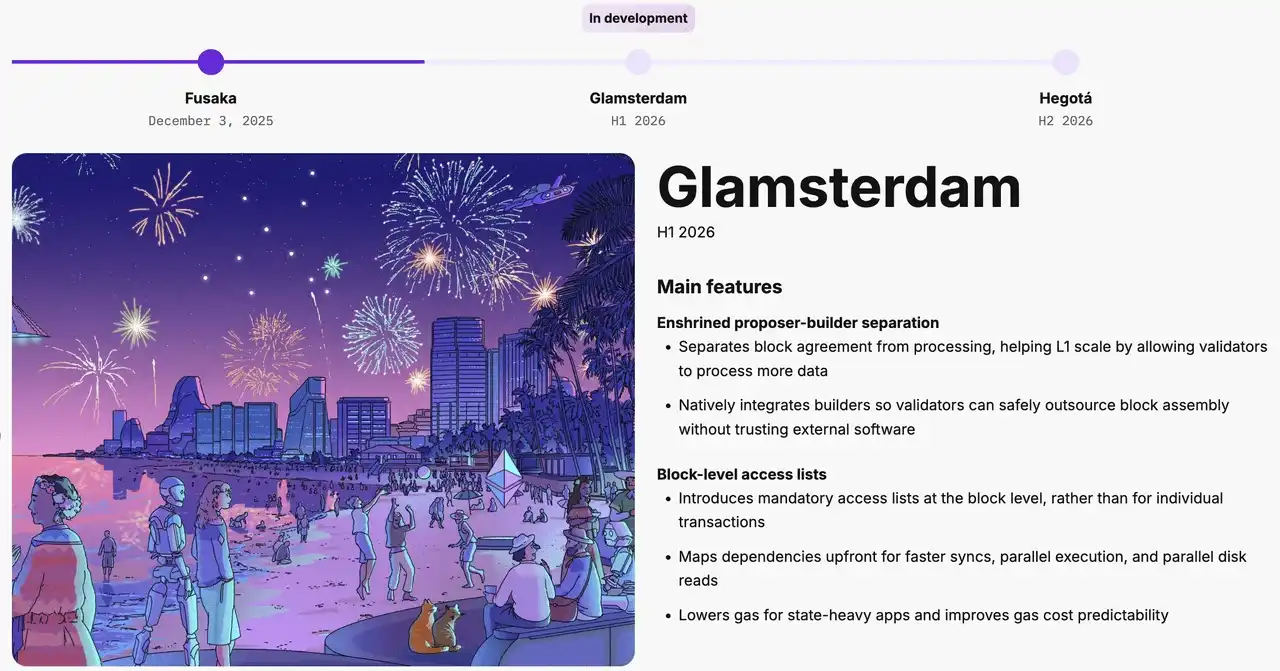
The original schedule was for the first half of 2026. Source: Ethereum

However, based on the latest developments, this schedule has most likely been pushed back. The EthPandaOps team recently launched a new testnet called Plataberget, which is the first short-term public testnet specifically designed for Glamsterdam. Formal deployments on Sepolia and Hoodi are now expected to be postponed until September, and the mainnet launch target has been correspondingly pushed back to the fourth quarter of 2026. This marks the second time Glamsterdam's dates have slipped, following a previous delay from the original first half of 2026. Core developers have repeatedly emphasized that the correctness of the upgrade takes priority over meeting any specific date. Therefore, until a specific block height is officially locked in by an ACD meeting, we may have to wait until the fourth quarter, or even the end of the year, to see this upgrade.

Crypto di tendenza

Domande pertinenti

QWhat are the three core goals of the Ethereum Glamsterdam upgrade?

AThe three core goals are: 1) Acceleration (Parallelization): Reorganizing how the network records data dependencies to allow safe parallel processing of many transactions. 2) Scaling: Separating the heavy work of block creation and validation, giving the network more time to propagate larger amounts of data. 3) Sustainability: Adjusting network fees to accurately reflect the long-term hardware costs of storing new data, paving the way for future gas limit increases while preventing hardware degradation.

QWhat problem does the ePBS (EIP-7732) proposal aim to solve on the consensus layer?

AePBS (Enshrined Proposer-Builder Separation) aims to eliminate the reliance on off-chain, third-party relayers (intermediaries) that currently coordinate the block proposer and block builder roles. By building the separation of these roles directly into the protocol rules, it creates a more secure, trust-minimized system for block delivery and payment. It also restructures block validation to separate checks for the block header and the block body, extending the validation window from ~2 seconds to ~9 seconds, allowing the network to handle more data, particularly for Layer 2s.

QHow does the BALs (EIP-7928) proposal improve transaction processing on the execution layer?

ABALs (Block-Level Access Lists) provide a 'shopping list' for each block, pre-declaring which data (e.g., which accounts) each transaction will access. This allows the system to identify which transactions are independent and can be processed in parallel, rather than being forced to process all transactions sequentially to avoid conflicts. This parallelization speeds up block execution. Additionally, it simplifies state synchronization for new nodes, as they can use these lists to verify final results without replaying all historical transactions.

QWhat is the stated purpose of the fee repricing proposals bundled with Glamsterdam?

AThe fee repricing proposals aim to adjust network costs to better reflect real-world hardware costs. The first adjusts fees for operations that permanently occupy state (like creating accounts or deploying contracts) to align cost with storage footprint, aiming to control annual state growth to a predictable ~120 GiB. The second increases the cost of opcodes that read data, bringing the price closer to modern hardware query costs and preventing spam attacks that exploit artificially low fees.

QWhat is the current estimated timeline for the Glamsterdam upgrade to activate on the Ethereum mainnet according to the article?

AAccording to the latest indications in the article, the Glamsterdam mainnet activation has likely been delayed to the fourth quarter of 2026. The original target date of September 16, 2026, has been pushed back. The formal deployments on the Sepolia and Holesky testnets are now expected in September, with the mainnet launch to follow. This is the second delay for the upgrade, and the core developers prioritize correctness over meeting a specific date, so the activation might occur by the end of 2026.

Letture associate

New ChatGPT Feature: AI Begins Monitoring Users

OpenAI has launched "Computer History," a new feature for its ChatGPT desktop app on macOS, designed to track user activity across applications and websites. This allows the AI model to use this data to provide more accurate and personalized responses in subsequent conversations. The feature, released on August 13th, is available to Pro, Business, and Enterprise subscribers. However, its rollout in the European Economic Area, the UK, and Switzerland is delayed as OpenAI works to align the tool with local data processing regulations. Computer History operates in the background, logging user activity into a temporary timeline. Users can review, manage, or delete this history via the app's interface or macOS menu bar. The feature is opt-in and requires explicit user activation in the settings. This release replaces and expands upon an earlier experimental project called Chronicle. OpenAI states the new version is more computationally efficient and offers improved privacy controls. The launch coincides with other AI advancements from the company, including a high-speed GPT-5.6 model. The article notes potential technical risks associated with the predecessor, Chronicle, such as prompt injection vulnerabilities and unencrypted local data storage. It also highlights the competitive landscape, where similar memory features are being developed by rivals like Anthropic's Claude and Google's Gemini. The delayed European rollout underscores the ongoing challenge of balancing deep personalization with stringent data protection laws.

cryptonews.ru34 min fa

New ChatGPT Feature: AI Begins Monitoring Users

cryptonews.ru34 min fa

GPT-5 Also Has Tip-of-the-Tongue Moments, Google Tested 4.5 Million Times: The Keys Are Lost

Google researchers have discovered that advanced AI models like GPT-5 and Gemini 3 experience a phenomenon akin to the human "tip-of-the-tongue" state, where they possess knowledge but fail to retrieve it. Their study, "Empty Shelves or Lost Keys?" (ICML 2026), introduces the "Knowledge Portrait" framework to analyze factual knowledge in models, distinguishing between failure to encode a fact versus failure to recall it. Testing on 13 models across 2.15 million queries from the WikiProfile benchmark revealed that state-of-the-art models successfully encode 95-98% of facts into their parameters. However, when asked directly, they fail to recall 26-34% of these known facts. Enabling chain-of-thought ("thinking") reasoning reduces this recall failure to 11-12%, recovering 40-65% of the previously unrecalled but encoded facts. The research identifies two key bottlenecks: recalling obscure ("long-tail") facts and answering reversed queries (e.g., "Who is Tom Cruise's mother?" vs. "Whose son is Tom Cruise?"). While scaling model size effectively reduces encoding failures, it does little to improve recall rates. In larger models, recall failure becomes the dominant source of factual errors, accounting for over 70% of mistakes in GPT-5.2. The findings suggest that for top models, the primary challenge is no longer storing knowledge but accessing it efficiently. Future accuracy gains may depend more on improved inference-time methods and "meta-cognitive" abilities, enabling models to recognize when they need to engage in deeper reasoning to retrieve information they already know.

marsbit54 min fa

GPT-5 Also Has Tip-of-the-Tongue Moments, Google Tested 4.5 Million Times: The Keys Are Lost

marsbit54 min fa

The Dollar is a Technology: Stablecoins Are Exporting U.S. Institutions to the World

This article argues that stablecoins and blockchain infrastructure are becoming a vehicle for exporting American financial systems globally. The core thesis is that the U.S. dollar, as a "technology," is increasingly embedded in blockchain rails, moving beyond a reserve currency to represent the institutional stability of the United States itself. The piece highlights three key areas where this is happening: 1. **Cross-border payments and trade finance:** Companies like Keyrails use stablecoins and blockchain to streamline and secure trade finance for emerging markets (e.g., Nigeria-China trade), offering faster, often cheaper dollar liquidity than traditional systems. 2. **Programmable collateral and credit:** Platforms like SemiLiquid allow institutions to use tokenized assets (e.g., treasuries, stocks) as "programmable collateral" for loans without moving them from custody, unlocking capital efficiency and improving transparency in institutional lending. 3. **Financing real-world assets:** Protocols like USD.AI create lending markets for productive, hard-to-finance assets like AI GPUs, connecting global stablecoin liquidity to physical capital. The author concludes that the true value of these new blockchain-based financial platforms lies not just in transaction volume, but in the deep, hard-to-replicate "context" (data, trust, operational knowledge) they build around specific economic activities like trade and asset finance. This represents crypto's evolution into an operating system for real-world capital formation, moving beyond speculation.

marsbit58 min fa

The Dollar is a Technology: Stablecoins Are Exporting U.S. Institutions to the World

marsbit58 min fa

Trading

Spot

Articoli Popolari

Cosa è ETH 3.0

ETH3.0 e $eth 3.0: Un'Analisi Approfondita del Futuro di Ethereum Introduzione Nel panorama in rapida evoluzione delle criptovalute e della tecnologia blockchain, ETH3.0, spesso indicato come $eth 3.0, è emerso come un argomento di considerevole interesse e speculazione. Il termine comprende due concetti principali che warrantono chiarimenti: Ethereum 3.0: Questo rappresenta un potenziale futuro aggiornamento volto ad aumentare le capacità dell'attuale blockchain di Ethereum, concentrandosi principalmente sul miglioramento della scalabilità e delle prestazioni. ETH3.0 Meme Token: Questo progetto di criptovaluta distinto cerca di sfruttare la blockchain di Ethereum per creare un ecosistema incentrato sui meme, promuovendo il coinvolgimento all'interno della comunità delle criptovalute. Comprendere questi aspetti di ETH3.0 è essenziale non solo per gli appassionati di criptovalute, ma anche per coloro che osservano tendenze tecnologiche più ampie nello spazio digitale. Che cos'è ETH3.0? Ethereum 3.0 Ethereum 3.0 è pubblicizzato come un aggiornamento proposto per la rete Ethereum già stabilita, che è stata la spina dorsale di molte applicazioni decentralizzate (dApps) e contratti smart sin dalla sua nascita. I miglioramenti previsti si concentrano principalmente sulla scalabilità, integrando tecnologie avanzate come lo sharding e le prove a conoscenza zero (zk-proofs). Queste innovazioni tecnologiche mirano a facilitare un numero senza precedenti di transazioni al secondo (TPS), potenzialmente raggiungendo milioni, affrontando così una delle limitazioni più significative della tecnologia blockchain attuale. Il miglioramento non è meramente tecnico, ma anche strategico; è volto a preparare la rete Ethereum per un'adozione e un'utilità diffuse in un futuro contrassegnato da un aumento della domanda di soluzioni decentralizzate. ETH3.0 Meme Token Al contrario di Ethereum 3.0, l'ETH3.0 Meme Token si avventura in un dominio più leggero e giocoso, combinando la cultura dei meme di internet con la dinamica delle criptovalute. Questo progetto consente agli utenti di acquistare, vendere e scambiare meme sulla blockchain di Ethereum, fornendo una piattaforma che promuove il coinvolgimento della comunità attraverso la creatività e interessi condivisi. L'ETH3.0 Meme Token mira a dimostrare come la tecnologia blockchain possa intersecarsi con la cultura digitale, creando casi d'uso che siano sia divertenti che finanziariamente praticabili. Chi è il Creatore di ETH3.0? Ethereum 3.0 L'iniziativa verso Ethereum 3.0 è principalmente propulsa da un consorzio di sviluppatori e ricercatori all'interno della comunità di Ethereum, tra cui Justin Drake. Conosciuto per le sue intuizioni e contributi all'evoluzione di Ethereum, Drake è stato una figura di spicco nelle discussioni riguardanti la transizione di Ethereum verso un nuovo livello di consenso, chiamato “Beam Chain.” Questo approccio collaborativo allo sviluppo significa che Ethereum 3.0 non è il prodotto di un creatore singolo, ma piuttosto una manifestazione di ingegno collettivo focalizzato sul progresso della tecnologia blockchain. ETH3.0 Meme Token I dettagli riguardanti il creatore dell'ETH3.0 Meme Token sono attualmente non rintracciabili. La natura dei token meme conduce spesso a una struttura più decentralizzata e guidata dalla comunità, il che potrebbe spiegare la mancanza di attribuzione specifica. Questo si allinea con l'etica della comunità crypto più ampia, dove l'innovazione spesso nasce da sforzi collaborativi piuttosto che individuali. Chi sono gli Investitori di ETH3.0? Ethereum 3.0 Il supporto per Ethereum 3.0 proviene principalmente dalla Ethereum Foundation insieme a una comunità entusiasta di sviluppatori e investitori. Questa associazione fondamentale fornisce un considerevole grado di legittimità e migliora le prospettive di implementazione di successo poiché sfrutta la fiducia e la credibilità costruite nel corso degli anni di operazioni della rete. Nel clima in rapida evoluzione delle criptovalute, il supporto della comunità gioca un ruolo cruciale nello sviluppo e nell'adozione, posizionando Ethereum 3.0 come un serio contenditore per i futuri progressi della blockchain. ETH3.0 Meme Token Sebbene le fonti attualmente disponibili non forniscano informazioni esplicite riguardo ai fondamenti o alle organizzazioni di investimento che sostengono l'ETH3.0 Meme Token, ciò è indicativo del modello di finanziamento tipico per i token meme, che spesso si basa sul supporto di base e sul coinvolgimento della comunità. Gli investitori in tali progetti sono tipicamente individui motivati dal potenziale per innovazioni guidate dalla comunità e dallo spirito di cooperazione trovato all'interno della comunità crypto. Come Funziona ETH3.0? Ethereum 3.0 Le caratteristiche distintive dell'Ethereum 3.0 risiedono nella sua proposta di implementazione della tecnologia di sharding e zk-proof. Lo sharding è un metodo di partizionamento della blockchain in pezzi più piccoli e gestibili o “shard,” che possono elaborare transazioni in modo concorrente piuttosto che sequenziale. Questa decentralizzazione dell'elaborazione aiuta a prevenire la congestione e garantisce che la rete rimanga reattiva anche sotto un carico pesante. La tecnologia delle prove a conoscenza zero (zk-proof) contribuisce con un ulteriore livello di sofisticazione consentendo la validazione delle transazioni senza rivelare i dati sottostanti coinvolti. Questo aspetto non solo migliora la privacy, ma aumenta anche l'efficienza complessiva della rete. Si parla anche di incorporare una macchina virtuale Ethereum a conoscenza zero (zkEVM) in questo aggiornamento, amplificando ulteriormente le capacità e l'utilità della rete. ETH3.0 Meme Token L'ETH3.0 Meme Token si distingue capitalizzando sulla popolarità della cultura dei meme. Stabilisce un mercato per gli utenti che desiderano partecipare al trading di meme, non solo per divertimento, ma anche per potenziale guadagno economico. Integrando funzioni come lo staking, la fornitura di liquidità e meccanismi di governance, il progetto promuove un ambiente che incentiva l'interazione e la partecipazione della comunità. Offrendo una miscela unica di intrattenimento e opportunità economica, l'ETH3.0 Meme Token mira ad attrarre un pubblico variegato, che va dagli appassionati di crypto ai semplici intenditori di meme. Timeline di ETH3.0 Ethereum 3.0 11 Novembre 2024: Justin Drake accenna al prossimo aggiornamento ETH 3.0, incentrato sui miglioramenti della scalabilità. Questo annuncio segna l'inizio delle discussioni formali riguardo l'architettura futura di Ethereum. 12 Novembre 2024: La proposta attesa per Ethereum 3.0 dovrebbe essere svelata a Devcon a Bangkok, preparando il terreno per un feedback più ampio della comunità e potenziali passi successivi nello sviluppo. ETH3.0 Meme Token 21 Marzo 2024: L'ETH3.0 Meme Token viene ufficialmente elencato su CoinMarketCap, segnando il suo ingresso nel dominio pubblico delle criptovalute e aumentando la visibilità per il suo ecosistema basato sui meme. Punti Chiave In conclusione, Ethereum 3.0 rappresenta una significativa evoluzione all'interno della rete Ethereum, concentrandosi sul superamento delle limitazioni riguardanti scalabilità e prestazioni attraverso tecnologie avanzate. I suoi aggiornamenti proposti riflettono un approccio proattivo alle future esigenze e usabilità. D'altra parte, l'ETH3.0 Meme Token incarna l'essenza della cultura guidata dalla comunità nello spazio delle criptovalute, sfruttando la cultura dei meme per creare piattaforme coinvolgenti che incoraggiano la creatività e la partecipazione degli utenti. Comprendere gli scopi e le funzionalità distinte di ETH3.0 e $eth 3.0 è fondamentale per chiunque sia interessato ai continui sviluppi nello spazio crypto. Con entrambe le iniziative che tracciano percorsi unici, esse sottolineano collettivamente la natura dinamica e multifacetica dell'innovazione blockchain.

323 Totale visualizzazioniPubblicato il 2024.04.04Aggiornato il 2024.12.03

Cosa è ETH 3.0

Cosa è ETHEREUM

HarryPotterTrumpHomerSimpson777Inu: Panoramica di un Progetto Crypto Web3 Introduzione Nel mondo in rapida evoluzione delle criptovalute e della finanza decentralizzata, progetti innovativi emergono frequentemente, catturando l'interesse della comunità degli investitori e degli appassionati di crypto. Uno di questi progetti è HarryPotterTrumpHomerSimpson777Inu, una criptovaluta che si trova all'incrocio tra cultura popolare e tecnologia blockchain. Questo token guidato dalla comunità mescola personaggi e figure politiche ben noti, con l'obiettivo di creare una piattaforma coinvolgente e promuovere un'adozione diffusa. Che cos'è HarryPotterTrumpHomerSimpson777Inu? HarryPotterTrumpHomerSimpson777Inu è un token costruito sulla blockchain di Ethereum, progettato per essere accessibile e divertente per un pubblico diversificato. L'unicità di questo progetto deriva dal suo approccio tematico, che intreccia elementi di fantasia, politica e intrattenimento. Sfruttando il fascino nostalgico di personaggi amati, il progetto cerca di creare un'esperienza di criptovaluta coinvolgente, incoraggiando il coinvolgimento e la partecipazione della comunità. L'obiettivo principale di HarryPotterTrumpHomerSimpson777Inu è stabilire un token che risuoni con gli utenti a livello personale, promuovendo sia il divertimento che il coinvolgimento nell'ambito crypto. Questo branding distintivo mira ad attrarre individui che in precedenza potrebbero non essersi interessati alle criptovalute, facilitando un nuovo punto di ingresso per utenti potenziali. Creatore di HarryPotterTrumpHomerSimpson777Inu L'identità del creatore dietro HarryPotterTrumpHomerSimpson777Inu rimane sconosciuta. Questa non è una pratica rara nel dominio delle criptovalute, dove l'anonimato è spesso preferito dai fondatori come mezzo di protezione della privacy e promozione di un ethos decentralizzato. Questa oscurità non diminuisce il valore del progetto; al contrario, riflette una tendenza più ampia all'interno del settore, dove molti progetti di successo sono emersi da origini anonime. Investitori di HarryPotterTrumpHomerSimpson777Inu Le informazioni pubbliche riguardo agli investitori di HarryPotterTrumpHomerSimpson777Inu sono limitate. La natura del progetto, incentrata sul coinvolgimento della comunità, suggerisce una dipendenza da investimenti di piccole dimensioni da parte di singoli appassionati piuttosto che da sostegni sostanziali da fondazioni di investimento consolidate o corporation. Questo livello di trasparenza nel finanziamento è tipico di molti progetti di criptovaluta guidati dalla comunità, dove il supporto spesso proviene da movimenti di base piuttosto che da investitori istituzionali. Come Funziona HarryPotterTrumpHomerSimpson777Inu? Operando sulla blockchain di Ethereum, HarryPotterTrumpHomerSimpson777Inu sfrutta la sua solida infrastruttura per facilitare transazioni e promuovere interazioni tra gli utenti all'interno della comunità. Ciò che distingue questo progetto è il suo posizionamento tematico: canalizzando il carisma di personaggi iconici provenienti da diversi ambiti culturali, crea un'identità di marca distintiva. Questo approccio non solo attrae gli utenti, ma coltiva anche una comunità fedele attorno al token. Le meccaniche operative del progetto si concentrano sul coinvolgimento della comunità. Adotta un modello decentralizzato che incoraggia la partecipazione, consentendo agli utenti di interagire attraverso vari canali mentre promuovono lo scambio di idee e esperienze. Inoltre, il progetto abbraccia i principi del Web3, privilegiando la sovranità degli utenti e la decentralizzazione, che sono i pilastri del futuro di Internet. Timeline di HarryPotterTrumpHomerSimpson777Inu La storia di HarryPotterTrumpHomerSimpson777Inu è segnata da diversi eventi decisivi: 12 agosto 2023: L'inizio di HarryPotterTrumpHomerSimpson777Inu, segnando il suo ingresso nell'ecosistema delle criptovalute. Fase di Sviluppo: Un periodo focalizzato sulla costruzione di una strategia completa per stimolare la crescita guidata dalla comunità e il coinvolgimento degli utenti. Listing sugli Scambi: Sebbene i dettagli specifici di listing non siano stati divulgati, il progetto è stato reso accessibile su vari scambi di criptovalute, migliorando la sua visibilità nel mercato. Coinvolgimento della Comunità: Sforzi continui per coinvolgere attivamente la comunità, stabilendo canali di dialogo e promuovendo la partecipazione attraverso varie attività, tra cui concorsi, discussioni e votazioni comunitarie. Aspetti Chiave di HarryPotterTrumpHomerSimpson777Inu Focus sulla Comunità Un tratto distintivo di HarryPotterTrumpHomerSimpson777Inu è la sua forte enfasi sul coinvolgimento della comunità. Il progetto incoraggia attivamente gli utenti a partecipare a discussioni, condividere idee e contribuire all'evoluzione del progetto. Questa interazione coltiva un senso di appartenenza e di ownership tra i membri della comunità, essenziale per la sostenibilità a lungo termine del token. Utilizzo della Blockchain di Ethereum La scelta di costruire sulla blockchain di Ethereum consente a HarryPotterTrumpHomerSimpson777Inu di sfruttare le sue caratteristiche di sicurezza ben consolidate e architettura decentralizzata. Questa base garantisce affidabilità per le transazioni e fornisce un framework affidabile su cui sviluppare varie funzionalità. Approccio Tematico Unico Fusione di elementi della cultura pop nella sua identità, HarryPotterTrumpHomerSimpson777Inu crea una narrazione coinvolgente che lo differenzia da altre criptovalute. L'amalgama di personaggi e temi genera riconoscimento e intrigo immediati, rendendo il token relazionabile a un'ampia gamma di utenti potenziali. Anonimato nello Sviluppo Il creatore anonimo del progetto rimane una caratteristica ricorrente in molte iniziative di criptovaluta. Questo aspetto evidenzia un ethos di decentralizzazione, introducendo anche un livello di mistero che potrebbe affascinare un segmento della comunità crypto, attirando l'attenzione sul progetto e invitando l'impegno da parte di utenti che supportano l'idea di un'iniziativa decentralizzata e gestita dalla comunità. Conclusione HarryPotterTrumpHomerSimpson777Inu si presenta come un'aggiunta distintiva al panorama delle criptovalute, combinando il fascino della cultura popolare con le meccaniche innovative della tecnologia blockchain. Sebbene i dettagli riguardanti il creatore e gli investitori specifici rimangano non divulgati, il focus del progetto sulla comunità e il suo approccio tematico lo contraddistinguono come un potenziale attore influente nel contesto del Web3 e delle criptovalute. Man mano che l'ecosistema delle criptovalute continua ad espandersi, iniziative come HarryPotterTrumpHomerSimpson777Inu ci ricordano le molteplici modalità in cui la blockchain può connettere le comunità globali attraverso narrazioni e valori condivisi.

1.2k Totale visualizzazioniPubblicato il 2024.04.06Aggiornato il 2024.12.03

Cosa è ETHEREUM

Come comprare ETH

Benvenuto in HTX.com! Abbiamo reso l'acquisto di Ethereum (ETH) semplice e conveniente. Segui la nostra guida passo passo per intraprendere il tuo viaggio nel mondo delle criptovalute.Step 1: Crea il tuo Account HTXUsa la tua email o numero di telefono per registrarti il tuo account gratuito su HTX. Vivi un'esperienza facile e sblocca tutte le funzionalità,Crea il mio accountStep 2: Vai in Acquista crypto e seleziona il tuo metodo di pagamentoCarta di credito/debito: utilizza la tua Visa o Mastercard per acquistare immediatamente EthereumETH.Bilancio: Usa i fondi dal bilancio del tuo account HTX per fare trading senza problemi.Terze parti: abbiamo aggiunto metodi di pagamento molto utilizzati come Google Pay e Apple Pay per maggiore comodità.P2P: Fai trading direttamente con altri utenti HTX.Over-the-Counter (OTC): Offriamo servizi su misura e tassi di cambio competitivi per i trader.Step 3: Conserva Ethereum (ETH)Dopo aver acquistato Ethereum (ETH), conserva nel tuo account HTX. In alternativa, puoi inviare tramite trasferimento blockchain o scambiare per altre criptovalute.Step 4: Scambia Ethereum (ETH)Scambia facilmente Ethereum (ETH) nel mercato spot di HTX. Accedi al tuo account, seleziona la tua coppia di trading, esegui le tue operazioni e monitora in tempo reale. Offriamo un'esperienza user-friendly sia per chi ha appena iniziato che per i trader più esperti.

3.2k Totale visualizzazioniPubblicato il 2024.12.10Aggiornato il 2026.06.02

Come comprare ETH

Discussioni

Benvenuto nella Community HTX. Qui puoi rimanere informato sugli ultimi sviluppi della piattaforma e accedere ad approfondimenti esperti sul mercato. Le opinioni degli utenti sul prezzo di ETH ETH sono presentate come di seguito.

活动图片