ETH/BTC looks promising – Is Ethereum set to surge?

ambcryptoPubblicato 2026-01-12Pubblicato ultima volta 2026-01-12

Introduzione

The ETH/BTC ratio appears to have bottomed in April 2025, similar to the pattern observed in 2019, suggesting a potential shift in Ethereum's performance relative to Bitcoin. Despite a nearly four-year downtrend, the ratio has stabilized and formed higher lows, indicating a constructive recovery phase. Key factors supporting Ethereum’s strength include a significant increase in stablecoin activity on the network. Stablecoin supply on Ethereum surged by over 65% in 2025, reaching roughly double its previous 2021 peak, with a market value of $160–170 billion—the highest on record. This growth suggests strong institutional and user confidence, as stablecoins often represent idle capital poised for future activity. Additionally, Ethereum continues to serve as the leading settlement layer for dollar-denominated transactions. Stablecoin transfer volume on the network reached a new all-time high of $8 trillion in Q4 2025, underscoring its foundational role in crypto liquidity and usage. With development activity remaining robust and on-chain metrics strengthening, Ethereum may be poised for a bullish breakout relative to Bitcoin.

The ETH/BTC ratio appeared to have bottomed in April, similar to what played out in 2019. Development activity on Ethereum is still strong, and more value is flowing into tokenized assets on the network.

While the market’s attention is elsewhere for now, ETH could just walk up into success soon.

ETH/BTC cycle set to shift?

The ETH/BTC pair has trended lower for nearly four years, leading many to write off Ethereum’s [ETH] relative performance.

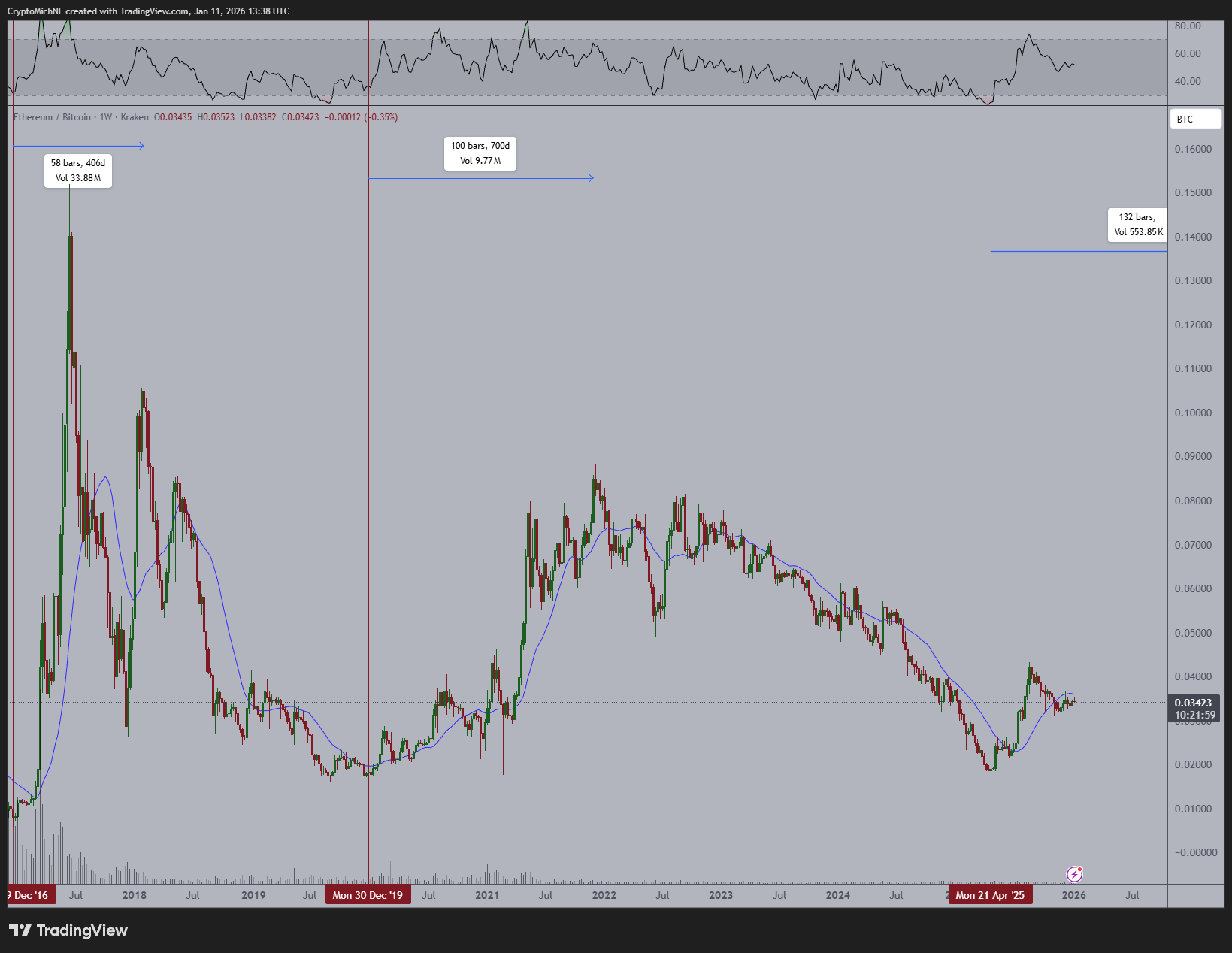
That downtrend appears to have stalled in April 2025, when the ratio found a base and began to stabilize.

Source: X

Market analyst Michael van de Poppe has drawn comparisons to the 2019 cycle, when ETH/BTC also bottomed after an extended slide before entering a recovery phase.

Since April, price has remained constructive, with higher lows forming on the chart. While the move has been gradual, Ethereum may be coming out of its weakest phase relative to Bitcoin [BTC].

Stablecoins on Ethereum

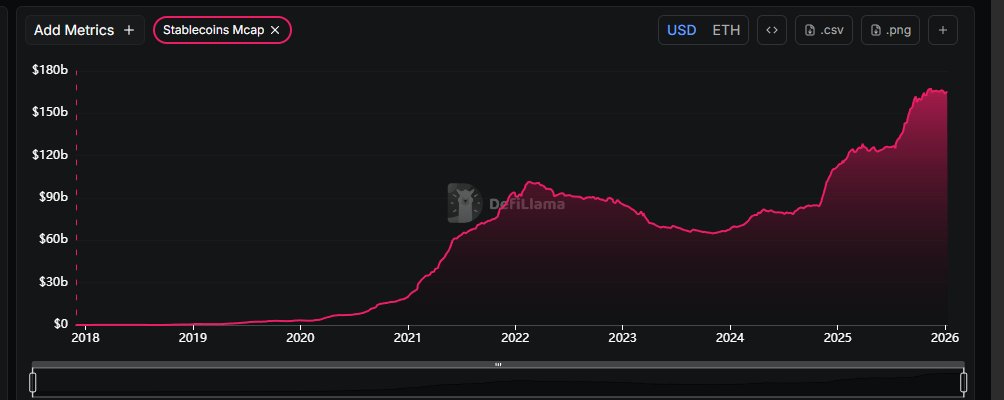
While ETH’s price has struggled, stablecoin balances on the network have surged. Supply on Ethereum rose by more than 65% over 2025 and is now roughly double its previous peak from 2021.

Source: DeFiLlama

This matters because stablecoins often act as idle capital. Rising balance means users and institutions are still placing value on Ethereum.

Van de Poppe sees this as constructive, with growing stablecoin liquidity usually coming before greater activity numbers.

The backbone is intact

Stablecoins on Ethereum now account for roughly $160-170 billion in market value, per DeFiLlama. This is the highest level on record and well above previous cycle peaks.

This expansion has continued even with ETH’s price being range-bound.

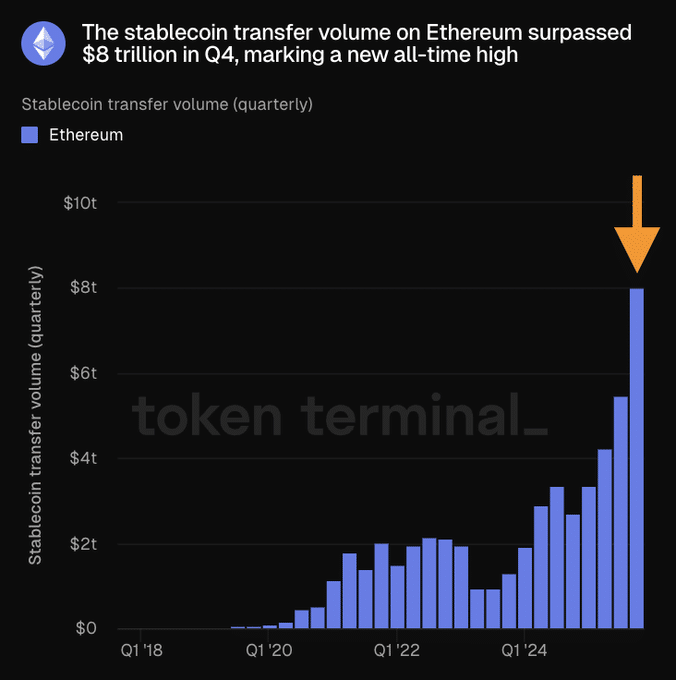
Usage has followed the same pace. According to Token Terminal, stablecoin transfer volume on Ethereum crossed $8 trillion in Q4 2025, a new ATH.

Source: Token Terminal

Ethereum is still functioning as the settlement layer of choice for dollar-denominated activity.


Final Thoughts

  • ETH/BTC may have bottomed in April; Ethereum looks like it’s recovering.
  • The network’s settlement role remains firmly intact.
Next: Ethereum: 2 factors strengthening ETH’s potential bullish breakout
Share
  • Share
  • Tweet

Domande pertinenti

QWhat key indicator suggests that the ETH/BTC ratio may have bottomed in April 2025?

AThe ETH/BTC ratio found a base and began to stabilize in April 2025, with higher lows forming on the chart, similar to the pattern observed in 2019.

QHow much did the stablecoin supply on Ethereum increase by in 2025, and why is this significant?

AThe stablecoin supply on Ethereum rose by more than 65% in 2025, reaching roughly double its previous peak from 2021. This is significant because stablecoins represent idle capital, and rising balances indicate that users and institutions continue to place value on the Ethereum network.

QWhat was the approximate market value of stablecoins on Ethereum as per DeFiLlama?

AStablecoins on Ethereum accounted for roughly $160-170 billion in market value, which is the highest level on record and well above previous cycle peaks.

QHow much stablecoin transfer volume was recorded on Ethereum in Q4 2025, and what does this indicate?

AStablecoin transfer volume on Ethereum crossed $8 trillion in Q4 2025, setting a new all-time high. This indicates that Ethereum remains the preferred settlement layer for dollar-denominated activity.

QAccording to the article, what two factors strengthen Ethereum's potential for a bullish breakout?

AThe two factors are: 1) The ETH/BTC ratio may have bottomed, showing signs of recovery, and 2) The network's settlement role remains firmly intact, supported by growing stablecoin liquidity and transfer volume.

Letture associate

BIT Research: Liquidity is Disappearing, Will Bitcoin Replay the Bottoming Pattern of 2022?

The crypto market is currently in an adjustment phase driven by policy expectations and liquidity shifts. Despite a brief rebound fueled by geopolitical easing and SpaceX's strong IPO performance, unexpectedly hawkish signals from new Fed Chair Kevin Warsh have removed anticipated easing support. Concurrently, stablecoin liquidity is shrinking, with insufficient new capital inflows, pushing the market into a typically quiet summer period. Pricing lacks catalysts for a sustained rally. Daily trading volume has significantly contracted, stablecoin growth has slowed markedly, and the supportive effect of Strategy's (formerly MicroStrategy) STRC preferred stock-financed Bitcoin purchases is fading. Amid policy uncertainty, seasonal weakness, and liquidity contraction, Bitcoin faces near-term downward pressure. Warsh's hawkish pivot and refusal to provide a clear policy outlook have increased risk premiums, historically unfavorable for Bitcoin. Technically, the trend remains bearish below $73,700, with $62,446 as critical support. A break below could accelerate declines, though a prolonged consolidation phase, similar to 2022's bottoming process, is possible. Liquidity is a core constraint. Current daily volume is around $500 billion, roughly 25% of the peak during the July-Oct 2025 rally. The 12-month growth rates for USDT and USDC have fallen to ~20%, with 6-month growth near zero, indicating weak new inflows. Bitcoin ETF and Strategy-driven inflows have also weakened, with a 30-day rolling net outflow. With inflation at 4.2% above the Fed's target, combined hawkish policy, seasonal factors, and liquidity shortages challenge Bitcoin's ability to hold above $60,000. However, this adjustment phase may be forming a cyclical low this summer, potentially setting the stage for the next bull cycle.

marsbit15 min fa
BIT Research: Liquidity is Disappearing, Will Bitcoin Replay the Bottoming Pattern of 2022?

marsbit15 min fa

Who Makes the Best Use of Claude Code? The Answer Might Not Be Programmers

Claude Code Usage Report Summary (Based on ~400k sessions) Core Finding: In agentic programming with Claude Code, a clear division of labor has emerged: humans primarily decide *what* to build (planning decisions), while Claude decides *how* to build it (execution decisions). Key Insights: 1. **Effectiveness is not limited to programmers.** In code-generation tasks, success rates for users in non-technical fields (law, finance, management, research) are nearing those of software engineers. What matters most is the user's domain expertise and understanding of the problem to be solved. 2. **Domain expertise drives success and efficiency.** Sessions where users exhibited "expert" proficiency in the task's domain saw verified success rates double compared to "novice" sessions. Experts also delegated more work per instruction, with Claude executing more actions and producing more output. 3. **AI is amplifying, not replacing, domain knowledge.** Claude Code lowers the *implementation* barrier, not the *judgment* barrier. The value of knowing the "what" and "why" is increasing relative to just knowing the "how" to code. 4. **Usage is evolving.** Over a 7-month period (Oct '25 - Apr '26), the share of sessions for debugging halved, while use for software operations, data analysis, and non-code writing roughly doubled. The estimated economic value of typical tasks increased by ~25%. Conclusion: The data suggests coding agents are making programming background less critical for completing technical tasks. However, they reward and amplify deep domain understanding. The ability to successfully direct an AI agent stems more from mastery of a specific field than from coding skill itself. The primary gains come from being competent in a domain; deep specialization adds only marginal additional advantage. This may signal a shift where software creation becomes integrated into various professions.

marsbit50 min fa

Who Makes the Best Use of Claude Code? The Answer Might Not Be Programmers

marsbit50 min fa

Trading

Spot
Futures
活动图片