DeepSeek Paralyzed for 12 Hours: Is the Computing Power of Domestic Large Models Failing to Keep Up with Ambitions?

marsbitPubblicato 2026-04-03Pubblicato ultima volta 2026-04-03

Introduzione

On the evening of March 29, DeepSeek, a leading Chinese large language model, experienced a 12-hour service outage affecting both its web and app platforms. The disruption, marked by repeated server failures and instability, raised significant concerns about the platform's reliability. Initial explanations pointed to overwhelming user traffic, but data did not support a sudden surge in users. Instead, the incident highlighted deeper structural challenges, particularly in computational supply struggling to keep pace with growing AI demands. As models become more complex—supporting longer context, advanced reasoning, and multimodal tasks—the computational load increases substantially. The outage also underscored emerging usage patterns like “lobster farming,” where automated, high-frequency API calls amplify server load. Meanwhile, anticipation for DeepSeek’s upcoming V4 model—featuring major upgrades like million-token context and stronger multimodal capabilities—suggests even greater future computational pressure. This incident signals a shift in the AI industry: competition is no longer just about model capability but also infrastructure stability, cost efficiency, and engineering scalability. The outage serves as an early warning of the systemic challenges facing AI platforms as adoption expands.

If you used AI on the evening of March 29, you likely experienced a sudden "disconnection."

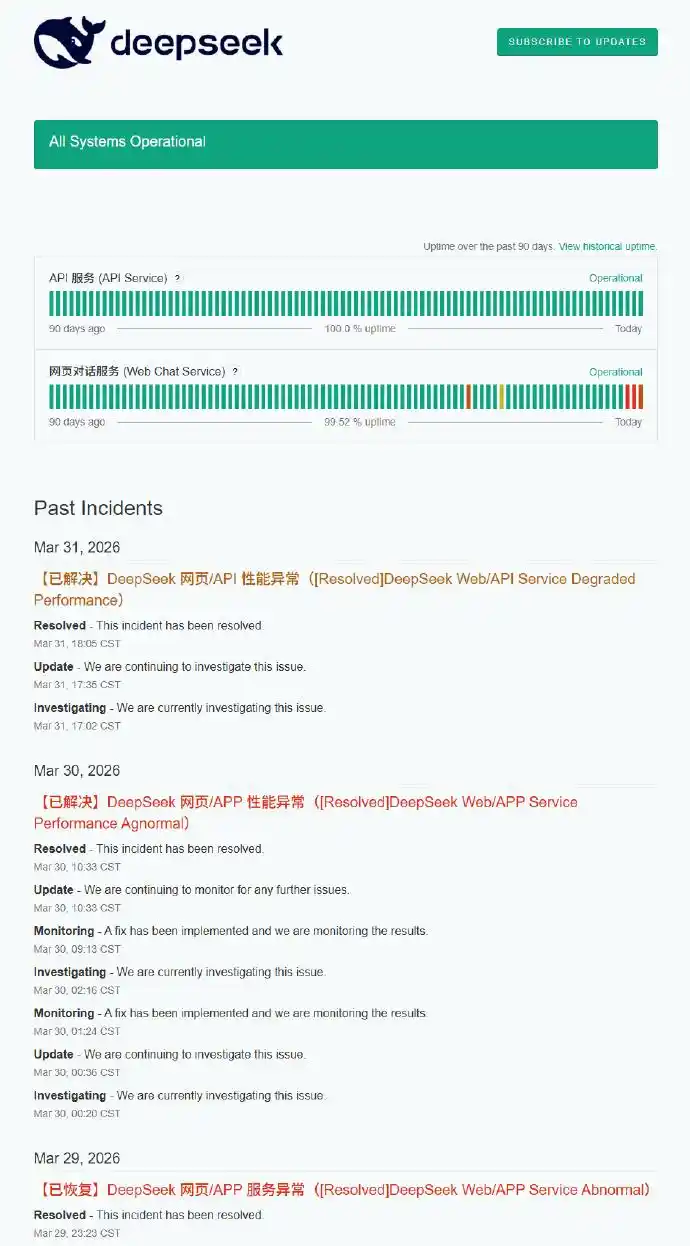
The center of this storm was DeepSeek, a leading domestic large model provider. Starting at 9:35 PM that night, its web and app services simultaneously encountered anomalies—login failures, interrupted conversations, lost content, and screens flooded with "server busy" prompts. For ordinary users, this was merely a temporary inconvenience, but for students rushing to finish papers and workers racing against deadlines, it felt more like an unannounced "disaster."
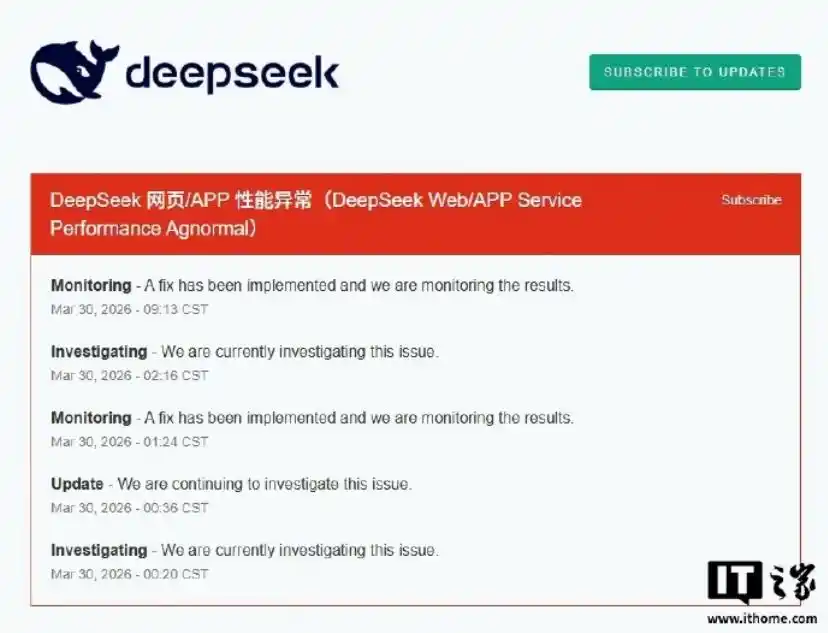
What made it even more frustrating was that this outage wasn’t a one-time crash but a typical case of "repeated fluctuations." Briefly restored at 11 PM, crashed again at midnight, urgently repaired in the early morning, and gradually stabilized only by the next morning.

A full 12 hours of instability not only set a new record for DeepSeek’s downtime but also led users to question the stability of large models like never before.

01 An Unexpected Crash: Was the Problem Really Just "Too Many Users"?

When the outage occurred, the first explanation offered was that "too many users overloaded the servers."

While this sounded plausible, it was quickly contradicted by real data. According to recent AI application rankings, DeepSeek’s monthly active user base is around 150 million—a substantial number, but not indicative of explosive growth. In other words, this wasn’t a typical "breakout traffic surge."
That makes the situation even more intriguing: If there was no sudden spike in user numbers, why did the system completely fail in such a short time?

The answer likely lies in deeper structural issues.

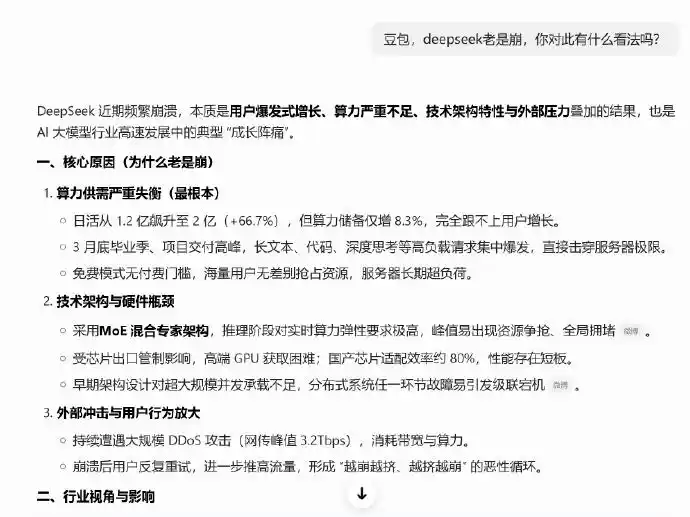
02 Computing Power vs. Demand: The Hidden Crisis in the AI Industry

Over the past year, large models have evolved at an almost visible pace. From longer context windows to stronger reasoning capabilities and the continuous expansion of multimodal abilities, the "upper limits" of model capabilities have been constantly raised.

But at the same time, a more fundamental yet critical issue is becoming increasingly apparent—computing power supply is gradually approaching its limits.

Every response from a large model is essentially a consumption of computing power. The larger the model, the longer the context, and the more complex the reasoning, the higher the computational resources required. When user scale, call frequency, and model complexity rise simultaneously, system strain is almost inevitable.

It is against this backdrop that DeepSeek’s outage appears less like an isolated incident and more like a "system-wide stress test."

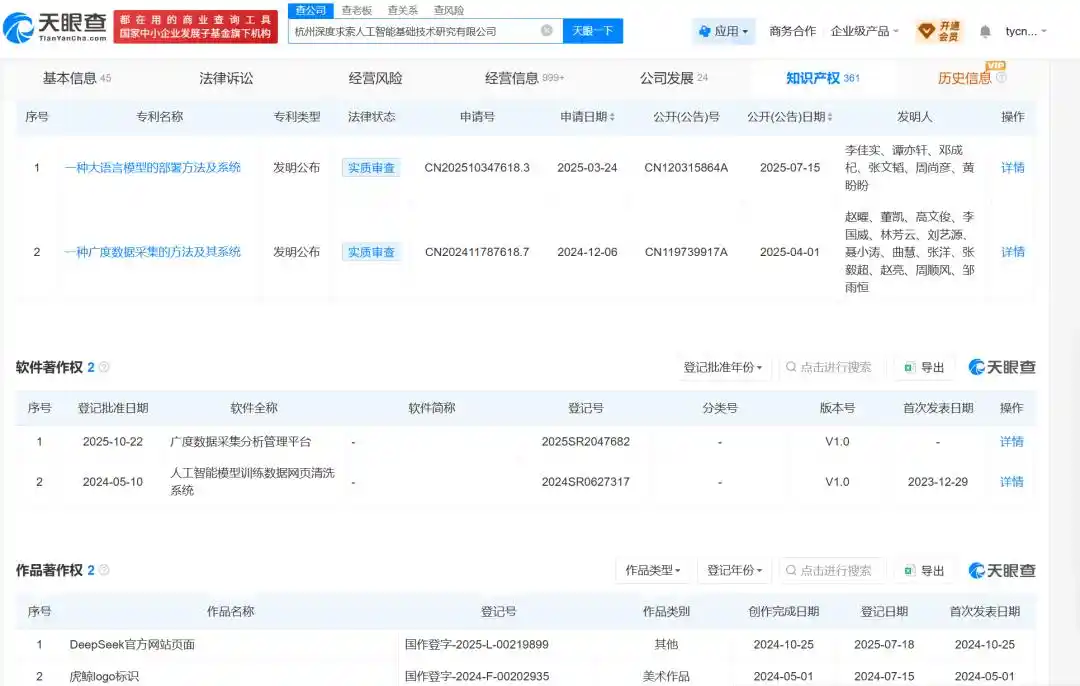
According to information from Tianyancha, DeepSeek’s affiliated entities have been increasing investments in AI algorithm R&D and computing infrastructure, continuously strengthening related technological inputs and industrial collaboration.
In fact, DeepSeek isn’t the only one under pressure. Recently, other vendors, including MiniMax, have begun limiting call frequencies during peak hours, while computing service providers like Alibaba Cloud have also adjusted their pricing strategies to varying degrees.

On the surface, these are business decisions, but they reflect the same reality—AI infrastructure supply is struggling to keep up with the pace of demand growth.

03 The "Lobster Farming" Trend: An Overlooked Traffic Amplifier

Another easily overlooked yet highly influential factor in this incident is the so-called "lobster farming" trend.

This approach essentially involves continuously calling the model via API to automate tasks, representing an early form of Agent applications. Compared to ordinary conversations, these calls occur at an extremely high frequency, sometimes triggering every minute or even every second.

When only a small number of users employ this method, it’s just an interesting experiment; but once it scales, it quickly becomes an "amplifier" of computing power consumption. This also explains why, even without a significant change in total user numbers, the system can still experience a "snowball" effect.

In a way, this outage is a classic case of "new application forms impacting old infrastructure."

04 V4 Is Approaching: Greater Expectations, Greater Pressure

Interestingly, this 12-hour outage did not significantly dampen market expectations for DeepSeek; instead, it amplified attention.

The reason is simple—the next-generation model, V4, is coming soon.

Industry rumors suggest that DeepSeek V4 will achieve leaps in multiple key capabilities: context length is expected to increase from the previous 128K tokens to millions, while multimodal and Agent execution capabilities will also be enhanced. More importantly, its computing power adaptation may further align with domestic chip systems, which holds significant meaning for China’s AI ecosystem.

But the problem is equally clear: as model capabilities improve, the demand for computing power will also increase. If the underlying infrastructure isn’t upgraded simultaneously, similar stability issues are likely to recur.

05 From "Model Competition" to "Infrastructure Competition"

Looking back at this incident, its significance may extend beyond a single product level.

Over the past two years, competition in the large model industry has centered on "capabilities"—who is smarter, who is more powerful, who leads in benchmarks. But as applications scale, a new dimension is emerging: stability and cost.

Users are starting to care not just about "whether it works" but "whether it keeps working"; enterprises are focusing not only on performance metrics but also on overall operational costs and sustainability.

In other words, AI competition is shifting from the "model layer" to the "infrastructure layer."

DeepSeek’s 12-hour outage serves as an early warning: when AI truly enters the phase of large-scale application, the deciding factor may not be the model itself but the underlying computing power, architecture, and engineering capabilities.

06 Conclusion: An Accident or a Signal?

So, what does these 12 hours really mean?

It can be seen as an accident in the development process, or it can be interpreted as a "structural warning." The former pertains to the individual, the latter to the industry.
One thing is certain: as AI applications deepen, similar stress tests will continue to occur. And each fluctuation will push the entire industry one step closer to maturity.

In a sense, DeepSeek’s crash is not an end but a beginning.

Finally, we’d like to ask: What were you using AI for during those 12 hours?

This article is from WeChat public account "Laotech," author: Laotech

Domande pertinenti

QWhat was the main cause of the 12-hour DeepSeek service outage according to the article?

AThe outage was not primarily due to a sudden surge in users, but rather a systemic issue where computing power (算力) could not keep up with growing model complexity and usage patterns, including high-frequency API calls from 'lobster farming' applications.

QHow did the 'lobster farming' phenomenon contribute to the server instability?

A'Lobster farming' refers to automated, high-frequency API calls that act as a traffic amplifier, significantly increasing compute resource consumption even without a large growth in total user numbers.

QWhat broader industry trend does the DeepSeek incident reflect?

AIt reflects a shift in AI industry competition from a focus solely on model capabilities to a critical need for robust infrastructure, including computing power, system architecture, and engineering capabilities to ensure stability and manage costs.

QWhat upcoming DeepSeek model version is mentioned, and what challenges might it bring?

ADeepSeek V4 is mentioned, which is expected to have significantly enhanced capabilities like million-token context windows. This could put even greater pressure on computing infrastructure if not matched with corresponding upgrades.

QWhat was the significance of the 12-hour outage beyond being a single service failure?

AThe outage served as a structural early warning for the entire AI industry, highlighting that as AI applications scale, the stability and scalability of the underlying infrastructure become paramount to success.

Letture associate

"Water Scarcity": The Hidden Fatal Flaw of AI Infrastructure

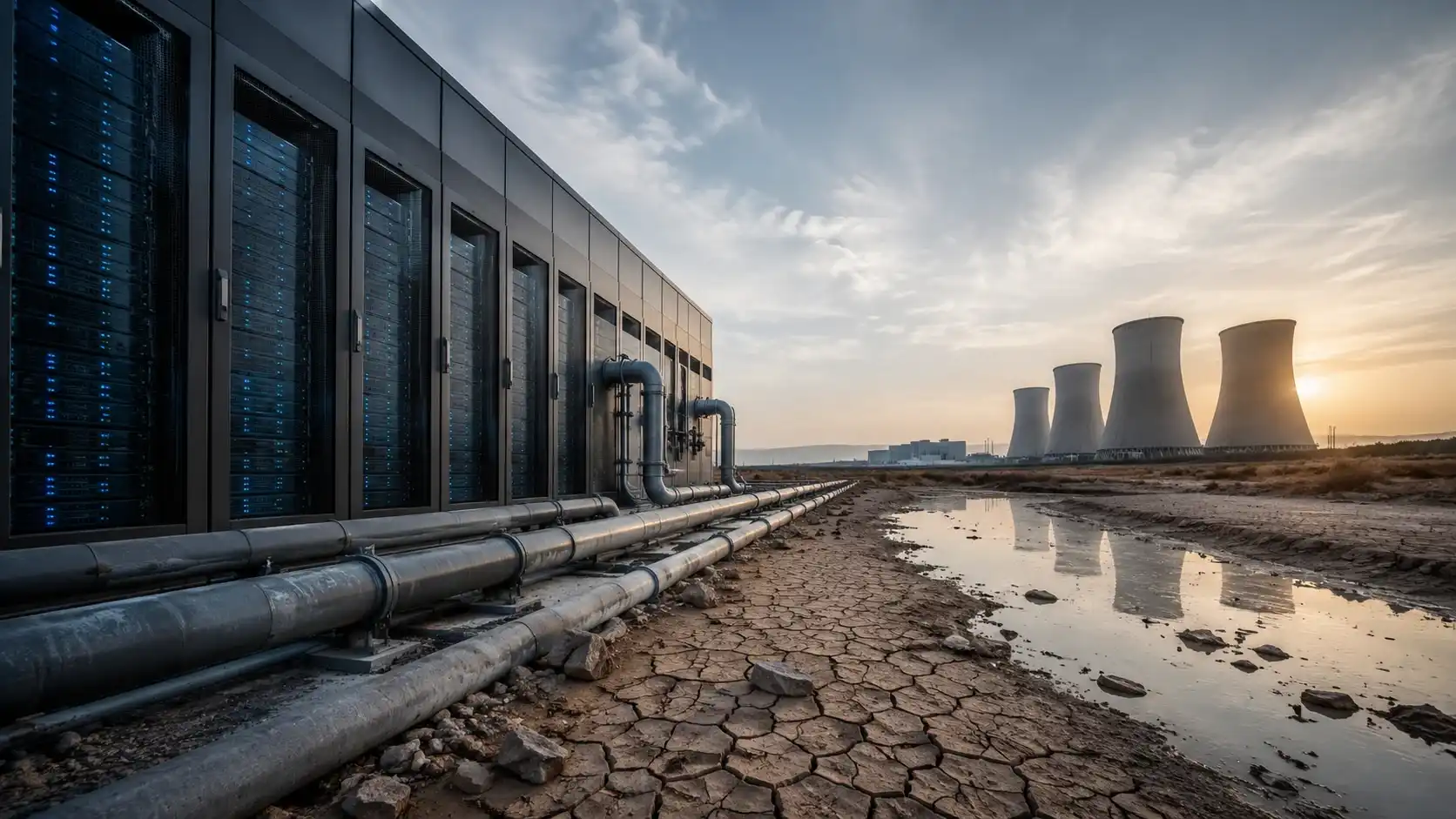
“Water Scarcity: The Hidden Vulnerability of AI Infrastructure” In June 2026, SpaceX revised its IPO prospectus to highlight a core resource constraint alongside power and processors: water. This move signals a pivotal shift where water scarcity has transformed from an operational cost to a major, uncontrollable investment risk, directly threatening AI data center expansion. The scale of the problem is immense. U.S. data centers consumed an estimated 17 billion gallons of water for direct cooling in 2023, with indirect water use for power generation exceeding 211 billion gallons. Giants like Google alone use billions of gallons annually, with single sites consuming volumes equivalent to a medium-sized city. This water is largely “consumptive,” evaporated into the atmosphere and lost. This massive demand is colliding with scarcity. Tech companies are building “water tigers” in arid regions, sparking community protests in places like Mexico and Arizona, where data centers can legally use millions of gallons daily—enough for tens of thousands of residents. These conflicts are not about illegality, but about a mismatch between historic water allocation frameworks and new, colossal demand. The consequences are real. Community opposition, largely centered on water, has reportedly stalled or canceled $64 billion in U.S. data center projects over two years. Simultaneously, investors are pressuring companies for greater water footprint transparency, viewing it as a financial risk, not just an ESG metric. Technological solutions like air or liquid cooling involve trade-offs between water and electricity use, with final choices dictated by local constraints. The irony is stark: while industry leaders envision AI as a utility “like water,” its physical infrastructure is straining real-world water supplies. The race for AI supremacy may ultimately be governed not by the fastest chip, but by the slowest water meter.

marsbit4 min fa

"Water Scarcity": The Hidden Fatal Flaw of AI Infrastructure

marsbit4 min fa

Global Card Issuance Enters a Compliance-Driven Era: WasabiCard is Building the Next-Generation Payment Infrastructure

Global card issuance is entering a compliance-driven era, with WasabiCard building next-generation payment infrastructure. The platform asserts that as stablecoins increasingly enter cross-border payments, corporate settlements, and global commerce, the industry is shifting focus from "availability" and "growth-driven" models to long-term, compliant operation under global frameworks. Competition will center on sustainable compliance and global infrastructure capabilities. Stablecoins are evolving from on-chain assets into key payment tools in global business, with card issuance acting as critical infrastructure connecting digital assets to traditional payment networks like Visa and Mastercard. This expansion has revealed structural issues, including cross-regional issuance, BIN resource management, and insufficient AML and risk controls. In response, the industry is moving away from reliance on "grey efficiency" towards prioritizing compliance, risk management, and long-term operational stability. WasabiCard outlines its strategy: collaborating with licensed principals and local partners for localized operations, building robust KYC/AML systems, strictly separating commercial and consumer BIN usage, and enhancing global issuance, payment, and cross-border fund flow infrastructure. The goal is to build stable, scalable payment infrastructure amid evolving global regulations, shifting industry competition from scale to infrastructure capability. As stablecoins integrate further with global commerce, payment infrastructure will become a fundamental, embedded component of internet business. WasabiCard will continue to develop capabilities in global card issuance, stablecoin payments, cross-border fund flows, and API-driven financial workflows.

marsbit14 min fa

Global Card Issuance Enters a Compliance-Driven Era: WasabiCard is Building the Next-Generation Payment Infrastructure

marsbit14 min fa

Zhou Hang: How Much Is SpaceX Really Worth?

**Zhou Hang: How Much is SpaceX Really Worth?** SpaceX, arguably one of the greatest industrial companies of the past 50 years, is reportedly targeting a staggering $1.75 trillion valuation in its potential IPO. However, the author argues this figure is inflated by approximately $1.25 trillion when assessed through standard financial metrics. The analysis begins by acknowledging SpaceX's undeniable success: drastically reducing launch costs, achieving near-monopoly in commercial launches, and building the strategic Starlink network. Its achievement surpasses even Tesla's, given it disrupted a state-monopolized industry. Despite this greatness, a $1.75 trillion valuation places SpaceX above the combined market cap of Boeing, Lockheed Martin, Northrop Grumman, RTX, and General Dynamics. Projecting optimistic 2030 revenues of $50-80 billion and applying generous tech-sector multiples yields a "reasonable" valuation range of $500 billion to $1.2 trillion. The $1.25 trillion gap is attributed to three non-financial premiums: 1. **Long-term vision premium** for future Starship-enabled markets (e.g., space-based computing). 2. **Sovereign asset/strategic premium**, as SpaceX is deeply integrated into U.S. national security. 3. **Retail narrative/Musk cult premium**, driven by a heroic story and personal following. Post-IPO, three scenarios are outlined: valuation solidifying (25% probability), sideways volatility as narrative outpaces reality (50%), or a re-rating down to $800B-$1.2T if execution falters or Musk-related risks emerge (25%). The probability-weighted expected value is $1.3-1.5 trillion, suggesting negative expected returns for those buying at the IPO price. The conclusion advises investors to separate the company's excellence from its stock price. Buying at the IPO likely prices in excessive optimism. A more prudent strategy would be to wait for key milestones (e.g., Starship V3 stability) or a significant price correction before investing, or to treat an early purchase as a long-term, high-conviction hold with limited position size, not a short-term bet.

链捕手19 min fa

Zhou Hang: How Much Is SpaceX Really Worth?

链捕手19 min fa

Trading

Spot
Futures
活动图片