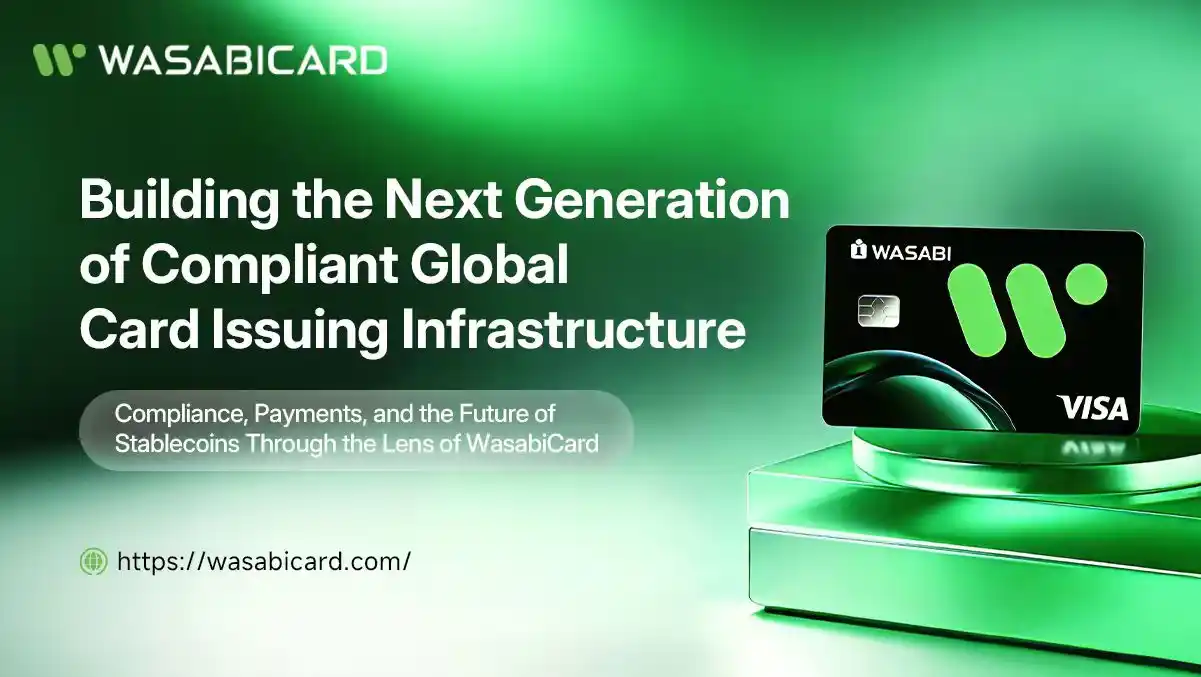
Global Card Issuance Enters a Compliance-Driven Era: WasabiCard is Building the Next-Generation Payment Infrastructure

marsbitPubblicato 2026-06-02Pubblicato ultima volta 2026-06-02

Introduzione

Global card issuance is entering a compliance-driven era, with WasabiCard building next-generation payment infrastructure. The platform asserts that as stablecoins increasingly enter cross-border payments, corporate settlements, and global commerce, the industry is shifting focus from "availability" and "growth-driven" models to long-term, compliant operation under global frameworks. Competition will center on sustainable compliance and global infrastructure capabilities. Stablecoins are evolving from on-chain assets into key payment tools in global business, with card issuance acting as critical infrastructure connecting digital assets to traditional payment networks like Visa and Mastercard. This expansion has revealed structural issues, including cross-regional issuance, BIN resource management, and insufficient AML and risk controls. In response, the industry is moving away from reliance on "grey efficiency" towards prioritizing compliance, risk management, and long-term operational stability. WasabiCard outlines its strategy: collaborating with licensed principals and local partners for localized operations, building robust KYC/AML systems, strictly separating commercial and consumer BIN usage, and enhancing global issuance, payment, and cross-border fund flow infrastructure. The goal is to build stable, scalable payment infrastructure amid evolving global regulations, shifting industry competition from scale to infrastructure capability. As stablecoins integrate furt...

Recently, WasabiCard released its latest industry perspective on the global card issuance sector and stablecoin payment infrastructure, stating that as stablecoins gradually enter cross-border payments, corporate settlements, and global business scenarios, the global card issuance industry is transitioning from a "growth-driven" phase to a "compliance-driven" stage.

WasabiCard indicated that in the past few years, the core issue in the stablecoin payment industry has largely revolved around "availability," whereas future industry competition will gradually shift its focus to "whether it can operate stably and sustainably under global compliance frameworks."

Ray, Co-founder of WasabiCard, stated: "Stablecoins are evolving from on-chain assets into important payment vehicles in global commerce. The competition in the next phase is no longer just about product efficiency or growth speed, but about whether companies possess the capacity for long-term compliant operations and the capability of globalized infrastructure."

As stablecoin applications extend from trading scenarios into the real business world, global card issuance capabilities are also becoming crucial infrastructure connecting digital assets with traditional payment networks. Through global payment networks like Visa and Mastercard, stablecoins and digital assets are further integrated into daily consumption, corporate payments, and cross-border capital flow scenarios.

Meanwhile, WasabiCard believes that the industry's rapid expansion has exposed increasingly structural issues, including risks related to cross-regional card issuance, BIN resource management, anonymous issuance, and insufficient anti-money laundering and risk control capabilities.

Against this backdrop, the industry is gradually shifting from a growth model reliant on "grey-area efficiency" to a development path that places greater emphasis on compliance, risk control, and long-term operational capabilities.

Centered on this trend, WasabiCard also disclosed its long-term infrastructure strategy, which includes: establishing localized operational systems through collaboration with licensed principal members and local partners; building robust KYC and AML risk control systems; strictly distinguishing between commercial BIN and consumer BIN usage scenarios; and continuously enhancing capabilities in global card issuance, payments, and cross-border capital flow infrastructure.

WasabiCard stated that the core objective of these strategies is not merely to improve short-term efficiency but to build payment infrastructure with long-term stability and scalability amid the evolving global regulatory landscape. The competitive logic of the future global card issuance industry will also gradually shift from "scale competition" to "infrastructure capability competition." As stablecoins further integrate with global commerce, payment infrastructure will no longer be just a financial tool but will gradually become an underlying capability embedded in internet commerce. Companies with global compliant operations, resource integration, and platformization capabilities will occupy more significant positions in the industry's next phase of development.

In the future, WasabiCard will continue to enhance its infrastructure capabilities, focusing on global card issuance, stablecoin payments, cross-border capital flows, and API-driven financial workflows.

About WasabiCard

WasabiCard is a stablecoin payment infrastructure platform for global business scenarios, dedicated to providing secure, reliable, and scalable global payment and capital flow capabilities for enterprises and individual users through the integration of stablecoins and the traditional financial system.

Addressing the needs for global payments and cross-border capital management, WasabiCard has built an integrated capability system covering card issuance, payments, and fund distribution, supporting enterprises in achieving a complete process from consumption to fund management across different usage scenarios.

Through its API-driven payment system, WasabiCard helps businesses and users quickly access global payment networks and continuously promotes the large-scale application of stablecoins in the real business world.

Read the full article:"Global Card Issuance Industry Enters a Compliance-Driven Era"

Disclaimer

This content is for informational purposes only and does not constitute any legal, tax, or professional advice provided by WasabiCard, nor should it substitute for seeking relevant professional advice independently. WasabiCard makes no express or implied representations, warranties, or commitments regarding the accuracy, completeness, or timeliness of the content herein.

If you wish to suggest updates to the relevant content, please contact us via the following email: [email protected]


Domande pertinenti

QWhat does WasabiCard identify as the main shift in the global card issuance industry, according to the article?

AWasabiCard states that the global card issuance industry is shifting from a 'growth-driven' phase to a 'compliance-driven' phase.

QAccording to WasabiCard co-founder Ray, what will the next stage of competition in the stablecoin industry focus on?

ARay states that the next stage of competition will focus on whether enterprises possess the capability for long-term compliant operations and global infrastructure, not just product efficiency or growth speed.

QWhat structural problems did the rapid expansion of the industry expose, as mentioned in the article?

AThe rapid expansion exposed structural problems including cross-regional card issuance, BIN resource management, anonymous card issuance, and insufficient AML and risk control capabilities.

QWhat are the core goals of WasabiCard's long-term infrastructure strategy?

AThe core goals are to build a payment infrastructure with long-term stability and scalability in the evolving global regulatory environment, not merely to improve short-term efficiency.

QWhat business does WasabiCard describe itself as?

AWasabiCard describes itself as a stablecoin payment infrastructure platform for global commercial scenarios, dedicated to integrating stablecoins with the traditional financial system to provide safe, reliable, and scalable global payment and capital flow capabilities for enterprises and individual users.

Letture associate

Cross-Chain Bridges Actively Adapt, LI.FI Leverages Intent Architecture to Become the Liquidity Hub for TradFi Institutions

Cross-Chain Bridge LI.FI Transforms with Intents Architecture to Serve as Liquidity Hub for TradFi Institutions Facing declining cross-chain transaction volumes and overall crypto market liquidity, cross-chain bridge protocol LI.FI is proactively shifting its strategy. Moving beyond its role as a "liquidity transfer protocol," LI.FI is targeting new assets, clients, and operational systems. Key to this transformation is the launch of LI.FI Intents, an intent-based execution architecture. This product positions itself as a foundational layer for stablecoin payments, Real World Assets (RWA), and compliant on-chain liquidity, catering specifically to fintech companies, neobanks, wallets, and regulated financial institutions. LI.FI Intents simplifies user experience by offering a turnkey solution. It leverages a solver network for market-maker level execution, enabling precise cross-chain swaps (e.g., between USDC and USDT) without users managing gas tokens or complex blockchain steps. It lowers barriers to entry by integrating with applications like Jumper and Rabby, allowing enterprise users to bypass direct wallet interactions for transactions like payments and asset transfers. The architecture emphasizes compliance. Its network consists of verified legal entities, and enterprises can review and approve orders within their compliance frameworks before processing. All interacting wallets undergo OFAC screening. For ecosystem coverage, LI.FI Intents supports major networks including EVM chains, Solana, and Tron, mitigating risks associated with single-chain dependency. In essence, as tokenized assets like RWAs gain traction, LI.FI Intents focuses on efficiently integrating stablecoin payments and compliant liquidity into enterprise ecosystems. By automating complex execution steps—allowing users to simply declare their intent (the "destination")—it aims to enhance operational efficiency and capital utilization for institutional clients.

Odaily星球日报51 min fa

Cross-Chain Bridges Actively Adapt, LI.FI Leverages Intent Architecture to Become the Liquidity Hub for TradFi Institutions

Odaily星球日报51 min fa

Trading

Spot
Futures

Articoli Popolari

Come comprare ERA

Benvenuto in HTX.com! Abbiamo reso l'acquisto di Caldera (ERA) semplice e conveniente. Segui la nostra guida passo passo per intraprendere il tuo viaggio nel mondo delle criptovalute.Step 1: Crea il tuo Account HTXUsa la tua email o numero di telefono per registrarti il tuo account gratuito su HTX. Vivi un'esperienza facile e sblocca tutte le funzionalità,Crea il mio accountStep 2: Vai in Acquista crypto e seleziona il tuo metodo di pagamentoCarta di credito/debito: utilizza la tua Visa o Mastercard per acquistare immediatamente CalderaERA.Bilancio: Usa i fondi dal bilancio del tuo account HTX per fare trading senza problemi.Terze parti: abbiamo aggiunto metodi di pagamento molto utilizzati come Google Pay e Apple Pay per maggiore comodità.P2P: Fai trading direttamente con altri utenti HTX.Over-the-Counter (OTC): Offriamo servizi su misura e tassi di cambio competitivi per i trader.Step 3: Conserva Caldera (ERA)Dopo aver acquistato Caldera (ERA), conserva nel tuo account HTX. In alternativa, puoi inviare tramite trasferimento blockchain o scambiare per altre criptovalute.Step 4: Scambia Caldera (ERA)Scambia facilmente Caldera (ERA) nel mercato spot di HTX. Accedi al tuo account, seleziona la tua coppia di trading, esegui le tue operazioni e monitora in tempo reale. Offriamo un'esperienza user-friendly sia per chi ha appena iniziato che per i trader più esperti.

345 Totale visualizzazioniPubblicato il 2025.07.17Aggiornato il 2026.06.02

Come comprare ERA

Discussioni

Benvenuto nella Community HTX. Qui puoi rimanere informato sugli ultimi sviluppi della piattaforma e accedere ad approfondimenti esperti sul mercato. Le opinioni degli utenti sul prezzo di ERA ERA sono presentate come di seguito.

活动图片












