Zhou Hang: How Much Is SpaceX Really Worth?

链捕手Pubblicato 2026-06-02Pubblicato ultima volta 2026-06-02

Introduzione

**Zhou Hang: How Much is SpaceX Really Worth?** SpaceX, arguably one of the greatest industrial companies of the past 50 years, is reportedly targeting a staggering $1.75 trillion valuation in its potential IPO. However, the author argues this figure is inflated by approximately $1.25 trillion when assessed through standard financial metrics. The analysis begins by acknowledging SpaceX's undeniable success: drastically reducing launch costs, achieving near-monopoly in commercial launches, and building the strategic Starlink network. Its achievement surpasses even Tesla's, given it disrupted a state-monopolized industry. Despite this greatness, a $1.75 trillion valuation places SpaceX above the combined market cap of Boeing, Lockheed Martin, Northrop Grumman, RTX, and General Dynamics. Projecting optimistic 2030 revenues of $50-80 billion and applying generous tech-sector multiples yields a "reasonable" valuation range of $500 billion to $1.2 trillion. The $1.25 trillion gap is attributed to three non-financial premiums: 1. **Long-term vision premium** for future Starship-enabled markets (e.g., space-based computing). 2. **Sovereign asset/strategic premium**, as SpaceX is deeply integrated into U.S. national security. 3. **Retail narrative/Musk cult premium**, driven by a heroic story and personal following. Post-IPO, three scenarios are outlined: valuation solidifying (25% probability), sideways volatility as narrative outpaces reality (50%), or a re-rating down to $8...

Author: Zhou Hang

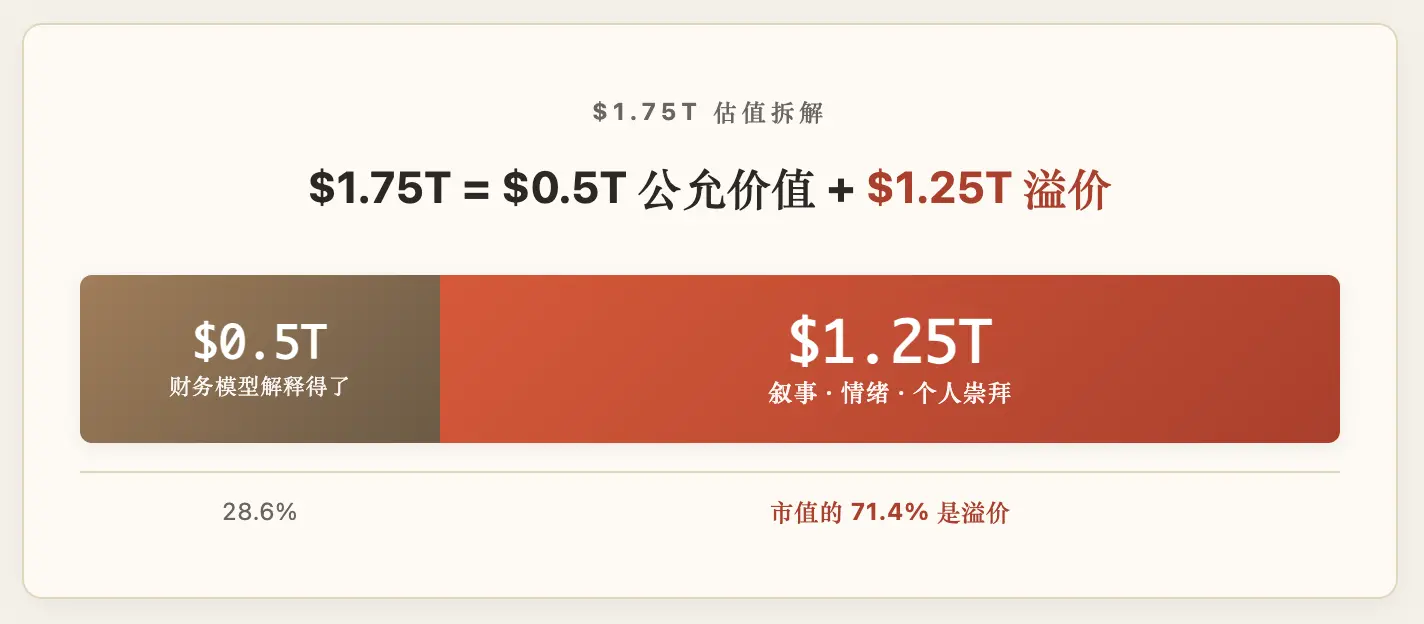
SpaceX may be overvalued by $1.25 trillion around its IPO.

This is not denying SpaceX's greatness. On the contrary, anyone seriously discussing SpaceX must first acknowledge: it might be one of the greatest industrial companies of the past 50 years.

But the greatness of a company and whether its stock is worth buying at any price are two completely different things.

SpaceX can simultaneously be the "greatest industrial entity of the 21st century" and a "seriously overvalued investment target." These two things are not contradictory.
First, Acknowledge Its True Greatness

Any honest discussion about SpaceX's valuation must start with one sentence: It is the most successful industrial company of the past 25 years, bar none—even more successful than Tesla. This is not mere praise; it's an economic and engineering fact.

Tesla disrupted a 150-year-old mature industry—automobiles. Its rivals are Mercedes, Ford, Toyota. These opponents are not weak, but they are commercial companies, without the backing of national interests or political barriers; the essence of the competition is product, brand, supply chain.

SpaceX disrupted a 60-year-old state-monopoly industry—space. Its opponents are NASA, Roscosmos, ESA, CNSA. This is an entirely different level of difficulty: higher engineering barriers, greater capital intensity, more complex regulation, deeper entanglement with national interests. In 2002 when Musk founded SpaceX, the entire space industry was essentially an extension of national missions; commercial companies were not believed capable of building rockets, let alone rockets cheaper than national ones.

More than 20 years later, SpaceX has slashed launch costs from $54,500/kg in the Space Shuttle era to $1,500/kg—a 36-fold decrease. It now launches 165 times a year, with one company exceeding the total launch count of all other countries and all commercial players combined. It built humanity's first truly reusable rocket, with a single Falcon 9 first stage flying 32 times and a success rate over 99%. It constructed the world's first global satellite internet—covering capacity for over 1 billion users, becoming a decisive strategic asset on the first day of the Ukraine war.

Tesla in 2025 still faces fierce competition from Chinese EVs; SpaceX's share in the global commercial launch market is approaching monopoly.

SpaceX is a great company, perhaps the greatest industrial company on Earth in the past 50 years. Any criticism about its valuation must first acknowledge this.

What Does $1.75 Trillion Even Mean?

Let's look at it through a set of comparisons:
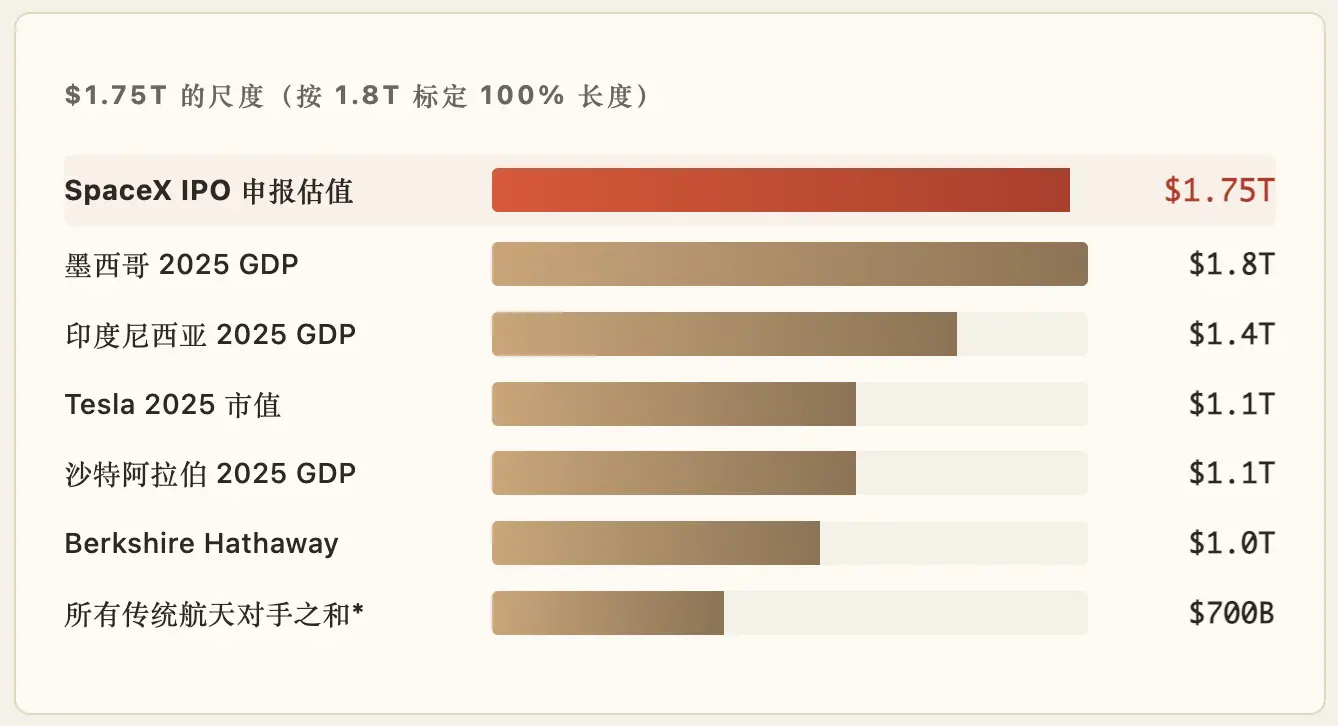
* Combined market cap of Boeing + Lockheed + Northrop + RTX + GD. SpaceX's valuation alone is 2.5 times their total.

In other words, the valuation of SpaceX alone would exceed Mexico's full-year GDP, surpass either Tesla or Berkshire, and be 2.5 times the total market cap of all its traditional space rivals.

This itself isn't the problem—great companies deserve great valuations. But that 2.5x ratio means the market is not pricing it as a "space company," nor as an "industrial company." The market is pricing it with a paradigm closer to some hybrid of "sovereign asset + AI-era infrastructure + narrative premium."

Is this pricing reasonable?

List all of SpaceX's current businesses and realistically calculate how much revenue they could generate by 2030, using a reasonable optimistic scenario for each line:
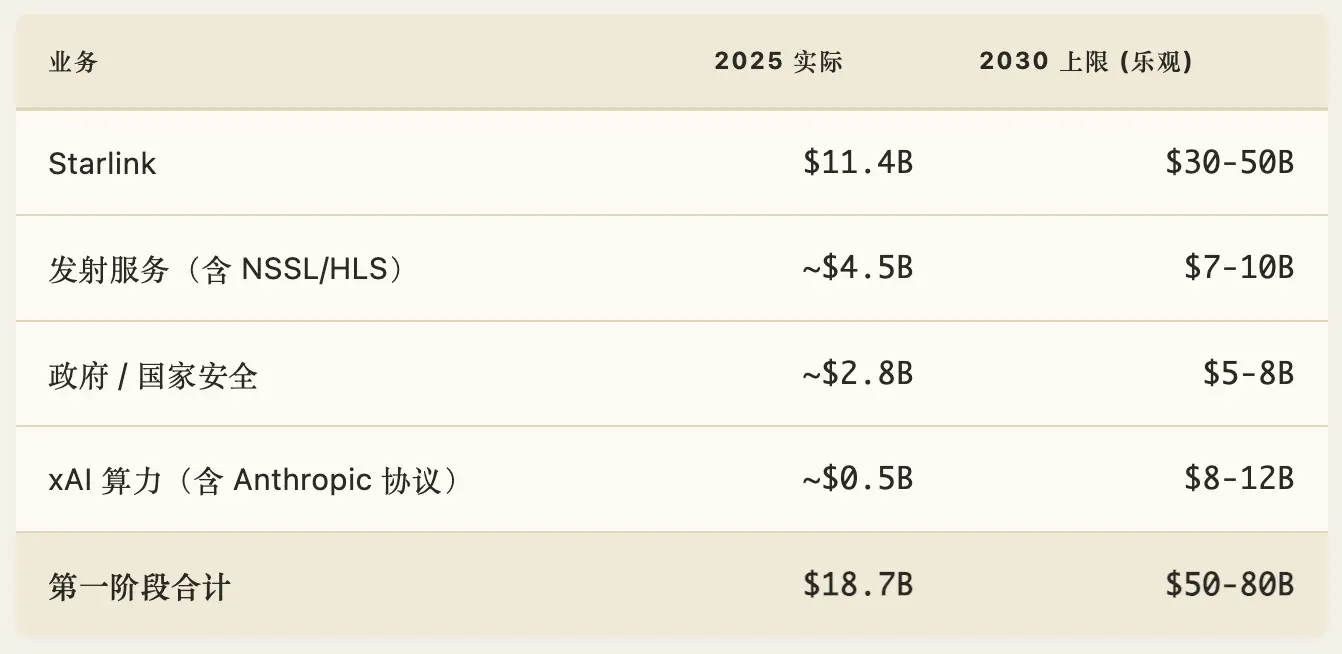
If SpaceX achieves $50-80B in revenue by 2030, corresponding EBITDA (Earnings Before Interest, Taxes, Depreciation, and Amortization, roughly understood as the operating cash profit from the company's main business) would be about $20-35B (using a 40% margin, already a very optimistic assumption).

Using the SaaS-diversified standard EV/EBITDA multiple of 25-35x—this is already a premium tech company valuation—SpaceX's "reasonable valuation" range in 2030 is from $500B to $1.2T.

Taking the conservative anchor of $500B (i.e., valuing all 2030 businesses at a reasonable, not wild, level), the market price is $1.75T.

Difference:$1.25T.

This difference cannot be explained by any standard financial model. It is not the result of DCF (Discounted Cash Flow), nor the result of pushing a P/S multiple, nor the result of comparable company benchmarking—none of these methods yield $1.75T.
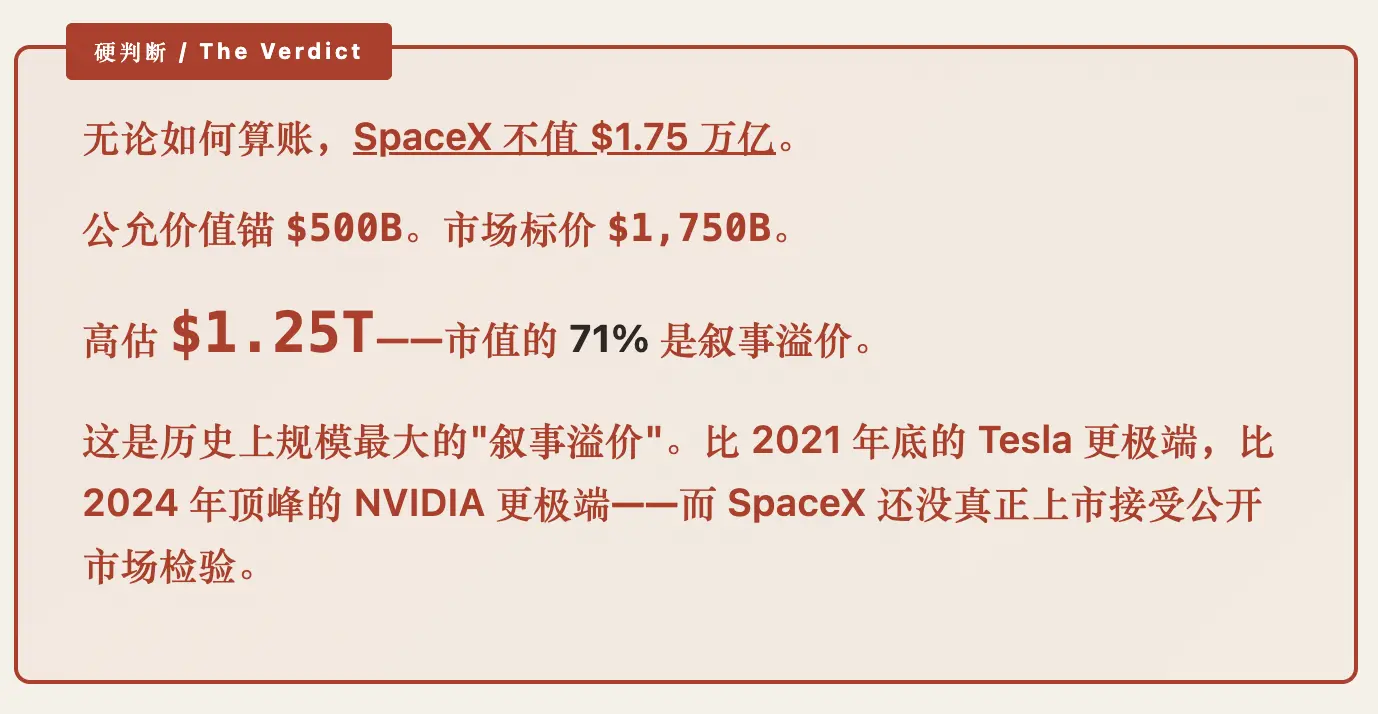
This difference doesn't appear out of thin air. It has three real sources:

First source: Long-term vision premium. If Starship becomes stable between 2027-2030, launch costs could drop to $200/kg or lower. That's a 30x increase in capacity—enough to support new businesses (orbital data centers, lunar commerce, deep-space robotics). Anthropic has publicly expressed interest in "paying for GW-level computing power in space." If this narrative materializes, SpaceX's total addressable market including new businesses by 2040 could reach $200-500B/year. This ceiling is indeed massive—so it's reasonable for the market to leave room for a "vision premium."

Second source: Sovereign asset + strategic positioning premium. SpaceX is no longer just a commercial company; it's a US national strategic asset. $22B in government contracts, HLS lunar lander, NRO's secret reconnaissance constellations, Golden Dome missile tracking—these bind SpaceX into the US national security apparatus. In today's rapidly fragmenting global communications order (Chinese sphere / American sphere / third parties), Starlink automatically gains "soft sovereignty" in all markets it can serve. The monetization of this position may take 10+ years to fully manifest, but the premium is real.

Third source: Retail investors' yearning for a heroic narrative + Musk's personal cult. This is the hardest to quantify, but anyone familiar with capital markets knows its power. Musk has 200 million followers on platform X; he himself is a valuation variable. The SpaceX story—a private company sending people to Mars, building a global internet, making humanity a multiplanetary species—is the most heroic commercial story of the past 50 years.

Retail investors aren't buying EBITDA; they're buying a ticket to participate in history.

The first two premiums are "real, but slow"; the third premium is "large, but fragile." The current $1.75T valuation bets that all three hold true and nothing goes wrong. This is a difficult combination to sustain.

What Happens After the IPO?

Assuming SpaceX completes its IPO in the second half of 2026, the next 3-5 years will likely look like this:

Scenario A: Valuation solidifies (Probability ~25%). Starship V3 successfully debuts in 2027, enters stable operation in 2028, and the first GW-level contract for space computing lands in 2028. Lunar commerce proceeds on NASA's schedule. Although Starlink growth slows, aviation + maritime + D2C segments make up for the deceleration in the residential market. In this scenario, $1.75T "starts to look cheap"—the market would revalue it to $2-3T.

Scenario B: Flat, volatile valuation (Probability ~50%). Starship progress is slower than expected—if the 2025 flight test success rate of 5/25 = 20% continues through 2026-2027, V3's true maturity may not arrive until 2029-2030. Starlink growth slows to +20%/year, the xAI-Anthropic agreement brings real cash flow but no second major contract follows. The market realizes "the narrative is ahead of reality," and the valuation oscillates between $1.2T - $1.8T for 3-5 years. This is the most probable scenario.

Scenario C: Revaluation (Probability ~25%). Persistent Starship delays, xAI lags significantly in AI competition, a Musk personal risk event (health, reputation, politics) triggers. The sentiment premium rapidly contracts. The market re-prices using financial models—valuation falls back to the $800B-$1.2T range, equivalent to "the reasonable valuation a great industrial company deserves." This scenario is actually good for long-term holders—but means a 30-50% paper loss for retail investors who buy after the IPO.
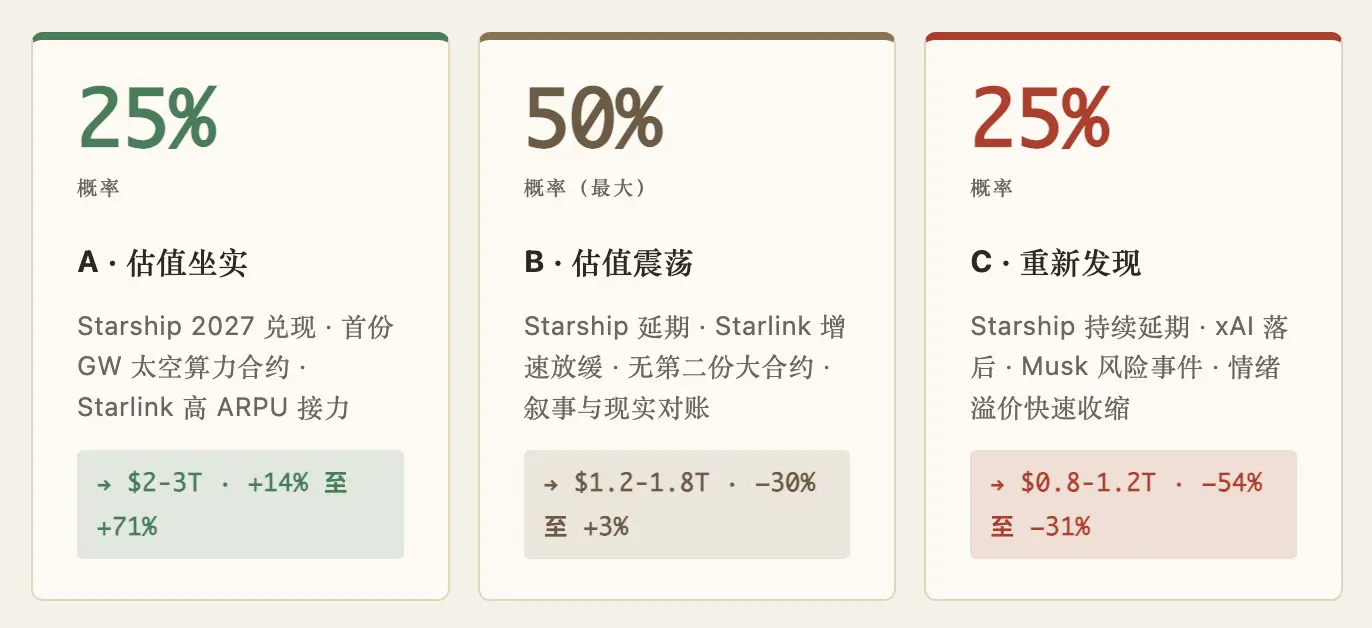
Probability-weighted = 0.25 × upside + 0.50 × volatility + 0.25 × downside ≈ expected value of $1.3-1.5T, lower than the IPO filing price of $1.75T.

Weighting the three probabilities, the expected central value for SpaceX's valuation over the next 3-5 years is around $1.3-1.5Tbelow the current IPO filing price.

In plain English: buying at $1.75T on IPO day results in a negative expected return over 5 years. This is the inevitable result after weighting the three scenarios by probability: you get no return in the most probable scenario; you lose 30-50% in the worst scenario; only in 1/4 of scenarios do you make money.

In the words of Charlie Munger: This is not an attractive bet.

For Those Planning to Buy on IPO Day

SpaceX is a great company, but a great company does not equal a stock that should be bought at any price. These two things must not be confused.

Tesla at the end of 2021 was also considered by many as "a buy at any price"—back then its market cap was $1.2T. Then over the next two years, Tesla fell 70%, from $1.2T to $400B. This wasn't because Tesla became a bad company—it remains an excellent EV company. It's because the price had run too far ahead of fundamentals.

SpaceX's current situation is highly similar to Tesla's at the end of 2021—possibly more dangerous, because SpaceX's "vision premium" accounts for a higher proportion, its story is grander, and retail participation could be deeper.

If you truly believe in SpaceX's long-term vision and are willing to hold for 10+ years without selling, then buying at the IPO price may be fine—in 10 years, this company will likely be worth more. But if you expect to "double your money within 1-3 years," the math is not on your side.

A more rational strategy:

  • Do not chase the price on IPO day
    The premium is usually highest on the first day of any mega-IPO
  • Wait for at least one of three things to happen
    Starship V3 stable operation, the first GW-level space computing contract, or the stock price falling below $1T
  • If you must buy now, limit your position
    Don't treat it as a "sure bet"—it's not. It's a "meaningful long-term +/- 30% uncertainty"

■ A Great Company, Can Also Be an Expensive Stock

A company's greatness is a fact; whether a stock's price is reasonable is math. Facts don't change, math changes every day. In SpaceX's current valuation structure, financial models can only explain half; the other half is market sentiment + sovereign status + personal cult—this part does exist, but it is fragile.

After the IPO, one thing will happen: retail investors will start measuring this company by its quarterly earnings. The first quarterly report, the second, the third—each will force the market to reconcile "story" with "reality." This reconciliation process is usually unfriendly to short-term valuation.

If you're buying the company—the great industrial entity, humanity's post-Starship infrastructure, the sovereign asset—then the IPO price is just a point in a 20-year marathon, no need to obsess.

If you're buying the story—participating in history, following a hero, for the sake of us becoming a multiplanetary species—then please acknowledge this is consumption, not investment. Consumption can be expensive, but you need to know what you're doing.

A company can be the world's best, and its stock can simultaneously be overvalued by $1.25 trillion. Both can be true, but they must be viewed separately. Distinguish whether you're buying the company, or the story.


Domande pertinenti

QAccording to Zhou Hang's analysis, what is the main argument regarding SpaceX's valuation ahead of its potential IPO?

AZhou Hang argues that SpaceX's potential IPO valuation of $1.75 trillion is significantly overvalued by approximately $1.25 trillion when analyzed through standard financial modeling of its projected 2030 business lines.

QWhat three sources of 'premium' does the article identify as inflating SpaceX's valuation beyond its fundamental financial value?

AThe article identifies three sources of premium: 1) Long-term vision premium (Starship enabling new markets like space-based computing), 2) Sovereign asset and strategic status premium (its role as a U.S. national security asset), and 3) Retail investor enthusiasm for the heroic narrative and Elon Musk's personal brand.

QHow does the article contrast the competitive challenges faced by Tesla and SpaceX?

AThe article states that Tesla disrupted the mature, commercially-driven automotive industry, facing rivals like Mercedes and Toyota. SpaceX, however, disrupted a 60-year state-monopolized space industry, competing against entities like NASA and Roscosmos, which involves much higher engineering barriers, capital intensity, and complex state interests.

QWhat are the three probable post-IPO scenarios for SpaceX's stock price, and what is their weighted expected outcome?

AThe three scenarios are: A) Valuation is validated (25% probability), B) Valuation trades sideways (50% probability), and C) Valuation is rediscovered downward (25% probability). The probability-weighted expected valuation range is $1.3 to $1.5 trillion, which is below the hypothetical $1.75 trillion IPO price.

QWhat investment advice does the article offer to those considering buying SpaceX stock on its IPO day?

AThe article advises against buying at the IPO day's likely peak premium. It suggests waiting for key milestones like Starship V3 stable operations or a major space-computing contract, or for the price to fall below $1 trillion. If one must buy immediately, it recommends limiting the position size, treating it as a long-term hold with significant uncertainty, not a sure bet.

Letture associate

How Difficult is Chip Making? A Division Error Costs 475 Million Dollars

How Hard Is It to Make a Chip? A Division Error Cost $475 Million Chip expert Shi Kan, a researcher at the Chinese Academy of Sciences and a popular tech creator, explains the immense challenges of chip development. Chips are foundational to modern technology, but their creation is extraordinarily difficult. The journey from sand to a functional chip involves complex design and manufacturing, but a critical bottleneck is verification—ensuring the design works flawlessly before costly production. A single, undetected bug can have catastrophic consequences, as illustrated by the infamous 1994 Intel Pentium FDIV bug. A flaw in the floating-point division unit forced a recall costing $475 million. Unlike software, chips cannot be easily patched after manufacture, making "first-time success" paramount. However, industry surveys show only 24% of chip projects achieve this; over three-quarters require at least one costly re-spin due to design flaws. Verification has thus become the dominant phase, consuming up to 70% of the design cycle. The core challenge is a "verification impossible triangle" between high performance, good debuggability, and low cost. Exhaustively verifying a modern CPU core could take 15,000 years with software simulation, or 30 years with advanced hardware emulation—timeframes utterly impractical for development. Despite being essential, verification is often seen as unglamorous "dirty work," receiving less academic attention than fields like AI. Shi and his team are tackling this by developing an agile verification research framework called ENCORE, based on FPGA technology, to improve verification efficiency and debug capability. Beyond research, Shi engages in public science communication through long-form video content, aiming to demystify chip technology, AI, and computer science. He argues for the value of pursuing "hard and long-term" endeavors, whether in the meticulous world of chip verification or in creating substantive educational content, believing such sustained effort is likely the right path forward.

marsbit4 min fa

How Difficult is Chip Making? A Division Error Costs 475 Million Dollars

marsbit4 min fa

Blockchain Has Finally Started to Sail into the Mainstream After 18 Years

Blockchain Finds Its True Path After 18 Years: Becoming the Financial Backbone for AI Agents and Autonomy This analysis explores a pivotal shift in the blockchain and crypto investment landscape, driven by the dominance of AI. Major venture capital firms, including Variant, Paradigm, Haun Ventures, and YZi Labs, are moving beyond pure "crypto" investment theses. They are expanding their focus to AI, robotics, and frontier tech, signaling that blockchain is no longer seen as a standalone sector but as an underlying infrastructure layer. The core argument is that blockchain's killer application may not be user-facing apps, but rather providing the economic rails for the coming wave of AI agents, autonomous robots, and automated systems. Key capabilities like self-custody wallets, programmable stablecoins for micropayments, on-chain identity, and verifiable smart contracts are positioned as essential for a future where machines conduct economic activity. The recent $1.4 billion investment by Tether (via its venture arm) in German robotics company NEURA Robotics exemplifies this, aiming to embed Tether's wallet tools directly into robots for autonomous transactions. While many "AI + Crypto" projects remain superficial, the article concludes that true value lies where crypto is a necessary component—enabling machine-to-machine payments, agent autonomy, verifiable data provenance, and open financial settlement for the AI era. For crypto venture capital, this convergence with AI represents both an adaptation to shifting capital flows and a potential path to unlocking the large-scale, non-speculative utility the industry has long sought.

marsbit25 min fa

Blockchain Has Finally Started to Sail into the Mainstream After 18 Years

marsbit25 min fa

Blockchain has finally begun sailing toward the main channel after 18 years

After 18 years of development, blockchain technology is beginning to move from a specialized niche into mainstream adoption, according to a recent industry analysis. The shift is reflected in the changing strategies of major crypto venture capital firms, which are expanding their focus beyond pure "digital ownership" towards broader themes like "autonomy." The report highlights that leading VC firms like Variant, Paradigm, Haun Ventures, and YZi Labs are broadening their investment mandates to include not only crypto but also artificial intelligence (AI), robotics, biotech, and other frontier technologies. This reflects a recognition that the isolated "crypto investment" narrative is losing appeal to limited partners (LPs) as capital and attention increasingly flow toward AI and other high-growth tech sectors. A key emerging thesis is that blockchain's most significant future application may not be as a consumer-facing product, but as the underlying economic and settlement infrastructure for the AI era. As AI agents and autonomous systems become more prevalent, they will require programmable, global, and low-cost payment networks (like stablecoins), verifiable digital identities, and secure wallets to manage transactions and assets on behalf of users. The investment by stablecoin issuer Tether into robotics company NEURA, with plans to integrate its wallet technology, is cited as a prime example of this convergence. However, the article cautions that simply labeling projects as "AI + Crypto" is insufficient. True value lies in integrations where blockchain technology is essential—such as enabling machine-to-machine micropayments, verifiable data provenance for AI, or transparent governance for autonomous organizations—rather than being a superficial marketing add-on. In conclusion, while AI currently dominates the tech narrative and capital flows, it may ultimately create the real-world, high-frequency demand that the crypto industry has long sought. For crypto VCs and projects, the path forward is to position blockchain not as a competing sector, but as a critical foundational layer powering autonomy and economic activity in an AI-driven future.

链捕手31 min fa

Blockchain has finally begun sailing toward the main channel after 18 years

链捕手31 min fa

Y Combinator Co-founder: How to Make a Billion Dollars?

The Y Combinator co-founder argues that becoming a billionaire by founding a successful startup is not only possible but demonstrably achievable without unfair or unethical practices. He disputes a politician's claim to the contrary, using the example of a founder whose company grew at 93% monthly solely through creating a product users loved and recommended. The core mechanism is exponential growth. A conservative 15% monthly growth rate compounds to a 4384x increase over five years, which can easily lead to billion-dollar valuations and founder wealth. The process depends on two key variables: the growth rate and the duration it can be sustained. A high growth rate stems from a great product that users naturally promote, while a long duration requires a large enough market. For aspiring founders, especially young ones, the simplest path is to build something they and their friends genuinely need. Young people's current needs often predict future mass-market trends. He advises against actively "searching" for ideas, as this tends to filter out unconventional but promising ones. Instead, inspiration should come from working on interesting projects with friends, as many iconic companies (e.g., Apple, Facebook) started this way. Ultimately, building a massively valuable startup is not about exploitation but empathy: deeply understanding a user group and building a product that significantly improves their lives. This, powered by exponential growth in a large market, is the legitimate path to immense wealth creation.

Foresight News34 min fa

Y Combinator Co-founder: How to Make a Billion Dollars?

Foresight News34 min fa

Trading

Spot
Futures

Articoli Popolari

Come comprare T

Benvenuto in HTX.com! Abbiamo reso l'acquisto di Threshold Network Token (T) semplice e conveniente. Segui la nostra guida passo passo per intraprendere il tuo viaggio nel mondo delle criptovalute.Step 1: Crea il tuo Account HTXUsa la tua email o numero di telefono per registrarti il tuo account gratuito su HTX. Vivi un'esperienza facile e sblocca tutte le funzionalità,Crea il mio accountStep 2: Vai in Acquista crypto e seleziona il tuo metodo di pagamentoCarta di credito/debito: utilizza la tua Visa o Mastercard per acquistare immediatamente Threshold Network TokenT.Bilancio: Usa i fondi dal bilancio del tuo account HTX per fare trading senza problemi.Terze parti: abbiamo aggiunto metodi di pagamento molto utilizzati come Google Pay e Apple Pay per maggiore comodità.P2P: Fai trading direttamente con altri utenti HTX.Over-the-Counter (OTC): Offriamo servizi su misura e tassi di cambio competitivi per i trader.Step 3: Conserva Threshold Network Token (T)Dopo aver acquistato Threshold Network Token (T), conserva nel tuo account HTX. In alternativa, puoi inviare tramite trasferimento blockchain o scambiare per altre criptovalute.Step 4: Scambia Threshold Network Token (T)Scambia facilmente Threshold Network Token (T) nel mercato spot di HTX. Accedi al tuo account, seleziona la tua coppia di trading, esegui le tue operazioni e monitora in tempo reale. Offriamo un'esperienza user-friendly sia per chi ha appena iniziato che per i trader più esperti.

414 Totale visualizzazioniPubblicato il 2024.12.10Aggiornato il 2026.06.02

Come comprare T

Discussioni

Benvenuto nella Community HTX. Qui puoi rimanere informato sugli ultimi sviluppi della piattaforma e accedere ad approfondimenti esperti sul mercato. Le opinioni degli utenti sul prezzo di T T sono presentate come di seguito.

活动图片